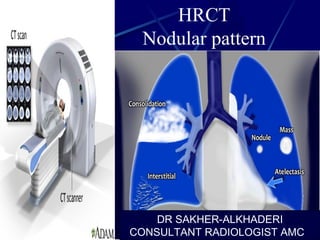
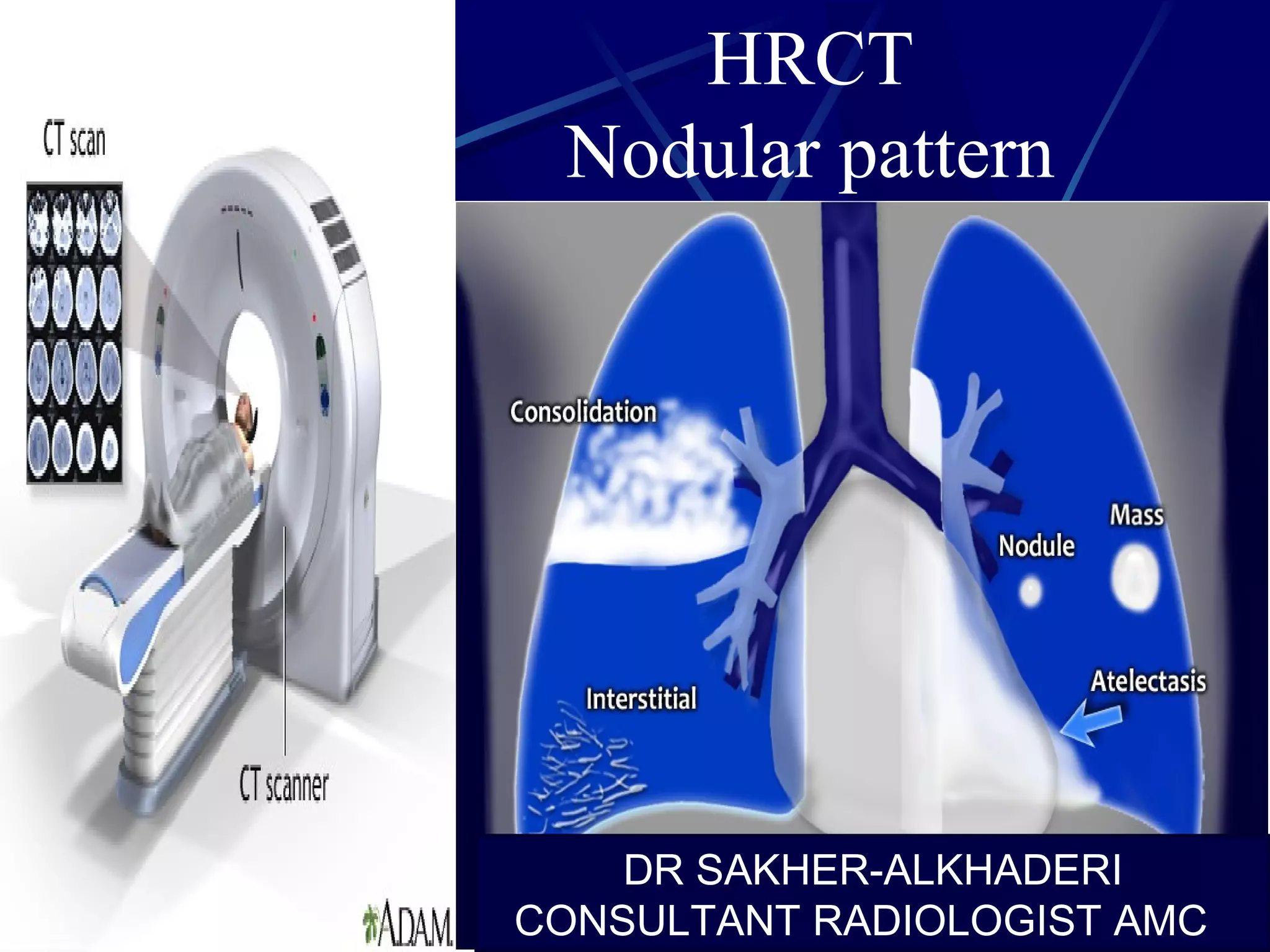
HRCT
Nodular pattern
DR SAKHER-ALKHADERI
CONSULTANT RADIOLOGIST AMC
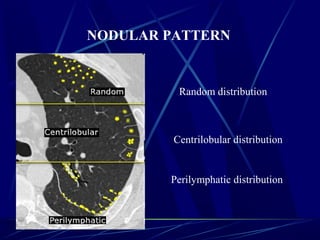
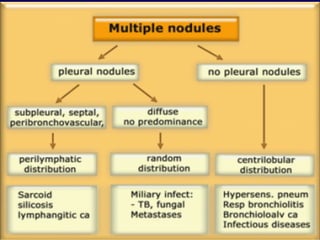
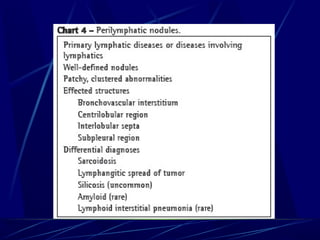
Perilymphatic distribution
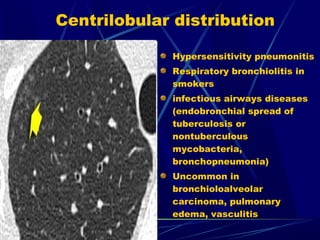
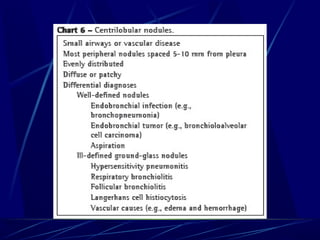
Centrilobular distribution
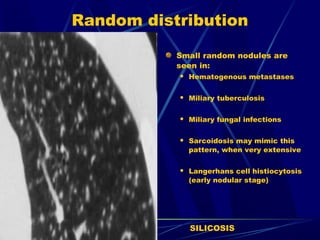
Random distribution
NODULAR PATTERN
DOTSss.....
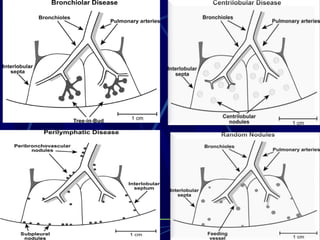
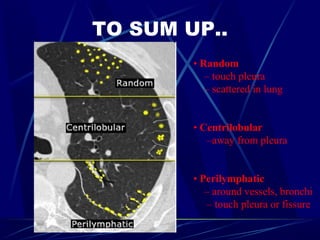
TO SUM UP..
โ€ข Random
โ€“ touch pleura
โ€“ scattered in lung
โ€ข Centrilobular
โ€“away from pleura
โ€ข Perilymphatic
โ€“ around vessels, bronchi
โ€“ touch pleura or fissure
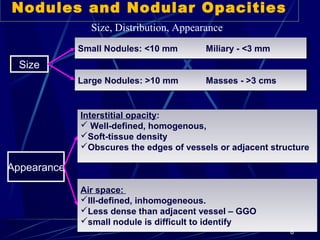
Size, Distribution, Appearance
Nodules and Nodular Opacities
SizeSize
Small Nodules: <10 mm Miliary - <3 mmSmall Nodules: <10 mm Miliary - <3 mm
Large Nodules: >10 mm Masses - >3 cmsLarge Nodules: >10 mm Masses - >3 cms
AppearanceAppearance
Interstitial opacity:
๏ƒผ Well-defined, homogenous,
๏ƒผSoft-tissue density
๏ƒผObscures the edges of vessels or adjacent structure
Interstitial opacity:
๏ƒผ Well-defined, homogenous,
๏ƒผSoft-tissue density
๏ƒผObscures the edges of vessels or adjacent structure
Air space:
๏ƒผIll-defined, inhomogeneous.
๏ƒผLess dense than adjacent vessel โ€“ GGO
๏ƒผsmall nodule is difficult to identify
Air space:
๏ƒผIll-defined, inhomogeneous.
๏ƒผLess dense than adjacent vessel โ€“ GGO
๏ƒผsmall nodule is difficult to identify
8
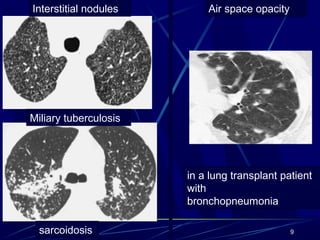
Interstitial nodules Air space opacity
9
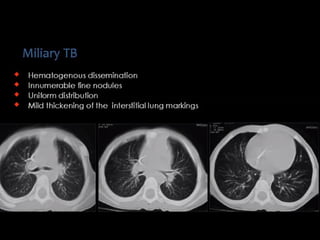
Miliary tuberculosis
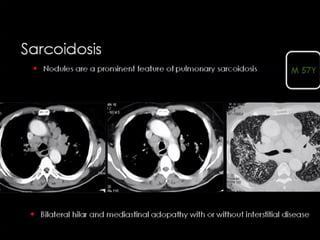
sarcoidosis
in a lung transplant patient
with
bronchopneumonia
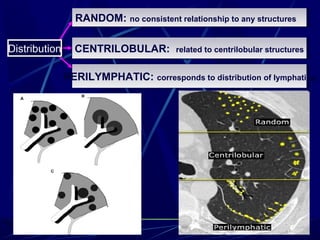
RANDOM: no consistent relationship to any structuresRANDOM: no consistent relationship to any structures
PERILYMPHATIC: corresponds to distribution of lymphaticsPERILYMPHATIC: corresponds to distribution of lymphatics
CENTRILOBULAR: related to centrilobular structuresCENTRILOBULAR: related to centrilobular structuresDistributionDistribution
10
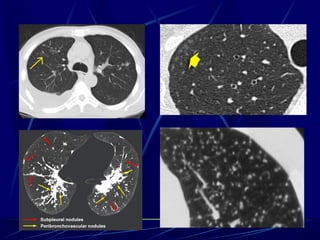
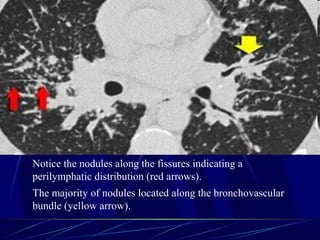
Notice the nodules along the fissures indicating a
perilymphatic distribution (red arrows).
The majority of nodules located along the bronchovascular
bundle (yellow arrow).
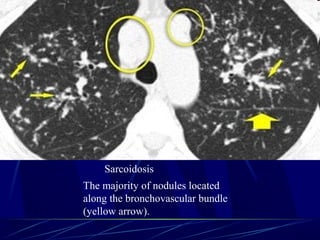
Sarcoidosis
The majority of nodules located
along the bronchovascular bundle
(yellow arrow).
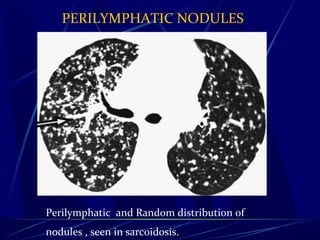
PERILYMPHATIC NODULES
Perilymphatic and Random distribution of
nodules , seen in sarcoidosis.
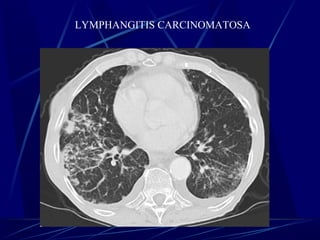
LYMPHANGITIS CARCINOMATOSA
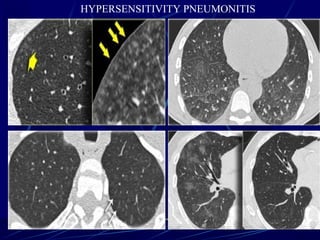
Centrilobular distribution
Hypersensitivity pneumonitis
Respiratory bronchiolitis in
smokers
infectious airways diseases
(endobronchial spread of
tuberculosis or
nontuberculous
mycobacteria,
bronchopneumonia)
Uncommon in
bronchioloalveolar
carcinoma, pulmonary
edema, vasculitis
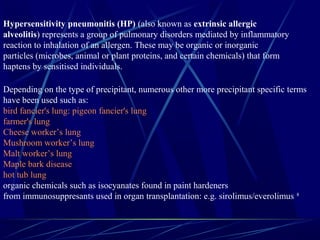
Hypersensitivity pneumonitis (HP) (also known as extrinsic allergic
alveolitis) represents a group of pulmonary disorders mediated by inflammatory
reaction to inhalation of an allergen. These may be organic or inorganic
particles (microbes, animal or plant proteins, and certain chemicals) that form
haptens by sensitised individuals.
Depending on the type of precipitant, numerous other more precipitant specific terms
have been used such as:
bird fancier's lung: pigeon fancier's lung
farmer's lung
Cheese workerโ€™s lung
Mushroom workerโ€™s lung
Malt workerโ€™s lung
Maple bark disease
hot tub lung
organic chemicals such as isocyanates found in paint hardeners
from immunosuppresants used in organ transplantation: e.g. sirolimus/everolimus 8
HYPERSENSITIVITY PNEUMONITIS
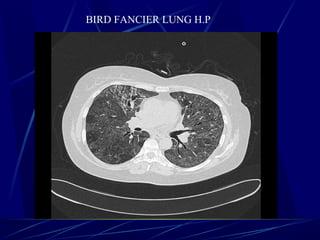
BIRD FANCIER LUNG H.P
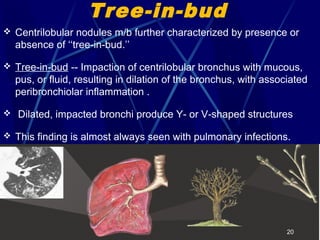
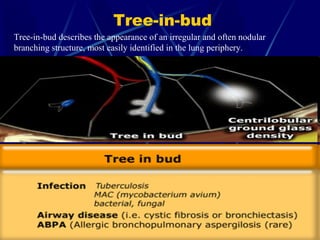
Tree-in-bud
๏ถ Centrilobular nodules m/b further characterized by presence or
absence of โ€˜โ€˜tree-in-bud.โ€™โ€™
๏ถ Tree-in-bud -- Impaction of centrilobular bronchus with mucous,
pus, or fluid, resulting in dilation of the bronchus, with associated
peribronchiolar inflammation .
๏ถ Dilated, impacted bronchi produce Y- or V-shaped structures
๏ถ This finding is almost always seen with pulmonary infections.
20
Tree-in-bud
Tree-in-bud describes the appearance of an irregular and often nodular
branching structure, most easily identified in the lung periphery.
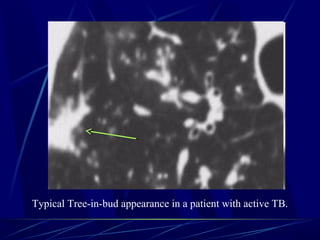
Typical Tree-in-bud appearance in a patient with active TB.
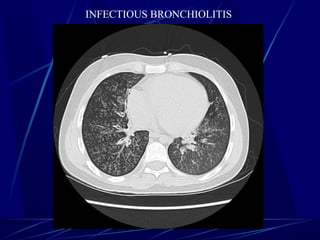
INFECTIOUS BRONCHIOLITIS
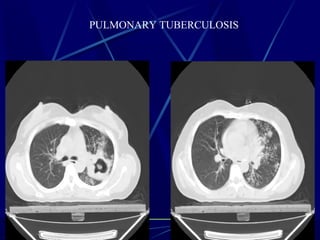
PULMONARY TUBERCULOSIS
Random distribution
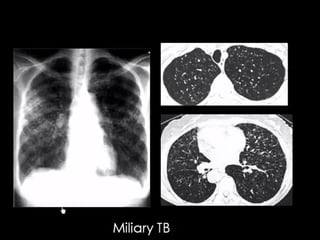
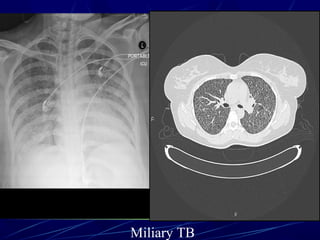
Small random nodules are
seen in:
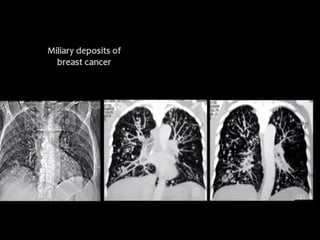
๏ฌ Hematogenous metastases
๏ฌ Miliary tuberculosis
๏ฌ Miliary fungal infections
๏ฌ Sarcoidosis may mimic this
pattern, when very extensive
๏ฌ Langerhans cell histiocytosis
(early nodular stage)
SILICOSIS
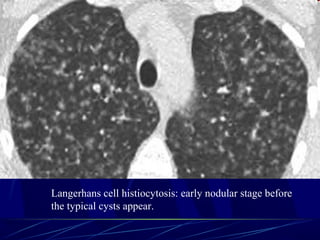
Langerhans cell histiocytosis: early nodular stage before
the typical cysts appear.
Miliary TB
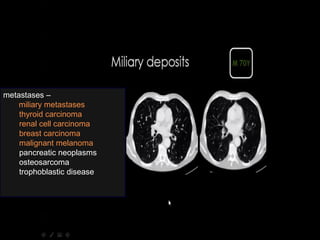
metastases โ€“
miliary metastases
thyroid carcinoma
renal cell carcinoma
breast carcinoma
malignant melanoma
pancreatic neoplasms
osteosarcoma
trophoblastic disease
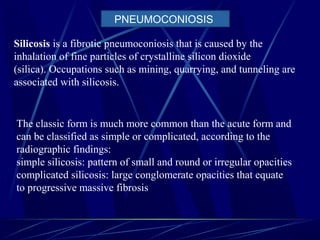
Silicosis is a fibrotic pneumoconiosis that is caused by the
inhalation of fine particles of crystalline silicon dioxide
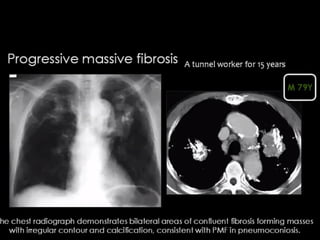
(silica). Occupations such as mining, quarrying, and tunneling are
associated with silicosis.
The classic form is much more common than the acute form and
can be classified as simple or complicated, according to the
radiographic findings:
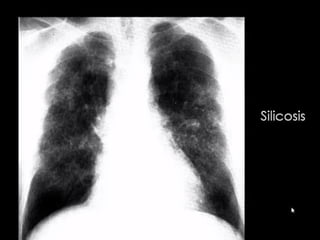
simple silicosis: pattern of small and round or irregular opacities
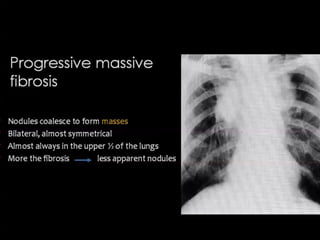
complicated silicosis: large conglomerate opacities that equate
to progressive massive fibrosis
PNEUMOCONIOSIS
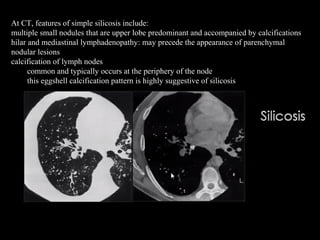
At CT, features of simple silicosis include:
multiple small nodules that are upper lobe predominant and accompanied by calcifications
hilar and mediastinal lymphadenopathy: may precede the appearance of parenchymal
nodular lesions
calcification of lymph nodes
common and typically occurs at the periphery of the node
this eggshell calcification pattern is highly suggestive of silicosis
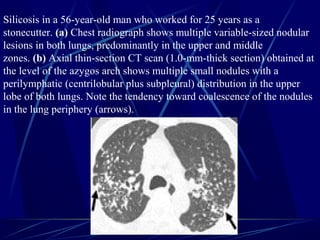
Silicosis in a 56-year-old man who worked for 25 years as a
stonecutter. (a) Chest radiograph shows multiple variable-sized nodular
lesions in both lungs, predominantly in the upper and middle
zones. (b) Axial thin-section CT scan (1.0-mm-thick section) obtained at
the level of the azygos arch shows multiple small nodules with a
perilymphatic (centrilobular plus subpleural) distribution in the upper
lobe of both lungs. Note the tendency toward coalescence of the nodules
in the lung periphery (arrows).
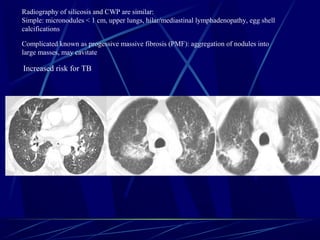
Radiography of silicosis and CWP are similar:
Simple: micronodules < 1 cm, upper lungs, hilar/mediastinal lymphadenopathy, egg shell
calcifications
Complicated known as progessive massive fibrosis (PMF): aggregation of nodules into
large masses, may cavitate
Increased risk for TB
THE END

HRCT Nodular pattern

  • 1.
  • 2.
  • 3.
  • 6.
    TO SUM UP.. โ€ขRandom โ€“ touch pleura โ€“ scattered in lung โ€ข Centrilobular โ€“away from pleura โ€ข Perilymphatic โ€“ around vessels, bronchi โ€“ touch pleura or fissure
  • 8.
    Size, Distribution, Appearance Nodulesand Nodular Opacities SizeSize Small Nodules: <10 mm Miliary - <3 mmSmall Nodules: <10 mm Miliary - <3 mm Large Nodules: >10 mm Masses - >3 cmsLarge Nodules: >10 mm Masses - >3 cms AppearanceAppearance Interstitial opacity: ๏ƒผ Well-defined, homogenous, ๏ƒผSoft-tissue density ๏ƒผObscures the edges of vessels or adjacent structure Interstitial opacity: ๏ƒผ Well-defined, homogenous, ๏ƒผSoft-tissue density ๏ƒผObscures the edges of vessels or adjacent structure Air space: ๏ƒผIll-defined, inhomogeneous. ๏ƒผLess dense than adjacent vessel โ€“ GGO ๏ƒผsmall nodule is difficult to identify Air space: ๏ƒผIll-defined, inhomogeneous. ๏ƒผLess dense than adjacent vessel โ€“ GGO ๏ƒผsmall nodule is difficult to identify 8
  • 9.
    Interstitial nodules Airspace opacity 9 Miliary tuberculosis sarcoidosis in a lung transplant patient with bronchopneumonia
  • 10.
    RANDOM: no consistentrelationship to any structuresRANDOM: no consistent relationship to any structures PERILYMPHATIC: corresponds to distribution of lymphaticsPERILYMPHATIC: corresponds to distribution of lymphatics CENTRILOBULAR: related to centrilobular structuresCENTRILOBULAR: related to centrilobular structuresDistributionDistribution 10
  • 11.
    Notice the nodulesalong the fissures indicating a perilymphatic distribution (red arrows). The majority of nodules located along the bronchovascular bundle (yellow arrow).
  • 12.
    Sarcoidosis The majority ofnodules located along the bronchovascular bundle (yellow arrow).
  • 13.
    PERILYMPHATIC NODULES Perilymphatic andRandom distribution of nodules , seen in sarcoidosis.
  • 14.
  • 16.
    Centrilobular distribution Hypersensitivity pneumonitis Respiratorybronchiolitis in smokers infectious airways diseases (endobronchial spread of tuberculosis or nontuberculous mycobacteria, bronchopneumonia) Uncommon in bronchioloalveolar carcinoma, pulmonary edema, vasculitis
  • 17.
    Hypersensitivity pneumonitis (HP)(also known as extrinsic allergic alveolitis) represents a group of pulmonary disorders mediated by inflammatory reaction to inhalation of an allergen. These may be organic or inorganic particles (microbes, animal or plant proteins, and certain chemicals) that form haptens by sensitised individuals. Depending on the type of precipitant, numerous other more precipitant specific terms have been used such as: bird fancier's lung: pigeon fancier's lung farmer's lung Cheese workerโ€™s lung Mushroom workerโ€™s lung Malt workerโ€™s lung Maple bark disease hot tub lung organic chemicals such as isocyanates found in paint hardeners from immunosuppresants used in organ transplantation: e.g. sirolimus/everolimus 8
  • 18.
  • 19.
  • 20.
    Tree-in-bud ๏ถ Centrilobular nodulesm/b further characterized by presence or absence of โ€˜โ€˜tree-in-bud.โ€™โ€™ ๏ถ Tree-in-bud -- Impaction of centrilobular bronchus with mucous, pus, or fluid, resulting in dilation of the bronchus, with associated peribronchiolar inflammation . ๏ถ Dilated, impacted bronchi produce Y- or V-shaped structures ๏ถ This finding is almost always seen with pulmonary infections. 20
  • 21.
    Tree-in-bud Tree-in-bud describes theappearance of an irregular and often nodular branching structure, most easily identified in the lung periphery.
  • 22.
    Typical Tree-in-bud appearancein a patient with active TB.
  • 23.
  • 24.
  • 26.
    Random distribution Small randomnodules are seen in: ๏ฌ Hematogenous metastases ๏ฌ Miliary tuberculosis ๏ฌ Miliary fungal infections ๏ฌ Sarcoidosis may mimic this pattern, when very extensive ๏ฌ Langerhans cell histiocytosis (early nodular stage) SILICOSIS
  • 27.
    Langerhans cell histiocytosis:early nodular stage before the typical cysts appear.
  • 30.
  • 32.
    metastases โ€“ miliary metastases thyroidcarcinoma renal cell carcinoma breast carcinoma malignant melanoma pancreatic neoplasms osteosarcoma trophoblastic disease
  • 33.
    Silicosis is afibrotic pneumoconiosis that is caused by the inhalation of fine particles of crystalline silicon dioxide (silica). Occupations such as mining, quarrying, and tunneling are associated with silicosis. The classic form is much more common than the acute form and can be classified as simple or complicated, according to the radiographic findings: simple silicosis: pattern of small and round or irregular opacities complicated silicosis: large conglomerate opacities that equate to progressive massive fibrosis PNEUMOCONIOSIS
  • 35.
    At CT, featuresof simple silicosis include: multiple small nodules that are upper lobe predominant and accompanied by calcifications hilar and mediastinal lymphadenopathy: may precede the appearance of parenchymal nodular lesions calcification of lymph nodes common and typically occurs at the periphery of the node this eggshell calcification pattern is highly suggestive of silicosis
  • 36.
    Silicosis in a56-year-old man who worked for 25 years as a stonecutter. (a) Chest radiograph shows multiple variable-sized nodular lesions in both lungs, predominantly in the upper and middle zones. (b) Axial thin-section CT scan (1.0-mm-thick section) obtained at the level of the azygos arch shows multiple small nodules with a perilymphatic (centrilobular plus subpleural) distribution in the upper lobe of both lungs. Note the tendency toward coalescence of the nodules in the lung periphery (arrows).
  • 39.
    Radiography of silicosisand CWP are similar: Simple: micronodules < 1 cm, upper lungs, hilar/mediastinal lymphadenopathy, egg shell calcifications Complicated known as progessive massive fibrosis (PMF): aggregation of nodules into large masses, may cavitate Increased risk for TB
  • 41.