EXTOL INSTITUTE OF MANAGEMENT
DEPARTMENT OF COMPUTER SCIENCE
PRESENTATION ON
NETWORK TOPOLOGY
SUBMITTED BY SUBMITTED TO
Siddharth Gupta
6 BCA (MLC)
Network topology is the arrangement of the various elements (links, nodes,
etc.) of a computer or biological network Essentially, it is
the topological structure of a network, and may be depicted physically or
logically. Physical topology refers to the placement of the network's
various components, including device location and cable installation,
while logical topology shows how data flows within a network, regardless
of its physical design. Distances between nodes, physical interconnections,
transmission rates, and/or signal types may differ between two networks,
yet their topologies may be identical.
INTRODUCTION
Bus Topology
Ring Topology
Star Topology
Tree Topology
Mesh Topology
TYPES OF TOPOLOGY
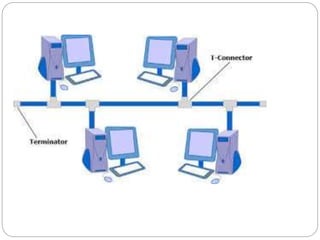
Bus topology
 A bus network topology is
a network architecture in
which a set of clients are
connected via a shared
communications line/cables,
called a bus. There are
several common instances of
the bus architecture,
including one in
the motherboard of most
computers. It is easy to
install.
Ring Topology
 A ring network is a network
topology in which each node
connects to exactly two other
nodes, forming a single
continuous pathway for signals
through each node - a ring. Data
travels from node to node, with
each node along the way
handling every packet.
 Because a ring topology provides
only one pathway between any
two nodes, ring networks may be
disrupted by the failure of a
single link. A node failure or
cable break might isolate every
node attached to the ring.
Star Topology
Star networks are one of the most
common computer network topologies.
In its simplest form, a star network
consists of one central switch, hub or
computer, which acts as a conduit to
transmit messages. This consists of a
central node, to which all other nodes
are connected; this central node
provides a common connection point
for all nodes through a hub. In Star
topology every node (computer
workstation or any other peripheral) is
connected to central node called hub or
switch. The switch is the server and
the peripherals are the clients. Thus,
the hub and leaf nodes, and the
transmission lines between them, form
a graph with the topology of a star.
Tree Topology
Alternatively referred to as
a star bus topology, tree
topology is one of the most
common network setups
that is similar to a bus
topology and a star
topology. A tree topology
connects multiple star
networks to other star
networks. Below is a visual
example of a simple
computer setup on a
network using the star
topology.
Mesh Topology
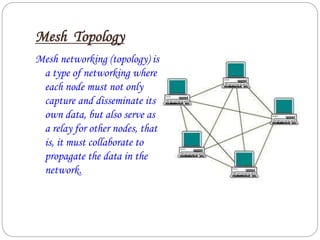
Mesh networking (topology) is
a type of networking where
each node must not only
capture and disseminate its
own data, but also serve as
a relay for other nodes, that
is, it must collaborate to
propagate the data in the
network.
THANK YOU

Ppt topologies

  • 1.
    EXTOL INSTITUTE OFMANAGEMENT DEPARTMENT OF COMPUTER SCIENCE PRESENTATION ON NETWORK TOPOLOGY SUBMITTED BY SUBMITTED TO Siddharth Gupta 6 BCA (MLC)
  • 2.
    Network topology isthe arrangement of the various elements (links, nodes, etc.) of a computer or biological network Essentially, it is the topological structure of a network, and may be depicted physically or logically. Physical topology refers to the placement of the network's various components, including device location and cable installation, while logical topology shows how data flows within a network, regardless of its physical design. Distances between nodes, physical interconnections, transmission rates, and/or signal types may differ between two networks, yet their topologies may be identical. INTRODUCTION
  • 4.
    Bus Topology Ring Topology StarTopology Tree Topology Mesh Topology TYPES OF TOPOLOGY
  • 5.
    Bus topology  Abus network topology is a network architecture in which a set of clients are connected via a shared communications line/cables, called a bus. There are several common instances of the bus architecture, including one in the motherboard of most computers. It is easy to install.
  • 6.
    Ring Topology  Aring network is a network topology in which each node connects to exactly two other nodes, forming a single continuous pathway for signals through each node - a ring. Data travels from node to node, with each node along the way handling every packet.  Because a ring topology provides only one pathway between any two nodes, ring networks may be disrupted by the failure of a single link. A node failure or cable break might isolate every node attached to the ring.
  • 7.
    Star Topology Star networksare one of the most common computer network topologies. In its simplest form, a star network consists of one central switch, hub or computer, which acts as a conduit to transmit messages. This consists of a central node, to which all other nodes are connected; this central node provides a common connection point for all nodes through a hub. In Star topology every node (computer workstation or any other peripheral) is connected to central node called hub or switch. The switch is the server and the peripherals are the clients. Thus, the hub and leaf nodes, and the transmission lines between them, form a graph with the topology of a star.
  • 8.
    Tree Topology Alternatively referredto as a star bus topology, tree topology is one of the most common network setups that is similar to a bus topology and a star topology. A tree topology connects multiple star networks to other star networks. Below is a visual example of a simple computer setup on a network using the star topology.
  • 9.
    Mesh Topology Mesh networking(topology) is a type of networking where each node must not only capture and disseminate its own data, but also serve as a relay for other nodes, that is, it must collaborate to propagate the data in the network.
  • 10.