Network Topologies and
Types
Topology
● The way in which the computers or other devices
  that need to communicate are inter-linked together – Topology
● Choice of topology depends on following factors
   ○ Desired Performance of the system
   ○ Desired Reliability of the system
   ○ No. of nodes(computer or devices) in the system
   ○ Cost of maintaining the network
   ○ Routing information from one node to another
Star Topology
 ● It has multiple nodes connected to host
   node
 ● Nodes in the network are interconnected
   to each other through host node
 ● They (node) can communicate only
   through host node
 ● The entire network is control by host node
 ● The logical path for the communication
   between two node is define by host node
Star Topology
● Advantage
  ○ It has minimal line cost because only n-1 lines
    are required for connecting n nodes
  ○ Adding new node in network delay the
    transmission
  ○ If host node fails network is down
● Dis – Advantage
  ○ Network depends on host node
Ring Topology
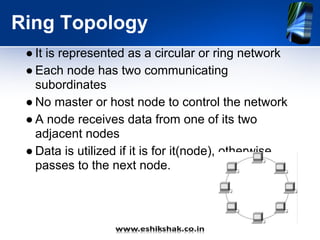
 ● It is represented as a circular or ring network
 ● Each node has two communicating
   subordinates
 ● No master or host node to control the network
 ● A node receives data from one of its two
   adjacent nodes
 ● Data is utilized if it is for it(node), otherwise
   passes to the next node.
Ring Topology
● Advantage
  ○ No central node, to control the network or
    routing decisions
  ○ It is more reliable than star topology if one of
    node is fail than the alternative routing is
    possible
● Dis Advantage
  ○ Addition of node in network increases
    communication delay
  ○ Requires special control software than star
    topology
Mesh Topology
● It is completely connected network
● Each node has Personal physical line for
  connecting to all other node
● Each Node has a direct link – Point-to-Point
  link
● Control is distributed with each node
Mesh Topology
● Advantage
  ○ It is very reliable because failure of any node
    doesn't affects the network
  ○ Each node of the network need not have
    individual routing capability
  ○ Communication very fast between two nodes
● Dis Advantage
  ○ It is most expensive network
Bus Topology
● All nodes in network share single
  transmission
  medium i.e same communication channel
● It appends destination address to message
  and checks whether channel is free
● Also known as ‘multipoint’ or ‘multidrop’ or
  ‘broadcast’ network
Bus Topology
● Advantage
  ○ It helps in reducing the number of physical lines
  ○ Failure of any node doesn’t affects the network
  ○ Adding of new nodes to the network is easy
● Dis-Advantage
  ○ All the nodes in a network must have good
    communication and decision making capability
  ○ If the shared communication line fails, the entire
    network fails
Hybrid Topology
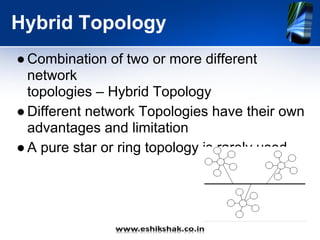
● Combination of two or more different
  network
  topologies – Hybrid Topology
● Different network Topologies have their own
  advantages and limitation
● A pure star or ring topology is rarely used
Types of Network
  Characteristics            LAN                 WAN
    Geograhpic           Only few km          Extend upto
    Distribution                             thousand km
     Data Rate         Much higher rate      1200 bps to 2
                        than WAN (10            Mbps
                       mbps) to1 (gbps)
     Error Rate             Fewer               Higher
  Communication          Twisted pair,      Telephone lines,
      Link             coaxial cable and   microwave link and
                          fiber optic      satellite channels
     Ownership              Single              Different
                         Organization         Organization
  Communication Cost      Negligible             Costly

Network Topologies

  • 1.
  • 2.
    Topology ● The wayin which the computers or other devices that need to communicate are inter-linked together – Topology ● Choice of topology depends on following factors ○ Desired Performance of the system ○ Desired Reliability of the system ○ No. of nodes(computer or devices) in the system ○ Cost of maintaining the network ○ Routing information from one node to another
  • 3.
    Star Topology ●It has multiple nodes connected to host node ● Nodes in the network are interconnected to each other through host node ● They (node) can communicate only through host node ● The entire network is control by host node ● The logical path for the communication between two node is define by host node
  • 4.
    Star Topology ● Advantage ○ It has minimal line cost because only n-1 lines are required for connecting n nodes ○ Adding new node in network delay the transmission ○ If host node fails network is down ● Dis – Advantage ○ Network depends on host node
  • 5.
    Ring Topology ●It is represented as a circular or ring network ● Each node has two communicating subordinates ● No master or host node to control the network ● A node receives data from one of its two adjacent nodes ● Data is utilized if it is for it(node), otherwise passes to the next node.
  • 6.
    Ring Topology ● Advantage ○ No central node, to control the network or routing decisions ○ It is more reliable than star topology if one of node is fail than the alternative routing is possible ● Dis Advantage ○ Addition of node in network increases communication delay ○ Requires special control software than star topology
  • 7.
    Mesh Topology ● Itis completely connected network ● Each node has Personal physical line for connecting to all other node ● Each Node has a direct link – Point-to-Point link ● Control is distributed with each node
  • 8.
    Mesh Topology ● Advantage ○ It is very reliable because failure of any node doesn't affects the network ○ Each node of the network need not have individual routing capability ○ Communication very fast between two nodes ● Dis Advantage ○ It is most expensive network
  • 9.
    Bus Topology ● Allnodes in network share single transmission medium i.e same communication channel ● It appends destination address to message and checks whether channel is free ● Also known as ‘multipoint’ or ‘multidrop’ or ‘broadcast’ network
  • 10.
    Bus Topology ● Advantage ○ It helps in reducing the number of physical lines ○ Failure of any node doesn’t affects the network ○ Adding of new nodes to the network is easy ● Dis-Advantage ○ All the nodes in a network must have good communication and decision making capability ○ If the shared communication line fails, the entire network fails
  • 11.
    Hybrid Topology ● Combinationof two or more different network topologies – Hybrid Topology ● Different network Topologies have their own advantages and limitation ● A pure star or ring topology is rarely used
  • 12.
    Types of Network Characteristics LAN WAN Geograhpic Only few km Extend upto Distribution thousand km Data Rate Much higher rate 1200 bps to 2 than WAN (10 Mbps mbps) to1 (gbps) Error Rate Fewer Higher Communication Twisted pair, Telephone lines, Link coaxial cable and microwave link and fiber optic satellite channels Ownership Single Different Organization Organization Communication Cost Negligible Costly