Elasticity and
its Application
Elasticity
• A measure of how much buyers and sellers respond
to changes in market conditions
• A measure of the responsiveness of quantity
demanded or quantity supplied to a change in one
of its determinants
Price Elasticity of Demand
• Measures how much the quantity demanded
responds to a change in price.
Factors Influencing PED
• Availability of Close Substitute
• Necessities vs. Luxuries
• Definition of Market
• Time Horizon
Computing the PED
Price Elasticity of Demand = % ∆ Qd
% ∆P
PED = 20% / 10% = 2
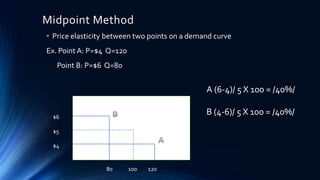
Midpoint Method
• Price elasticity between two points on a demand curve
Ex. Point A: P=$4 Q=120
Point B: P=$6 Q=80
$6
$5
$4
80 100 120
A (6-4)/ 5 X 100 = /40%/
B (4-6)/ 5 X 100 = /40%/
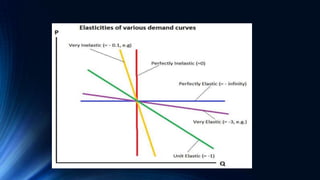
Variety of Demand Curves
• Elastic- when elasticity is greater than 1.
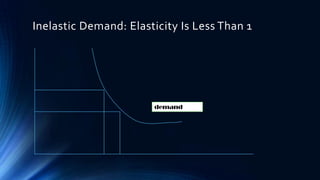
• Inelastic-when elasticity is less than 1.
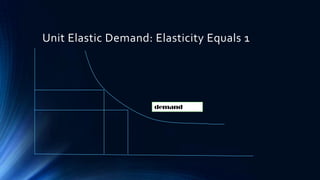
• Unit Elastic- when elasticity is equal to 1.
• Perfectly elastic- when elasticity is infinite.
• Perfectly inelastic- when elasticity is 0.
demand
Inelastic Demand: Elasticity Is Less Than 1
demand
Unit Elastic Demand: Elasticity Equals 1
demand
Elastic Demand: Elasticity Is Greater Than 1
demand
Perfectly elastic demand: Elasticity equals
infinity
demand
Total Revenue and the PED
• amount paid by the buyers and received by the sellers.
(PxQ)
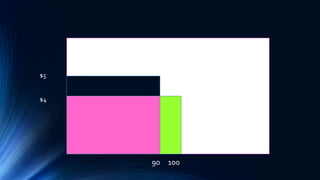
a. The Case of Inelastic Demand
Ex. Consider rice as an inelastic demand. An increase in price
leads to a decrease in quantity demanded that is
proportionately smaller
$5
$4
90 100
$5
$4
70 100
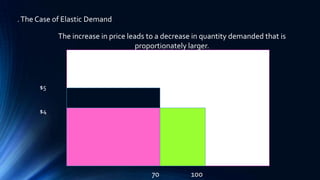
b.The Case of Elastic Demand
The increase in price leads to a decrease in quantity demanded that is
proportionately larger.
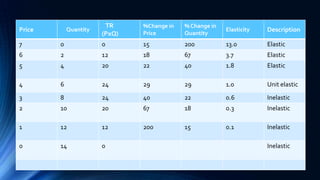
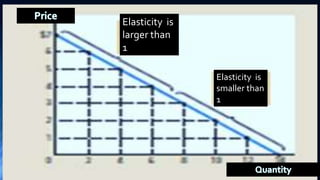
Elasticity and TR along a linear demand
curve
•The slope of a linear demand curve is constant
but its elasticity is not.
Price Quantity
TR
(PxQ)
%Change in
Price
% Change in
Quantity
Elasticity Description
7 0 0 15 200 13.0 Elastic
6 2 12 18 67 3.7 Elastic
5 4 20 22 40 1.8 Elastic
4 6 24 29 29 1.0 Unit elastic
3 8 24 40 22 0.6 Inelastic
2 10 20 67 18 0.3 Inelastic
1 12 12 200 15 0.1 Inelastic
0 14 0 Inelastic
Elasticity is
larger than
1
Elasticity is
smaller than
1
Income Elasticity of demand
• Measures how the quantity demanded changes as consumer income
changes.
• = %∆Qd/%∆Y
Cross Price Elasticity of Demand
-- measures how the quantity demanded of one good respond to a
change in the price of another good.
= %∆Qd of good 1
%∆P of good 2
The Elasticity of Supply
DETERMINANTS
 Flexibility of Sellers
Time Period
Price Elasticity of Supply
• Measures how much the quantity supplied responds
to changes in the price
• = %∆ Quantity Supplied
%∆ in Price
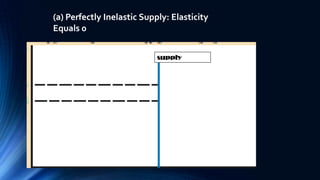
(a) Perfectly Inelastic Supply: Elasticity
Equals 0
supply
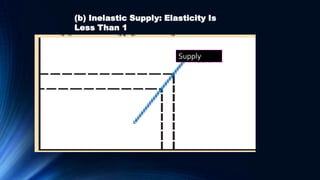
Supply
(b) Inelastic Supply: Elasticity Is
Less Than 1
supply
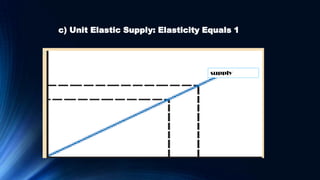
c) Unit Elastic Supply: Elasticity Equals 1
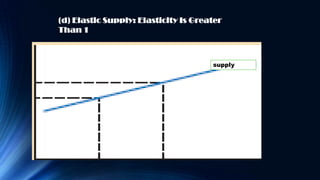
(d) Elastic Supply: Elasticity Is Greater
Than 1
supply
Supply
Perfectly Elastic Supply
Elasticity and its application

Elasticity and its application