NETWORK
TOPOLOGY
CONTENTS:
Network
Network Topology
• Bus Topology
• Ring Topology
• Star Topology
• Tree Topology
• Mesh Topology
Conclusion
NETWORK
Interconnection of 2 or more independent
computer and peripherals
NETWORK TOPOLOGY
The physical layout or arrangement of connected devices in a
network is called network topology. It is shape of a network. The
topology describe actual layout of the network hardware. This
include all the hardware that makes up the network. The point of
connection to the network by the stations are called nodes or link-
stations. There are different types of topologies as below:
• Bus Topology
• Ring Topology
• Star Topology
• Tree Topology
• Mesh Topology
BUS TOPOLOGY
Bus topology is the simplest type of network. It
supports a small numbers of computers. In bus
topology, all computers or network nodes are
connected to a common communication medium.
This medium is often a central wire known as bus.
The terminators are used at the end of a bus to
absorb signals. A collision can occur in bus topology
if two computers transmit data at a same time
CONT….
Structure of bus topology:
CONT….
Working of bus topology:
The sending computer sends the data and destination
address through the bus. The data and address move
from computer to other in the network. Each
computer checks the address. If it matches with the
address of a computer, the computer keeps the data.
Otherwise the data moves to the next computer.
CONT ….
Advantages:
• It is simple and easy to use.
• It requires small length of cable to connect computers.
• It is easy to troubleshoot.
• It is easy to implement.
• It is easy to maintain.
Disadvantages:
• If the central wire damage whole network will lay down.
• The network speeds slows down as the number of computers
increases.
RING TOPOLOGY
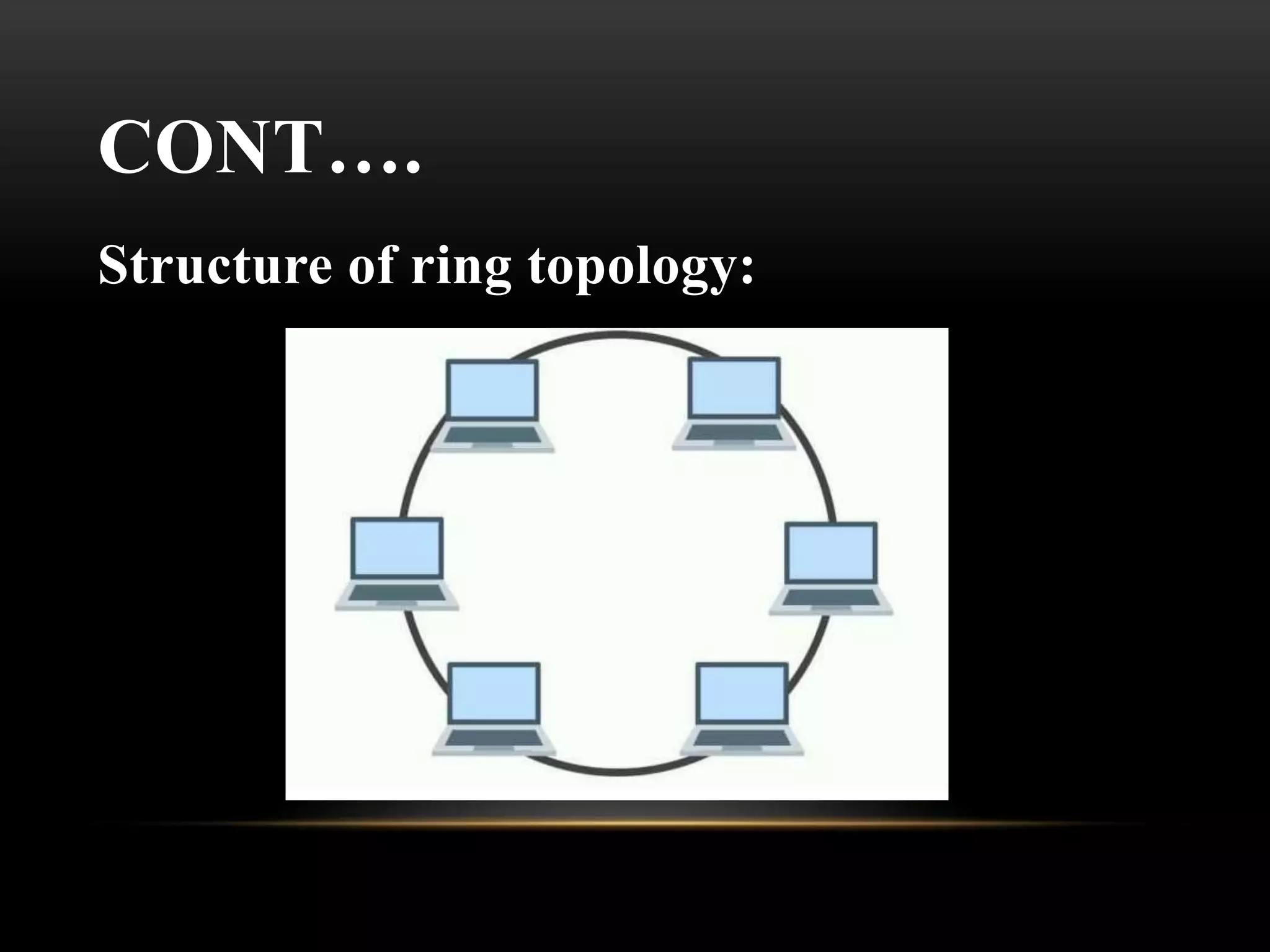
In ring topology, each computer is connected to the
next computer with the last one connected to the
first. Thus, a ring of connecters is formed.
CONT….
Structure of ring topology:
CONT….
Working of ring topology:
Every computer is connected to next computer in a
ring. Each computer receives message from the
previous computer and transmits it to the next
computer. The message flows in one direction. The
message is passed around the ring until it reaches the
correct destination computer.
CONT….
Advantages:
• It is less expensive.
• Every computer has equal access to the network.
• It can be install easily.
• If one link disconnect, other link is available.
Disadvantages:
• Adding or removing computer in the ring can affect the
whole network.
• It may disturb the privacy.
STAR TOPOLOGY
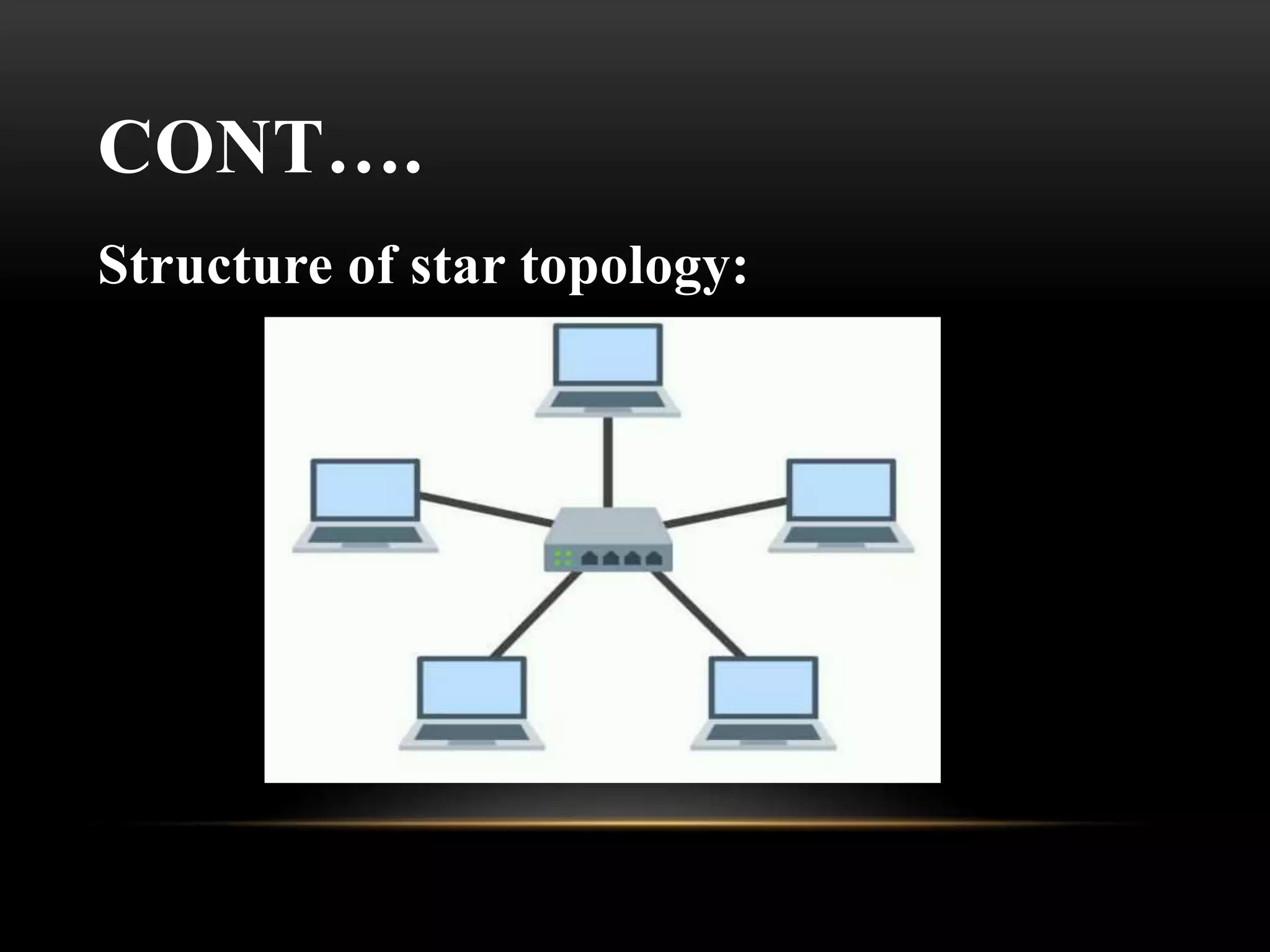
All computers in star topology are connected with
central device called hub or switch. Star topology is
mostly used.
CONT….
Structure of star topology:
CONT….
Working of star topology:
The sending computer sends the data to the central
device. The central device sends data to the
receiving computer. Each computer in star network
communication with the central device.
CONT….
Advantages:
• It is easy to maintain and modify network.
• It is easy to troubleshoot.
• It is more flexible.
• Single computer failure does not effect the while network
Disadvantages:
• If the central switch fails, the whole network break down.
• It requires a large length of cable to connect the
computers.
TREE TOPOLOGY
Tree topology is the combination of bus topology
and star topology. It consists of characteristics of bus
and star topology. It consists of different group of
computers attached in star topology. The groups are
then connected to a bus backbone cable.
CONT….
Structure of tree topology:
CONT….
Advantages:
• It provides point-to-point wiring for individual
segments.
• It is supported by several hardware and software
vendors.
Disadvantages:
• It is a complex network.
• If central wire break, whole network break down.
MESH TOPOLOGY
In a mesh topology, every device in the network is
physically connected to each device in the network.
A message can be sent on different possible paths to
the destination. Mesh topology are not used in local
area network, it is mostly used in wide area network.
CONT….
Structure of mesh topology:
CONT….
Advantages:
• If one link breaks, another link is available.
• Privacy ensure
Disadvantages:
• It is a complex network
• It is expensive than other topologies.
• It is difficult to configure.
CONCLUSION:
• Knowledge of networking topologies is of core
importance of computer networking design.
• Which structure or topology is best for which
organization or business.
• Network topology brings inherent advantages and
disadvantages to any system under study.
Thank you

Network Topology

  • 2.
  • 3.
    CONTENTS: Network Network Topology • BusTopology • Ring Topology • Star Topology • Tree Topology • Mesh Topology Conclusion
  • 4.
    NETWORK Interconnection of 2or more independent computer and peripherals
  • 5.
    NETWORK TOPOLOGY The physicallayout or arrangement of connected devices in a network is called network topology. It is shape of a network. The topology describe actual layout of the network hardware. This include all the hardware that makes up the network. The point of connection to the network by the stations are called nodes or link- stations. There are different types of topologies as below: • Bus Topology • Ring Topology • Star Topology • Tree Topology • Mesh Topology
  • 6.
    BUS TOPOLOGY Bus topologyis the simplest type of network. It supports a small numbers of computers. In bus topology, all computers or network nodes are connected to a common communication medium. This medium is often a central wire known as bus. The terminators are used at the end of a bus to absorb signals. A collision can occur in bus topology if two computers transmit data at a same time
  • 7.
  • 8.
    CONT…. Working of bustopology: The sending computer sends the data and destination address through the bus. The data and address move from computer to other in the network. Each computer checks the address. If it matches with the address of a computer, the computer keeps the data. Otherwise the data moves to the next computer.
  • 9.
    CONT …. Advantages: • Itis simple and easy to use. • It requires small length of cable to connect computers. • It is easy to troubleshoot. • It is easy to implement. • It is easy to maintain. Disadvantages: • If the central wire damage whole network will lay down. • The network speeds slows down as the number of computers increases.
  • 10.
    RING TOPOLOGY In ringtopology, each computer is connected to the next computer with the last one connected to the first. Thus, a ring of connecters is formed.
  • 11.
  • 12.
    CONT…. Working of ringtopology: Every computer is connected to next computer in a ring. Each computer receives message from the previous computer and transmits it to the next computer. The message flows in one direction. The message is passed around the ring until it reaches the correct destination computer.
  • 13.
    CONT…. Advantages: • It isless expensive. • Every computer has equal access to the network. • It can be install easily. • If one link disconnect, other link is available. Disadvantages: • Adding or removing computer in the ring can affect the whole network. • It may disturb the privacy.
  • 14.
    STAR TOPOLOGY All computersin star topology are connected with central device called hub or switch. Star topology is mostly used.
  • 15.
  • 16.
    CONT…. Working of startopology: The sending computer sends the data to the central device. The central device sends data to the receiving computer. Each computer in star network communication with the central device.
  • 17.
    CONT…. Advantages: • It iseasy to maintain and modify network. • It is easy to troubleshoot. • It is more flexible. • Single computer failure does not effect the while network Disadvantages: • If the central switch fails, the whole network break down. • It requires a large length of cable to connect the computers.
  • 18.
    TREE TOPOLOGY Tree topologyis the combination of bus topology and star topology. It consists of characteristics of bus and star topology. It consists of different group of computers attached in star topology. The groups are then connected to a bus backbone cable.
  • 19.
  • 20.
    CONT…. Advantages: • It providespoint-to-point wiring for individual segments. • It is supported by several hardware and software vendors. Disadvantages: • It is a complex network. • If central wire break, whole network break down.
  • 21.
    MESH TOPOLOGY In amesh topology, every device in the network is physically connected to each device in the network. A message can be sent on different possible paths to the destination. Mesh topology are not used in local area network, it is mostly used in wide area network.
  • 22.
  • 23.
    CONT…. Advantages: • If onelink breaks, another link is available. • Privacy ensure Disadvantages: • It is a complex network • It is expensive than other topologies. • It is difficult to configure.
  • 24.
    CONCLUSION: • Knowledge ofnetworking topologies is of core importance of computer networking design. • Which structure or topology is best for which organization or business. • Network topology brings inherent advantages and disadvantages to any system under study.
  • 25.