Microeconomics Price Elasticity of Demand
Microeconomics Preparing this term paper on “Price Elasticity of Demand” was a wonderful experience for us. We would like to thank our faculty, Mrs. Monsura Zaman, Lecturer in Economics,   Faculty of Business ASA University Bangladesh for giving us this opportunity as well as for her guidance. Finally we would like to thank our family and almighty Allah for supporting us the courage to carry on our work.
Microeconomics Price Elasticity of Demand The responsiveness or sensitivity of consumers to a price change is measured by a product’s Price elasticity of demand   Price elasticity of demand shows that how much quantity demanded of a commodity changes when its price changes. The most common elasticity measurement is that of price elasticity of demand. It measures how much consumers respond in their buying decisions to a change in price.
Microeconomics There are five types of price elasticity of demand: Unit elasticity  More elasticity  More inelastic Perfectly inelastic Perfectly elastic
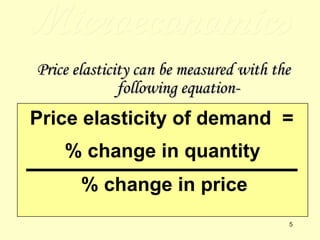
Microeconomics Price elasticity can be measured with the following equation- Price elasticity of demand  =  % change in price  % change in quantity
Microeconomics Mr. Shahadat Hossain Tanim Id No : 071-12-470 G.M. : Group - 1 Presentation Topic Unit elasticity(Ed=1)
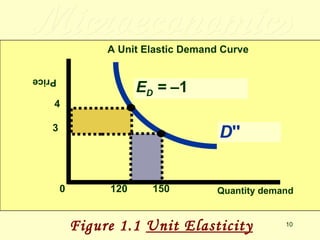
Microeconomics Unit elasticity(Ed=1) A change in the price of a good will bring about a proportionate change in the quantity demanded. That means the rate of change between price and quantity demanded is same. If price decrease 50 percent then quantity demanded will be increased 50 percent.
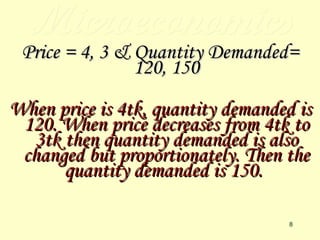
Microeconomics Price = 4, 3 & Quantity Demanded= 120, 150 When price is 4tk, quantity demanded is 120. When price decreases from 4tk to 3tk then quantity demanded is also changed but proportionately. Then the quantity demanded is 150.
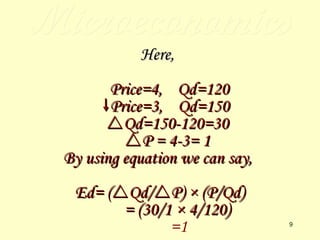
Microeconomics Here, Price=4,  Qd=120  Price=3,  Qd=150  Qd=150-120=30  P = 4-3= 1 By using equation we can say, Ed= (  Qd/  P) × (P/Qd) = (30/1 × 4/120) =1
Microeconomics Price  Figure 1.1  Unit Elasticity 0 D '' 120 Quantity demand 150 3 4 E D  =  –1 A Unit Elastic Demand Curve
Microeconomics Mr. Mohsin Arif Reja Id No : 071-12-473 G.L. : Group - 1 Presentation Topic More Elasticity(Ed>1)
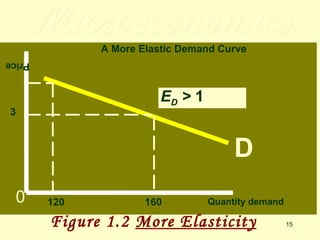
Microeconomics More Elasticity(Ed>1) A small change in the price of the commodity leads to a more than proportionate change in the quantity demanded. That means change in the quantity demanded is greater than change in price. Luxurious goods like video cassette and television and substitutes goods are included in more elastic demand.
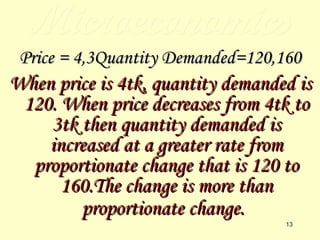
Microeconomics Price = 4,3Quantity Demanded=120,160 When price is 4tk, quantity demanded is 120. When price decreases from 4tk to 3tk then quantity demanded is increased at a greater rate from proportionate change that is 120 to 160.The change is more than proportionate change.
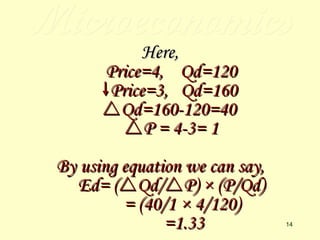
Microeconomics Here, Price=4,  Qd=120  Price=3,  Qd=160  Qd=160-120=40  P = 4-3= 1 By using equation we can say, Ed= (  Qd/  P) × (P/Qd) = (40/1 × 4/120) =1.33
Microeconomics Figure 1.2  More Elasticity 0 D Quantity demand 160 120 3 E D  >  1 A More Elastic Demand Curve Price
Microeconomics Mr. Md. Arifur Rahman Id No : 071-12-482 G.M. : Group - 1 Presentation Topic More Inelastic(Ed<1)
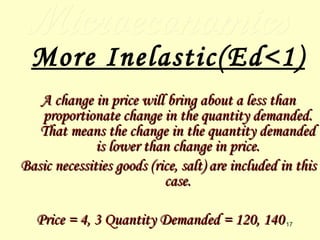
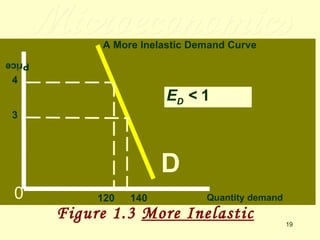
Microeconomics More Inelastic(Ed<1) A change in price will bring about a less than proportionate change in the quantity demanded. That means the change in the quantity demanded is lower than change in price. Basic necessities goods (rice, salt) are included in this case. Price = 4, 3 Quantity Demanded = 120, 140
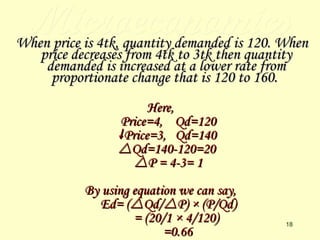
Microeconomics When price is 4tk, quantity demanded is 120. When price decreases from 4tk to 3tk then quantity demanded is increased at a lower rate from proportionate change that is 120 to 160.   Here, Price=4,  Qd=120  Price=3,  Qd=140  Qd=140-120=20  P = 4-3= 1 By using equation we can say, Ed= (  Qd/  P) × (P/Qd) = (20/1 × 4/120) =0.66
Microeconomics Figure 1.3  More Inelastic 0 D Quantity demand 4 3 120 140 A More Inelastic Demand Curve E D  <  1 Price
Microeconomics Mr. Md. Jewel Ahmed Id No : 071-12-485 G.M. : Group - 1 Presentation Topic Perfectly Inelastic(Ed=0)
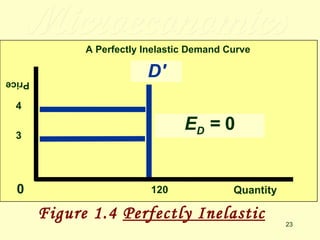
Microeconomics Perfectly Inelastic(Ed=0) The quantity demanded is totally unresponsive to changes in price that means there is no change in quantity demanded when its price changes. Price = 4, 3 & Quantity Demanded =120, 120 When price is 4tk, quantity demanded is 120. When price decreases from 4tk to 3tk then quantity demanded are still 120. There is no change in quantity demanded...
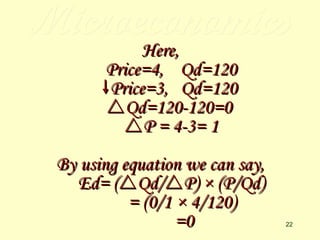
Microeconomics Here, Price=4,  Qd=120  Price=3,  Qd=120  Qd=120-120=0  P = 4-3= 1 By using equation we can say, Ed= (  Qd/  P) × (P/Qd) = (0/1 × 4/120) =0
Microeconomics A Perfectly Inelastic Demand Curve Figure 1.4  Perfectly Inelastic Quantity 0 D' E D  =  0 120 3 4 Price
Microeconomics Mr. Mahibur Rahman Chowdhury Id No : 071-12-486 G.M. : Group - 1 Presentation Topic Perfectly elastic(Ed= ∞)
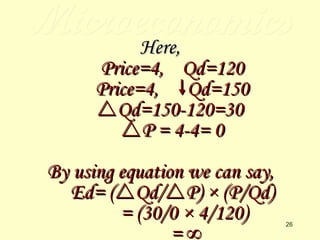
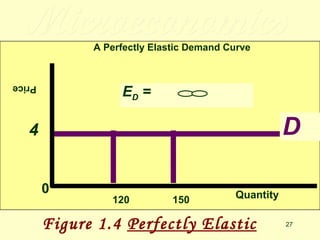
Microeconomics Perfectly elastic(Ed= ∞) The prices of a commodity is totally unresponsive to changes in quantity demanded that means there is no change in price when quantity demand changes. Price = 4, 4 & Quantity Demanded = 120, 150 When price is 4tk, quantity demanded is 120. When no change in price brings a change in quantity demanded from 120 to 150. There is no change in price of a commodity...
Microeconomics Here, Price=4,  Qd=120 Price=4,   Qd=150  Qd=150-120=30  P = 4-4= 0 By using equation we can say, Ed= (  Qd/  P) × (P/Qd) = (30/0 × 4/120) = ∞
Microeconomics Price  Figure 1.4  Perfectly Elastic A Perfectly Elastic Demand Curve  0 D E D  =  4 Quantity 120 150
Microeconomics Factors that determine the price  Elasticity of demand 1. Availability of close substitutes - price elasticity of demand will tend to be:  - High if there are close substitutes.   - Low if there are no close substitutes. 2. Necessities vs. luxury goods - price elasticity of demand tend to be:  - Low if the good is a necessity - High if the good is a luxury
Microeconomics 3. Time - long-run p rice elasticity of demand is often higher than the short-run elasticity 4. Price relative to income - price elasticity of demand will tend to be:  - High if the price of the good is high relative to income - Low if the price of the good is low relative to income
Thank You
THE END

Elasticity Ppt

  • 1.
  • 2.
    Microeconomics Preparing thisterm paper on “Price Elasticity of Demand” was a wonderful experience for us. We would like to thank our faculty, Mrs. Monsura Zaman, Lecturer in Economics, Faculty of Business ASA University Bangladesh for giving us this opportunity as well as for her guidance. Finally we would like to thank our family and almighty Allah for supporting us the courage to carry on our work.
  • 3.
    Microeconomics Price Elasticityof Demand The responsiveness or sensitivity of consumers to a price change is measured by a product’s Price elasticity of demand Price elasticity of demand shows that how much quantity demanded of a commodity changes when its price changes. The most common elasticity measurement is that of price elasticity of demand. It measures how much consumers respond in their buying decisions to a change in price.
  • 4.
    Microeconomics There arefive types of price elasticity of demand: Unit elasticity More elasticity More inelastic Perfectly inelastic Perfectly elastic
  • 5.
    Microeconomics Price elasticitycan be measured with the following equation- Price elasticity of demand = % change in price % change in quantity
  • 6.
    Microeconomics Mr. ShahadatHossain Tanim Id No : 071-12-470 G.M. : Group - 1 Presentation Topic Unit elasticity(Ed=1)
  • 7.
    Microeconomics Unit elasticity(Ed=1)A change in the price of a good will bring about a proportionate change in the quantity demanded. That means the rate of change between price and quantity demanded is same. If price decrease 50 percent then quantity demanded will be increased 50 percent.
  • 8.
    Microeconomics Price =4, 3 & Quantity Demanded= 120, 150 When price is 4tk, quantity demanded is 120. When price decreases from 4tk to 3tk then quantity demanded is also changed but proportionately. Then the quantity demanded is 150.
  • 9.
    Microeconomics Here, Price=4, Qd=120  Price=3, Qd=150  Qd=150-120=30  P = 4-3= 1 By using equation we can say, Ed= (  Qd/  P) × (P/Qd) = (30/1 × 4/120) =1
  • 10.
    Microeconomics Price Figure 1.1 Unit Elasticity 0 D '' 120 Quantity demand 150 3 4 E D = –1 A Unit Elastic Demand Curve
  • 11.
    Microeconomics Mr. MohsinArif Reja Id No : 071-12-473 G.L. : Group - 1 Presentation Topic More Elasticity(Ed>1)
  • 12.
    Microeconomics More Elasticity(Ed>1)A small change in the price of the commodity leads to a more than proportionate change in the quantity demanded. That means change in the quantity demanded is greater than change in price. Luxurious goods like video cassette and television and substitutes goods are included in more elastic demand.
  • 13.
    Microeconomics Price =4,3Quantity Demanded=120,160 When price is 4tk, quantity demanded is 120. When price decreases from 4tk to 3tk then quantity demanded is increased at a greater rate from proportionate change that is 120 to 160.The change is more than proportionate change.
  • 14.
    Microeconomics Here, Price=4, Qd=120  Price=3, Qd=160  Qd=160-120=40  P = 4-3= 1 By using equation we can say, Ed= (  Qd/  P) × (P/Qd) = (40/1 × 4/120) =1.33
  • 15.
    Microeconomics Figure 1.2 More Elasticity 0 D Quantity demand 160 120 3 E D > 1 A More Elastic Demand Curve Price
  • 16.
    Microeconomics Mr. Md.Arifur Rahman Id No : 071-12-482 G.M. : Group - 1 Presentation Topic More Inelastic(Ed<1)
  • 17.
    Microeconomics More Inelastic(Ed<1)A change in price will bring about a less than proportionate change in the quantity demanded. That means the change in the quantity demanded is lower than change in price. Basic necessities goods (rice, salt) are included in this case. Price = 4, 3 Quantity Demanded = 120, 140
  • 18.
    Microeconomics When priceis 4tk, quantity demanded is 120. When price decreases from 4tk to 3tk then quantity demanded is increased at a lower rate from proportionate change that is 120 to 160. Here, Price=4, Qd=120  Price=3, Qd=140  Qd=140-120=20  P = 4-3= 1 By using equation we can say, Ed= (  Qd/  P) × (P/Qd) = (20/1 × 4/120) =0.66
  • 19.
    Microeconomics Figure 1.3 More Inelastic 0 D Quantity demand 4 3 120 140 A More Inelastic Demand Curve E D < 1 Price
  • 20.
    Microeconomics Mr. Md.Jewel Ahmed Id No : 071-12-485 G.M. : Group - 1 Presentation Topic Perfectly Inelastic(Ed=0)
  • 21.
    Microeconomics Perfectly Inelastic(Ed=0)The quantity demanded is totally unresponsive to changes in price that means there is no change in quantity demanded when its price changes. Price = 4, 3 & Quantity Demanded =120, 120 When price is 4tk, quantity demanded is 120. When price decreases from 4tk to 3tk then quantity demanded are still 120. There is no change in quantity demanded...
  • 22.
    Microeconomics Here, Price=4, Qd=120  Price=3, Qd=120  Qd=120-120=0  P = 4-3= 1 By using equation we can say, Ed= (  Qd/  P) × (P/Qd) = (0/1 × 4/120) =0
  • 23.
    Microeconomics A PerfectlyInelastic Demand Curve Figure 1.4 Perfectly Inelastic Quantity 0 D' E D = 0 120 3 4 Price
  • 24.
    Microeconomics Mr. MahiburRahman Chowdhury Id No : 071-12-486 G.M. : Group - 1 Presentation Topic Perfectly elastic(Ed= ∞)
  • 25.
    Microeconomics Perfectly elastic(Ed=∞) The prices of a commodity is totally unresponsive to changes in quantity demanded that means there is no change in price when quantity demand changes. Price = 4, 4 & Quantity Demanded = 120, 150 When price is 4tk, quantity demanded is 120. When no change in price brings a change in quantity demanded from 120 to 150. There is no change in price of a commodity...
  • 26.
    Microeconomics Here, Price=4, Qd=120 Price=4,  Qd=150  Qd=150-120=30  P = 4-4= 0 By using equation we can say, Ed= (  Qd/  P) × (P/Qd) = (30/0 × 4/120) = ∞
  • 27.
    Microeconomics Price Figure 1.4 Perfectly Elastic A Perfectly Elastic Demand Curve 0 D E D = 4 Quantity 120 150
  • 28.
    Microeconomics Factors thatdetermine the price Elasticity of demand 1. Availability of close substitutes - price elasticity of demand will tend to be: - High if there are close substitutes. - Low if there are no close substitutes. 2. Necessities vs. luxury goods - price elasticity of demand tend to be: - Low if the good is a necessity - High if the good is a luxury
  • 29.
    Microeconomics 3. Time- long-run p rice elasticity of demand is often higher than the short-run elasticity 4. Price relative to income - price elasticity of demand will tend to be: - High if the price of the good is high relative to income - Low if the price of the good is low relative to income
  • 30.
  • 31.