 Name:- SAAD SAIF
 Section:- FA17-BSCS-359-H
 Subject:- Computer Network
 Presented To:- Sir Attique-Rehman
LAHORE GARRISON UNIVERSITY
 The word network topology is used to explain
the manner in which a network is physically
connected
 Devices Are Connected Using Communication
Links
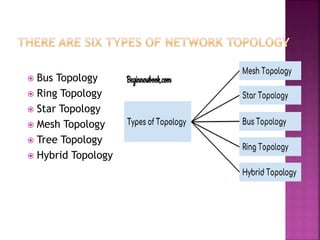
 Bus Topology
 Ring Topology
 Star Topology
 Mesh Topology
 Tree Topology
 Hybrid Topology
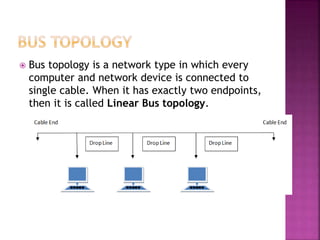
 Bus topology is a network type in which every
computer and network device is connected to
single cable. When it has exactly two endpoints,
then it is called Linear Bus topology.
It transmits data only in one direction.
Every device is connected to a single
cable
Advantages of Bus Topology
It is cost effective.
Used in small networks.
It is easy to understand.
Easy to expand joining two cables together.
Disadvantages of Bus Topology
 Cables fails then whole network fails.
 If network traffic is heavy or nodes are more the
performance of the network decreases.
 Cable has a limited length.
 It is slower than the ring topology.
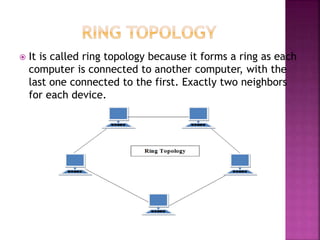
 It is called ring topology because it forms a ring as each
computer is connected to another computer, with the
last one connected to the first. Exactly two neighbors
for each device.
 One station is known as monitor station which
takes all the responsibility to perform the
operations.
 When no station is transmitting the data, then
the token will circulate in the ring.
Advantages of Ring Topology
 Transmitting network is not affected by high traffic or
by adding more nodes, as only the nodes having tokens
can transmit data.
 Cheap to install and expand
Disadvantages of Ring Topology
 Troubleshooting is difficult in ring topology.
 Adding or deleting the computers disturbs the network
activity.
 Failure of one computer disturbs the whole network.
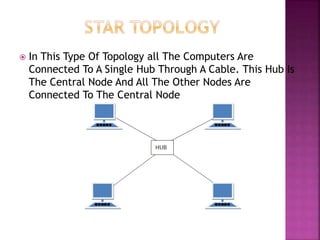
 In This Type Of Topology all The Computers Are
Connected To A Single Hub Through A Cable. This Hub Is
The Central Node And All The Other Nodes Are
Connected To The Central Node
 Every node has its own dedicated connection to the
hub.
 Hub acts as a repeater for data flow.
 Can be used with twisted pair, Optical Fiber or
coaxial cable.
Advantages of Star Topology
 Fast performance with few nodes and low network traffic.
 Hub can be upgraded easily.
 Easy to troubleshoot.
 Easy to setup and modify.
 Only that node is affected which has failed, rest of the nodes
can work smoothly.
Disadvantages of Star Topology
 Cost of installation is high.
 Expensive to use.
 If the hub fails then the whole network is stopped because all
the nodes depend on the hub.
 Performance is based on the hub that is it depends on its
capacity
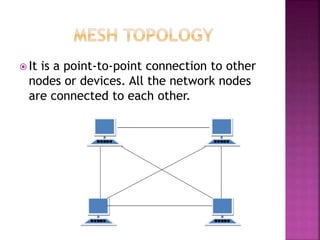
 It is a point-to-point connection to other
nodes or devices. All the network nodes
are connected to each other.
 Fully connected.
 Robust.
 Not flexible.
Advantages of Mesh Topology
 Each connection can carry its own data load.
 It is robust.
 Fault is diagnosed easily.
 Provides security and privacy.
Disadvantages of Mesh Topology
 Installation and configuration is difficult.
 Cabling cost is more.
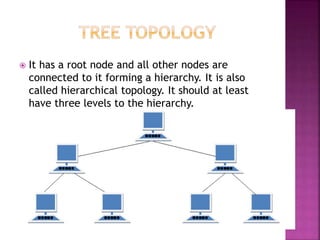
 It has a root node and all other nodes are
connected to it forming a hierarchy. It is also
called hierarchical topology. It should at least
have three levels to the hierarchy.
 Ideal if workstations are located in groups.
 Used in Wide Area Network.
Advantages of Tree Topology
 Extension of bus and star topologies.
 Easily managed and maintained.
 Error detection is easily done.
Disadvantages of Tree Topology
 Heavily cabled.
 Costly.
 If more nodes are added maintenance is difficult.
 Central hub fails, network fails.
 It is two different types of topologies which is a
mixture of two or more topologies. For example
if in an office in one department ring topology
is used and in another star topology is used,
connecting these topologies will result in Hybrid
Topology (ring topology and star topology).
 It is a combination of two or topologies
 Inherits the advantages and disadvantages of the
topologies included
Advantages of Hybrid Topology
 Reliable as Error detecting and trouble shooting
is easy.
 Effective.
 Scalable as size can be increased easily.
 Flexible.
Disadvantages of Hybrid Topology
 Complex in design.
 Costly.
THANKS

Network Topology And Its Types

  • 1.
     Name:- SAADSAIF  Section:- FA17-BSCS-359-H  Subject:- Computer Network  Presented To:- Sir Attique-Rehman LAHORE GARRISON UNIVERSITY
  • 2.
     The wordnetwork topology is used to explain the manner in which a network is physically connected  Devices Are Connected Using Communication Links
  • 3.
     Bus Topology Ring Topology  Star Topology  Mesh Topology  Tree Topology  Hybrid Topology
  • 4.
     Bus topologyis a network type in which every computer and network device is connected to single cable. When it has exactly two endpoints, then it is called Linear Bus topology.
  • 5.
    It transmits dataonly in one direction. Every device is connected to a single cable
  • 6.
    Advantages of BusTopology It is cost effective. Used in small networks. It is easy to understand. Easy to expand joining two cables together. Disadvantages of Bus Topology  Cables fails then whole network fails.  If network traffic is heavy or nodes are more the performance of the network decreases.  Cable has a limited length.  It is slower than the ring topology.
  • 7.
     It iscalled ring topology because it forms a ring as each computer is connected to another computer, with the last one connected to the first. Exactly two neighbors for each device.
  • 8.
     One stationis known as monitor station which takes all the responsibility to perform the operations.  When no station is transmitting the data, then the token will circulate in the ring.
  • 9.
    Advantages of RingTopology  Transmitting network is not affected by high traffic or by adding more nodes, as only the nodes having tokens can transmit data.  Cheap to install and expand Disadvantages of Ring Topology  Troubleshooting is difficult in ring topology.  Adding or deleting the computers disturbs the network activity.  Failure of one computer disturbs the whole network.
  • 10.
     In ThisType Of Topology all The Computers Are Connected To A Single Hub Through A Cable. This Hub Is The Central Node And All The Other Nodes Are Connected To The Central Node
  • 11.
     Every nodehas its own dedicated connection to the hub.  Hub acts as a repeater for data flow.  Can be used with twisted pair, Optical Fiber or coaxial cable.
  • 12.
    Advantages of StarTopology  Fast performance with few nodes and low network traffic.  Hub can be upgraded easily.  Easy to troubleshoot.  Easy to setup and modify.  Only that node is affected which has failed, rest of the nodes can work smoothly. Disadvantages of Star Topology  Cost of installation is high.  Expensive to use.  If the hub fails then the whole network is stopped because all the nodes depend on the hub.  Performance is based on the hub that is it depends on its capacity
  • 13.
     It isa point-to-point connection to other nodes or devices. All the network nodes are connected to each other.
  • 14.
     Fully connected. Robust.  Not flexible.
  • 15.
    Advantages of MeshTopology  Each connection can carry its own data load.  It is robust.  Fault is diagnosed easily.  Provides security and privacy. Disadvantages of Mesh Topology  Installation and configuration is difficult.  Cabling cost is more.
  • 16.
     It hasa root node and all other nodes are connected to it forming a hierarchy. It is also called hierarchical topology. It should at least have three levels to the hierarchy.
  • 17.
     Ideal ifworkstations are located in groups.  Used in Wide Area Network.
  • 18.
    Advantages of TreeTopology  Extension of bus and star topologies.  Easily managed and maintained.  Error detection is easily done. Disadvantages of Tree Topology  Heavily cabled.  Costly.  If more nodes are added maintenance is difficult.  Central hub fails, network fails.
  • 19.
     It istwo different types of topologies which is a mixture of two or more topologies. For example if in an office in one department ring topology is used and in another star topology is used, connecting these topologies will result in Hybrid Topology (ring topology and star topology).
  • 20.
     It isa combination of two or topologies  Inherits the advantages and disadvantages of the topologies included
  • 21.
    Advantages of HybridTopology  Reliable as Error detecting and trouble shooting is easy.  Effective.  Scalable as size can be increased easily.  Flexible. Disadvantages of Hybrid Topology  Complex in design.  Costly.
  • 22.