Stress
 Measures and Failure Criteria


Alan Ho
08 February 2010
Stress tensor: principal components
By calculating its eigen-values & eigen-vectors, the stress tensors can be
written in its principal coordinate system in a purely diagonal form
containing only normal stress components which are called the principal
stress components. The eigenvectors of σ determine the orientation of the
principal coordinate system ê1,2,3 and thus of the principal stress directions :

                                          σ1 0    0
                          σê            =  0 σ2
                                                  0 
                             1, 2 , 3

                                          0 0
                                                  σ3 
                                                      

The principal stresses are also one set of invariants of the stress tensor.
Conventionally, the principal stresses σ1, σ2 and σ3 are ordered such that:

                                  σ1 > σ2 > σ3
Stress tensor decomposition: hydrostatic - deviatoric parts
The stress tensor can be divided in hydrostatic and deviatoric part:

                               σ = σh + σ = pl + ~
                                        ~        σ
Where p = 3 σ ii is the hydrostatic pressure and ~ is called the deviatoric stress tensor.
          1
                                                 σ


Strain energy decomposition
Using the hydrostatic - deviatoric stress & strain decomposition, the strain
energy can be written as:

                                                                  ~
                       E = 2 σ : ε = 2 σh : ε h + 2 σ : ~ = E h + E
                           1         1            1~
                                                        ε
Tresca equivalent stress criteria
The Tresca stress criteria is based on the comparison of maximum shear τmax
and is thus defined basically from the maximum principal stress difference :
                σ eq = max( σ1 − σ2 , σ2 − σ3 , σ3 − σ1 )
                  tresca


The corresponding yield / failure criteria is simply written as a comparison
with the maximum allowed shear stress τy or from a uniaxial stress state
                            σ y : σ eq ≤ 2τ y = σ y
                                    tresca


Postulates that yielding occur when the maximum shearing stress at a
particle of a body in a general, triaxial state of stress attains a value equal to
the maximum shearing stress at yielding in uniaxial tension.

Also known as the maximum shear stress criterion.
Tresca criteria                               τ


                  τmax = 2 (σ1 − σ3 ) ≤ τ y
                         1


        σ3                                                σ1   σ


          representation of Tresca criteria in Mohr diagram
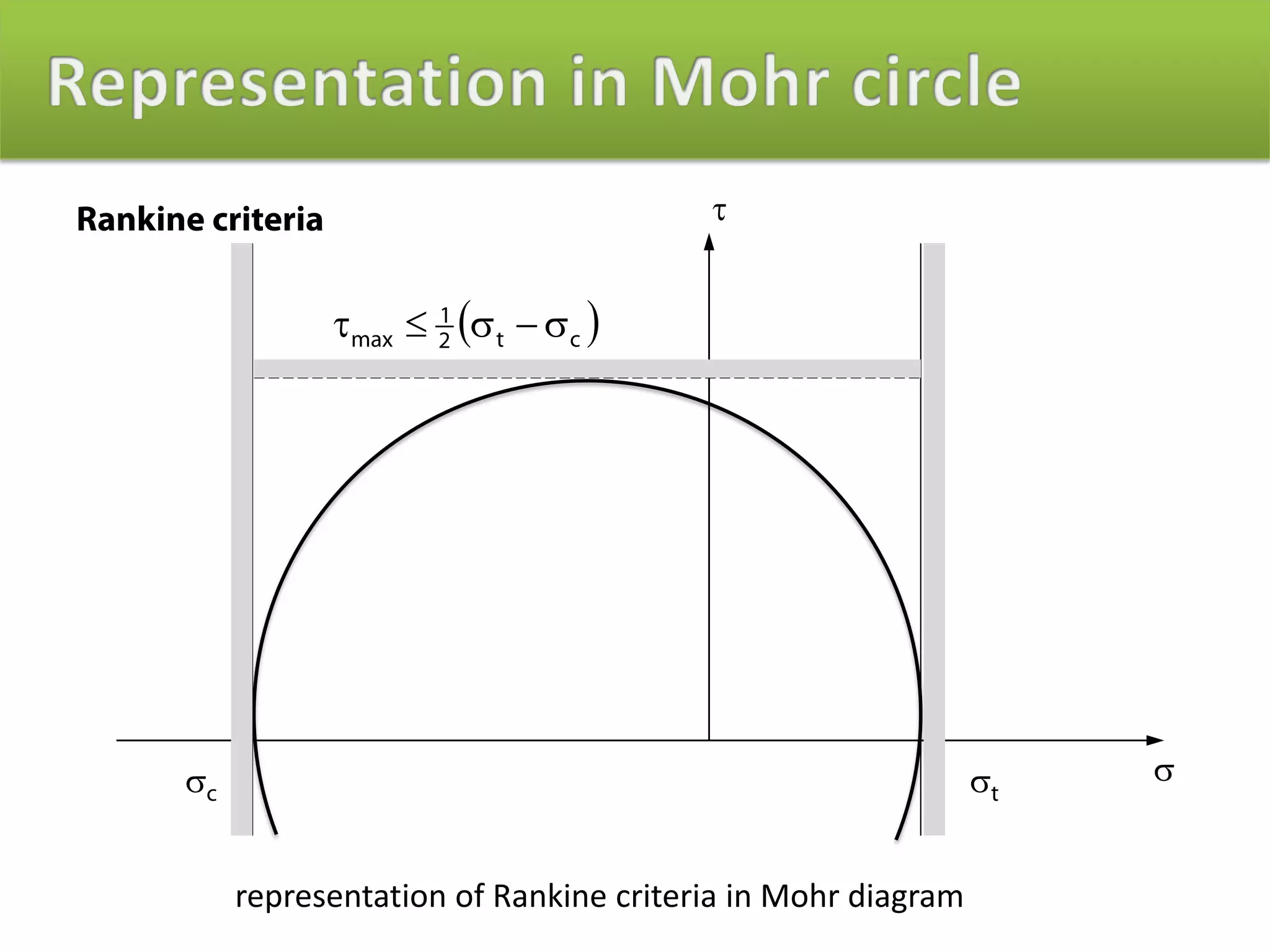
Rankine stress criteria
The Rankine stress criteria simply imposes that the principal stress
components are bounded between σc (compression) and σt (tension) :

                       σ c < σi < σ t   ∀i = 1,2,3
As a result, the maximum shear stress is also bounded: τmax ≤   1
                                                                2   (σ t − σc )
Rankine criteria                            τ


                   τmax ≤ 2 (σ t − σ c )
                          1


       σc                                                        σt   σ


            representation of Rankine criteria in Mohr diagram
Von Mises equivalent stress criteria
The Von Mises equivalent stress criteria is based on a comparison of maximum
                         ~
deviatoric strain energy E and is thus defined from the deviatoric stress tensor ~ :
                                                                                 σ

                                      σmises =
                                       eq                3   ~:~
                                                             σ σ
                                                         2

It can also be written directly from the principal stresses σ1,2,3 or from the
stress tensor components:

                                (σ1 − σ2 )2 + (σ2 − σ3 )2 + (σ3 − σ1 )2
                σ   eq
                    mises   =                     2

                                (σ11 − σ22 )2 + (σ22 − σ33 )2 + (σ33 − σ11 )2 + 6 (σ12 − σ2 + σ2 )
                                                                                    2
                            =                                    2
                                                                                          23   31


The corresponding yield / failure criteria is simply written as a comparison
with the maximum allowed uniaxial stress y (yield stress):

                                           σmises ≤ σ y
                                            eq
3D representation of Von Mises & Tresca yield surfaces
2D representation of Von Mises & Tresca yield surfaces
Between Von Mises and Tresca Yield Criteria
• The Von Mises yield criterion is non-linear. whereas the Tresca yield
   criterion is piecewise linear.

•   However, if the ordering of the magnitudes of the principal components
    of stress is not known, the Tresca yield surface involves singularities
    (edges and corners) and is difficult to handle.
Stress criteria
• Use Von Mises criteria for isotropic, dense & ductile materials like metals which
   failure does not depend on hydrostatic pressure.
•   Von Mises criterion also gives a reasonable estimation of fatigue failure,
    especially in cases of repeated tensile and tensile-shear loading
•   Tresca criteria is more conservative than Von Mises, it is also valid for isotropic &
    ductile materials and is also independent of hydrostatic pressure.
•   Both Tresca & Mises criteria impose that the material has the same limit in
    traction & compression. If not, consider another criteria or take the lowest limit
    for safety.
•   Rankine criteria is more suitable to low cohesion materials like ceramics where
    the tension limit is significantly lower than the compression. In this case, you
    should also check that the maximum shear (Tresca) is also below the admissible
    values.
•   Complex materials like concrete, ceramics, composites require much more
    complex criteria taking into account the hydrostatic pressure, the
    tension/compression asymmetry or the anisotropy of the material.

Stress Measures And Failure Criteria

  • 1.
    Stress Measures andFailure Criteria Alan Ho 08 February 2010
  • 2.
    Stress tensor: principalcomponents By calculating its eigen-values & eigen-vectors, the stress tensors can be written in its principal coordinate system in a purely diagonal form containing only normal stress components which are called the principal stress components. The eigenvectors of σ determine the orientation of the principal coordinate system ê1,2,3 and thus of the principal stress directions : σ1 0 0 σê =  0 σ2  0  1, 2 , 3 0 0  σ3   The principal stresses are also one set of invariants of the stress tensor. Conventionally, the principal stresses σ1, σ2 and σ3 are ordered such that: σ1 > σ2 > σ3
  • 3.
    Stress tensor decomposition:hydrostatic - deviatoric parts The stress tensor can be divided in hydrostatic and deviatoric part: σ = σh + σ = pl + ~ ~ σ Where p = 3 σ ii is the hydrostatic pressure and ~ is called the deviatoric stress tensor. 1 σ Strain energy decomposition Using the hydrostatic - deviatoric stress & strain decomposition, the strain energy can be written as: ~ E = 2 σ : ε = 2 σh : ε h + 2 σ : ~ = E h + E 1 1 1~ ε
  • 4.
    Tresca equivalent stresscriteria The Tresca stress criteria is based on the comparison of maximum shear τmax and is thus defined basically from the maximum principal stress difference : σ eq = max( σ1 − σ2 , σ2 − σ3 , σ3 − σ1 ) tresca The corresponding yield / failure criteria is simply written as a comparison with the maximum allowed shear stress τy or from a uniaxial stress state σ y : σ eq ≤ 2τ y = σ y tresca Postulates that yielding occur when the maximum shearing stress at a particle of a body in a general, triaxial state of stress attains a value equal to the maximum shearing stress at yielding in uniaxial tension. Also known as the maximum shear stress criterion.
  • 5.
    Tresca criteria τ τmax = 2 (σ1 − σ3 ) ≤ τ y 1 σ3 σ1 σ representation of Tresca criteria in Mohr diagram
  • 6.
    Rankine stress criteria TheRankine stress criteria simply imposes that the principal stress components are bounded between σc (compression) and σt (tension) : σ c < σi < σ t ∀i = 1,2,3 As a result, the maximum shear stress is also bounded: τmax ≤ 1 2 (σ t − σc )
  • 7.
    Rankine criteria τ τmax ≤ 2 (σ t − σ c ) 1 σc σt σ representation of Rankine criteria in Mohr diagram
  • 8.
    Von Mises equivalentstress criteria The Von Mises equivalent stress criteria is based on a comparison of maximum ~ deviatoric strain energy E and is thus defined from the deviatoric stress tensor ~ : σ σmises = eq 3 ~:~ σ σ 2 It can also be written directly from the principal stresses σ1,2,3 or from the stress tensor components: (σ1 − σ2 )2 + (σ2 − σ3 )2 + (σ3 − σ1 )2 σ eq mises = 2 (σ11 − σ22 )2 + (σ22 − σ33 )2 + (σ33 − σ11 )2 + 6 (σ12 − σ2 + σ2 ) 2 = 2 23 31 The corresponding yield / failure criteria is simply written as a comparison with the maximum allowed uniaxial stress y (yield stress): σmises ≤ σ y eq
  • 9.
    3D representation ofVon Mises & Tresca yield surfaces
  • 10.
    2D representation ofVon Mises & Tresca yield surfaces
  • 11.
    Between Von Misesand Tresca Yield Criteria • The Von Mises yield criterion is non-linear. whereas the Tresca yield criterion is piecewise linear. • However, if the ordering of the magnitudes of the principal components of stress is not known, the Tresca yield surface involves singularities (edges and corners) and is difficult to handle.
  • 12.
    Stress criteria • UseVon Mises criteria for isotropic, dense & ductile materials like metals which failure does not depend on hydrostatic pressure. • Von Mises criterion also gives a reasonable estimation of fatigue failure, especially in cases of repeated tensile and tensile-shear loading • Tresca criteria is more conservative than Von Mises, it is also valid for isotropic & ductile materials and is also independent of hydrostatic pressure. • Both Tresca & Mises criteria impose that the material has the same limit in traction & compression. If not, consider another criteria or take the lowest limit for safety. • Rankine criteria is more suitable to low cohesion materials like ceramics where the tension limit is significantly lower than the compression. In this case, you should also check that the maximum shear (Tresca) is also below the admissible values. • Complex materials like concrete, ceramics, composites require much more complex criteria taking into account the hydrostatic pressure, the tension/compression asymmetry or the anisotropy of the material.