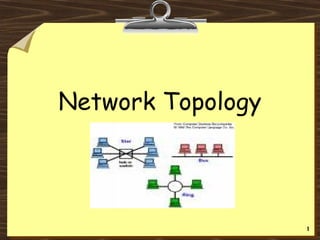
Network Topology


                   1
Introduction
Physical and Logical Topologies
Topologies
  Bus
  Ring
  Star
  Extended Star
  Mesh
  Hybrid

                                  2
Physical vs. Logical Topology
The actual layout of a network and its media
is its Physical Topology
The way in which the data access the medium
and transmits packets is the Logical Topology
A glance at a network is not always revealing.
 Cables emerging from a Hub does not make
it necessarily a Star Topology – it may
actually be a bus or a ring


                                             3
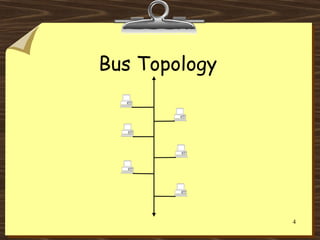
Bus Topology


               4
Bus Topology (5)
Advantages                Disadvantages
 Inexpensive to install     No longer recommended
 Easy to add stations       Backbone breaks, whole
                            network down
 Use less cable than        Limited no of devices can
 other topologies           be attached
 Works well for small       Difficult to isolate problems
 networks                   Sharing same cable slows
                            response rates
                                                      5
Ring Topology


                6
Ring Topology (3)
Advantages              Disadvantages
 Data packets travel      Requires more cable
 at great speed           than a bus
 No collisions            A break in the ring
 Easier to fault find     will bring it down
 No terminators           Not as common as
 required                 the bus – less
                          devices available
                                           7
Star Topology


                8
Star Topology (3)
Advantages                      Disadvantages
Easy to add devices as the      A star network requires more
network expands                 cable than a ring or bus
One cable failure does not      network
bring down the entire           Failure of the central hub can
network (resilience)            bring down the entire
Hub provides centralised        network
management                      Costs are higher (installation
Easy to find device and cable   and equipment) than for most
problems                        bus networks
Can be upgraded to faster
speeds
Lots of support as it is the
most used
                                                          9
Extended Star Topology
   A Star
  Network
 which has
    been
expanded to
 include an
 additional
hub or hubs.

                         10
Mesh Topology (Web)


                      11
Mesh Topology (2)
Not common on LANs
Most often used in WANs to interconnect
LANS
Each node is connected to every other node
Allows communication to continue in the
event of a break in any one connection
It is “Fault Tolerant”
                                             12
Mesh Topology (3)
Advantages                   Disadvantages
 Improves Fault               Expensive
 Tolerance                    Difficult to install
                              Difficult to
                              manage
                              Difficult to
                              troubleshoot
                  CP2073 Networking            13
Hybrid Topology


                  14
Logical Bus


•Modern Ethernet networks are Star Topologies (physically)
•The Hub is at the centre, and defines a Star Topology
•The Hub itself uses a Logical Bus Topology internally, to
transmit data to all segments
                                                             15
Logical Bus
Advantages                Disadvantages
  A single node failure     Collisions can occur
  does not bring the        easily
  network down              Only one device can
  Most widely               access the network
  implemented topology      media at a time
  Network can be added
  to or changed without
  affecting other
  stations
                                                   16
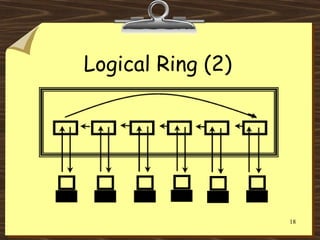
Logical Ring
Data in a Star Topology can transmit data
in a Ring
The MAU (Multistation Access Unit) looks
like an ordinary Hub, but data is passed
internally using a logical ring
It is superior to a Logical Bus Hub – see
later slide
                                        17
Logical Ring (2)


                   18
Logical Ring (3)
Advantages            Disadvantages
 The amount of data     A broken ring will
 that can be carried    stop all
 in a single message    transmissions
 is greater than on a   A device must wait
 logical bus            for an empty token
 There are no           to be able to
 collisions             transmit

                                        19
Summary
Bus Topology
Ring Topology
Star Topology
Other Topologies
Logical Topologies
Questions and Answers
                        20

Network topology....sajal

  • 1.
  • 2.
    Introduction Physical and LogicalTopologies Topologies Bus Ring Star Extended Star Mesh Hybrid 2
  • 3.
    Physical vs. LogicalTopology The actual layout of a network and its media is its Physical Topology The way in which the data access the medium and transmits packets is the Logical Topology A glance at a network is not always revealing. Cables emerging from a Hub does not make it necessarily a Star Topology – it may actually be a bus or a ring 3
  • 4.
  • 5.
    Bus Topology (5) Advantages Disadvantages Inexpensive to install No longer recommended Easy to add stations Backbone breaks, whole network down Use less cable than Limited no of devices can other topologies be attached Works well for small Difficult to isolate problems networks Sharing same cable slows response rates 5
  • 6.
  • 7.
    Ring Topology (3) Advantages Disadvantages Data packets travel Requires more cable at great speed than a bus No collisions A break in the ring Easier to fault find will bring it down No terminators Not as common as required the bus – less devices available 7
  • 8.
  • 9.
    Star Topology (3) Advantages Disadvantages Easy to add devices as the A star network requires more network expands cable than a ring or bus One cable failure does not network bring down the entire Failure of the central hub can network (resilience) bring down the entire Hub provides centralised network management Costs are higher (installation Easy to find device and cable and equipment) than for most problems bus networks Can be upgraded to faster speeds Lots of support as it is the most used 9
  • 10.
    Extended Star Topology A Star Network which has been expanded to include an additional hub or hubs. 10
  • 11.
  • 12.
    Mesh Topology (2) Notcommon on LANs Most often used in WANs to interconnect LANS Each node is connected to every other node Allows communication to continue in the event of a break in any one connection It is “Fault Tolerant” 12
  • 13.
    Mesh Topology (3) Advantages Disadvantages Improves Fault Expensive Tolerance Difficult to install Difficult to manage Difficult to troubleshoot CP2073 Networking 13
  • 14.
  • 15.
    Logical Bus •Modern Ethernetnetworks are Star Topologies (physically) •The Hub is at the centre, and defines a Star Topology •The Hub itself uses a Logical Bus Topology internally, to transmit data to all segments 15
  • 16.
    Logical Bus Advantages Disadvantages A single node failure Collisions can occur does not bring the easily network down Only one device can Most widely access the network implemented topology media at a time Network can be added to or changed without affecting other stations 16
  • 17.
    Logical Ring Data ina Star Topology can transmit data in a Ring The MAU (Multistation Access Unit) looks like an ordinary Hub, but data is passed internally using a logical ring It is superior to a Logical Bus Hub – see later slide 17
  • 18.
  • 19.
    Logical Ring (3) Advantages Disadvantages The amount of data A broken ring will that can be carried stop all in a single message transmissions is greater than on a A device must wait logical bus for an empty token There are no to be able to collisions transmit 19
  • 20.
    Summary Bus Topology Ring Topology StarTopology Other Topologies Logical Topologies Questions and Answers 20