Topic :Self-Instructional
module.
CONTENTS
▶ Introduction
▶ Defnitions of self –instruction and module
▶ Advantages
▶ Limitations
▶ Conclusion
▶ References.
▶INTRODUCTION
▶ Self instructional module is one of the educational
materials, that help individualized learning. It is
important to go through the module in schematic
way. All need continuing education, in order to
posses upto date knowledge and skills for the effective
dilivery of health care.
▶SELF –INSTRUCTION
▶ Self Instruction is a method used by the teacher
to provide or design instructional activities that guide the
learner in independently achieving the objectives of learning.
▶ “Self Instruction is defined as self contained instructional
activities that allows learner to progress by themselves on
their own pace.
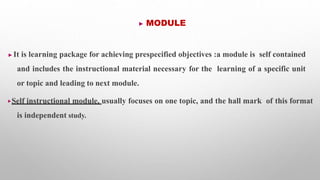
▶ MODULE
▶It is learning package for achieving prespecified objectives :a module is self contained
and includes the instructional material necessary for the learning of a specific unit
or topic and leading to next module.
▶Self instructional module, usually focuses on one topic, and the hall mark of this format
is independent study.
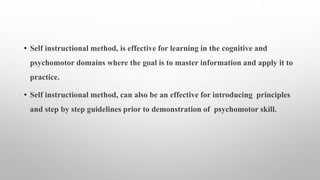
• Self instructional method, is effective for learning in the cognitive and
psychomotor domains where the goal is to master information and apply it to
practice.
• Self instructional method, can also be an effective for introducing principles
and step by step guidelines prior to demonstration of psychomotor skill.
ADVANTAGES:
- Learning become more effective.
- Work at his/her own time and space.
- Modules can be made readily accessible to learner along with the learner
can study at home without undue disruption of any resources that are
needed to complete the self-study programmes.
- There is advantage of self-pacing active learning and the chance to review and
reflect on information.
- The ability to get frequent feedback.
- Self-instructional module represents an attractive alternative to traditional
classroom.
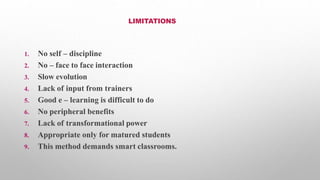
LIMITATIONS
1. No self – discipline
2. No – face to face interaction
3. Slow evolution
4. Lack of input from trainers
5. Good e – learning is difficult to do
6. No peripheral benefits
7. Lack of transformational power
8. Appropriate only for matured students
9. This method demands smart classrooms.
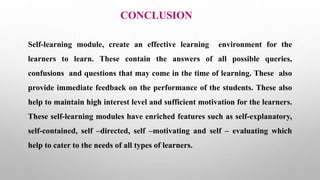
CONCLUSION
Self-learning module, create an effective learning environment for the
learners to learn. These contain the answers of all possible queries,
confusions and questions that may come in the time of learning. These also
provide immediate feedback on the performance of the students. These also
help to maintain high interest level and sufficient motivation for the learners.
These self-learning modules have enriched features such as self-explanatory,
self-contained, self –directed, self –motivating and self – evaluating which
help to cater to the needs of all types of learners.
REFERENCES
1. Neerja. K.P, textbook of nursing education, 1st Edition, 2004,
kundli, Jaypee Brothers medical publishers .
2. Heidgerken. Loretta.E, Teaching and learning in schools of
nursing, 3rd Edition,Delhi, Konark publishers .
3. White. Ruth and Ewan. Christine, Clinical teaching in
nursing, 1st Edition, 1997, Chennai, Chennai micro point.
1. Basavanthappa.B.T, Textbook of Nursing Education, 1st
Edition, Noida, Jaypee Brothers Medical publishers.
😍THANK YOU😍

ppt on self instructional module.pptx

  • 1.
  • 2.
    CONTENTS ▶ Introduction ▶ Defnitionsof self –instruction and module ▶ Advantages ▶ Limitations ▶ Conclusion ▶ References.
  • 3.
    ▶INTRODUCTION ▶ Self instructionalmodule is one of the educational materials, that help individualized learning. It is important to go through the module in schematic way. All need continuing education, in order to posses upto date knowledge and skills for the effective dilivery of health care.
  • 4.
    ▶SELF –INSTRUCTION ▶ SelfInstruction is a method used by the teacher to provide or design instructional activities that guide the learner in independently achieving the objectives of learning. ▶ “Self Instruction is defined as self contained instructional activities that allows learner to progress by themselves on their own pace.
  • 5.
    ▶ MODULE ▶It islearning package for achieving prespecified objectives :a module is self contained and includes the instructional material necessary for the learning of a specific unit or topic and leading to next module. ▶Self instructional module, usually focuses on one topic, and the hall mark of this format is independent study.
  • 6.
    • Self instructionalmethod, is effective for learning in the cognitive and psychomotor domains where the goal is to master information and apply it to practice. • Self instructional method, can also be an effective for introducing principles and step by step guidelines prior to demonstration of psychomotor skill.
  • 7.
    ADVANTAGES: - Learning becomemore effective. - Work at his/her own time and space. - Modules can be made readily accessible to learner along with the learner can study at home without undue disruption of any resources that are needed to complete the self-study programmes.
  • 8.
    - There isadvantage of self-pacing active learning and the chance to review and reflect on information. - The ability to get frequent feedback. - Self-instructional module represents an attractive alternative to traditional classroom.
  • 9.
    LIMITATIONS 1. No self– discipline 2. No – face to face interaction 3. Slow evolution 4. Lack of input from trainers 5. Good e – learning is difficult to do 6. No peripheral benefits 7. Lack of transformational power 8. Appropriate only for matured students 9. This method demands smart classrooms.
  • 10.
    CONCLUSION Self-learning module, createan effective learning environment for the learners to learn. These contain the answers of all possible queries, confusions and questions that may come in the time of learning. These also provide immediate feedback on the performance of the students. These also help to maintain high interest level and sufficient motivation for the learners. These self-learning modules have enriched features such as self-explanatory, self-contained, self –directed, self –motivating and self – evaluating which help to cater to the needs of all types of learners.
  • 11.
    REFERENCES 1. Neerja. K.P,textbook of nursing education, 1st Edition, 2004, kundli, Jaypee Brothers medical publishers . 2. Heidgerken. Loretta.E, Teaching and learning in schools of nursing, 3rd Edition,Delhi, Konark publishers . 3. White. Ruth and Ewan. Christine, Clinical teaching in nursing, 1st Edition, 1997, Chennai, Chennai micro point. 1. Basavanthappa.B.T, Textbook of Nursing Education, 1st Edition, Noida, Jaypee Brothers Medical publishers.
  • 12.