





DISCUSSION
METHOD
PRESENTATION
ON
DISCUSSION METHOD
SUBMITTED TO:- SUBMITTED BY:-
DR.PALLAVI PATHANIA KAJAL CHANDEL
ASSOCIATE PROFESSOR M.SC.(N)1ST YEAR
MEDICAL SURGICAL NURSING ROLL-NO:2
PRESENTED TO:-
MISS.NEETALI
NURSING TUTOR
OBSTETRIC AND GYNACOLOGY
INDEX
SR.NO. CONTENT
1. INTRODUCTION AND DEFINITION OF DISCUSSION METHOD
2. PURPOSE OF DISCUSSION METHOD
3. GENERAL PRINCIPLES OF DISCUSSION
4. TYPES OF DISCUSSION METHOD
5. DISCUSSION TECHNIQUES
6. TIPS FOR GOOD DISCUSSION
7. MERITS OF DISCUSSION METHOD
8. DEMERRITS OF DISCUSSION METHOD
INTRODUCTION
 Discussion method of teaching is a group activity involving the teacher and the student
to define the problem and seek its solution. Discussion method is also described as a
constructive process involving listening ,thinking ,as well as the speaking ability of the
student.
DEFINITION
 Discussion involves and interchanges of informed opinions and reaction, group
consideration of a problem or issue, sharing of ideas and information and exchange of
questions and answers.
( Sandra De Young)
 Discussion is a thoughtful consideration of relationship involved in the topic or problem
under study. These relationship are analyzed, compared and evaluated for drawing
conclusion.
PURPOSES OF DISCUSSION
 To teach context, specific interpretation
and application.
 Assist students to develop, express and
validates their opinions or belief.
 To clarify information and concepts.
 To share information
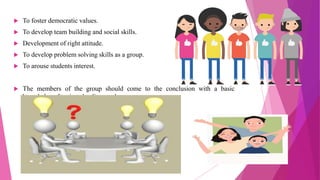
 To foster democratic values.
 To develop team building and social skills.
 Development of right attitude.
 To develop problem solving skills as a group.
 To arouse students interest.
 The members of the group should come to the conclusion with a basic
knowledge of topic to be discussed.
DISCUSSION TECHNIQUES
 Proper planning.
 Preparing students for discussion.
 Discussion guiding techniques.
 Open the discussion session with a keynote address.
CONTINUE….
 Ensuring participation of all students is very important.
 Make sure that opinions or viewpoint are between the group members.
 Group leaders have to summarize the viewpoints.
 Discussion end with a concluding note.
GENERAL PRINCIPLE OF DISCUSSION
 The topic should be selected from daily life.
 Students should have sufficient information about it.
 Participants should be small in number to ensure the participation of each
individual in the discussion.
 During the discussion, the teacher should remain present for guidance and
maintain discipline.
 Everyone should be given a chance to share ideas but in turn.
 Clearly defined objective which is understood by all the participants .
 Leader to guide and coordinate proceeding.
 The main points in the discussion should be recorded.
 Everyone should feel free to participate.
 Shy person should be encourage to contributes .
 All points of view should be fairly considered.
 Discussion should keep to the point.
 Properly closed with a report, discussion, recommendation or summing up of the matter
discussed.
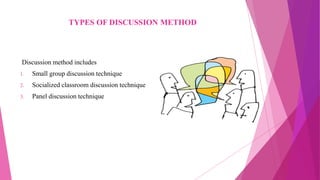
TYPES OF DISCUSSION METHOD
Discussion method includes
1. Small group discussion technique
2. Socialized classroom discussion technique
3. Panel discussion technique
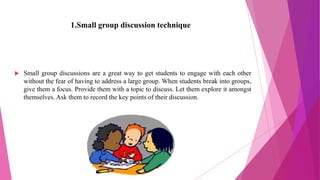
1.Small group discussion technique
 Small group discussions are a great way to get students to engage with each other
without the fear of having to address a large group. When students break into groups,
give them a focus. Provide them with a topic to discuss. Let them explore it amongst
themselves. Ask them to record the key points of their discussion.
2.Socialized classroom discussion technique
 It is a technique of teaching in which a friendly spirit of cooperation prevails.
Children discuss the various social, economic, cultural, political and moral problems
and discover for themselves the real meaning and significance of these.
3. Panel discussion technique
 A panel discussion, involves a group of people, gathered to discuss a topic in front of an
audience. Panels usually include a moderator who guide the discussion and some elicits
audience questions, with the goal of being informative and entertaining.
TIPS FOR GOOD DISCUSSION
 Keep eye contact while speaking.
 Keep eye contact with every team members while
speaking.
 Initiate the discussion.
 Initiate the group discussion only when you
understood the group discussion topic clearly and
have some topic knowledge.
 Allow others to speak.
 Do not interrupt anyone in between while speaking.
 Speak clearly and politely.
 Use simple and understandable words while speaking.
 Positive attitude.
 Be confident.
 Do not try to dominate anyone.
 Keep positive body language.
 Show interest in discussion.
 Speak less and listen more.
 Pay attention while others are speaking.
MERITS OF DISCUSSION METHOD
 Student centered method.
 Active role of student.
 Discussion make classroom environment alive.
 Equal opportunity for all the students
CONTINUE….
 It develop critical thinking in the students.
 Helpful to improve verbal communication power of students.
 It’s a two way communication.
 It develop the habits of study.
 Democratic attitude develop among the students.
DEMERITS OF DISCUSSION METHOD
 Science subjects cannot teach through discussion.
 Discussion method is only suitable for higher classes.
 It is not applicable in early classes.
CONTINUE….
 It can be time consuming when discussion diverges from the topic.
 Discussion method creates the problem of discipline.
 Class control losses and near class are disturbed.
SUMMARIZATION
 Discussion method of teaching is a group activity involving the teacher and the
student to define the problem and seek its solution. Discussion method is also
described as a constructive process involving listening ,thinking ,as well as the
speaking ability of the student.
CONCLUSION
 Discussion methods are a variety of forums for open-ended, collaborative exchange
of ideas among a teacher and students or among students for the purpose of furthering
students thinking, learning, problem solving, understanding, or literary appreciation.
BIBLIOGRAPHY
BOOK REFRENCE
 Saran Johal Kulvinder A textbook of Nursing Education, Edition-,Pp 45-48.
INTERNET REFRENCE:-
 https://www.wikipedia .com
 https://www.Slideshare.net/Field -trip
 https://www.Field tripideas.com
Discussion method

Discussion method

  • 1.
  • 2.
    PRESENTATION ON DISCUSSION METHOD SUBMITTED TO:-SUBMITTED BY:- DR.PALLAVI PATHANIA KAJAL CHANDEL ASSOCIATE PROFESSOR M.SC.(N)1ST YEAR MEDICAL SURGICAL NURSING ROLL-NO:2 PRESENTED TO:- MISS.NEETALI NURSING TUTOR OBSTETRIC AND GYNACOLOGY
  • 3.
    INDEX SR.NO. CONTENT 1. INTRODUCTIONAND DEFINITION OF DISCUSSION METHOD 2. PURPOSE OF DISCUSSION METHOD 3. GENERAL PRINCIPLES OF DISCUSSION 4. TYPES OF DISCUSSION METHOD 5. DISCUSSION TECHNIQUES 6. TIPS FOR GOOD DISCUSSION 7. MERITS OF DISCUSSION METHOD 8. DEMERRITS OF DISCUSSION METHOD
  • 4.
    INTRODUCTION  Discussion methodof teaching is a group activity involving the teacher and the student to define the problem and seek its solution. Discussion method is also described as a constructive process involving listening ,thinking ,as well as the speaking ability of the student.
  • 5.
    DEFINITION  Discussion involvesand interchanges of informed opinions and reaction, group consideration of a problem or issue, sharing of ideas and information and exchange of questions and answers. ( Sandra De Young)  Discussion is a thoughtful consideration of relationship involved in the topic or problem under study. These relationship are analyzed, compared and evaluated for drawing conclusion.
  • 6.
    PURPOSES OF DISCUSSION To teach context, specific interpretation and application.  Assist students to develop, express and validates their opinions or belief.  To clarify information and concepts.  To share information
  • 7.
     To fosterdemocratic values.  To develop team building and social skills.  Development of right attitude.  To develop problem solving skills as a group.  To arouse students interest.  The members of the group should come to the conclusion with a basic knowledge of topic to be discussed.
  • 8.
    DISCUSSION TECHNIQUES  Properplanning.  Preparing students for discussion.  Discussion guiding techniques.  Open the discussion session with a keynote address.
  • 9.
    CONTINUE….  Ensuring participationof all students is very important.  Make sure that opinions or viewpoint are between the group members.  Group leaders have to summarize the viewpoints.  Discussion end with a concluding note.
  • 10.
    GENERAL PRINCIPLE OFDISCUSSION  The topic should be selected from daily life.  Students should have sufficient information about it.  Participants should be small in number to ensure the participation of each individual in the discussion.  During the discussion, the teacher should remain present for guidance and maintain discipline.
  • 11.
     Everyone shouldbe given a chance to share ideas but in turn.  Clearly defined objective which is understood by all the participants .  Leader to guide and coordinate proceeding.  The main points in the discussion should be recorded.  Everyone should feel free to participate.  Shy person should be encourage to contributes .
  • 12.
     All pointsof view should be fairly considered.  Discussion should keep to the point.  Properly closed with a report, discussion, recommendation or summing up of the matter discussed.
  • 13.
    TYPES OF DISCUSSIONMETHOD Discussion method includes 1. Small group discussion technique 2. Socialized classroom discussion technique 3. Panel discussion technique
  • 14.
    1.Small group discussiontechnique  Small group discussions are a great way to get students to engage with each other without the fear of having to address a large group. When students break into groups, give them a focus. Provide them with a topic to discuss. Let them explore it amongst themselves. Ask them to record the key points of their discussion.
  • 15.
    2.Socialized classroom discussiontechnique  It is a technique of teaching in which a friendly spirit of cooperation prevails. Children discuss the various social, economic, cultural, political and moral problems and discover for themselves the real meaning and significance of these.
  • 16.
    3. Panel discussiontechnique  A panel discussion, involves a group of people, gathered to discuss a topic in front of an audience. Panels usually include a moderator who guide the discussion and some elicits audience questions, with the goal of being informative and entertaining.
  • 17.
    TIPS FOR GOODDISCUSSION  Keep eye contact while speaking.  Keep eye contact with every team members while speaking.  Initiate the discussion.  Initiate the group discussion only when you understood the group discussion topic clearly and have some topic knowledge.  Allow others to speak.
  • 18.
     Do notinterrupt anyone in between while speaking.  Speak clearly and politely.  Use simple and understandable words while speaking.  Positive attitude.  Be confident.  Do not try to dominate anyone.  Keep positive body language.  Show interest in discussion.  Speak less and listen more.  Pay attention while others are speaking.
  • 19.
    MERITS OF DISCUSSIONMETHOD  Student centered method.  Active role of student.  Discussion make classroom environment alive.  Equal opportunity for all the students
  • 20.
    CONTINUE….  It developcritical thinking in the students.  Helpful to improve verbal communication power of students.  It’s a two way communication.  It develop the habits of study.  Democratic attitude develop among the students.
  • 21.
    DEMERITS OF DISCUSSIONMETHOD  Science subjects cannot teach through discussion.  Discussion method is only suitable for higher classes.  It is not applicable in early classes.
  • 22.
    CONTINUE….  It canbe time consuming when discussion diverges from the topic.  Discussion method creates the problem of discipline.  Class control losses and near class are disturbed.
  • 23.
    SUMMARIZATION  Discussion methodof teaching is a group activity involving the teacher and the student to define the problem and seek its solution. Discussion method is also described as a constructive process involving listening ,thinking ,as well as the speaking ability of the student.
  • 24.
    CONCLUSION  Discussion methodsare a variety of forums for open-ended, collaborative exchange of ideas among a teacher and students or among students for the purpose of furthering students thinking, learning, problem solving, understanding, or literary appreciation.
  • 26.
    BIBLIOGRAPHY BOOK REFRENCE  SaranJohal Kulvinder A textbook of Nursing Education, Edition-,Pp 45-48. INTERNET REFRENCE:-  https://www.wikipedia .com  https://www.Slideshare.net/Field -trip  https://www.Field tripideas.com