Teaching Learning Methods
dr. hironmoy roy
MD, MBA, DHM, ACME (2019), FAIMER (2015)
Assoc. Prof. Anatomy, IPGME&R
Categories of Teaching-Learning Methods
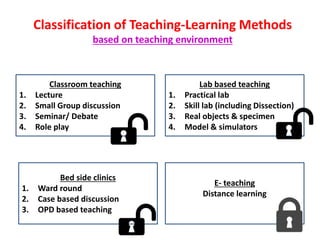
Classroom teaching
1. Lecture
2. Small Group discussion
3. Seminar/ Debate
4. Role play
Lab based teaching
1. Practical lab
2. Skill lab (including Dissection)
3. Real objects & specimen
4. Model & simulators
Bed side clinics
1. Ward round
2. Case based discussion
3. OPD based teaching
E- teaching
Distance learning
Classification of Teaching-Learning Methods
based on teaching environment
Classification of Teaching-Learning Methods
based on number of audiences
Large group teaching
Small group teaching
Individualised learning
TL Method Role of teacher Role of student
Mass-Instruction
(Conventional lecture/
mass-practical-
demonstration class/ video
broadcast etc.)
Traditional expository role.
Controller of all aspects of
Instruction process (style/
content/pace)
Largely Passive.
Practically they are totally
dependent on what they
are getting from the
teacher. Little scope of
interaction.
Individualized learning.
(Directed study of texts,
study of open-learning
materials/ CBL/ Individual
assignments etc.)
Producer/ manager of
learning resource.
Tutor & guide.
Provides support, when
required.
Active.
Responsible for own
learning. Individual
students control their own
pace of learning & depth of
study.
In-Group learning.
(Buzz sessions, group
discussions, seminars,
group-project, group-
assignments, games,
tutorials)
Organizer of group activity.
Facilitator of learning
experience.
(supportive role)
Active.
Responsible for own
learning. Strongly
dependent on one
another’s preparation &
interaction.
Section 1.
Large group Teaching-
offline mode
A careful presentation of organized thoughts & ideas
By a qualified person
Serves as good means of introducing a subject
Covers a large group of learners
9
Disadvantages
Learners passive
Not possible to check
learners’ learning
“A process by which the
notes of a teacher become
the notes of a student
without passing through the
minds of either. ”
O’Donnel 1997
Uninterrupted delivery of
apparently irrelevant material in a
sleep inducing monotone over one
hour.
Lecturodynia
Heightened emotion
• Anxiety
• Annoyance
• Anger
Suppressed emotion
• Apathy
• Frustration
• Somnolence
Can we make interactive lecture?
How you practice?
asking person specific questions
general questioning
What else can be done?
brain storming
Buzz session
……followed by snowball
Exit ticket
Enlist three interactive methods of teaching you
learned in today’s lecture
Enlist two “teaching learning methods” about
which you want to know more
Ask “One” question what makes your maximum
doubt
Check the misconcept
‘Circle
the
question’
‘Ask the winner’
Mini- Debate
Peer-review writing task
A Flipped class
A series of prepared
speeches given by 2-5
experts on various aspects
of a problem under a
chairman.
Talk short & to the point (10-25
minutes)
Audience-passive No discussion between speakers
29
Panel discussion
A group of 4 or more persons
Under a moderator (have specific knowledge on the topic)
Sits at a table in front of audience
Holds an orderly & logical conversation on an assigned topic
Each member makes a short statement (5 mins), before
exchanging ideas
31
Symposium Panel discussion
Both of the cases subject-experts meet on table
They makes their statements
There is NO exchange of
ideas
Moderator sums up
There are exchange of
ideas under a moderator
and finally a conclusion
arrives
Audience is Mute
Speakers have long speech
(20-25 minutes)
Short speech
(max 5 minutes)
Section 2.
Small group Teaching-
offline mode
Seminar
• An activity in which a group of persons engaged in
research or advanced study of a subject meet under
general direction of an expert for a discussion leading
to an in depth study of a problem/subject
• No audience usually
38
Small group (5-20 )
Face to face mutual interchange of ideas
More than random unstructured conversation
Has a method and structure
But can be informal & democratic
A problem to be solved/ a decision to be
made
40
Group Discussion
Seminar Group Discussion
Both of the cases learners/ researchers meet on round
table for face to face interaction
They carry on discussion
Participants seek
clarification from the
experts
Participants finds out
clarification from resources
available
No audience
One expert is present,
directs, conducts the
activities in structured way.
Unstructured informal
discussion usually themed
to solve a problem
Workshop
Divided into
small groups
Individuals work
within the group
under a chairman
and recorder
Finally some plan
comes out in
solving a
particular problem
42
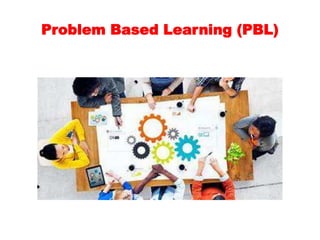
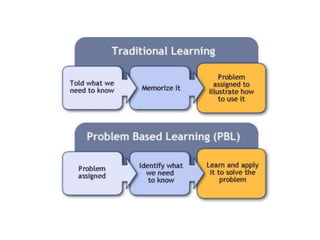
Problem Based Learning (PBL)
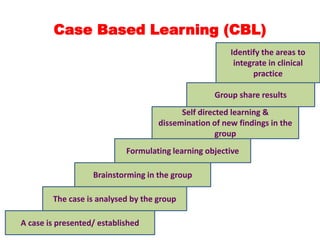
Case Based Learning (CBL)
A case is presented/ established
The case is analysed by the group
Brainstorming in the group
Formulating learning objective
Self directed learning &
dissemination of new findings in the
group
Group share results
Identify the areas to
integrate in clinical
practice
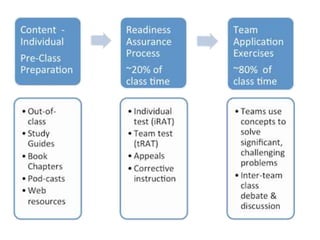
Team Based Learning (TBL)
“Anatomy of the stomach”
How can we go through a
Team-Based Learning?
Phase 1
Pre-class room Assignments
Three days before the scheduled class the
teacher asks the group to study
“Anatomy of stomach” from their book
Phase 2
Readiness
1. Students attends class with their ready-
knowledge
2. The facilitator may assess their
readiness to participate in GD
(Readiness assessment- 20% of class time)
Phase 3
Team-application Exercise
1. Team members start interaction
2. The facilitator only guides their interaction in
right way- divides the broad topic in
subheadings- Gross anatomy/ histology/
blood supply (Interaction 70% of class time)
3. Common queries are met up
(10% of class time)
Team A
A1, A2, A3,
Team B
B1, B2, B3,
Team C
C1, C2, C3,
Team A
B1, C1, A3
Team B
A1, C2, B3
Team C
A2, B2, C3
Gross Anatomy of stomach
Blood Supply of stomach
Histology of stomach
Gross
anatomy
of
Stomach
Blood
Supply
of
stomach
Histology
of
stomach
Gross
anatomy
of
Stomach
Blood
Supply
of
stomach
Histology
of
stomach
Gross
anatomy
of
Stomach
Blood
Supply of
stomach
Histology
of
stomach
Jigsaw class
Buzz group
• Divide participants into groups of 3 to 6
participants
• Give the groups 3 to 8 minutes to consider a
specific, limited problem or question
• Walk around the room to answer doubts
• Ask for answers from each group, or provide the
answer to on an overhead/flip chart/board
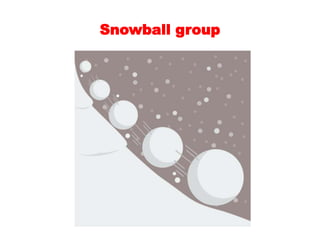
Snowball group
Fishbowl
Horse
shoe
group
Circle chat
1. The students stand in two concentric circles facing each
other.
2. Working with the partner they face, they take it in
turns to share information and ideas or ask each other
question.
3. At a signal from the teacher the outside circle moves a
given number of places clockwise.
4. Students now report to the new partner and repeat the
process.
Doughnut round
Question- Answer matching
• A significant practical unit of activity having
educational value
• Aimed at one or more definite goals of
understanding
• Involves investigation & solution of problems
69
Programmed Learning
• Instructions utilizing a work book or mechanical
or electronic device- Computer- assisted
learning (CAL)
• Help learner in attaining a specified level of
performance
• A method of self learning
70
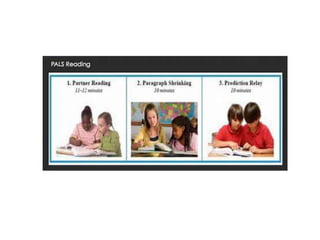
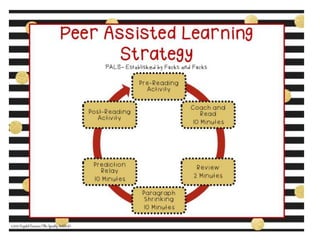
Peer Assisted Learning (PAL)
Role play
75
Video Demonstration & reflection
76
Module based learning
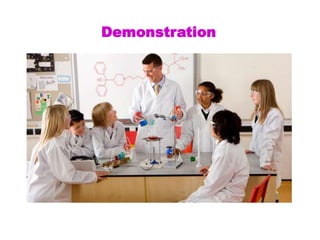
Demonstration
Master- apprenticeship model
Copyright@Hironmoy Roy
The “master is the model”, who
directs, demonstrates, comments, inspires
&
The “apprentice is the disciple”, who,
listens, watches, imitates, does and seeks approval
Copyright@Hironmoy Roy
How u learnt?
Copyright@Hironmoy Roy
Instructor does & describes
Instructor does, while the
student describes
The student does & describes
(under supervision) ; receives
feedback
The student practice his own
The student does his own
Copyright@Hironmoy Roy
Unaware
Incompetence
Aware
Incompetence
Conscious
Competence
Reflex
(Unconscious)
Competence
Awareness
Training
Practice
Copyright@Hironmoy Roy
Clinical skill teaching
Skill labs
One minute Preceptor
Student
examines a
patient
Student
presents the
case to VP
VP diagnose the
case, examining
his own
VP probes the student
for commitment, asks
for supporting
evidence
VP reinforces
what was right;
corrects the
mistakes of the
student
Copyright@Hironmoy Roy
One Minute Preceptor
Copyright@Hironmoy Roy
The 5-Step Micro-skills Method
1. Get a Commitment
2. Probe for Supporting Evidence
3. Reinforce What Was Done Well
4. Give Guidance About Errors or Omissions
5. Teach a General Principle
Copyright@Hironmoy Roy
S N A P P S
2020-2021
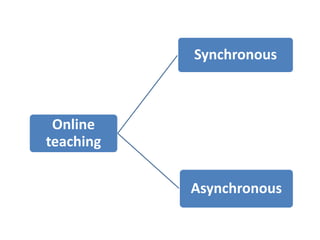
Online
teaching
Synchronous
Asynchronous
Synchronous
Live interaction
• Popular platforms- Zoom, google meet, MS team, Go
to webiner etc.
• Commonly used aid- PPT via share screen. Chalk-talk;
pen-paper also can be carried on
• Even small group activities can be carried on within
the class hour
Asynchronous
Educational broadcast
So, whatever be the TL Method.....the
“We want a living loving teacher.
Unless I can love my teacher, I cannot
like the subject.”
A student
Teaching learning methods & Interactive innovative teaching

Teaching learning methods & Interactive innovative teaching

  • 1.
    Teaching Learning Methods dr.hironmoy roy MD, MBA, DHM, ACME (2019), FAIMER (2015) Assoc. Prof. Anatomy, IPGME&R
  • 2.
  • 3.
    Classroom teaching 1. Lecture 2.Small Group discussion 3. Seminar/ Debate 4. Role play Lab based teaching 1. Practical lab 2. Skill lab (including Dissection) 3. Real objects & specimen 4. Model & simulators Bed side clinics 1. Ward round 2. Case based discussion 3. OPD based teaching E- teaching Distance learning Classification of Teaching-Learning Methods based on teaching environment
  • 4.
    Classification of Teaching-LearningMethods based on number of audiences Large group teaching Small group teaching Individualised learning
  • 5.
    TL Method Roleof teacher Role of student Mass-Instruction (Conventional lecture/ mass-practical- demonstration class/ video broadcast etc.) Traditional expository role. Controller of all aspects of Instruction process (style/ content/pace) Largely Passive. Practically they are totally dependent on what they are getting from the teacher. Little scope of interaction. Individualized learning. (Directed study of texts, study of open-learning materials/ CBL/ Individual assignments etc.) Producer/ manager of learning resource. Tutor & guide. Provides support, when required. Active. Responsible for own learning. Individual students control their own pace of learning & depth of study. In-Group learning. (Buzz sessions, group discussions, seminars, group-project, group- assignments, games, tutorials) Organizer of group activity. Facilitator of learning experience. (supportive role) Active. Responsible for own learning. Strongly dependent on one another’s preparation & interaction.
  • 7.
    Section 1. Large groupTeaching- offline mode
  • 9.
    A careful presentationof organized thoughts & ideas By a qualified person Serves as good means of introducing a subject Covers a large group of learners 9 Disadvantages Learners passive Not possible to check learners’ learning
  • 11.
    “A process bywhich the notes of a teacher become the notes of a student without passing through the minds of either. ” O’Donnel 1997
  • 12.
    Uninterrupted delivery of apparentlyirrelevant material in a sleep inducing monotone over one hour.
  • 13.
    Lecturodynia Heightened emotion • Anxiety •Annoyance • Anger Suppressed emotion • Apathy • Frustration • Somnolence
  • 14.
    Can we makeinteractive lecture? How you practice?
  • 15.
  • 16.
  • 17.
    What else canbe done?
  • 19.
  • 20.
  • 21.
  • 22.
    Exit ticket Enlist threeinteractive methods of teaching you learned in today’s lecture Enlist two “teaching learning methods” about which you want to know more Ask “One” question what makes your maximum doubt
  • 23.
  • 24.
  • 25.
  • 26.
  • 27.
  • 28.
  • 29.
    A series ofprepared speeches given by 2-5 experts on various aspects of a problem under a chairman. Talk short & to the point (10-25 minutes) Audience-passive No discussion between speakers 29
  • 31.
    Panel discussion A groupof 4 or more persons Under a moderator (have specific knowledge on the topic) Sits at a table in front of audience Holds an orderly & logical conversation on an assigned topic Each member makes a short statement (5 mins), before exchanging ideas 31
  • 34.
    Symposium Panel discussion Bothof the cases subject-experts meet on table They makes their statements There is NO exchange of ideas Moderator sums up There are exchange of ideas under a moderator and finally a conclusion arrives Audience is Mute Speakers have long speech (20-25 minutes) Short speech (max 5 minutes)
  • 36.
    Section 2. Small groupTeaching- offline mode
  • 37.
  • 38.
    • An activityin which a group of persons engaged in research or advanced study of a subject meet under general direction of an expert for a discussion leading to an in depth study of a problem/subject • No audience usually 38
  • 40.
    Small group (5-20) Face to face mutual interchange of ideas More than random unstructured conversation Has a method and structure But can be informal & democratic A problem to be solved/ a decision to be made 40 Group Discussion
  • 41.
    Seminar Group Discussion Bothof the cases learners/ researchers meet on round table for face to face interaction They carry on discussion Participants seek clarification from the experts Participants finds out clarification from resources available No audience One expert is present, directs, conducts the activities in structured way. Unstructured informal discussion usually themed to solve a problem
  • 42.
    Workshop Divided into small groups Individualswork within the group under a chairman and recorder Finally some plan comes out in solving a particular problem 42
  • 43.
  • 47.
    Case Based Learning(CBL) A case is presented/ established The case is analysed by the group Brainstorming in the group Formulating learning objective Self directed learning & dissemination of new findings in the group Group share results Identify the areas to integrate in clinical practice
  • 48.
  • 50.
    “Anatomy of thestomach” How can we go through a Team-Based Learning?
  • 51.
    Phase 1 Pre-class roomAssignments Three days before the scheduled class the teacher asks the group to study “Anatomy of stomach” from their book
  • 52.
    Phase 2 Readiness 1. Studentsattends class with their ready- knowledge 2. The facilitator may assess their readiness to participate in GD (Readiness assessment- 20% of class time)
  • 53.
    Phase 3 Team-application Exercise 1.Team members start interaction 2. The facilitator only guides their interaction in right way- divides the broad topic in subheadings- Gross anatomy/ histology/ blood supply (Interaction 70% of class time) 3. Common queries are met up (10% of class time)
  • 55.
    Team A A1, A2,A3, Team B B1, B2, B3, Team C C1, C2, C3, Team A B1, C1, A3 Team B A1, C2, B3 Team C A2, B2, C3 Gross Anatomy of stomach Blood Supply of stomach Histology of stomach Gross anatomy of Stomach Blood Supply of stomach Histology of stomach Gross anatomy of Stomach Blood Supply of stomach Histology of stomach Gross anatomy of Stomach Blood Supply of stomach Histology of stomach
  • 56.
  • 58.
  • 59.
    • Divide participantsinto groups of 3 to 6 participants • Give the groups 3 to 8 minutes to consider a specific, limited problem or question • Walk around the room to answer doubts • Ask for answers from each group, or provide the answer to on an overhead/flip chart/board
  • 60.
  • 61.
  • 65.
  • 66.
  • 67.
    1. The studentsstand in two concentric circles facing each other. 2. Working with the partner they face, they take it in turns to share information and ideas or ask each other question. 3. At a signal from the teacher the outside circle moves a given number of places clockwise. 4. Students now report to the new partner and repeat the process. Doughnut round
  • 68.
  • 69.
    • A significantpractical unit of activity having educational value • Aimed at one or more definite goals of understanding • Involves investigation & solution of problems 69
  • 70.
    Programmed Learning • Instructionsutilizing a work book or mechanical or electronic device- Computer- assisted learning (CAL) • Help learner in attaining a specified level of performance • A method of self learning 70
  • 71.
  • 75.
  • 76.
    Video Demonstration &reflection 76
  • 77.
  • 80.
  • 81.
  • 82.
    The “master isthe model”, who directs, demonstrates, comments, inspires & The “apprentice is the disciple”, who, listens, watches, imitates, does and seeks approval Copyright@Hironmoy Roy
  • 83.
  • 84.
    Instructor does &describes Instructor does, while the student describes The student does & describes (under supervision) ; receives feedback The student practice his own The student does his own Copyright@Hironmoy Roy
  • 85.
  • 86.
  • 87.
  • 89.
  • 90.
    Student examines a patient Student presents the caseto VP VP diagnose the case, examining his own VP probes the student for commitment, asks for supporting evidence VP reinforces what was right; corrects the mistakes of the student Copyright@Hironmoy Roy
  • 91.
  • 92.
    The 5-Step Micro-skillsMethod 1. Get a Commitment 2. Probe for Supporting Evidence 3. Reinforce What Was Done Well 4. Give Guidance About Errors or Omissions 5. Teach a General Principle Copyright@Hironmoy Roy
  • 93.
    S N AP P S
  • 95.
  • 96.
  • 97.
  • 98.
    Live interaction • Popularplatforms- Zoom, google meet, MS team, Go to webiner etc. • Commonly used aid- PPT via share screen. Chalk-talk; pen-paper also can be carried on • Even small group activities can be carried on within the class hour
  • 100.
  • 102.
  • 104.
    So, whatever bethe TL Method.....the
  • 110.
    “We want aliving loving teacher. Unless I can love my teacher, I cannot like the subject.” A student

Editor's Notes

  • #94 The “One Minute Preceptor” strategy is based on 5 steps that build on each other. [read them]