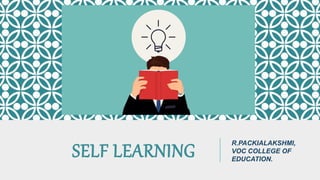
SELF LEARNING
R.PACKIALAKSHMI,
VOC COLLEGE OF
EDUCATION.
WHATISSELFLEARNING???
According to Malcom Knowles,
self-learning is defined as:
“A process by which individuals
take the initiative, without the assistance
of others, in diagnosing their learning
needs, formulating learning goals,
identifying human and material
resources for learning, and evaluating
learning outcomes”.
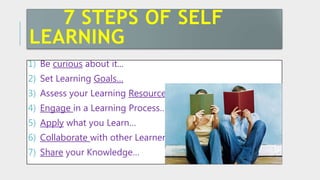
7 STEPS OF SELF
LEARNING
1) Be curious about it...
2) Set Learning Goals…
3) Assess your Learning Resources…
4) Engage in a Learning Process…
5) Apply what you Learn…
6) Collaborate with other Learners…
7) Share your Knowledge…
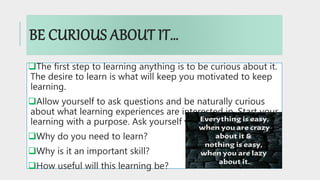
BE CURIOUS ABOUT IT…
The first step to learning anything is to be curious about it.
The desire to learn is what will keep you motivated to keep
learning.
Allow yourself to ask questions and be naturally curious
about what learning experiences are interested in. Start your
learning with a purpose. Ask yourself various questions:
Why do you need to learn?
Why is it an important skill?
How useful will this learning be?
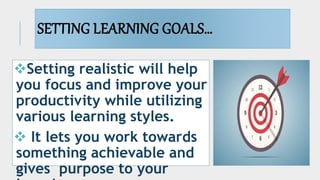
SETTING LEARNING GOALS…
Setting realistic will help
you focus and improve your
productivity while utilizing
various learning styles.
 It lets you work towards
something achievable and
gives purpose to your
ASSESS YOUR LEARNING RESOURCES…
This is an important step you need to
focus on. As self-learners, it is necessary to
verify the authenticity and correctness of
the materials you use to educate yourself.
You should also look into what is accessible
you to make your learning progress.
Unlike traditional classroom learning, self-
learning can be a sporadic process that
does not follow a set plan or syllabus.
ENGAGE IN LEARNING PROCESS…
The more you keep putting off your learning process,
more difficult it becomes for you to start learning.
Learning gaps will make you procrastinate. So try to
stick to a self-made process to your learning efforts.
Decide on how you want to assess your improvements.
It could be self-made quizzes, online tests, or anything
that lets you be assured of your progress. Just create an
effective feedback.
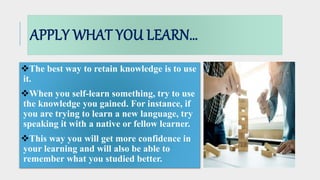
APPLY WHAT YOU LEARN…
The best way to retain knowledge is to use
it.
When you self-learn something, try to use
the knowledge you gained. For instance, if
you are trying to learn a new language, try
speaking it with a native or fellow learner.
This way you will get more confidence in
your learning and will also be able to
remember what you studied better.
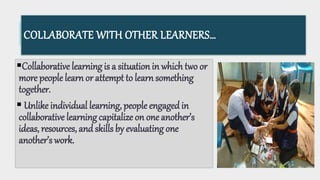
COLLABORATE WITH OTHER LEARNERS…
Collaborative learning is a situation in which two or
more people learn or attempt to learn something
together.
 Unlike individual learning, people engagedin
collaborative learning capitalize on one another’s
ideas, resources, andskills by evaluating one
another’s work.
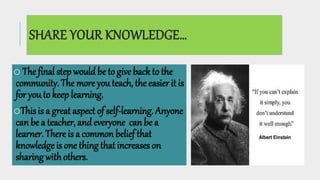
SHARE YOUR KNOWLEDGE…
o The final step wouldbe to give back to the
community. The more you teach, the easier it is
for you to keep learning.
oThis is a great aspect of self-learning. Anyone
can be a teacher, andeveryone can be a
learner. There is a common belief that
knowledge is one thing that increases on
sharing with others.
ADVANTAGES???
1) Self-learning helps you develop your problem solving skills.
2) Self-learning is stress free. There are no exams, no
deadlines. Only pure satisfaction and curiosity being
answered.
3) You gain secondary skills that will help you advance your
career.
4) You get to choose the way you learn. You can find your
comfortable medium, videos, texts, experiments, or
webinars, and other diverse mediums can be efficiently used
1) Unmotivated learners or those with poor study
habits may fall behind.
2) Students may feel isolated or free isolated or is
social interaction .
3) Without the routine structures of a traditional class,
students may get lost or confused about course
activities.
4) Lack of interaction between learners and instructor.
DISADVANTAGES???
SAY ME???...
WHAT IS THE THING YOU WOULD
LIKE TO LEARN USING THE SELF-
LEARNING METHOD???

Self Learning

  • 1.
  • 2.
    WHATISSELFLEARNING??? According to MalcomKnowles, self-learning is defined as: “A process by which individuals take the initiative, without the assistance of others, in diagnosing their learning needs, formulating learning goals, identifying human and material resources for learning, and evaluating learning outcomes”.
  • 3.
    7 STEPS OFSELF LEARNING 1) Be curious about it... 2) Set Learning Goals… 3) Assess your Learning Resources… 4) Engage in a Learning Process… 5) Apply what you Learn… 6) Collaborate with other Learners… 7) Share your Knowledge…
  • 4.
    BE CURIOUS ABOUTIT… The first step to learning anything is to be curious about it. The desire to learn is what will keep you motivated to keep learning. Allow yourself to ask questions and be naturally curious about what learning experiences are interested in. Start your learning with a purpose. Ask yourself various questions: Why do you need to learn? Why is it an important skill? How useful will this learning be?
  • 5.
    SETTING LEARNING GOALS… Settingrealistic will help you focus and improve your productivity while utilizing various learning styles.  It lets you work towards something achievable and gives purpose to your
  • 6.
    ASSESS YOUR LEARNINGRESOURCES… This is an important step you need to focus on. As self-learners, it is necessary to verify the authenticity and correctness of the materials you use to educate yourself. You should also look into what is accessible you to make your learning progress. Unlike traditional classroom learning, self- learning can be a sporadic process that does not follow a set plan or syllabus.
  • 7.
    ENGAGE IN LEARNINGPROCESS… The more you keep putting off your learning process, more difficult it becomes for you to start learning. Learning gaps will make you procrastinate. So try to stick to a self-made process to your learning efforts. Decide on how you want to assess your improvements. It could be self-made quizzes, online tests, or anything that lets you be assured of your progress. Just create an effective feedback.
  • 8.
    APPLY WHAT YOULEARN… The best way to retain knowledge is to use it. When you self-learn something, try to use the knowledge you gained. For instance, if you are trying to learn a new language, try speaking it with a native or fellow learner. This way you will get more confidence in your learning and will also be able to remember what you studied better.
  • 9.
    COLLABORATE WITH OTHERLEARNERS… Collaborative learning is a situation in which two or more people learn or attempt to learn something together.  Unlike individual learning, people engagedin collaborative learning capitalize on one another’s ideas, resources, andskills by evaluating one another’s work.
  • 10.
    SHARE YOUR KNOWLEDGE… oThe final step wouldbe to give back to the community. The more you teach, the easier it is for you to keep learning. oThis is a great aspect of self-learning. Anyone can be a teacher, andeveryone can be a learner. There is a common belief that knowledge is one thing that increases on sharing with others.
  • 11.
    ADVANTAGES??? 1) Self-learning helpsyou develop your problem solving skills. 2) Self-learning is stress free. There are no exams, no deadlines. Only pure satisfaction and curiosity being answered. 3) You gain secondary skills that will help you advance your career. 4) You get to choose the way you learn. You can find your comfortable medium, videos, texts, experiments, or webinars, and other diverse mediums can be efficiently used
  • 12.
    1) Unmotivated learnersor those with poor study habits may fall behind. 2) Students may feel isolated or free isolated or is social interaction . 3) Without the routine structures of a traditional class, students may get lost or confused about course activities. 4) Lack of interaction between learners and instructor. DISADVANTAGES???
  • 13.
    SAY ME???... WHAT ISTHE THING YOU WOULD LIKE TO LEARN USING THE SELF- LEARNING METHOD???