The document discusses bedside clinics in nursing education. It defines bedside clinic as a process where a clinical teacher and students examine a patient together to discuss diagnosis, management, and care. The purposes are to provide learning experiences for students to identify patient problems and plan appropriate nursing care. The method involves preparation, introduction, discussion, and evaluation phases. Conducting bedside clinics helps develop students' clinical skills while allowing them to prepare and apply knowledge, but it also risks disturbing patients' privacy.
SUBMITTED TO :MRS. LEHALI BALA PRESENTED BY: ANUPRIYA KUMARI
CLINICAL TUTOR TANUSHREE DAS
COLLEGE OF NURSING , RIMS 2ND YEAR BASIC B. SC. NURSING
NURSING
COLLEGE OF NURSING, RIMS
2.
CONTENT
OBJECTIVES
INTRODUCTION
DEFINITION
PURPOSE
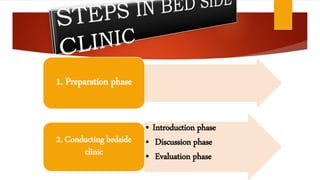
METHODS OF CONDUCTING BED SIDE CLINIC
POINTS TO REMEMBER WHILE CONDUCTING BEDSIDE CLINIC
ADVANTAGES
DISADVANTAGES
RESOURCES USED
BIBILIOGRAPHY
3.
OBJECTIVES
1. Define andstate the meaning of BED SIDE CLINIC.
2. Explain the purpose of BED SIDE CLINIC.
3. Discuss the method of conducting BED SIDE CLINIC.
4. Enumerate the advantages and disadvantages of BED SIDE
CLINIC.
5. Develop communication skills.
5.
DEFINITION
Bedside clinicis process in which a clinical
teacher and a group of learners sees a patients
,elicits or verifies physical signs ,discussion the
provisional diagnosis , diagnostic or therapeutic
options in the clinical settings.
-
GABERSON
6.
PURPOSE
To providea learning experience to identify the problems of patients .
To collect information about patient .
To improve quality nursing care .
To plan nursing care according to the priority needs of each patients .
To increase the ability to solve nursing problems by detailed study and analysis .
To increase ability to make an organized and systematic observation of the patient .
To understand certain types of apparatus used for particular patient care .
To apply knowledge and experience to real-life situations .
Preparation phase
Selectthe patient whose condition and the problems should to be discussed .
Explain and take written consent from the patient and relatives.
Inform students about the details of patient and date and time of bed side clinic.
Explain the purposes of bed side clinic and specific observations to be made to
students before visiting the patients .
Limit the size of the group to 8-10 students .
Plan the session for about 30 min.
9.
INTRODUCTION
PHASE
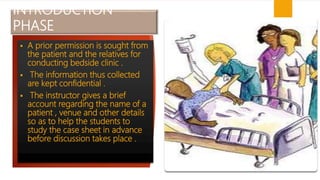
A priorpermission is sought from
the patient and the relatives for
conducting bedside clinic .
The information thus collected
are kept confidential .
The instructor gives a brief
account regarding the name of a
patient , venue and other details
so as to help the students to
study the case sheet in advance
before discussion takes place .
10.
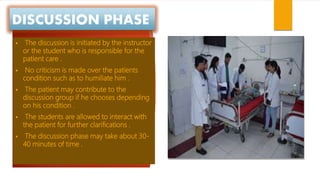
DISCUSSION PHASE
Thediscussion is initiated by the instructor
or the student who is responsible for the
patient care .
No criticism is made over the patients
condition such as to humiliate him .
The patient may contribute to the
discussion group if he chooses depending
on his condition .
The students are allowed to interact with
the patient for further clarifications .
The discussion phase may take about 30-
40 minutes of time .
11.
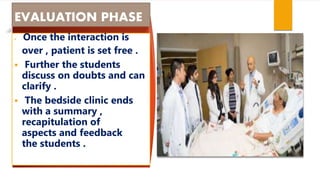
EVALUATION PHASE
Oncethe interaction is
over , patient is set free .
Further the students
discuss on doubts and can
clarify .
The bedside clinic ends
with a summary ,
recapitulation of
aspects and feedback
the students .
12.
POINTS TO REMEMBERWHILE
ORGANISING BED SIDE CLINIC
ESTABILISHMENT OF THE RULES OF CONDUCT: Students should be instructed not to whisper in patient’s room. No calls
should made or attended at the bed side. It is not appropriate to laugh at patients or patients response. Behavior of the
learner should be proper and respectful.
MAKE A PROPER INTRODUCTORY INTERACTION BETWEEN THE PATIENT AND THE LEARNER: It helps to develop IPR
and relieves the anxiety of the patient. Patient develop confidence on learner and learner also feels comfortable with
performing procedure.
ENSURE SUITABLE SETTING FOR LEARNING: Maintain privacy for patients, arrangement of an attended who will wait in
the waiting area . Request patient to stop the activities like reading newspaper , television .
DEMONSTRATE APPROPRIATE COMMUNICTION TECHNIQUE: use appropriate techniques at the time of bedside clinic
and also explain patients that what will going to be done at the bedside .
AVOID SHOP TALKING: Be well prepared , remain focused to the topic and avoid any kind of talk out of reference .
Find out from team portion of the physical examination if there is any difficulty then discus and demonstrate proper
techniques.
As the bedside presentation closes leave the patient with an over view of his or her disease process. Always give patient to
opportunity to ask question.
13.
ADVANTAGES
Bedside clinicallows the students to prepare extensively in advance to participate effectively in
patient care .
It helps the students to develop autonomy .
It allows students to select patients with disease conditions of common interest .
Bedside clinic allows the students to develop and maintain professional competence .
It promotes a better understanding among the students in the terms of health , illness and health care
system .
Bedside clinic promotes clinical competencies like reasoning , psychomotor and communication skills
among students .
It develops the ability of the students to evaluate critically and improve own performance .
14.
DISADVANTAGES
Bedside clinicsmay be an encumbrance to the patients .
It’s narrowness limits the utilization of the process .
Bedside clinic is an expensive procedure .
It may disturb the privacy of the patient .
Results in poor standardization .
It is not suitable clinical teaching method for the large group of students .
Sometimes bedside nursing clinic may disrupt the routine care of patient or vice
versa .
Bedside teaching-learning environment may not be always conducive for students ,
teachers , patients and neighbouring patients and health care workers of particular
ward .