PREPARED BY:SAVITA S H
FETAL DEVELOPMENT
OBJECTIVES
 To discuss the periods of development.
 To elaborate sequential development of fetus.
PERIODS OF FETAL DEVELOPMENT
The fetal development is divided into 3 periods:
 Ovular Period- Begins from fertilization and lasts
upto 2 weeks.
 Embryonic Period- Starts from 3rd
week following
fertilization and lasts upto end of 7th
week.
 Fetal Period- Begins from 8th
week following
fertilization until birth.
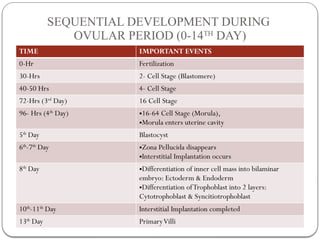
SEQUENTIAL DEVELOPMENT DURING
OVULAR PERIOD (0-14TH
DAY)
TIME IMPORTANT EVENTS
0-Hr Fertilization
30-Hrs 2- Cell Stage (Blastomere)
40-50 Hrs 4- Cell Stage
72-Hrs (3rd
Day) 16 Cell Stage
96- Hrs (4th
Day) •16-64 Cell Stage (Morula),
•Morula enters uterine cavity
5th
Day Blastocyst
6th
-7th
Day •Zona Pellucida disappears
•Interstitial Implantation occurs
8th
Day •Differentiation of inner cell mass into bilaminar
embryo: Ectoderm & Endoderm
•Differentiation ofTrophoblast into 2 layers:
Cytotrophoblast & Syncitiotrophoblast
10th
-11th
Day Interstitial Implantation completed
13th
Day PrimaryVilli
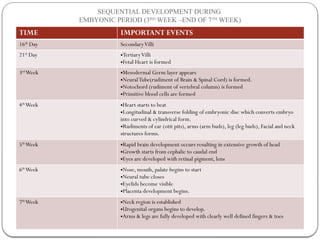
SEQUENTIAL DEVELOPMENT DURING
EMBYONIC PERIOD (3RD
WEEK –END OF 7TH
WEEK)
TIME IMPORTANT EVENTS
16th
Day SecondaryVilli
21st
Day •TertiaryVilli
•Fetal Heart is formed
3rd
Week •Mesodermal Germ layer appears
•NeuralTube(rudiment of Brain & Spinal Cord) is formed.
•Notochord (rudiment of vertebral column) is formed
•Primitive blood cells are formed
4th
Week •Heart starts to beat
•Longitudinal & transverse folding of embryonic disc which converts embryo
into curved & cylindrical form.
•Rudiments of ear (otit pits), arms (arm buds), leg (leg buds), Facial and neck
structures forms.
5th
Week •Rapid brain development occurs resulting in extensive growth of head
•Growth starts from cephalic to caudal end
•Eyes are developed with retinal pigment, lens
6th
Week •Nose, mouth, palate begins to start
•Neural tube closes
•Eyelids become visible
•Placenta development begins.
7th
Week •Neck region is established
•Urogenital organs begins to develop.
•Arms & legs are fully developed with clearly well defined fingers & toes
SEQUENTIAL DEVELOPMENT DURING
FETAL PERIOD (8TH
WEEK –UNTIL BIRTH)
TIME IMPORTANT EVENTS
8th
Week •All essential structures have developed
•Embryo has distinct human characteristics and hence marks the beginning of
fetal period
•Fetus is 3 cm in length.
9th
Week- 12th
Week
(3rd
Month)
•Intestine are fully developed
•External genitalia have male & female characteristics but not fully dev eloped.
•Anus is formed
•Fetus can swallow, urinate, move specific parts of limbs
•Open and shut mouth
•Eyelids are fused
•Fetal heart rate can be detected by doppler
•Placenta development is completed by 12th
weeks
•Fetal circulation is functioning
•Length-6 to 8 cm
•Weight- 15-30 gms
13th
Week- 16th
Week
(4th
Month)
•Body growth accelerates
•Sex is clearly distinguishable by 14th
week
•Rapid skeletal development
•Lanugo hair appears on head
•Stronger fetal movement felt by mother at the end of 16th
week. (Quickening)
•Meconium in gut
•CRL-11.5 cm
•Weight- 99 to 113 gms contd………..
SEQUENTIAL DEVELOPMENT DURING
FETAL PERIOD (8TH
WEEK –UNTIL BIRTH)
TIME IMPORTANT EVENTS
17th
Week- 20th
Week
(5th
Month)
•Visible & frequent fetal movement
•Quickening may experienced by mother around 18th
week (if not felt earlier)
•Vernix caeseosa covers body
•Lanugo covers body especially on back
•FHS heard on auscultation
•Skin wrinkled due to less fat
•CRL- 13 to 14 cm
•FL- 19 cm
•Weight- 435 to 465 gms
21st
Week- 24th
Week
(6th
Month)
•Hair growth is prominent & fetus is covered with lanugo
•Skin red and wrinkled with little subcutaneous fat
•Eyebrows & eyelids are formed
•Periods of sleep & activity
•Responds to sound (startle reflex)
•Most organs are capable of functioning
•CRL- 20 cm
•FL- 26 cm
•Weight- 780- 820 gms
25th
Week- 28th
Week
(7th
Month)
•Eyelids reopen
•Respiratory movements seen
•Lungs are developed enough to provide sufficient gas exchange
•Suckling reflex is stronger
•Body becomes proportioned
•Survival is possible if born with life support system
•CRL-22.5 cm
•FL- 30 cm
•Weight- 1200 to 1250 gms contd………..
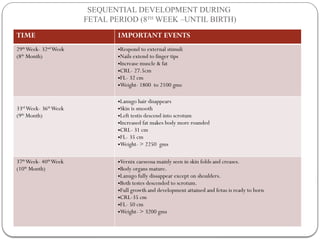
SEQUENTIAL DEVELOPMENT DURING
FETAL PERIOD (8TH
WEEK –UNTIL BIRTH)
TIME IMPORTANT EVENTS
29th
Week- 32nd
Week
(8th
Month)
•Respond to external stimuli
•Nails extend to finger tips
•Increase muscle & fat
•CRL- 27.5cm
•FL- 32 cm
•Weight- 1800 to 2100 gms
33rd
Week- 36th
Week
(9th
Month)
•Lanugo hair disappears
•Skin is smooth
•Left testis descend into scrotum
•Increased fat makes body more rounded
•CRL- 31 cm
•FL- 35 cm
•Weight- > 2250 gms
37th
Week- 40th
Week
(10th
Month)
•Vernix caeseosa mainly seen in skin folds and creases.
•Body organs mature.
•Lanugo fully dissappear except on shoulders.
•Both testes descended to scrotum.
•Full growth and development attained and fetus is ready to born
•CRL-35 cm
•FL- 50 cm
•Weight- > 3200 gms
 https://youtu.be/y4HK5CTVkXM?feature=shared
SUMMARY
 Fetal development has 3 periods – Ovular, Embryonic and fetal.
 Blastocyst penetrates into the compact layer of endometrium called as
implantation.This is the final stage which confirms conception.
 Blastocyst differentiates into inner cell mass and trophoblast. Fetus, amnion and
umbilical cord develops from inner cell mass. Placenta and chorion develops from
trophoblast.
 Placenta is an essential structure which provides nourishment to fetus and connects
mother with fetus. Placental development begins at 6th
week and completed by 12th
week.
 During ovular and embryonic periods, the development of all essential organs of
fetus occurs. It is a crucial period of pregnant woman.
 Embyro has human characteristics at 8th
week which marks the beginning of fetal
period.
 During fetal period the growth and development occurs.
 Growth of fetus accelerates at 4th
month.
 At 10th
month fetus is ready to born.
REFERENCES
 Dutta D.C,Textbook of Obstetrics, Jaypee Brothers
Publishers, 8th
Edition, Pg. No. 23- 31
 Jacob Annama,A ComprehensiveTextbook of Midwifery,
Jaypee Brothers Publishers, 2nd
Edition, Pg. No. 71- 87
ASSIGNMENT
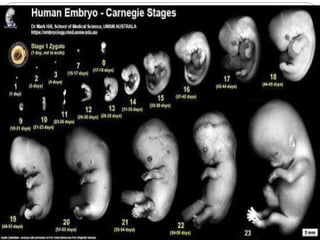
 Draw the schematic diagram of embryonic and fetal
development in class notebook.
 Draw or download colored diagrams as per sequential
development during embryonic and fetal development.
EVALUATION
 Answer following questions:
i. When does fetal period starts?
ii. Which month the body growth accelerates?
iii. The fetal movements felt by mother for the first time is called as _________.
iv. Define lanugo and vernix caeseosa?
v. Placenta development begins at _________ week and completed at __________week.
vi. Survival is possible at ___________ month if born earlier.
vii. Lanugo disappears at _________ month.
viii. When does zona pellucida disappears?
ix. Name the rudiment of brain & spinal cord.
x. Trophoblast differentiate into ______________ & ______________.
xi. Bilaminar gem disc are _______________ & ______________.
xii. Deeper penetration of blastocyst into compact layer of endometrium is called as
____________
xiii. The stage in which cells appears a cluster of ball resembling a mulberry is
______________
xiv. Name the rudiment of vertebral column.
xv. At what week the embryo has distinct human characteristics.
ANSWER KEY
Answer following questions:
i. When does fetal period starts?
Ans: 8th
week until birth
ii. Which month the body growth accelerates?
Ans: 4th
month
iii. The fetal movements felt by mother for the first time is called as Quickening
iv. Define lanugo and vernix caeseosa?
Ans: Lanugo is the first hair in fetus & fine & soft which covers the body and limbs of fetus.
Vernix caeseosa is a waxy, sticky substance coating on skin of fetus and newborn baby whci act as
thermal insulator.
v. Placenta development begins at 6th
week and completed at 12th
week.
vi. Survival is possible at 7th
month if born earlier.
vii. Lanugo disappears at 9th
month.
viii. When does zona pellucida disappears?
Ans: 6th
- 7th
Day
ix. Name the rudiment of brain & spinal cord.
Ans: Neural tube
x. Trophoblast differentiate into cytotrophoblast & syncitiotrophoblast.
xi. Bilaminar gem disc are ectoderm & endoderm.
xii. Deeper penetration of blastocyst into compact layer of endometrium is called as interstitial implantation
xiii. The stage in which cells appears a cluster of ball resembling a mulberry is morula.
xiv. Name the rudiment of vertebral column.
Ans: Notochord
xv. At what week the embryo has distinct human characteristics.
Ans: 8th
week
FETAL DEVLOPMENT.pptx pppppppppppppppppp

FETAL DEVLOPMENT.pptx pppppppppppppppppp

  • 1.
    PREPARED BY:SAVITA SH FETAL DEVELOPMENT
  • 2.
    OBJECTIVES  To discussthe periods of development.  To elaborate sequential development of fetus.
  • 3.
    PERIODS OF FETALDEVELOPMENT The fetal development is divided into 3 periods:  Ovular Period- Begins from fertilization and lasts upto 2 weeks.  Embryonic Period- Starts from 3rd week following fertilization and lasts upto end of 7th week.  Fetal Period- Begins from 8th week following fertilization until birth.
  • 4.
    SEQUENTIAL DEVELOPMENT DURING OVULARPERIOD (0-14TH DAY) TIME IMPORTANT EVENTS 0-Hr Fertilization 30-Hrs 2- Cell Stage (Blastomere) 40-50 Hrs 4- Cell Stage 72-Hrs (3rd Day) 16 Cell Stage 96- Hrs (4th Day) •16-64 Cell Stage (Morula), •Morula enters uterine cavity 5th Day Blastocyst 6th -7th Day •Zona Pellucida disappears •Interstitial Implantation occurs 8th Day •Differentiation of inner cell mass into bilaminar embryo: Ectoderm & Endoderm •Differentiation ofTrophoblast into 2 layers: Cytotrophoblast & Syncitiotrophoblast 10th -11th Day Interstitial Implantation completed 13th Day PrimaryVilli
  • 7.
    SEQUENTIAL DEVELOPMENT DURING EMBYONICPERIOD (3RD WEEK –END OF 7TH WEEK) TIME IMPORTANT EVENTS 16th Day SecondaryVilli 21st Day •TertiaryVilli •Fetal Heart is formed 3rd Week •Mesodermal Germ layer appears •NeuralTube(rudiment of Brain & Spinal Cord) is formed. •Notochord (rudiment of vertebral column) is formed •Primitive blood cells are formed 4th Week •Heart starts to beat •Longitudinal & transverse folding of embryonic disc which converts embryo into curved & cylindrical form. •Rudiments of ear (otit pits), arms (arm buds), leg (leg buds), Facial and neck structures forms. 5th Week •Rapid brain development occurs resulting in extensive growth of head •Growth starts from cephalic to caudal end •Eyes are developed with retinal pigment, lens 6th Week •Nose, mouth, palate begins to start •Neural tube closes •Eyelids become visible •Placenta development begins. 7th Week •Neck region is established •Urogenital organs begins to develop. •Arms & legs are fully developed with clearly well defined fingers & toes
  • 8.
    SEQUENTIAL DEVELOPMENT DURING FETALPERIOD (8TH WEEK –UNTIL BIRTH) TIME IMPORTANT EVENTS 8th Week •All essential structures have developed •Embryo has distinct human characteristics and hence marks the beginning of fetal period •Fetus is 3 cm in length. 9th Week- 12th Week (3rd Month) •Intestine are fully developed •External genitalia have male & female characteristics but not fully dev eloped. •Anus is formed •Fetus can swallow, urinate, move specific parts of limbs •Open and shut mouth •Eyelids are fused •Fetal heart rate can be detected by doppler •Placenta development is completed by 12th weeks •Fetal circulation is functioning •Length-6 to 8 cm •Weight- 15-30 gms 13th Week- 16th Week (4th Month) •Body growth accelerates •Sex is clearly distinguishable by 14th week •Rapid skeletal development •Lanugo hair appears on head •Stronger fetal movement felt by mother at the end of 16th week. (Quickening) •Meconium in gut •CRL-11.5 cm •Weight- 99 to 113 gms contd………..
  • 10.
    SEQUENTIAL DEVELOPMENT DURING FETALPERIOD (8TH WEEK –UNTIL BIRTH) TIME IMPORTANT EVENTS 17th Week- 20th Week (5th Month) •Visible & frequent fetal movement •Quickening may experienced by mother around 18th week (if not felt earlier) •Vernix caeseosa covers body •Lanugo covers body especially on back •FHS heard on auscultation •Skin wrinkled due to less fat •CRL- 13 to 14 cm •FL- 19 cm •Weight- 435 to 465 gms 21st Week- 24th Week (6th Month) •Hair growth is prominent & fetus is covered with lanugo •Skin red and wrinkled with little subcutaneous fat •Eyebrows & eyelids are formed •Periods of sleep & activity •Responds to sound (startle reflex) •Most organs are capable of functioning •CRL- 20 cm •FL- 26 cm •Weight- 780- 820 gms 25th Week- 28th Week (7th Month) •Eyelids reopen •Respiratory movements seen •Lungs are developed enough to provide sufficient gas exchange •Suckling reflex is stronger •Body becomes proportioned •Survival is possible if born with life support system •CRL-22.5 cm •FL- 30 cm •Weight- 1200 to 1250 gms contd………..
  • 11.
    SEQUENTIAL DEVELOPMENT DURING FETALPERIOD (8TH WEEK –UNTIL BIRTH) TIME IMPORTANT EVENTS 29th Week- 32nd Week (8th Month) •Respond to external stimuli •Nails extend to finger tips •Increase muscle & fat •CRL- 27.5cm •FL- 32 cm •Weight- 1800 to 2100 gms 33rd Week- 36th Week (9th Month) •Lanugo hair disappears •Skin is smooth •Left testis descend into scrotum •Increased fat makes body more rounded •CRL- 31 cm •FL- 35 cm •Weight- > 2250 gms 37th Week- 40th Week (10th Month) •Vernix caeseosa mainly seen in skin folds and creases. •Body organs mature. •Lanugo fully dissappear except on shoulders. •Both testes descended to scrotum. •Full growth and development attained and fetus is ready to born •CRL-35 cm •FL- 50 cm •Weight- > 3200 gms
  • 13.
  • 14.
    SUMMARY  Fetal developmenthas 3 periods – Ovular, Embryonic and fetal.  Blastocyst penetrates into the compact layer of endometrium called as implantation.This is the final stage which confirms conception.  Blastocyst differentiates into inner cell mass and trophoblast. Fetus, amnion and umbilical cord develops from inner cell mass. Placenta and chorion develops from trophoblast.  Placenta is an essential structure which provides nourishment to fetus and connects mother with fetus. Placental development begins at 6th week and completed by 12th week.  During ovular and embryonic periods, the development of all essential organs of fetus occurs. It is a crucial period of pregnant woman.  Embyro has human characteristics at 8th week which marks the beginning of fetal period.  During fetal period the growth and development occurs.  Growth of fetus accelerates at 4th month.  At 10th month fetus is ready to born.
  • 15.
    REFERENCES  Dutta D.C,Textbookof Obstetrics, Jaypee Brothers Publishers, 8th Edition, Pg. No. 23- 31  Jacob Annama,A ComprehensiveTextbook of Midwifery, Jaypee Brothers Publishers, 2nd Edition, Pg. No. 71- 87
  • 16.
    ASSIGNMENT  Draw theschematic diagram of embryonic and fetal development in class notebook.  Draw or download colored diagrams as per sequential development during embryonic and fetal development.
  • 17.
    EVALUATION  Answer followingquestions: i. When does fetal period starts? ii. Which month the body growth accelerates? iii. The fetal movements felt by mother for the first time is called as _________. iv. Define lanugo and vernix caeseosa? v. Placenta development begins at _________ week and completed at __________week. vi. Survival is possible at ___________ month if born earlier. vii. Lanugo disappears at _________ month. viii. When does zona pellucida disappears? ix. Name the rudiment of brain & spinal cord. x. Trophoblast differentiate into ______________ & ______________. xi. Bilaminar gem disc are _______________ & ______________. xii. Deeper penetration of blastocyst into compact layer of endometrium is called as ____________ xiii. The stage in which cells appears a cluster of ball resembling a mulberry is ______________ xiv. Name the rudiment of vertebral column. xv. At what week the embryo has distinct human characteristics.
  • 18.
    ANSWER KEY Answer followingquestions: i. When does fetal period starts? Ans: 8th week until birth ii. Which month the body growth accelerates? Ans: 4th month iii. The fetal movements felt by mother for the first time is called as Quickening iv. Define lanugo and vernix caeseosa? Ans: Lanugo is the first hair in fetus & fine & soft which covers the body and limbs of fetus. Vernix caeseosa is a waxy, sticky substance coating on skin of fetus and newborn baby whci act as thermal insulator. v. Placenta development begins at 6th week and completed at 12th week. vi. Survival is possible at 7th month if born earlier. vii. Lanugo disappears at 9th month. viii. When does zona pellucida disappears? Ans: 6th - 7th Day ix. Name the rudiment of brain & spinal cord. Ans: Neural tube x. Trophoblast differentiate into cytotrophoblast & syncitiotrophoblast. xi. Bilaminar gem disc are ectoderm & endoderm. xii. Deeper penetration of blastocyst into compact layer of endometrium is called as interstitial implantation xiii. The stage in which cells appears a cluster of ball resembling a mulberry is morula. xiv. Name the rudiment of vertebral column. Ans: Notochord xv. At what week the embryo has distinct human characteristics. Ans: 8th week