


















MICRO TEACHING & SELF DIRECTED LEARNING
MATHEW VARGHESE V
MSN(RAK),FHNP (CMC Vellore),CPEPC
Nursing officer
AIIMS Delhi
WELCOME
KINDLY SWITCH OFF YOUR MOBILE PHONES
OR
KEEP IT ON SILENT MODE
MICRO TEACHING
Introduction
• It is a training procedure aimed at simplifying the
complexities of a regular teaching process.
• The complex act of teaching is broken down on to
simple components .
• Only one particular skill is attempted and developed
during microteaching session.
• The teaching act is scaled down in terms of the content
of the lesson, duration of the lesson and the strength
of the class.
Definition
According to Allen (1966)
• Microteaching defined as a scale down teaching
encounter in class size, and class time .
• The number of students is from 5-10 and the
duration of period ranges from 5-20 minutes.
Objectives
 To enable teacher trainee to learn and
assimilate new teaching skills under
controlled conditions.
 To enable the teacher trainee to gain
confidence in teaching
 To master a number of teaching skills on a
small group of students
Objectives
To utilize academic potentials of teacher
trainee for providing much needed
feedback.
To gain maximum advantage with little time,
money and material.
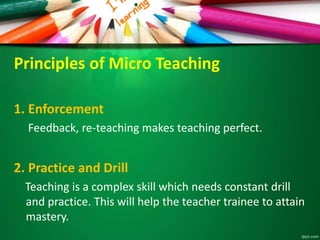
Principles of Micro Teaching
1. Enforcement
Feedback, re-teaching makes teaching perfect.
2. Practice and Drill
Teaching is a complex skill which needs constant drill
and practice. This will help the teacher trainee to attain
mastery.
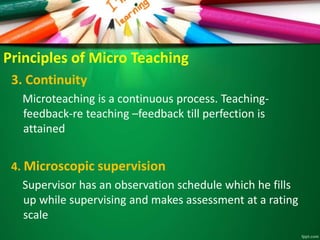
Principles of Micro Teaching
3. Continuity
Microteaching is a continuous process. Teaching-
feedback-re teaching –feedback till perfection is
attained
4. Microscopic supervision
Supervisor has an observation schedule which he fills
up while supervising and makes assessment at a rating
scale
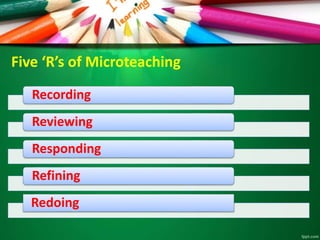
Five ‘R’s of Microteaching
Recording
Reviewing
Responding
Refining
Redoing
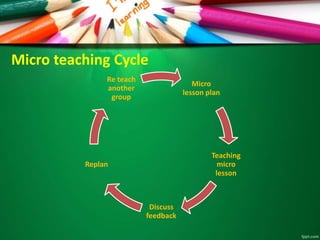
Micro teaching Cycle
Micro
lesson plan
Teaching
micro
lesson
Discuss
feedback
Replan
Re teach
another
group
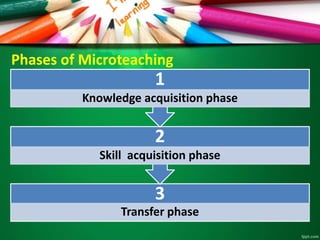
Phases of Microteaching
3
Transfer phase
2
Skill acquisition phase
1
Knowledge acquisition phase
• In this phase student teacher attempts to acquire
knowledge about the skill, its rationale, its role in class
room and its component behavior. For this he should
read relevant literature.
• He also observes demonstration lesson.
• In this phase student teacher gets theoretical as well as
practical knowledge of skill
1. Knowledge acquisition phase
• In this phase student teacher prepare the micro
lesson and practices the skill and carries out the
micro teaching cycle
2.Skill acquisition phase
• Here the student teacher integrates different skill. In
place of scale down situation, he teaches in the real
class room and tries to integrate all the skills.
3.Transfer phase
Merits of microteaching
• Microteaching help student teachers to acquire
teaching skills by providing a real situation for
practicing skills
• Since microteaching focuses on a particular skill at a
time ,student teachers can attain proficiency in
teaching skills in a phased manner
Merits of microteaching
• Provision of immediate feedback makes
microteaching more interesting and reliable
• As gadgets like video camera and tape recorders are
used extensively in microteaching, it exemplifies the
effective use of technology in the field of education
Demerits of microteaching
Microteaching is time consuming
Real life situations are quite different
Scope is narrow
Limited to lecturing
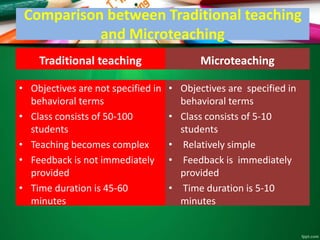
Comparison between Traditional teaching
and Microteaching
Traditional teaching
• Objectives are not specified in
behavioral terms
• Class consists of 50-100
students
• Teaching becomes complex
• Feedback is not immediately
provided
• Time duration is 45-60
minutes
Microteaching
• Objectives are specified in
behavioral terms
• Class consists of 5-10
students
• Relatively simple
• Feedback is immediately
provided
• Time duration is 5-10
minutes
SELF DIRECTED LEARNING
Introduction
• Self-directed learning (SDL) is also called as Self
Instructional Module.
• It is a type of adult learning method. Here the learner
learns himself or herself without the help of a teacher.
It is a kind of self-learning where there is focus on self-
development and self-education.
Definition
• It is a process in which students take initiative to
diagnose their learning needs, formulate learning goals
and identify and utilize learning resources for learning.
• It is adult learning concept with behavioral objectives
with or without pretest, learning activities, self-
evaluation tools, and posttest.
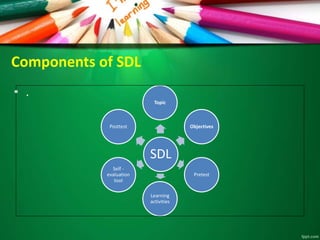
Components of SDL
• .
SDL
Topic
Objectives
Pretest
Learning
activities
Self -
evaluation
tool
Posttest
Learning resources
• Text books
• Information sheet
• Written lectures
• Pamphlets
• Audio visual materials
• Internet and e learning materials etc.
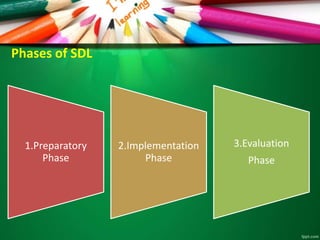
Phases of SDL
1.Preparatory
Phase
2.Implementation
Phase
3.Evaluation
Phase
Preparatory phase
• In this phase, there is collection, analysis and
interpretation of data.
• Collected resource material is arranged for the
development of self-instructional module.
Implementation phase
• Production, dissemination and utilization of the self-
learning module.
• The cost involved in the production of self-learning
module varies depending up on the availability of
resources and the quality of the material used.
Evaluation Phase
• It is done to check the effectiveness of the module. It is
done to find out how much improvement has been
there in terms of competencies of learner.
• Evaluation can be of input, process, and output.
• The input includes the resource material collected and
utilized.
• The process is the way the material was developed and
output is the type result or material generated.
Conclusion
• Self-directed learning is matured learning strategy. It
is an economical method in which learner can study
the material at home without disturbing his work. It
provides flexible environment to the learner. It is
one of most acceptable adult learning method
References
• Neeraja .K.P.Text book of Nursing Education.1st Ed.New
Delhi:Jaypee Brothers Medical Publishers Pvt Ltd;2003
• Aggrawal JC. Principles , Methods and Techniques of
Teaching.New Delhi:Vikas Publishing House Pvt Ltd;1996
• Sankaranarayanan B, Sindhu B.Learning and teaching
nursing.4th Ed.New Delhi: Jaypee Brothers Medical Publishers
Pvt Ltd;2012
• Gopichandran .L,Kanniammal .C.Essentials of Communication
and Technology.1st Ed.New Delhi:CBS Publishers and
Distributers Pvt Ltd;2017
Additional reading
Advantages and Disadvantages of Self-directed
learning
Teaching skills involved in Microteaching
Anything to add on..?
Acknowledgement
Madam Mrs. Sunita Patney
Assistant Professor
RAK College of Nursing
Lajpat Nagar
New Delhi
Microteaching & Self Directed Learning PPT

Microteaching & Self Directed Learning PPT

  • 1.
    MICRO TEACHING &SELF DIRECTED LEARNING MATHEW VARGHESE V MSN(RAK),FHNP (CMC Vellore),CPEPC Nursing officer AIIMS Delhi
  • 2.
    WELCOME KINDLY SWITCH OFFYOUR MOBILE PHONES OR KEEP IT ON SILENT MODE
  • 3.
  • 4.
    Introduction • It isa training procedure aimed at simplifying the complexities of a regular teaching process. • The complex act of teaching is broken down on to simple components . • Only one particular skill is attempted and developed during microteaching session. • The teaching act is scaled down in terms of the content of the lesson, duration of the lesson and the strength of the class.
  • 5.
    Definition According to Allen(1966) • Microteaching defined as a scale down teaching encounter in class size, and class time . • The number of students is from 5-10 and the duration of period ranges from 5-20 minutes.
  • 6.
    Objectives  To enableteacher trainee to learn and assimilate new teaching skills under controlled conditions.  To enable the teacher trainee to gain confidence in teaching  To master a number of teaching skills on a small group of students
  • 7.
    Objectives To utilize academicpotentials of teacher trainee for providing much needed feedback. To gain maximum advantage with little time, money and material.
  • 8.
    Principles of MicroTeaching 1. Enforcement Feedback, re-teaching makes teaching perfect. 2. Practice and Drill Teaching is a complex skill which needs constant drill and practice. This will help the teacher trainee to attain mastery.
  • 9.
    Principles of MicroTeaching 3. Continuity Microteaching is a continuous process. Teaching- feedback-re teaching –feedback till perfection is attained 4. Microscopic supervision Supervisor has an observation schedule which he fills up while supervising and makes assessment at a rating scale
  • 10.
    Five ‘R’s ofMicroteaching Recording Reviewing Responding Refining Redoing
  • 11.
    Micro teaching Cycle Micro lessonplan Teaching micro lesson Discuss feedback Replan Re teach another group
  • 12.
    Phases of Microteaching 3 Transferphase 2 Skill acquisition phase 1 Knowledge acquisition phase
  • 13.
    • In thisphase student teacher attempts to acquire knowledge about the skill, its rationale, its role in class room and its component behavior. For this he should read relevant literature. • He also observes demonstration lesson. • In this phase student teacher gets theoretical as well as practical knowledge of skill 1. Knowledge acquisition phase
  • 14.
    • In thisphase student teacher prepare the micro lesson and practices the skill and carries out the micro teaching cycle 2.Skill acquisition phase
  • 15.
    • Here thestudent teacher integrates different skill. In place of scale down situation, he teaches in the real class room and tries to integrate all the skills. 3.Transfer phase
  • 16.
    Merits of microteaching •Microteaching help student teachers to acquire teaching skills by providing a real situation for practicing skills • Since microteaching focuses on a particular skill at a time ,student teachers can attain proficiency in teaching skills in a phased manner
  • 17.
    Merits of microteaching •Provision of immediate feedback makes microteaching more interesting and reliable • As gadgets like video camera and tape recorders are used extensively in microteaching, it exemplifies the effective use of technology in the field of education
  • 18.
    Demerits of microteaching Microteachingis time consuming Real life situations are quite different Scope is narrow Limited to lecturing
  • 19.
    Comparison between Traditionalteaching and Microteaching Traditional teaching • Objectives are not specified in behavioral terms • Class consists of 50-100 students • Teaching becomes complex • Feedback is not immediately provided • Time duration is 45-60 minutes Microteaching • Objectives are specified in behavioral terms • Class consists of 5-10 students • Relatively simple • Feedback is immediately provided • Time duration is 5-10 minutes
  • 20.
  • 21.
    Introduction • Self-directed learning(SDL) is also called as Self Instructional Module. • It is a type of adult learning method. Here the learner learns himself or herself without the help of a teacher. It is a kind of self-learning where there is focus on self- development and self-education.
  • 22.
    Definition • It isa process in which students take initiative to diagnose their learning needs, formulate learning goals and identify and utilize learning resources for learning. • It is adult learning concept with behavioral objectives with or without pretest, learning activities, self- evaluation tools, and posttest.
  • 23.
    Components of SDL •. SDL Topic Objectives Pretest Learning activities Self - evaluation tool Posttest
  • 24.
    Learning resources • Textbooks • Information sheet • Written lectures • Pamphlets • Audio visual materials • Internet and e learning materials etc.
  • 25.
  • 26.
    Preparatory phase • Inthis phase, there is collection, analysis and interpretation of data. • Collected resource material is arranged for the development of self-instructional module.
  • 27.
    Implementation phase • Production,dissemination and utilization of the self- learning module. • The cost involved in the production of self-learning module varies depending up on the availability of resources and the quality of the material used.
  • 28.
    Evaluation Phase • Itis done to check the effectiveness of the module. It is done to find out how much improvement has been there in terms of competencies of learner. • Evaluation can be of input, process, and output. • The input includes the resource material collected and utilized. • The process is the way the material was developed and output is the type result or material generated.
  • 29.
    Conclusion • Self-directed learningis matured learning strategy. It is an economical method in which learner can study the material at home without disturbing his work. It provides flexible environment to the learner. It is one of most acceptable adult learning method
  • 30.
    References • Neeraja .K.P.Textbook of Nursing Education.1st Ed.New Delhi:Jaypee Brothers Medical Publishers Pvt Ltd;2003 • Aggrawal JC. Principles , Methods and Techniques of Teaching.New Delhi:Vikas Publishing House Pvt Ltd;1996 • Sankaranarayanan B, Sindhu B.Learning and teaching nursing.4th Ed.New Delhi: Jaypee Brothers Medical Publishers Pvt Ltd;2012 • Gopichandran .L,Kanniammal .C.Essentials of Communication and Technology.1st Ed.New Delhi:CBS Publishers and Distributers Pvt Ltd;2017
  • 31.
    Additional reading Advantages andDisadvantages of Self-directed learning Teaching skills involved in Microteaching
  • 32.
  • 33.
    Acknowledgement Madam Mrs. SunitaPatney Assistant Professor RAK College of Nursing Lajpat Nagar New Delhi