JSS MAHAVIDYAPEETA, MYSORE-04
JSS INSTITUTE OF EDUCATION, SAKALESHPURA-573134
SUBJECT: TECHNIQUES, METHODS AND APPROACHES OF
PEDOGOGY
TOPIC: Self instructional module
SUBMITTED BY
Sushmitha
U29YH23E0089
JSS institute of education
Sakaleshpura
SUBMITTED TO,
Dr.Prabhuswamy.M.
Asst. Professor
JSS Institute of Education sakalshpura
INTRODUCTION
A self-instructional module (SIM) is a set of materials that allows
students to learn at their own pace and independently to
achieve a specific set of learning outcomes. SIMs are designed
to be flexible and accessible, and to give students control over
their learning process.
MEANING AND DEFINITION
• A self-instructional module is a set of materials that
students can use independently to learn about a specific
topic at their own pace. Self-instructional modules can help
students achieve a predetermined set of learning outcomes.
• It defines self-instruction as self-contained instructional
activities that allow learners to progress independently at
their own pace. A module is a self-contained learning
package focused on a specific topic
SELF INSTRUCTIONAL MODUL
Self instruction modules
• Comes in a variety of forms including but not limited to workbooks, study
guides, work stations, videotapes, internet modules and computer programmes.
• They are specifically designed to be used independently. The teacher serves as
a facilitator, resource person to provide motivation and reinforcement for
learning.
• • This method requires less teacher time to ‘give’ information and each session
with the leaner is intended to meet individual needs.
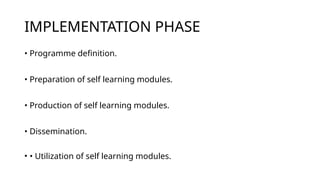
IMPLEMENTATION PHASE
• Programme definition.
• Preparation of self learning modules.
• Production of self learning modules.
• Dissemination.
• • Utilization of self learning modules.
PROCESS FOR THE DEVELOPMENT OF
SELF INSTRUCTIONAL MODULES
1. Preparatory phase.
2. Implementation phase.
Preparation.
Production.
- Dissemination.
- Assessment.
- Monitoring of activities.
• 3. Evaluation phase.
CONCLUSION
• Self-learning module, create an effective learning
environment for the learners to learn. These contain the
answers of all possible queries, confusions and questions
that may come in the time of learning. These also provide
immediate feedback on the performance of the students.
These also help to maintain high interest level and sufficient
motivation for the learners. These self-learning modules
have enriched features such as self-explanatory, self-
contained, self-directed, self-motivating and self-evaluating
which help to cater to the needs of all types of learners.
THANK YOU

TMAP- Self instructional module.Sushmitha.pptx

  • 1.
    JSS MAHAVIDYAPEETA, MYSORE-04 JSSINSTITUTE OF EDUCATION, SAKALESHPURA-573134 SUBJECT: TECHNIQUES, METHODS AND APPROACHES OF PEDOGOGY TOPIC: Self instructional module SUBMITTED BY Sushmitha U29YH23E0089 JSS institute of education Sakaleshpura SUBMITTED TO, Dr.Prabhuswamy.M. Asst. Professor JSS Institute of Education sakalshpura
  • 2.
    INTRODUCTION A self-instructional module(SIM) is a set of materials that allows students to learn at their own pace and independently to achieve a specific set of learning outcomes. SIMs are designed to be flexible and accessible, and to give students control over their learning process.
  • 3.
    MEANING AND DEFINITION •A self-instructional module is a set of materials that students can use independently to learn about a specific topic at their own pace. Self-instructional modules can help students achieve a predetermined set of learning outcomes. • It defines self-instruction as self-contained instructional activities that allow learners to progress independently at their own pace. A module is a self-contained learning package focused on a specific topic
  • 4.
    SELF INSTRUCTIONAL MODUL Selfinstruction modules • Comes in a variety of forms including but not limited to workbooks, study guides, work stations, videotapes, internet modules and computer programmes. • They are specifically designed to be used independently. The teacher serves as a facilitator, resource person to provide motivation and reinforcement for learning. • • This method requires less teacher time to ‘give’ information and each session with the leaner is intended to meet individual needs.
  • 5.
    IMPLEMENTATION PHASE • Programmedefinition. • Preparation of self learning modules. • Production of self learning modules. • Dissemination. • • Utilization of self learning modules.
  • 6.
    PROCESS FOR THEDEVELOPMENT OF SELF INSTRUCTIONAL MODULES 1. Preparatory phase. 2. Implementation phase. Preparation. Production. - Dissemination. - Assessment. - Monitoring of activities. • 3. Evaluation phase.
  • 7.
    CONCLUSION • Self-learning module,create an effective learning environment for the learners to learn. These contain the answers of all possible queries, confusions and questions that may come in the time of learning. These also provide immediate feedback on the performance of the students. These also help to maintain high interest level and sufficient motivation for the learners. These self-learning modules have enriched features such as self-explanatory, self- contained, self-directed, self-motivating and self-evaluating which help to cater to the needs of all types of learners.
  • 8.