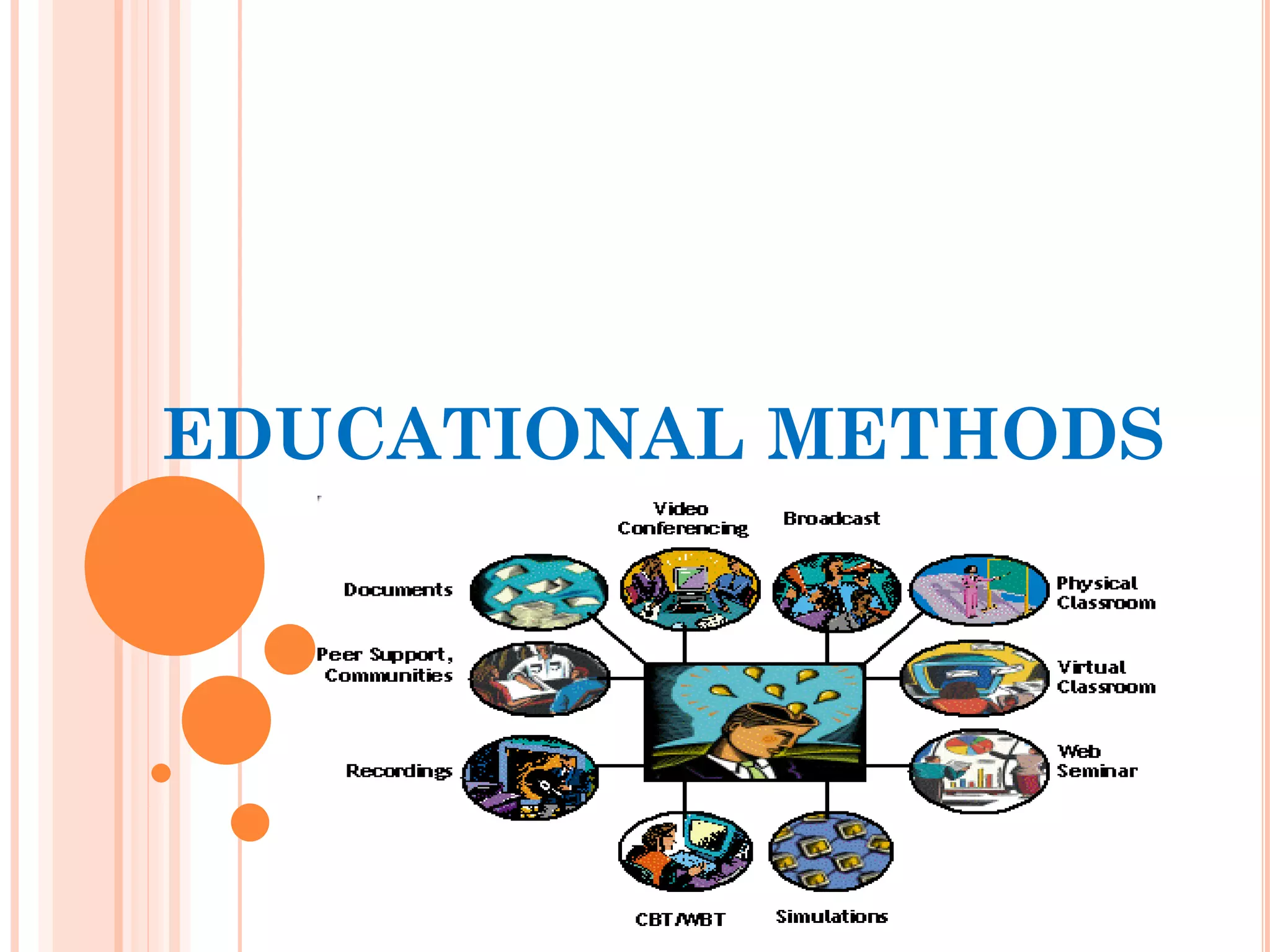
EDUCATIONAL METHODS
OBJECTIVES:
 By the end of this lecture all participants should
be able to :
1-understand the educational methods
2-types of educational methods
A-traditional methods :
-lecture (advantages and disadvantages)
-Group discussion (advantages and disadvantages)
-One- to-one (advantages and dis advantages)
B-Nontraditional methods:
-Gaming (advantages and disadvantages)
-Simulation (advantages and disadvantages )
-Role playing (advantages and disadvantages)
-Role modeling (advantages and disadvantages)
-self-education activity (advantages and
disadvantages)
3 -Selection of educational methods
4-Evaluation of educational methods
INTRODUCTION :
:
There is no one perfect method for teaching all
learners in all settings .Whatever the method chosen, it
will usually be most effective if used in conjunction with
other Instructional techniques and tools to optimize
learning. The importance of selecting appropriate
methods to meet the needs of learners.
DEFINITION:
Educational approach for turning knowledge into
learning .
Teaching method comprises the principles and
methods used by teacher to enable student learning .
How to deliver information
METHODS :
A) Traditional methods
1-Lecture :
Lecture can be defined as a highly structured
method by which the teacher verbally transmits
information directly to groups of learners for the
purpose of instruction.
It is one of the oldest and most often used
approaches to teaching.
The lecture format allows for only minimal exchange
between the teacher and the learner. (learner passsive)
The lecture is an ideal way to provide foundational
background information as basis for subsequent group
discussion.
Domain: Cognitive
ADVANTAGES :
1-An effective means for transmitting large amount of
information to a large number of people at the same
time.
2-An effective approach for cognitive learning,
3- Develop listening abilities .
4- Easily supplemented with handout materials and
other audiovisual aids to enhance learning.
DISADVANTAGES:
 Ineffective in influencing psychomotor behavior.
 Don't provide for much stimulation or participatory
involvement of learners.(passive)
 All learners are exposed to the same information
regardless of their needs.
 Don't account for individual differences ( cognitive
abilities and attention span).
 It place little emphasis on analytic thinking , decision
making, problem solving.
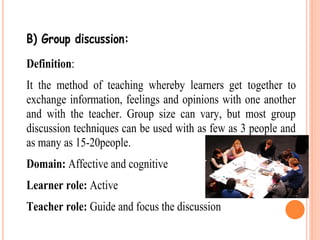
B) Group discussion:
Definition:
It the method of teaching whereby learners get together to
exchange information, feelings and opinions with one another
and with the teacher. Group size can vary, but most group
discussion techniques can be used with as few as 3 people and
as many as 15-20people.
Domain: Affective and cognitive
Learner role: Active
Teacher role: Guide and focus the discussion
Disadvantages:
1. Shy learners may refuse to become involved or may need a
great deal of encouragement to participate.
2. It is expensive and time consuming.
3. It is effective only in small groups.
4. It will be frustrated if one person or few people monopolized
the discussion.
5. It is only valuable if the participants come prepared with the
necessary background information.
3-ONE TO ONE EDUCATION :
 It is the method in which the teacher delivers the
individual education designed specifically for a
particular learner.
 This method should be a lecture delivered to an
audience of one based on learner’s needs.
 Domains: Cognitive, psychomotor and affective
 Learner role: Active( shred and immediate feedback)
 Teacher role: Presents information and facilitate
individualized learning.
ADVANTAGE
 The pace and content of teaching can be tailored to
meet individual need.
 Ideal as an intervention for initial assessment and
ongoing evaluation of the learner.
 Good for achieving all three domains of learning.
 Provide immediate feedback to be shared between the
teacher and the learner.
DISADVANTAGE :
 The learner is isolated from others who have similar
 Questioning and answering may be interpreted by the
learner ( one side) as a technique to test their
knowledge and skills
 Time consuming
4. DEMONSTRATION AND RE- DEMONSTRATION:
It is imperative to begin by making a clear distinction
between the methods of demonstration and return
demonstration.
Demonstration is a method by which the learner is
shown by the teacher how to perform a particular skill.
Return demonstration is the method by which the learner
attempts to perform the skill with cues from the teacher as
needed.
 Domains: Psychomotor
 Lerner role: Demonstration: Passive
Return demonstration: Active
 Teacher role:
Demonstration: Models skills or behavior
Return demonstration: Individualizes
feedback to refine performance.
ADVANTAGES:
1-Especially effective for learning in the psychomotor
domain through repeated movement and reinforcement
of practice.
2-Provide opportunity for over learning to achieve the
teaching goal and increase performance level.
3-Actively engages the learner through stimulations of
visual, auditory , tactile senses.
DISADVANTAGES:
1-Time consuming.
2-Equipment can be expensive to purchase
3-Extra equipment is needed for practicing certain
skills.
4- size of learners must kept small to ensure
opportunity for practice and close supervision.
:
B)NONTRADITIONAL METHODS
Gaming:
Is an instructional method requiring the learner to
participate in competitive activities with rules.
- These have reality but they are designed to
accomplish educational objectives.
- It is used by learner to apply knowledge and
rehearsing skills previously learned.
- It increase learner involvement and influence
affective behavior through social interaction and it is
effective for improving cognitive functioning also
enhance skills in psychomotor domain .
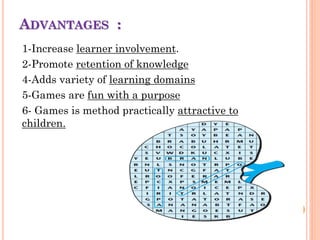
ADVANTAGES :
1-Increase learner involvement.
2-Promote retention of knowledge
4-Adds variety of learning domains
5-Games are fun with a purpose
6- Games is method practically attractive to
children.
DISADVANTAGES:
1-Creates a competitive environment that may be
threatening to some learners
2-Reqires more flexible space for teamwork than a
traditional classroom
3-Some learners may not be able to participate if they
are restricted by a disability
4-When people play games, winning (primary
consideration) is upper most in their minds, with
learning is a secondary consideration.
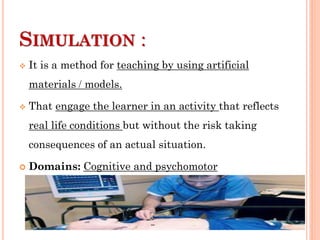
SIMULATION :
 It is a method for teaching by using artificial
materials / models.
 That engage the learner in an activity that reflects
real life conditions but without the risk taking
consequences of an actual situation.
 Domains: Cognitive and psychomotor
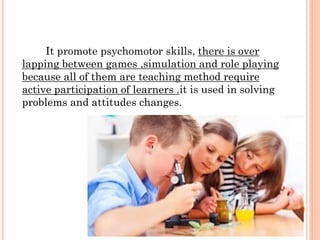
It promote psychomotor skills, there is over
lapping between games ,simulation and role playing
because all of them are teaching method require
active participation of learners .it is used in solving
problems and attitudes changes.
There are many types of simulation
including the following:
1-Written simulation:
use case studies about real situations / problem
ex; personnel communication problem of nursing staff on a
unit .
2-Clinical simulation:
A) Low fidelity: for example, exercise like practicing giving a
bed bath to a non-responsive doll.
B) Medium fidelity: for example, manikins that have heart
and lung sounds but no movements.
C) High fidelity: for example, new manikins like Sim Man
that are attached to a computer and produce vital signs and
physiological reactivity.
ADVANTAGES:
1-Excellent for psychomotor skills development
2-Enhances higher level problem –solving and
interactive abilities in the cognitive .
3-Provides for active learner involvement in a real life
situation .
4-guanerate safe ,non threating environment for
learning
Disadvantages:
1. Can be expensive
2. Not readily available to all learners yet
3. Time consuming
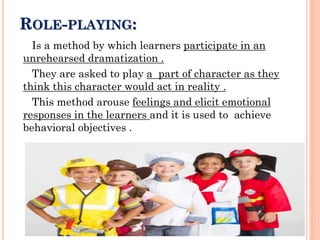
ROLE-PLAYING:
Is a method by which learners participate in an
unrehearsed dramatization .
They are asked to play a part of character as they
think this character would act in reality .
This method arouse feelings and elicit emotional
responses in the learners and it is used to achieve
behavioral objectives .
 Ex1 :
patient in diabetes self-management education
program will do need to Behaviors as selecting food from
restaurant's menu and setting their insulin pumps for
the correct bolus of insulin as these are self-management
skills
 Domain: Affective( behaviors), cognitive
ADVANTAGES:
1-Opportunity to explore feelings and attitudes .
2-Narrows the role distance between clients and
professionals( Patient plays the professionals 'roles)
3-Matching between understanding ,feelings and
practice
:
ISADVANTAGES
D
1-Limited to small group
2-some participants may be uncomfortable in their role
3-Tendency by some participants to overly exaggerate
their role .
4- It depend on learner imagination and willing to
participate
:
MODELING
OLE
R
The use of self as a role model is often over-looked as
an instructional method.
Learning from role model is called identification and
emanates from learning and developmental theories
such as Erickson of psychosocial stages of development
which explain how people acquire behaviors and social
role.
This method primarily achieves behavior change in
the affective domain
Advantages :
1- Influence attitudes to achieve behavior changes in
the affective domain.
2-Positive role models have the potential to instill
socially desired behaviors
Disadvantages :
1-Require rapport( build role models ideas and behavior
in learner) between the role model and the learner
2-Negative role models have the potential to instill un
acceptable behavior.
SELF-EDUCATIONAL ACTIVITIES:
Self -instruction is a method used by the teacher to
provide or design instructional activities that guide the
learner in independently achieving the objectives of
learning .
The self –instruction method is effective for learning
in the cognitive and psychomotor domain where the
goal is master information and apply it to practice.
 Examples: workbook
This method contain the following elements :
 1. Introduction and instructions: In this part tell
the learner how to work through the module
( ICDL modules).
 2. Behavioral objectives: Expression in clear
language what the learner will be able to do on the
completion of the module.
 3. Pretest: To help the learners which section of the
module they might skip and which ones they need to
study in depth.
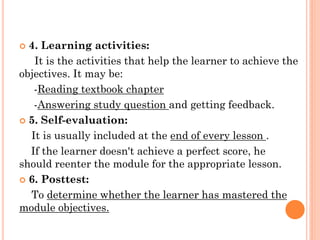
 4. Learning activities:
It is the activities that help the learner to achieve the
objectives. It may be:
-Reading textbook chapter
-Answering study question and getting feedback.
 5. Self-evaluation:
It is usually included at the end of every lesson .
If the learner doesn't achieve a perfect score, he
should reenter the module for the appropriate lesson.
 6. Posttest:
To determine whether the learner has mastered the
module objectives.
Advantages :
 Allows for self-pacing
 Stimulates active learning
 Frequent feedback is built in
Disadvantages:
 Limited with learners who have low literacy skills
 Not appropriate for learners with visual and hearing
impairments
 Require high level of motivation
educational methods.pdf

educational methods.pdf

  • 1.
  • 3.
    OBJECTIVES:  By theend of this lecture all participants should be able to : 1-understand the educational methods 2-types of educational methods A-traditional methods : -lecture (advantages and disadvantages) -Group discussion (advantages and disadvantages) -One- to-one (advantages and dis advantages)
  • 4.
    B-Nontraditional methods: -Gaming (advantagesand disadvantages) -Simulation (advantages and disadvantages ) -Role playing (advantages and disadvantages) -Role modeling (advantages and disadvantages) -self-education activity (advantages and disadvantages) 3 -Selection of educational methods 4-Evaluation of educational methods
  • 5.
    INTRODUCTION : : There isno one perfect method for teaching all learners in all settings .Whatever the method chosen, it will usually be most effective if used in conjunction with other Instructional techniques and tools to optimize learning. The importance of selecting appropriate methods to meet the needs of learners.
  • 6.
    DEFINITION: Educational approach forturning knowledge into learning . Teaching method comprises the principles and methods used by teacher to enable student learning . How to deliver information
  • 7.
    METHODS : A) Traditionalmethods 1-Lecture : Lecture can be defined as a highly structured method by which the teacher verbally transmits information directly to groups of learners for the purpose of instruction. It is one of the oldest and most often used approaches to teaching. The lecture format allows for only minimal exchange between the teacher and the learner. (learner passsive) The lecture is an ideal way to provide foundational background information as basis for subsequent group discussion. Domain: Cognitive
  • 8.
    ADVANTAGES : 1-An effectivemeans for transmitting large amount of information to a large number of people at the same time. 2-An effective approach for cognitive learning, 3- Develop listening abilities . 4- Easily supplemented with handout materials and other audiovisual aids to enhance learning.
  • 9.
    DISADVANTAGES:  Ineffective ininfluencing psychomotor behavior.  Don't provide for much stimulation or participatory involvement of learners.(passive)  All learners are exposed to the same information regardless of their needs.  Don't account for individual differences ( cognitive abilities and attention span).  It place little emphasis on analytic thinking , decision making, problem solving.
  • 10.
    B) Group discussion: Definition: Itthe method of teaching whereby learners get together to exchange information, feelings and opinions with one another and with the teacher. Group size can vary, but most group discussion techniques can be used with as few as 3 people and as many as 15-20people. Domain: Affective and cognitive Learner role: Active Teacher role: Guide and focus the discussion
  • 12.
    Disadvantages: 1. Shy learnersmay refuse to become involved or may need a great deal of encouragement to participate. 2. It is expensive and time consuming. 3. It is effective only in small groups. 4. It will be frustrated if one person or few people monopolized the discussion. 5. It is only valuable if the participants come prepared with the necessary background information.
  • 13.
    3-ONE TO ONEEDUCATION :  It is the method in which the teacher delivers the individual education designed specifically for a particular learner.  This method should be a lecture delivered to an audience of one based on learner’s needs.  Domains: Cognitive, psychomotor and affective  Learner role: Active( shred and immediate feedback)  Teacher role: Presents information and facilitate individualized learning.
  • 14.
    ADVANTAGE  The paceand content of teaching can be tailored to meet individual need.  Ideal as an intervention for initial assessment and ongoing evaluation of the learner.  Good for achieving all three domains of learning.  Provide immediate feedback to be shared between the teacher and the learner.
  • 15.
    DISADVANTAGE :  Thelearner is isolated from others who have similar  Questioning and answering may be interpreted by the learner ( one side) as a technique to test their knowledge and skills  Time consuming
  • 16.
    4. DEMONSTRATION ANDRE- DEMONSTRATION: It is imperative to begin by making a clear distinction between the methods of demonstration and return demonstration. Demonstration is a method by which the learner is shown by the teacher how to perform a particular skill. Return demonstration is the method by which the learner attempts to perform the skill with cues from the teacher as needed.  Domains: Psychomotor  Lerner role: Demonstration: Passive Return demonstration: Active  Teacher role: Demonstration: Models skills or behavior Return demonstration: Individualizes feedback to refine performance.
  • 17.
    ADVANTAGES: 1-Especially effective forlearning in the psychomotor domain through repeated movement and reinforcement of practice. 2-Provide opportunity for over learning to achieve the teaching goal and increase performance level. 3-Actively engages the learner through stimulations of visual, auditory , tactile senses.
  • 18.

    DISADVANTAGES: 1-Time consuming. 2-Equipment canbe expensive to purchase 3-Extra equipment is needed for practicing certain skills. 4- size of learners must kept small to ensure opportunity for practice and close supervision.
  • 20.
    : B)NONTRADITIONAL METHODS Gaming: Is aninstructional method requiring the learner to participate in competitive activities with rules. - These have reality but they are designed to accomplish educational objectives. - It is used by learner to apply knowledge and rehearsing skills previously learned. - It increase learner involvement and influence affective behavior through social interaction and it is effective for improving cognitive functioning also enhance skills in psychomotor domain .
  • 21.
    ADVANTAGES : 1-Increase learnerinvolvement. 2-Promote retention of knowledge 4-Adds variety of learning domains 5-Games are fun with a purpose 6- Games is method practically attractive to children.
  • 22.
    DISADVANTAGES: 1-Creates a competitiveenvironment that may be threatening to some learners 2-Reqires more flexible space for teamwork than a traditional classroom 3-Some learners may not be able to participate if they are restricted by a disability 4-When people play games, winning (primary consideration) is upper most in their minds, with learning is a secondary consideration.
  • 23.
    SIMULATION :  Itis a method for teaching by using artificial materials / models.  That engage the learner in an activity that reflects real life conditions but without the risk taking consequences of an actual situation.  Domains: Cognitive and psychomotor
  • 24.
    It promote psychomotorskills, there is over lapping between games ,simulation and role playing because all of them are teaching method require active participation of learners .it is used in solving problems and attitudes changes.
  • 25.
    There are manytypes of simulation including the following: 1-Written simulation: use case studies about real situations / problem ex; personnel communication problem of nursing staff on a unit . 2-Clinical simulation: A) Low fidelity: for example, exercise like practicing giving a bed bath to a non-responsive doll. B) Medium fidelity: for example, manikins that have heart and lung sounds but no movements. C) High fidelity: for example, new manikins like Sim Man that are attached to a computer and produce vital signs and physiological reactivity.
  • 26.
    ADVANTAGES: 1-Excellent for psychomotorskills development 2-Enhances higher level problem –solving and interactive abilities in the cognitive . 3-Provides for active learner involvement in a real life situation . 4-guanerate safe ,non threating environment for learning Disadvantages: 1. Can be expensive 2. Not readily available to all learners yet 3. Time consuming
  • 27.
    ROLE-PLAYING: Is a methodby which learners participate in an unrehearsed dramatization . They are asked to play a part of character as they think this character would act in reality . This method arouse feelings and elicit emotional responses in the learners and it is used to achieve behavioral objectives .
  • 28.
     Ex1 : patientin diabetes self-management education program will do need to Behaviors as selecting food from restaurant's menu and setting their insulin pumps for the correct bolus of insulin as these are self-management skills  Domain: Affective( behaviors), cognitive
  • 29.
    ADVANTAGES: 1-Opportunity to explorefeelings and attitudes . 2-Narrows the role distance between clients and professionals( Patient plays the professionals 'roles) 3-Matching between understanding ,feelings and practice
  • 30.
    : ISADVANTAGES D 1-Limited to smallgroup 2-some participants may be uncomfortable in their role 3-Tendency by some participants to overly exaggerate their role . 4- It depend on learner imagination and willing to participate
  • 31.
    : MODELING OLE R The use ofself as a role model is often over-looked as an instructional method. Learning from role model is called identification and emanates from learning and developmental theories such as Erickson of psychosocial stages of development which explain how people acquire behaviors and social role. This method primarily achieves behavior change in the affective domain
  • 32.
    Advantages : 1- Influenceattitudes to achieve behavior changes in the affective domain. 2-Positive role models have the potential to instill socially desired behaviors Disadvantages : 1-Require rapport( build role models ideas and behavior in learner) between the role model and the learner 2-Negative role models have the potential to instill un acceptable behavior.
  • 33.
    SELF-EDUCATIONAL ACTIVITIES: Self -instructionis a method used by the teacher to provide or design instructional activities that guide the learner in independently achieving the objectives of learning . The self –instruction method is effective for learning in the cognitive and psychomotor domain where the goal is master information and apply it to practice.  Examples: workbook
  • 34.
    This method containthe following elements :  1. Introduction and instructions: In this part tell the learner how to work through the module ( ICDL modules).  2. Behavioral objectives: Expression in clear language what the learner will be able to do on the completion of the module.  3. Pretest: To help the learners which section of the module they might skip and which ones they need to study in depth.
  • 35.
     4. Learningactivities: It is the activities that help the learner to achieve the objectives. It may be: -Reading textbook chapter -Answering study question and getting feedback.  5. Self-evaluation: It is usually included at the end of every lesson . If the learner doesn't achieve a perfect score, he should reenter the module for the appropriate lesson.  6. Posttest: To determine whether the learner has mastered the module objectives.
  • 36.
    Advantages :  Allowsfor self-pacing  Stimulates active learning  Frequent feedback is built in Disadvantages:  Limited with learners who have low literacy skills  Not appropriate for learners with visual and hearing impairments  Require high level of motivation