PREPARATION FOR
CHILDBIRTH AND
PLANNED
PARENTHOOD.
Goals of childbirth preparation:
 To provide parents with the knowledge
and skill they need to cope with stress of
pregnancy, labor and birth.
 To prepare parents to be intelligent
consumers of maternity care.
 To assist parents in achieving a safe,
positive and rewarding labor and birth
experience.
PREPARATION FOR CHILDBIRTH
 Birth Plan : is set of instructions
prepared in advance for the
medical professionals who will help
you through the delivery process.
Childbearing decision
 Choosing the birth settings
• Giving Birth in a Hospital
• Out-of-Hospital Births
 Sibling preparation for birth
 Classes for Family Members during
Pregnancy
 Antepartal education
 Class content
 Early classes ( 1st
trimester)
o Early gestational changes.
o Self-care during pregnancy.
o Fetal development, environmental dangers for the
fetus.
o Sexuality in pregnancy.
o Birth settings and type of care providers.
o Nutrition, rest and exercise suggestions.
o Relief measures for common discomfort of
pregnancy.
o Psychological changes in pregnancy.
o Information for getting pregnancy to a good start.
 Later classes ( 2nd
and 3rd
trimesters)
◦Preparation for birth process.
◦postpartum self care
◦birth choices( analgesia, fetal
monitoring etc)
◦relaxation techniques
◦infant stimulation, care and feeding
◦Newborn safety issues.
 Adolescent parenting classes
o How to be a good parent.
o Newborn care
o Health dangers for the baby
o Healthy diet during pregnancy
o How to recognize when baby is ill,
protecting from accidents
o Baby care: physical and emotional, make
the baby feel happy and loved
 Breast feeding programs
o Methods of breast preparation
o Techniques of breast feeding
o Advantages of breast feeding
o Involvement of fathers in feeding process
 Sibling preparation: Adjustment to
newborn
 Classes for grand parents
 Education of the family having cesarean
birth
 Preparation for cesarean birth
o Participating in the choice of anesthetic
o Father (significant other) being present
during birth
o Planning initial contact with their newborn
 Preparation for repeat cesarean birth
 Preparation for couples desiring vaginal
birth after cesarean birth (VBAC)
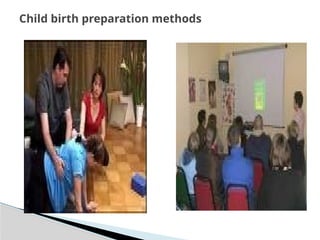
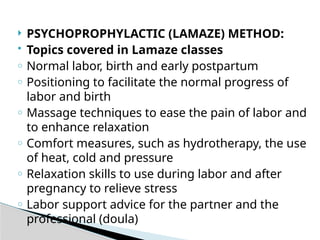
Child birth preparation methods
 PSYCHOPROPHYLACTIC (LAMAZE) METHOD:
 Topics covered in Lamaze classes
o Normal labor, birth and early postpartum
o Positioning to facilitate the normal progress of
labor and birth
o Massage techniques to ease the pain of labor and
to enhance relaxation
o Comfort measures, such as hydrotherapy, the use
of heat, cold and pressure
o Relaxation skills to use during labor and after
pregnancy to relieve stress
o Labor support advice for the partner and the
professional (doula)
o Communication skills between the pregnant
woman and her partner, and with members of the
healthcare team
o Problems that could occur during labor and birth
o Guidance for the pregnant woman to make
informed decisions about anesthesia and medical
procedures
o Breastfeeding and the early postpartum period
o Healthy lifestyles for pregnancy and postpartum
period
o Background about epidurals and other
anesthesia choices to enable you to make the
best choice for yourself
o Breastfeeding and the early postpartum period
 Body conditioning exercises
 Relaxation exercises
 Breathing techniques: it uses 3 patterns of chest
breathing which vary. The woman is taught to use
one pattern until it is no longer effective, then move
on to another.
o First pattern: it is called slow paced breathing.
During the breathing movements only the chest
moves. The woman inhales slowly through her nose.
She lifts her chest up and out during the inhalation.
She exhales through pursed lips. The breathing rate
is 6-9 breaths a minute( 2 breaths every 15 seconds)
o Second pattern: also called shallow
breathing or modified-paced breathing.
The woman begins with a cleansing
breath and at the end of this she
pushes out a short breath. She then
inhales and exhales through the mouth
at a rate of about 4 breaths every 5
seconds. She keeps her jaw relaxed and
her mouth slightly open. The air should
move in and out smoothly and silently
and the breathing should be mouth
centered.
o Third pattern: it is also called pant-blow or
pattern-paced breathing. The breathing is
punctuated every few breaths by a forceful
exhalation through pursed lips. A variation of
this pattern consists of drawing the lips back to
the teeth and making a hee sound with the
exhalations. The forceful exhalation is through
more pursed lips making a hoo sound.A
pattern of 4 breaths may be used to begin. All
breaths are kept equal and rhythmical. As the
contractions become more intense, the pattern
may be changed to 3:1, 2:1and finally 1:1.
o Second stage breathing: in the
second stage of labor the woman may
assume any comfortable physiologic
position, take several deep breaths,
then hold her breath, bulge abdominal
muscles, relax the perineum and push
out through the vagina. This pushing
effort is repeated throughout the
contraction, timed and coached by the
partner.
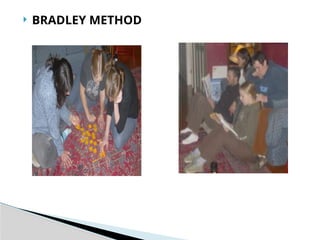
 BRADLEY METHOD
 It places an emphasis of natural approach to birth
and on active participation of the baby’s father as the
birth coach. Major goal is avoidance of medications
unless absolutely necessary and working in harmony
with the body using abdominal breathing and
general body relaxation.
 Bradley Method natural childbirth classes offer 12
weeks of comprehensive education: information
designed for couples planning to give birth in the
hospital or at home. They total 24 hours of quality
instruction, labor rehearsal, medical information,
communication suggestions and more.
 The Bradley Method of Natural Childbirth
promotes:
o Natural childbirth
o Active participation by the husband as coach
o Excellent nutrition
o Avoidance of drugs during pregnancy, birth and
breastfeeding
o Training and preparation
o Relaxation and natural breathing
o Understanding your body and working with it
o Breastfeeding your baby
o Parents preparing for unexpected situation
 DICK -READ METHOD
o Conscious relaxation: progressive relaxation of
muscle groups in entire body.
o Breathing technique: primarily abdominal.
Woman concentrates on forcing the abdominal
muscles to rise. Works on slowing number of
respiration/ minute so that she can take 1
breath /minute. Slow abdominal breathing during
1st
stage. Rapid chest breathing used towards end
of labor if abdominal breathing not sufficient;
panting is used to prevent pushing until needed.
o Physical exercise: to prepare body for labor.
 KITZINGER METHOD: It uses sensory memory to
help the woman understand and work with her body
in preparation for birth. Uses chest breathing in
conjunction with abdominal relaxation.
 GAMPER METHOD: self determination and
confidence instilled by instructor in the ability of the
women to work and cooperate with the natural
forces of childbirth. The emphasis is on the
contraction rather than away from the contraction.
Classes begin early in pregnancy so that the fear-
tension-pain cycle can be broken and new self
confidence instilled early on
 SIMKINS METHOD: this approach works with the
strength of the couple giving birth. They are
encouraged to use whatever means of breathing
and style which helps them as individuals. An electic
mix of techniques is taught.
 NOBLE METHOD: it involves relaxation of pelvic
floor muscles and learning ways to relax them. Her
gentle pushing or breathing the baby out technique
is now incorporated in many classes. Her approach
emphasizes woman listening to their body.
 LE BOYER METHOD: introduced by French
obstetrician in the 70’s allow the baby to be born
amid dim lights and soft voices. The baby is given
a warm water bath, and then placed on mother’s
abdomen for bonding. They are handled gently
and without certain movement that may jar or
startle the baby. Babies are massaged at birth to
start breathing.
 ODENT METHOD: Michael Odent another French
physician introduced this. He put mother and
baby both in warm water and allowed his laboring
mothers to submerse in a pool of water. It appears
to help some women ease labor pain.
 Supporting the support person
 Providing comfort and
reassurance
 Maintaining relaxation and
concentration
 Giving information
 Supporting the unprepared
women
Role of nurse in childbirth
preparation
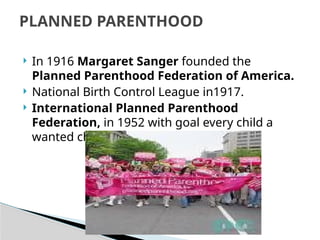
 In 1916 Margaret Sanger founded the
Planned Parenthood Federation of America.
 National Birth Control League in1917.
 International Planned Parenthood
Federation, in 1952 with goal every child a
wanted child
PLANNED PARENTHOOD
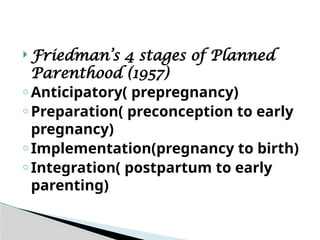
 Friedman’s 4 stages of Planned
Parenthood (1957)
o Anticipatory( prepregnancy)
o Preparation( preconception to early
pregnancy)
o Implementation(pregnancy to birth)
o Integration( postpartum to early
parenting)
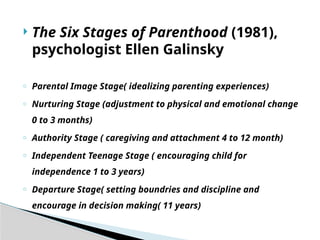
 The Six Stages of Parenthood (1981),
psychologist Ellen Galinsky
o Parental Image Stage( idealizing parenting experiences)
o Nurturing Stage (adjustment to physical and emotional change
0 to 3 months)
o Authority Stage ( caregiving and attachment 4 to 12 month)
o Independent Teenage Stage ( encouraging child for
independence 1 to 3 years)
o Departure Stage( setting boundries and discipline and
encourage in decision making( 11 years)
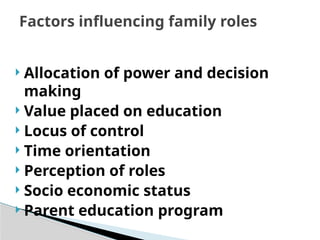
 Allocation of power and decision
making
 Value placed on education
 Locus of control
 Time orientation
 Perception of roles
 Socio economic status
 Parent education program
Factors influencing family roles
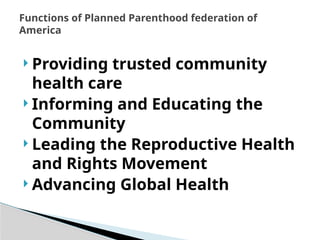
 Providing trusted community
health care
 Informing and Educating the
Community
 Leading the Reproductive Health
and Rights Movement
 Advancing Global Health
Functions of Planned Parenthood federation of
America
 Since 1972, (PPFA) has been working in India to
improve the sexual and reproductive health of
women, men, and youth.
 Four partners, The Child in Need Institute, Tata
Steel Family Initiative Foundation, Prerana, and
Action Research and Training for Health, oversee
similar projects countrywide and follow the same
innovative program models. The current phase of
our youth program in India focuses on adolescents
aged 15-19.
PPFA in India
 It is a vital step in economic and social planning.
 It maintains peace and harmony within the
family and also assists the government to
provide better living condition to all people.
 It improves socio cultural changes which are
accompanying the developmental processes.
 It provides an opportunity for the couple to
decide the family size, budgeting the family
expenses.
 Provides congenial and conflict free
environment.
 Promotes safe motherhood techniques and
Advantages of Planned Parenthood
 Promote the health and welfare of mother and
children specific and the family and total
community in general.
 Reduces the morbidity and mortality of mother
and child.
 Makes the woman, couple and other family
members within the family to accept and adopt
the changes in a holistic manner.
 Receiving proper guidance and counseling
techniques with appropriate health care
professionals.
 Parents will be able to will be able to give proper
attention and concern for child’s developmental
activities.

Bibliography
 Ladewig PW, London ML, Olds SB. Maternal newborn nursing.
California: Addison Wesley nursing; 1994.
 Orshan SA. Maternity, Newborn and Women’s health nursing.
Philadelphia: Lippincott Williams and Wilkins ; 2008
 Pilliteri A. Maternal and child health nursing. Philadelphia:
Lippincott Williams and Wilkins; 1999
 Fraser DM, Cooper MA. Myles textbook for midwives. 14th
edition. London: Churchill Livingstone; 2003
 Varney H, Kriebs JM , Gregor CL. Varneys textbook of
midwifery . 4th
edition. New Delhi: Elsevier; 2005
 Novak C.J ,Broom B.L . Maternal and Child Health Nursing. 9th
edition. Missouri: Mosby Inc; 1999.
 May AK, Mahlmeister LR. Comprehensive Maternity Nursing.
2nd
edition. Philadelphia: Lippincott; 1990.
 http://www.pregnancy.org/article/lamaze-method-
childbirth
 http://www.cks.library.nhs.uk
 http://www.guidance.nice.org.uk
 http://www.slideshare.net/uploader/pregnancy-and-
childbirth-are-the-gateway-to-parenthood
 http://www.webquester.com/connectext/psy/ch03/
parenthood.mhtml
 http:// www.health on.com
 http://www.womens healthnews.com
 http://www.sciencedirect.com/science
 http://www.pregnancy.freebiebooks.com

Planned-Parenthood (1).pptxssssssssssssss

  • 1.
  • 2.
    Goals of childbirthpreparation:  To provide parents with the knowledge and skill they need to cope with stress of pregnancy, labor and birth.  To prepare parents to be intelligent consumers of maternity care.  To assist parents in achieving a safe, positive and rewarding labor and birth experience. PREPARATION FOR CHILDBIRTH
  • 3.
     Birth Plan: is set of instructions prepared in advance for the medical professionals who will help you through the delivery process. Childbearing decision
  • 4.
     Choosing thebirth settings • Giving Birth in a Hospital • Out-of-Hospital Births  Sibling preparation for birth  Classes for Family Members during Pregnancy  Antepartal education  Class content
  • 5.
     Early classes( 1st trimester) o Early gestational changes. o Self-care during pregnancy. o Fetal development, environmental dangers for the fetus. o Sexuality in pregnancy. o Birth settings and type of care providers. o Nutrition, rest and exercise suggestions. o Relief measures for common discomfort of pregnancy. o Psychological changes in pregnancy. o Information for getting pregnancy to a good start.
  • 6.
     Later classes( 2nd and 3rd trimesters) ◦Preparation for birth process. ◦postpartum self care ◦birth choices( analgesia, fetal monitoring etc) ◦relaxation techniques ◦infant stimulation, care and feeding ◦Newborn safety issues.
  • 7.
     Adolescent parentingclasses o How to be a good parent. o Newborn care o Health dangers for the baby o Healthy diet during pregnancy o How to recognize when baby is ill, protecting from accidents o Baby care: physical and emotional, make the baby feel happy and loved
  • 8.
     Breast feedingprograms o Methods of breast preparation o Techniques of breast feeding o Advantages of breast feeding o Involvement of fathers in feeding process  Sibling preparation: Adjustment to newborn  Classes for grand parents
  • 9.
     Education ofthe family having cesarean birth  Preparation for cesarean birth o Participating in the choice of anesthetic o Father (significant other) being present during birth o Planning initial contact with their newborn  Preparation for repeat cesarean birth  Preparation for couples desiring vaginal birth after cesarean birth (VBAC)
  • 10.
  • 11.
     PSYCHOPROPHYLACTIC (LAMAZE)METHOD:  Topics covered in Lamaze classes o Normal labor, birth and early postpartum o Positioning to facilitate the normal progress of labor and birth o Massage techniques to ease the pain of labor and to enhance relaxation o Comfort measures, such as hydrotherapy, the use of heat, cold and pressure o Relaxation skills to use during labor and after pregnancy to relieve stress o Labor support advice for the partner and the professional (doula)
  • 12.
    o Communication skillsbetween the pregnant woman and her partner, and with members of the healthcare team o Problems that could occur during labor and birth o Guidance for the pregnant woman to make informed decisions about anesthesia and medical procedures o Breastfeeding and the early postpartum period o Healthy lifestyles for pregnancy and postpartum period o Background about epidurals and other anesthesia choices to enable you to make the best choice for yourself o Breastfeeding and the early postpartum period
  • 13.
     Body conditioningexercises  Relaxation exercises  Breathing techniques: it uses 3 patterns of chest breathing which vary. The woman is taught to use one pattern until it is no longer effective, then move on to another. o First pattern: it is called slow paced breathing. During the breathing movements only the chest moves. The woman inhales slowly through her nose. She lifts her chest up and out during the inhalation. She exhales through pursed lips. The breathing rate is 6-9 breaths a minute( 2 breaths every 15 seconds)
  • 14.
    o Second pattern:also called shallow breathing or modified-paced breathing. The woman begins with a cleansing breath and at the end of this she pushes out a short breath. She then inhales and exhales through the mouth at a rate of about 4 breaths every 5 seconds. She keeps her jaw relaxed and her mouth slightly open. The air should move in and out smoothly and silently and the breathing should be mouth centered.
  • 15.
    o Third pattern:it is also called pant-blow or pattern-paced breathing. The breathing is punctuated every few breaths by a forceful exhalation through pursed lips. A variation of this pattern consists of drawing the lips back to the teeth and making a hee sound with the exhalations. The forceful exhalation is through more pursed lips making a hoo sound.A pattern of 4 breaths may be used to begin. All breaths are kept equal and rhythmical. As the contractions become more intense, the pattern may be changed to 3:1, 2:1and finally 1:1.
  • 16.
    o Second stagebreathing: in the second stage of labor the woman may assume any comfortable physiologic position, take several deep breaths, then hold her breath, bulge abdominal muscles, relax the perineum and push out through the vagina. This pushing effort is repeated throughout the contraction, timed and coached by the partner.
  • 17.
  • 18.
     It placesan emphasis of natural approach to birth and on active participation of the baby’s father as the birth coach. Major goal is avoidance of medications unless absolutely necessary and working in harmony with the body using abdominal breathing and general body relaxation.  Bradley Method natural childbirth classes offer 12 weeks of comprehensive education: information designed for couples planning to give birth in the hospital or at home. They total 24 hours of quality instruction, labor rehearsal, medical information, communication suggestions and more.
  • 19.
     The BradleyMethod of Natural Childbirth promotes: o Natural childbirth o Active participation by the husband as coach o Excellent nutrition o Avoidance of drugs during pregnancy, birth and breastfeeding o Training and preparation o Relaxation and natural breathing o Understanding your body and working with it o Breastfeeding your baby o Parents preparing for unexpected situation
  • 20.
     DICK -READMETHOD o Conscious relaxation: progressive relaxation of muscle groups in entire body. o Breathing technique: primarily abdominal. Woman concentrates on forcing the abdominal muscles to rise. Works on slowing number of respiration/ minute so that she can take 1 breath /minute. Slow abdominal breathing during 1st stage. Rapid chest breathing used towards end of labor if abdominal breathing not sufficient; panting is used to prevent pushing until needed. o Physical exercise: to prepare body for labor.
  • 21.
     KITZINGER METHOD:It uses sensory memory to help the woman understand and work with her body in preparation for birth. Uses chest breathing in conjunction with abdominal relaxation.  GAMPER METHOD: self determination and confidence instilled by instructor in the ability of the women to work and cooperate with the natural forces of childbirth. The emphasis is on the contraction rather than away from the contraction. Classes begin early in pregnancy so that the fear- tension-pain cycle can be broken and new self confidence instilled early on
  • 22.
     SIMKINS METHOD:this approach works with the strength of the couple giving birth. They are encouraged to use whatever means of breathing and style which helps them as individuals. An electic mix of techniques is taught.  NOBLE METHOD: it involves relaxation of pelvic floor muscles and learning ways to relax them. Her gentle pushing or breathing the baby out technique is now incorporated in many classes. Her approach emphasizes woman listening to their body.
  • 23.
     LE BOYERMETHOD: introduced by French obstetrician in the 70’s allow the baby to be born amid dim lights and soft voices. The baby is given a warm water bath, and then placed on mother’s abdomen for bonding. They are handled gently and without certain movement that may jar or startle the baby. Babies are massaged at birth to start breathing.  ODENT METHOD: Michael Odent another French physician introduced this. He put mother and baby both in warm water and allowed his laboring mothers to submerse in a pool of water. It appears to help some women ease labor pain.
  • 24.
     Supporting thesupport person  Providing comfort and reassurance  Maintaining relaxation and concentration  Giving information  Supporting the unprepared women Role of nurse in childbirth preparation
  • 25.
     In 1916Margaret Sanger founded the Planned Parenthood Federation of America.  National Birth Control League in1917.  International Planned Parenthood Federation, in 1952 with goal every child a wanted child PLANNED PARENTHOOD
  • 26.
     Friedman’s 4stages of Planned Parenthood (1957) o Anticipatory( prepregnancy) o Preparation( preconception to early pregnancy) o Implementation(pregnancy to birth) o Integration( postpartum to early parenting)
  • 27.
     The SixStages of Parenthood (1981), psychologist Ellen Galinsky o Parental Image Stage( idealizing parenting experiences) o Nurturing Stage (adjustment to physical and emotional change 0 to 3 months) o Authority Stage ( caregiving and attachment 4 to 12 month) o Independent Teenage Stage ( encouraging child for independence 1 to 3 years) o Departure Stage( setting boundries and discipline and encourage in decision making( 11 years)
  • 28.
     Allocation ofpower and decision making  Value placed on education  Locus of control  Time orientation  Perception of roles  Socio economic status  Parent education program Factors influencing family roles
  • 29.
     Providing trustedcommunity health care  Informing and Educating the Community  Leading the Reproductive Health and Rights Movement  Advancing Global Health Functions of Planned Parenthood federation of America
  • 30.
     Since 1972,(PPFA) has been working in India to improve the sexual and reproductive health of women, men, and youth.  Four partners, The Child in Need Institute, Tata Steel Family Initiative Foundation, Prerana, and Action Research and Training for Health, oversee similar projects countrywide and follow the same innovative program models. The current phase of our youth program in India focuses on adolescents aged 15-19. PPFA in India
  • 31.
     It isa vital step in economic and social planning.  It maintains peace and harmony within the family and also assists the government to provide better living condition to all people.  It improves socio cultural changes which are accompanying the developmental processes.  It provides an opportunity for the couple to decide the family size, budgeting the family expenses.  Provides congenial and conflict free environment.  Promotes safe motherhood techniques and Advantages of Planned Parenthood
  • 32.
     Promote thehealth and welfare of mother and children specific and the family and total community in general.  Reduces the morbidity and mortality of mother and child.  Makes the woman, couple and other family members within the family to accept and adopt the changes in a holistic manner.  Receiving proper guidance and counseling techniques with appropriate health care professionals.  Parents will be able to will be able to give proper attention and concern for child’s developmental activities. 
  • 33.
    Bibliography  Ladewig PW,London ML, Olds SB. Maternal newborn nursing. California: Addison Wesley nursing; 1994.  Orshan SA. Maternity, Newborn and Women’s health nursing. Philadelphia: Lippincott Williams and Wilkins ; 2008  Pilliteri A. Maternal and child health nursing. Philadelphia: Lippincott Williams and Wilkins; 1999  Fraser DM, Cooper MA. Myles textbook for midwives. 14th edition. London: Churchill Livingstone; 2003  Varney H, Kriebs JM , Gregor CL. Varneys textbook of midwifery . 4th edition. New Delhi: Elsevier; 2005  Novak C.J ,Broom B.L . Maternal and Child Health Nursing. 9th edition. Missouri: Mosby Inc; 1999.  May AK, Mahlmeister LR. Comprehensive Maternity Nursing. 2nd edition. Philadelphia: Lippincott; 1990.
  • 34.
     http://www.pregnancy.org/article/lamaze-method- childbirth  http://www.cks.library.nhs.uk http://www.guidance.nice.org.uk  http://www.slideshare.net/uploader/pregnancy-and- childbirth-are-the-gateway-to-parenthood  http://www.webquester.com/connectext/psy/ch03/ parenthood.mhtml  http:// www.health on.com  http://www.womens healthnews.com  http://www.sciencedirect.com/science  http://www.pregnancy.freebiebooks.com