9/5/2015 1
Scale up of Powder Blending
March 2014
1 of 50
Tehran University of Medical
Sciences
School of Pharmacy
Batch Size Increase in
Dry Blending and Mixing
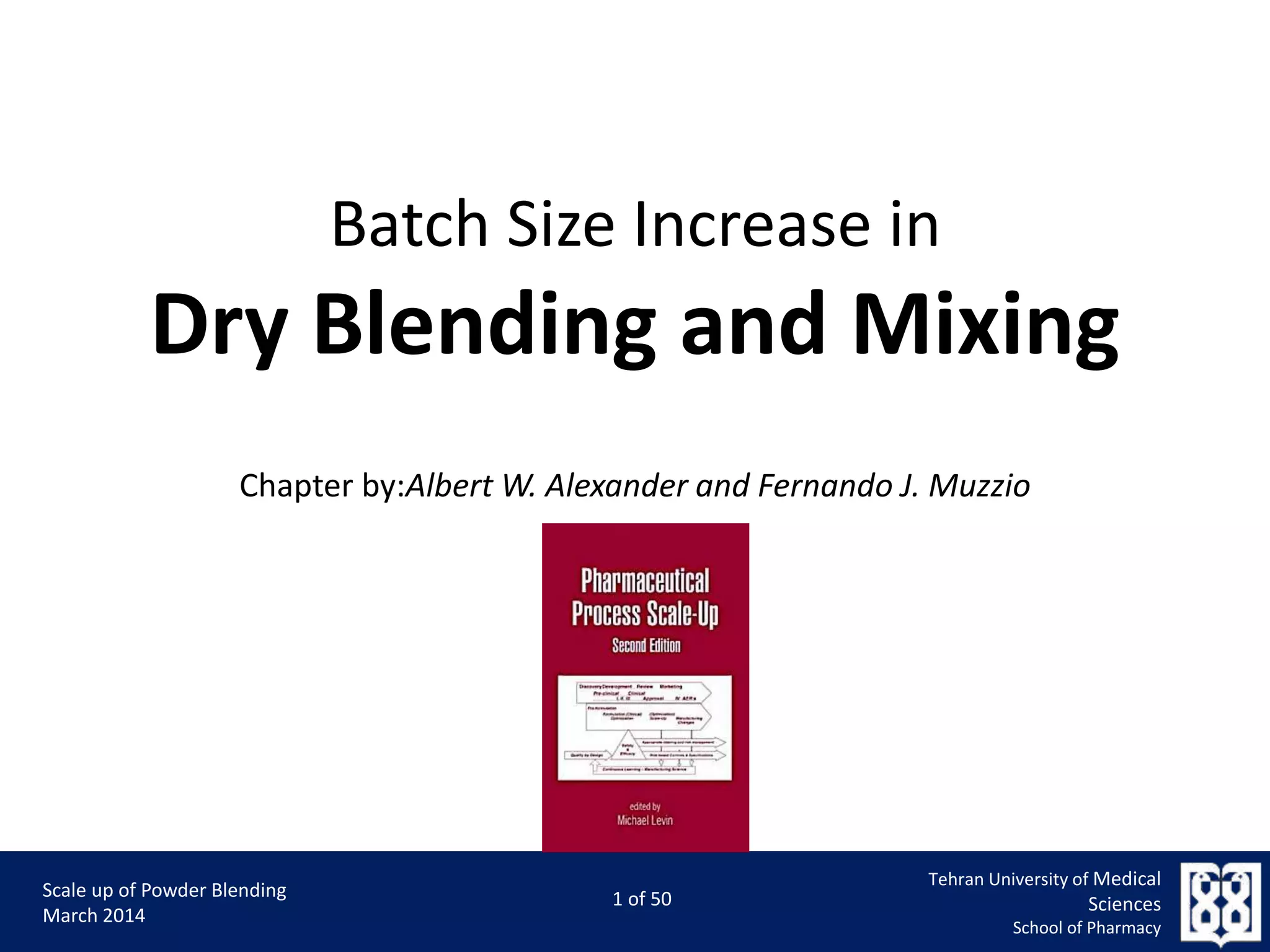
Chapter by:Albert W. Alexander and Fernando J. Muzzio
9/5/2015 2
Scale up of Powder Blending
March 2014
2 of 50
Tehran University of Medical
Sciences
School of Pharmacy
Introduction
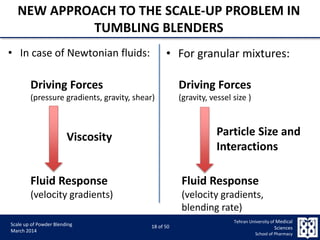
• Dry particle blending is a critical step that has a
direct impact on content uniformity
• There are currently no mathematical techniques
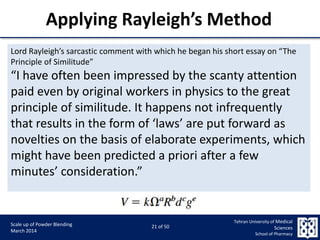
to predict blending behavior of granular
components without prior experimental work.
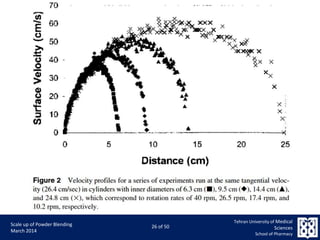
• Blending studies start with a small-scale, try-it-
and-see approach.
9/5/2015 3
Scale up of Powder Blending
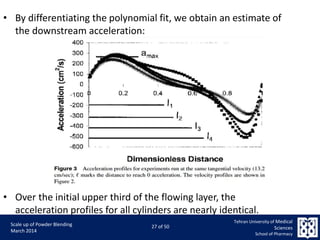
March 2014
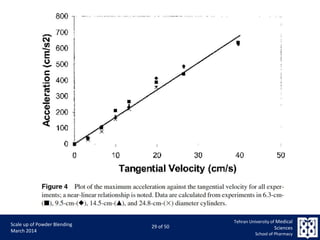
3 of 50
Tehran University of Medical
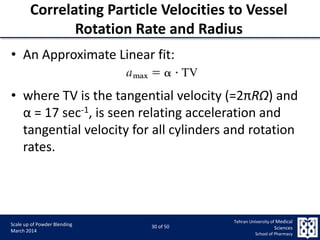
Sciences
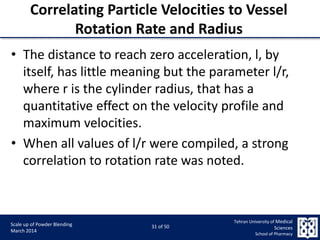
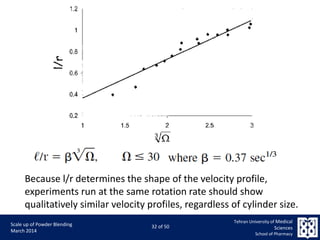
School of Pharmacy
A Typical Problem
• A 5ft3 tumble blender filled to 50% of capacity and
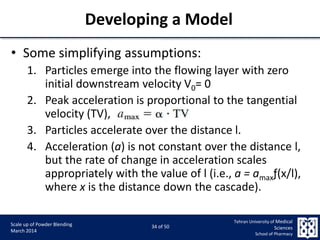
run at 15 rpm for 15 min produces the desired
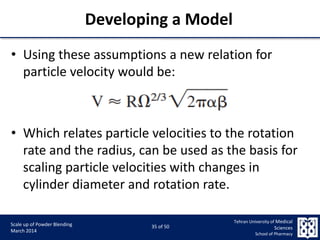
mixture homogeneity. What conditions should be
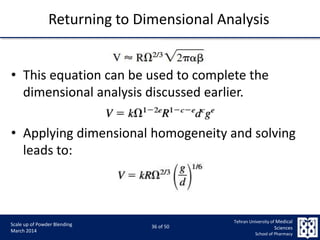
used to duplicate these results in a 25ft3 blender?
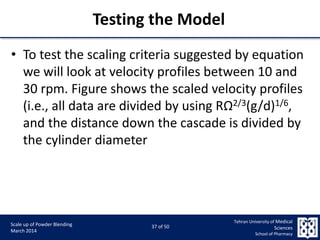
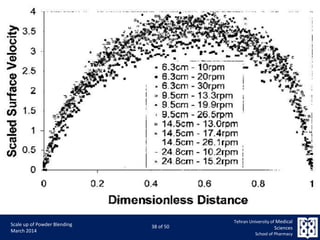
• The following questions might arise:
– 1. What rotation rate should be used?
– 2. Should filling level be the same?
– 3. How long should the blender be operated?
– 4. Are variations to the blender geometry between scales
acceptable?
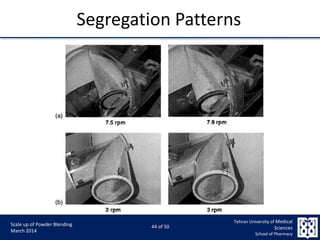
9/5/2015 4
Scale up of Powder Blending
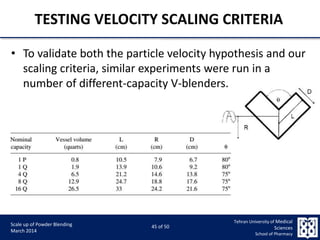
March 2014
4 of 50
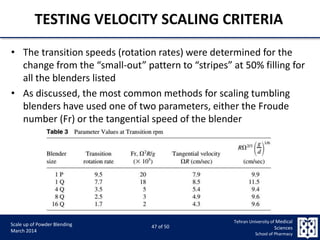
Tehran University of Medical
Sciences
School of Pharmacy
Tumbling Blenders
9/5/2015 5
Scale up of Powder Blending
March 2014
5 of 50
Tehran University of Medical
Sciences
School of Pharmacy
Defining Mixedness
• The final objective of any granular mixing process is
homogeneity.
• No reliable techniques for on-line measuring of
composition have been developed yet.
• Granular mixtures are usually quantified by
removing samples from the mixture.
• Interrupting the blend cycle and repeated sampling
may change the state of the blend.
• The mean value and sample variance are
determined and then often used in a mixing index.
9/5/2015 6
Scale up of Powder Blending
March 2014
6 of 50
Tehran University of Medical
Sciences
School of Pharmacy
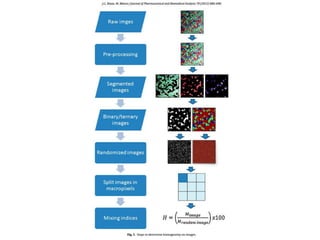
Online Processing of Homogenicity
• Imaging (NIR)
• Image Processing
9/5/2015 7
Scale up of Powder Blending
March 2014
7 of 50
Tehran University of Medical
Sciences
School of Pharmacy
Mixing in Tumbling Blenders
• Particle motions is in a thin, cascading layer at
the surface, while the remainder of the material
rotates with the vessel as a rigid body.
• Most tumbling blenders are symmetrical which
impedes achieving a homogeneous mixture.
• The mixing rate often becomes limited by the
amount of material that can cross from one side
of the symmetry plane to the other
9/5/2015 8
Scale up of Powder Blending
March 2014
8 of 50
Tehran University of Medical
Sciences
School of Pharmacy
Mixing in Tumbling Blenders
• Blending process takes place by three essentially
independent mechanisms:
• Convection causes large groups of particles to move
in the direction of flow (orthogonal to the axis of
rotation), the result of vessel rotation.
• Dispersion is the random motion of particles as a
result of collisions or inter-particle motion, usually
orthogonal to the direction of flow (parallel to the
axis of rotation).
• Shear separates particles that have joined due to
agglomeration or cohesion and requires high forces.
9/5/2015 9
Scale up of Powder Blending
March 2014
9 of 50
Tehran University of Medical
Sciences
School of Pharmacy
Mixing in Tumbling Blenders
• Loading of multiple ingredients will have a dramatic
effect on mixing rate if dispersion is the critical
blending mechanism.
• Care must be taken when loading a minor (~1%)
component into the blender
• The order of constituent addition can also have
significant effects on the degree of final
homogeneity, especially if ordered mixing (bonding
of one component to another) can occur within the
blend
9/5/2015 10
Scale up of Powder Blending
March 2014
10 of 50
Tehran University of Medical
Sciences
School of Pharmacy
Mixing in Tumbling Blenders
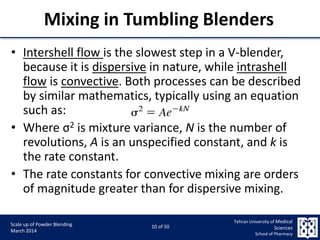
• Intershell flow is the slowest step in a V-blender,
because it is dispersive in nature, while intrashell
flow is convective. Both processes can be described
by similar mathematics, typically using an equation
such as:
• Where σ2 is mixture variance, N is the number of
revolutions, A is an unspecified constant, and k is
the rate constant.
• The rate constants for convective mixing are orders
of magnitude greater than for dispersive mixing.
9/5/2015 11
Scale up of Powder Blending
March 2014
11 of 50
Tehran University of Medical
Sciences
School of Pharmacy
Process Parameters
• One parameter consideration that arises is
whether rotation rate should change with
variations in size.
• When far from the critical speed of the blender,
the rotation rate does not have strong effects on
the mixing rate
• The number of revolutions was the most
important parameter governing the mixing rate.
9/5/2015 12
Scale up of Powder Blending
March 2014
12 of 50
Tehran University of Medical
Sciences
School of Pharmacy
Process Parameters
• Given a geometrically similar blender and the
same mixture composition, the fill level should
also be kept constant with changes in scale.
• However, an increase in vessel size at the same
fill level may correspond to a significant decrease
in the relative volume of particles in the
cascading layer compared to the bulk.
• A large decrease in mixing rate.
9/5/2015 13
Scale up of Powder Blending
March 2014
13 of 50
Tehran University of Medical
Sciences
School of Pharmacy
SCALE-UP APPROACHES
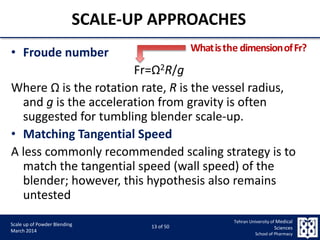
• Froude number
Fr=Ω2R/g
Where Ω is the rotation rate, R is the vessel radius,
and g is the acceleration from gravity is often
suggested for tumbling blender scale-up.
• Matching Tangential Speed
A less commonly recommended scaling strategy is to
match the tangential speed (wall speed) of the
blender; however, this hypothesis also remains
untested
Whatisthe dimensionofFr?
9/5/2015 14
Scale up of Powder Blending
March 2014
14 of 50
Tehran University of Medical
Sciences
School of Pharmacy
Back to our problem with a Fr approach
• We now look at our general problem of scaling
the 5ft3 blender using Fr as the scaling approach:
• The requisites are:
– Geometric Similarity
– Keep total number of revolutions constant
9/5/2015 15
Scale up of Powder Blending
March 2014
15 of 50
Tehran University of Medical
Sciences
School of Pharmacy
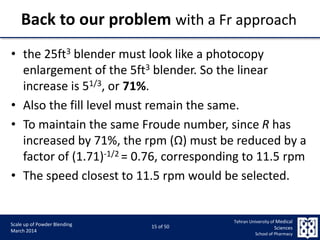
Back to our problem with a Fr approach
• the 25ft3 blender must look like a photocopy
enlargement of the 5ft3 blender. So the linear
increase is 51/3, or 71%.
• Also the fill level must remain the same.
• To maintain the same Froude number, since R has
increased by 71%, the rpm (Ω) must be reduced by a
factor of (1.71)-1/2 = 0.76, corresponding to 11.5 rpm
• The speed closest to 11.5 rpm would be selected.
9/5/2015 16
Scale up of Powder Blending
March 2014
16 of 50
Tehran University of Medical
Sciences
School of Pharmacy
Back to our problem with a Fr approach
• If the initial blend time were 15 minutes at 15
rpm, the total revolutions of 225 must be
maintained with the 25ft3 scale. Assuming 11.5
rpm were selected, this would amount to a 19.5-
minute blend time.
9/5/2015 17
Scale up of Powder Blending
March 2014
17 of 50
Tehran University of Medical
Sciences
School of Pharmacy
NEW APPROACH TO THE SCALE-UP PROBLEM IN
TUMBLING BLENDERS
• We begin by proposing a set of variables that
may control the process.
• The driving force for flow in tumbling blenders is
the acceleration from gravity.
• Vessel size is obviously a critical parameter, as is
the rotation rate, which defines the energy input
to the system.
• These variables define the system parameters
but do not cover the mixture response.
9/5/2015 18
Scale up of Powder Blending
March 2014
18 of 50
Tehran University of Medical
Sciences
School of Pharmacy
NEW APPROACH TO THE SCALE-UP PROBLEM IN
TUMBLING BLENDERS
• In case of Newtonian fluids:
Driving Forces
(pressure gradients, gravity, shear)
Fluid Response
(velocity gradients)
Viscosity
• For granular mixtures:
Driving Forces
(gravity, vessel size )
Particle Size and
Interactions
Fluid Response
(velocity gradients,
blending rate)
9/5/2015 19
Scale up of Powder Blending
March 2014
19 of 50
Tehran University of Medical
Sciences
School of Pharmacy
NEW APPROACH TO THE SCALE-UP PROBLEM IN
TUMBLING BLENDERS
• For granular mixtures we will define particle size
and particle velocity as our “performance
variables.”
• Particle size plays a large role in determining
mixing (or segregation) rates because dispersion
distance is expected to vary inversely with
particle size.
9/5/2015 20
Scale up of Powder Blending
March 2014
20 of 50
Tehran University of Medical
Sciences
School of Pharmacy
NEW APPROACH TO THE SCALE-UP PROBLEM IN
TUMBLING BLENDERS
• Although previous studies have indicated that
rotation rate (and, hence, probably particle
velocities) does not affect mixing rate, these
experiments were done in very small blenders. It
is conceivable that at larger scales, these
variables could become important.
• We can now address the development of non-
dimensional scaling criteria.
9/5/2015 21
Scale up of Powder Blending
March 2014
21 of 50
Tehran University of Medical
Sciences
School of Pharmacy
Applying Rayleigh’s Method
• Variables that are believed to govern particle dynamics
in tumbling blenders are listed:
• Using these variables and the Rayleigh method, we
derive the following equation:
Lord Rayleigh’s sarcastic comment with which he began his short essay on “The
Principle of Similitude”
“I have often been impressed by the scanty attention
paid even by original workers in physics to the great
principle of similitude. It happens not infrequently
that results in the form of ‘laws’ are put forward as
novelties on the basis of elaborate experiments, which
might have been predicted a priori after a few
minutes’ consideration.”
9/5/2015 22
Scale up of Powder Blending
March 2014
22 of 50
Tehran University of Medical
Sciences
School of Pharmacy
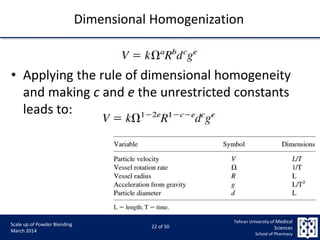
Dimensional Homogenization
• Applying the rule of dimensional homogeneity
and making c and e the unrestricted constants
leads to:
9/5/2015 23
Scale up of Powder Blending
March 2014
23 of 50
Tehran University of Medical
Sciences
School of Pharmacy
Correlating Particle Velocities to Vessel
Rotation Rate and Radius
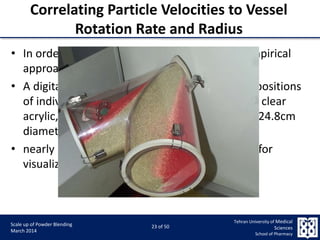
• In order to determine particle velocities, an empirical
approach is taken.
• A digital video camera was used to record the positions
of individual particles on the flowing surface in clear
acrylic, rotating cylinders of 6.3, 9.5, 14.5, and 24.8cm
diameter filled to 50% of capacity.
• nearly monodisperse 1.6mm glass beads dyed for
visualization was used.
9/5/2015 24
Scale up of Powder Blending
March 2014
24 of 50
Tehran University of Medical
Sciences
School of Pharmacy
Correlating Particle Velocities to Vessel
Rotation Rate and Radius
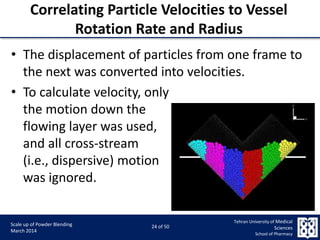
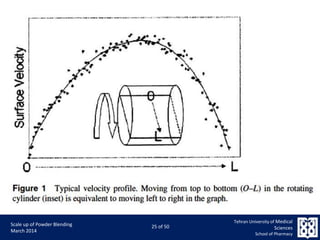
• The displacement of particles from one frame to
the next was converted into velocities.
• To calculate velocity, only
the motion down the
flowing layer was used,
and all cross-stream
(i.e., dispersive) motion
was ignored.
9/5/2015 25
Scale up of Powder Blending
March 2014
25 of 50
Tehran University of Medical
Sciences
School of Pharmacy
9/5/2015 26
Scale up of Powder Blending
March 2014
26 of 50
Tehran University of Medical
Sciences
School of Pharmacy
9/5/2015 27
Scale up of Powder Blending
March 2014
27 of 50
Tehran University of Medical
Sciences
School of Pharmacy
• By differentiating the polynomial fit, we obtain an estimate of
the downstream acceleration:
• Over the initial upper third of the flowing layer, the
acceleration profiles for all cylinders are nearly identical.
9/5/2015 28
Scale up of Powder Blending
March 2014
28 of 50
Tehran University of Medical
Sciences
School of Pharmacy
Correlating Particle Velocities to Vessel
Rotation Rate and Radius
• maximum accelerations are nearly equal,
implying that tangential velocity may be
proportional to maximum acceleration.
• Maximum accelerations were determined for all
experiments; the results are plotted against the
tangential velocity
9/5/2015 29
Scale up of Powder Blending
March 2014
29 of 50
Tehran University of Medical
Sciences
School of Pharmacy
9/5/2015 30
Scale up of Powder Blending
March 2014
30 of 50
Tehran University of Medical
Sciences
School of Pharmacy
Correlating Particle Velocities to Vessel
Rotation Rate and Radius
• An Approximate Linear fit:
• where TV is the tangential velocity (=2πRΩ) and
α = 17 sec-1, is seen relating acceleration and
tangential velocity for all cylinders and rotation
rates.
9/5/2015 31
Scale up of Powder Blending
March 2014
31 of 50
Tehran University of Medical
Sciences
School of Pharmacy
Correlating Particle Velocities to Vessel
Rotation Rate and Radius
• The distance to reach zero acceleration, l, by
itself, has little meaning but the parameter l/r,
where r is the cylinder radius, that has a
quantitative effect on the velocity profile and
maximum velocities.
• When all values of l/r were compiled, a strong
correlation to rotation rate was noted.
9/5/2015 32
Scale up of Powder Blending
March 2014
32 of 50
Tehran University of Medical
Sciences
School of Pharmacy
Because l/r determines the shape of the velocity profile,
experiments run at the same rotation rate should show
qualitatively similar velocity profiles, regardless of cylinder size.
9/5/2015 33
Scale up of Powder Blending
March 2014
33 of 50
Tehran University of Medical
Sciences
School of Pharmacy
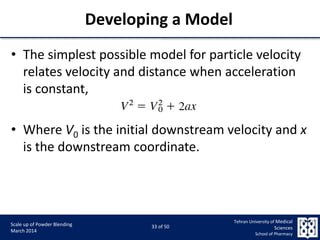
Developing a Model
• The simplest possible model for particle velocity
relates velocity and distance when acceleration
is constant,
• Where V0 is the initial downstream velocity and x
is the downstream coordinate.
9/5/2015 34
Scale up of Powder Blending
March 2014
34 of 50
Tehran University of Medical
Sciences
School of Pharmacy
• Some simplifying assumptions:
1. Particles emerge into the flowing layer with zero
initial downstream velocity V0= 0
2. Peak acceleration is proportional to the tangential
velocity (TV),
3. Particles accelerate over the distance l.
4. Acceleration (a) is not constant over the distance l,
but the rate of change in acceleration scales
appropriately with the value of l (i.e., a = amaxƒ(x/l),
where x is the distance down the cascade).
Developing a Model
9/5/2015 35
Scale up of Powder Blending
March 2014
35 of 50
Tehran University of Medical
Sciences
School of Pharmacy
Developing a Model
• Using these assumptions a new relation for
particle velocity would be:
• Which relates particle velocities to the rotation
rate and the radius, can be used as the basis for
scaling particle velocities with changes in
cylinder diameter and rotation rate.
9/5/2015 36
Scale up of Powder Blending
March 2014
36 of 50
Tehran University of Medical
Sciences
School of Pharmacy
Returning to Dimensional Analysis
• This equation can be used to complete the
dimensional analysis discussed earlier.
• Applying dimensional homogeneity and solving
leads to:
9/5/2015 37
Scale up of Powder Blending
March 2014
37 of 50
Tehran University of Medical
Sciences
School of Pharmacy
Testing the Model
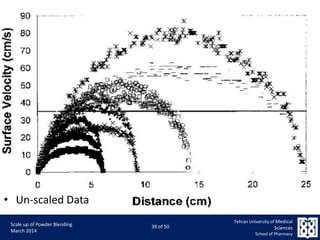
• To test the scaling criteria suggested by equation
we will look at velocity profiles between 10 and
30 rpm. Figure shows the scaled velocity profiles
(i.e., all data are divided by using RΩ2/3(g/d)1/6,
and the distance down the cascade is divided by
the cylinder diameter
9/5/2015 38
Scale up of Powder Blending
March 2014
38 of 50
Tehran University of Medical
Sciences
School of Pharmacy
9/5/2015 39
Scale up of Powder Blending
March 2014
39 of 50
Tehran University of Medical
Sciences
School of Pharmacy
• Un-scaled Data
9/5/2015 40
Scale up of Powder Blending
March 2014
40 of 50
Tehran University of Medical
Sciences
School of Pharmacy
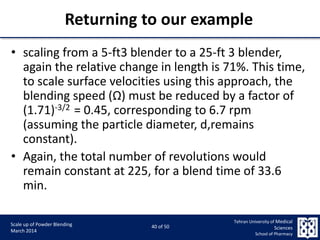
Returning to our example
• scaling from a 5-ft3 blender to a 25-ft 3 blender,
again the relative change in length is 71%. This time,
to scale surface velocities using this approach, the
blending speed (Ω) must be reduced by a factor of
(1.71)-3/2 = 0.45, corresponding to 6.7 rpm
(assuming the particle diameter, d,remains
constant).
• Again, the total number of revolutions would
remain constant at 225, for a blend time of 33.6
min.
9/5/2015 41
Scale up of Powder Blending
March 2014
41 of 50
Tehran University of Medical
Sciences
School of Pharmacy
TESTING VELOCITY SCALING CRITERIA
• Experimental work has not validated the
preceding scaling procedure with respect to
scale-up of blending processes.
• This model should not be favored over other
approaches currently in use, though it may
provide additional insight.
9/5/2015 42
Scale up of Powder Blending
March 2014
42 of 50
Tehran University of Medical
Sciences
School of Pharmacy
TESTING VELOCITY SCALING CRITERIA
• recent work has indicated that particle velocities
may be critical for determining segregation
dynamics in double-cone blenders and V-
blenders.
• Segregation occurs within the blender as
particles begin to flow in regular, defined
patterns that differ according to their particle
size.
9/5/2015 43
Scale up of Powder Blending
March 2014
43 of 50
Tehran University of Medical
Sciences
School of Pharmacy
TESTING VELOCITY SCALING CRITERIA
• In a 1.9-quart-capacity V-blender at fixed filling
(50%), incrementally changing rotation rate
induced a transition between two segregation
patterns
• At the lower rotation rate, the “small-out” pattern forms
• At a slightly higher rotation rate, the “stripes” pattern forms
9/5/2015 44
Scale up of Powder Blending
March 2014
44 of 50
Tehran University of Medical
Sciences
School of Pharmacy
Segregation Patterns
9/5/2015 45
Scale up of Powder Blending
March 2014
45 of 50
Tehran University of Medical
Sciences
School of Pharmacy
TESTING VELOCITY SCALING CRITERIA
• To validate both the particle velocity hypothesis and our
scaling criteria, similar experiments were run in a
number of different-capacity V-blenders.
9/5/2015 46
Scale up of Powder Blending
March 2014
46 of 50
Tehran University of Medical
Sciences
School of Pharmacy
TESTING VELOCITY SCALING CRITERIA
• All the vessels are constructed from clear plexiglass,
enabling visual identification of segregation
patterns.
• For these experiments, a binary mixture of sieved
fractions of 150 to 250-(nominally 200) and 710- to
840- (nominally 775-) glass beads was used.
• A symmetrical initial condition (top-to-bottom
loading) is implemented.
• The blender is run at constant rotation rate; a
segregation pattern was assumed to be stable when
it did not discernibly change for 100 revolutions.
9/5/2015 47
Scale up of Powder Blending
March 2014
47 of 50
Tehran University of Medical
Sciences
School of Pharmacy
TESTING VELOCITY SCALING CRITERIA
• The transition speeds (rotation rates) were determined for the
change from the “small-out” pattern to “stripes” at 50% filling for
all the blenders listed
• As discussed, the most common methods for scaling tumbling
blenders have used one of two parameters, either the Froude
number (Fr) or the tangential speed of the blender
9/5/2015 48
Scale up of Powder Blending
March 2014
48 of 50
Tehran University of Medical
Sciences
School of Pharmacy
RECOMMENDATIONS AND CONCLUSIONS
• The analysis of particle velocities provides a good first
step toward the rigorous development of scaling criteria
for granular flow, but it is far from conclusive.
• It is important in granular systems to first determine the
dynamic variable that governs the process at hand
before determining scaling rules
• A systematic, generalized approach for the scale-up of
granular mixing devices is still far from attainable.
Clearly, more research is required both to test current
hypotheses and to generate new approaches to the
problem.
9/5/2015 49
Scale up of Powder Blending
March 2014
49 of 50
Tehran University of Medical
Sciences
School of Pharmacy
some simple guidelines that can help through the
scale-up
Make sure that changes in scale have not changed the dominant
mixing mechanism in the blender (i.e., convective to dispersive)
Number of revolutions is a key parameter, but rotation rates are
largely unimportant.
When performing scale-up tests, be sure to take enough samples,
be wary of how you interpret your samples.
One simple way to increase mixing rate is to decrease the fill level. It
also reduces the probability that dead zones will form.
Addition of asymmetry into the vessel, either by design or baffles,
can have a tremendous impact on mixing rate.

Powder blending scaleup

  • 1.
    9/5/2015 1 Scale upof Powder Blending March 2014 1 of 50 Tehran University of Medical Sciences School of Pharmacy Batch Size Increase in Dry Blending and Mixing Chapter by:Albert W. Alexander and Fernando J. Muzzio
  • 2.
    9/5/2015 2 Scale upof Powder Blending March 2014 2 of 50 Tehran University of Medical Sciences School of Pharmacy Introduction • Dry particle blending is a critical step that has a direct impact on content uniformity • There are currently no mathematical techniques to predict blending behavior of granular components without prior experimental work. • Blending studies start with a small-scale, try-it- and-see approach.
  • 3.
    9/5/2015 3 Scale upof Powder Blending March 2014 3 of 50 Tehran University of Medical Sciences School of Pharmacy A Typical Problem • A 5ft3 tumble blender filled to 50% of capacity and run at 15 rpm for 15 min produces the desired mixture homogeneity. What conditions should be used to duplicate these results in a 25ft3 blender? • The following questions might arise: – 1. What rotation rate should be used? – 2. Should filling level be the same? – 3. How long should the blender be operated? – 4. Are variations to the blender geometry between scales acceptable?
  • 4.
    9/5/2015 4 Scale upof Powder Blending March 2014 4 of 50 Tehran University of Medical Sciences School of Pharmacy Tumbling Blenders
  • 5.
    9/5/2015 5 Scale upof Powder Blending March 2014 5 of 50 Tehran University of Medical Sciences School of Pharmacy Defining Mixedness • The final objective of any granular mixing process is homogeneity. • No reliable techniques for on-line measuring of composition have been developed yet. • Granular mixtures are usually quantified by removing samples from the mixture. • Interrupting the blend cycle and repeated sampling may change the state of the blend. • The mean value and sample variance are determined and then often used in a mixing index.
  • 6.
    9/5/2015 6 Scale upof Powder Blending March 2014 6 of 50 Tehran University of Medical Sciences School of Pharmacy Online Processing of Homogenicity • Imaging (NIR) • Image Processing
  • 7.
    9/5/2015 7 Scale upof Powder Blending March 2014 7 of 50 Tehran University of Medical Sciences School of Pharmacy Mixing in Tumbling Blenders • Particle motions is in a thin, cascading layer at the surface, while the remainder of the material rotates with the vessel as a rigid body. • Most tumbling blenders are symmetrical which impedes achieving a homogeneous mixture. • The mixing rate often becomes limited by the amount of material that can cross from one side of the symmetry plane to the other
  • 8.
    9/5/2015 8 Scale upof Powder Blending March 2014 8 of 50 Tehran University of Medical Sciences School of Pharmacy Mixing in Tumbling Blenders • Blending process takes place by three essentially independent mechanisms: • Convection causes large groups of particles to move in the direction of flow (orthogonal to the axis of rotation), the result of vessel rotation. • Dispersion is the random motion of particles as a result of collisions or inter-particle motion, usually orthogonal to the direction of flow (parallel to the axis of rotation). • Shear separates particles that have joined due to agglomeration or cohesion and requires high forces.
  • 9.
    9/5/2015 9 Scale upof Powder Blending March 2014 9 of 50 Tehran University of Medical Sciences School of Pharmacy Mixing in Tumbling Blenders • Loading of multiple ingredients will have a dramatic effect on mixing rate if dispersion is the critical blending mechanism. • Care must be taken when loading a minor (~1%) component into the blender • The order of constituent addition can also have significant effects on the degree of final homogeneity, especially if ordered mixing (bonding of one component to another) can occur within the blend
  • 10.
    9/5/2015 10 Scale upof Powder Blending March 2014 10 of 50 Tehran University of Medical Sciences School of Pharmacy Mixing in Tumbling Blenders • Intershell flow is the slowest step in a V-blender, because it is dispersive in nature, while intrashell flow is convective. Both processes can be described by similar mathematics, typically using an equation such as: • Where σ2 is mixture variance, N is the number of revolutions, A is an unspecified constant, and k is the rate constant. • The rate constants for convective mixing are orders of magnitude greater than for dispersive mixing.
  • 11.
    9/5/2015 11 Scale upof Powder Blending March 2014 11 of 50 Tehran University of Medical Sciences School of Pharmacy Process Parameters • One parameter consideration that arises is whether rotation rate should change with variations in size. • When far from the critical speed of the blender, the rotation rate does not have strong effects on the mixing rate • The number of revolutions was the most important parameter governing the mixing rate.
  • 12.
    9/5/2015 12 Scale upof Powder Blending March 2014 12 of 50 Tehran University of Medical Sciences School of Pharmacy Process Parameters • Given a geometrically similar blender and the same mixture composition, the fill level should also be kept constant with changes in scale. • However, an increase in vessel size at the same fill level may correspond to a significant decrease in the relative volume of particles in the cascading layer compared to the bulk. • A large decrease in mixing rate.
  • 13.
    9/5/2015 13 Scale upof Powder Blending March 2014 13 of 50 Tehran University of Medical Sciences School of Pharmacy SCALE-UP APPROACHES • Froude number Fr=Ω2R/g Where Ω is the rotation rate, R is the vessel radius, and g is the acceleration from gravity is often suggested for tumbling blender scale-up. • Matching Tangential Speed A less commonly recommended scaling strategy is to match the tangential speed (wall speed) of the blender; however, this hypothesis also remains untested Whatisthe dimensionofFr?
  • 14.
    9/5/2015 14 Scale upof Powder Blending March 2014 14 of 50 Tehran University of Medical Sciences School of Pharmacy Back to our problem with a Fr approach • We now look at our general problem of scaling the 5ft3 blender using Fr as the scaling approach: • The requisites are: – Geometric Similarity – Keep total number of revolutions constant
  • 15.
    9/5/2015 15 Scale upof Powder Blending March 2014 15 of 50 Tehran University of Medical Sciences School of Pharmacy Back to our problem with a Fr approach • the 25ft3 blender must look like a photocopy enlargement of the 5ft3 blender. So the linear increase is 51/3, or 71%. • Also the fill level must remain the same. • To maintain the same Froude number, since R has increased by 71%, the rpm (Ω) must be reduced by a factor of (1.71)-1/2 = 0.76, corresponding to 11.5 rpm • The speed closest to 11.5 rpm would be selected.
  • 16.
    9/5/2015 16 Scale upof Powder Blending March 2014 16 of 50 Tehran University of Medical Sciences School of Pharmacy Back to our problem with a Fr approach • If the initial blend time were 15 minutes at 15 rpm, the total revolutions of 225 must be maintained with the 25ft3 scale. Assuming 11.5 rpm were selected, this would amount to a 19.5- minute blend time.
  • 17.
    9/5/2015 17 Scale upof Powder Blending March 2014 17 of 50 Tehran University of Medical Sciences School of Pharmacy NEW APPROACH TO THE SCALE-UP PROBLEM IN TUMBLING BLENDERS • We begin by proposing a set of variables that may control the process. • The driving force for flow in tumbling blenders is the acceleration from gravity. • Vessel size is obviously a critical parameter, as is the rotation rate, which defines the energy input to the system. • These variables define the system parameters but do not cover the mixture response.
  • 18.
    9/5/2015 18 Scale upof Powder Blending March 2014 18 of 50 Tehran University of Medical Sciences School of Pharmacy NEW APPROACH TO THE SCALE-UP PROBLEM IN TUMBLING BLENDERS • In case of Newtonian fluids: Driving Forces (pressure gradients, gravity, shear) Fluid Response (velocity gradients) Viscosity • For granular mixtures: Driving Forces (gravity, vessel size ) Particle Size and Interactions Fluid Response (velocity gradients, blending rate)
  • 19.
    9/5/2015 19 Scale upof Powder Blending March 2014 19 of 50 Tehran University of Medical Sciences School of Pharmacy NEW APPROACH TO THE SCALE-UP PROBLEM IN TUMBLING BLENDERS • For granular mixtures we will define particle size and particle velocity as our “performance variables.” • Particle size plays a large role in determining mixing (or segregation) rates because dispersion distance is expected to vary inversely with particle size.
  • 20.
    9/5/2015 20 Scale upof Powder Blending March 2014 20 of 50 Tehran University of Medical Sciences School of Pharmacy NEW APPROACH TO THE SCALE-UP PROBLEM IN TUMBLING BLENDERS • Although previous studies have indicated that rotation rate (and, hence, probably particle velocities) does not affect mixing rate, these experiments were done in very small blenders. It is conceivable that at larger scales, these variables could become important. • We can now address the development of non- dimensional scaling criteria.
  • 21.
    9/5/2015 21 Scale upof Powder Blending March 2014 21 of 50 Tehran University of Medical Sciences School of Pharmacy Applying Rayleigh’s Method • Variables that are believed to govern particle dynamics in tumbling blenders are listed: • Using these variables and the Rayleigh method, we derive the following equation: Lord Rayleigh’s sarcastic comment with which he began his short essay on “The Principle of Similitude” “I have often been impressed by the scanty attention paid even by original workers in physics to the great principle of similitude. It happens not infrequently that results in the form of ‘laws’ are put forward as novelties on the basis of elaborate experiments, which might have been predicted a priori after a few minutes’ consideration.”
  • 22.
    9/5/2015 22 Scale upof Powder Blending March 2014 22 of 50 Tehran University of Medical Sciences School of Pharmacy Dimensional Homogenization • Applying the rule of dimensional homogeneity and making c and e the unrestricted constants leads to:
  • 23.
    9/5/2015 23 Scale upof Powder Blending March 2014 23 of 50 Tehran University of Medical Sciences School of Pharmacy Correlating Particle Velocities to Vessel Rotation Rate and Radius • In order to determine particle velocities, an empirical approach is taken. • A digital video camera was used to record the positions of individual particles on the flowing surface in clear acrylic, rotating cylinders of 6.3, 9.5, 14.5, and 24.8cm diameter filled to 50% of capacity. • nearly monodisperse 1.6mm glass beads dyed for visualization was used.
  • 24.
    9/5/2015 24 Scale upof Powder Blending March 2014 24 of 50 Tehran University of Medical Sciences School of Pharmacy Correlating Particle Velocities to Vessel Rotation Rate and Radius • The displacement of particles from one frame to the next was converted into velocities. • To calculate velocity, only the motion down the flowing layer was used, and all cross-stream (i.e., dispersive) motion was ignored.
  • 25.
    9/5/2015 25 Scale upof Powder Blending March 2014 25 of 50 Tehran University of Medical Sciences School of Pharmacy
  • 26.
    9/5/2015 26 Scale upof Powder Blending March 2014 26 of 50 Tehran University of Medical Sciences School of Pharmacy
  • 27.
    9/5/2015 27 Scale upof Powder Blending March 2014 27 of 50 Tehran University of Medical Sciences School of Pharmacy • By differentiating the polynomial fit, we obtain an estimate of the downstream acceleration: • Over the initial upper third of the flowing layer, the acceleration profiles for all cylinders are nearly identical.
  • 28.
    9/5/2015 28 Scale upof Powder Blending March 2014 28 of 50 Tehran University of Medical Sciences School of Pharmacy Correlating Particle Velocities to Vessel Rotation Rate and Radius • maximum accelerations are nearly equal, implying that tangential velocity may be proportional to maximum acceleration. • Maximum accelerations were determined for all experiments; the results are plotted against the tangential velocity
  • 29.
    9/5/2015 29 Scale upof Powder Blending March 2014 29 of 50 Tehran University of Medical Sciences School of Pharmacy
  • 30.
    9/5/2015 30 Scale upof Powder Blending March 2014 30 of 50 Tehran University of Medical Sciences School of Pharmacy Correlating Particle Velocities to Vessel Rotation Rate and Radius • An Approximate Linear fit: • where TV is the tangential velocity (=2πRΩ) and α = 17 sec-1, is seen relating acceleration and tangential velocity for all cylinders and rotation rates.
  • 31.
    9/5/2015 31 Scale upof Powder Blending March 2014 31 of 50 Tehran University of Medical Sciences School of Pharmacy Correlating Particle Velocities to Vessel Rotation Rate and Radius • The distance to reach zero acceleration, l, by itself, has little meaning but the parameter l/r, where r is the cylinder radius, that has a quantitative effect on the velocity profile and maximum velocities. • When all values of l/r were compiled, a strong correlation to rotation rate was noted.
  • 32.
    9/5/2015 32 Scale upof Powder Blending March 2014 32 of 50 Tehran University of Medical Sciences School of Pharmacy Because l/r determines the shape of the velocity profile, experiments run at the same rotation rate should show qualitatively similar velocity profiles, regardless of cylinder size.
  • 33.
    9/5/2015 33 Scale upof Powder Blending March 2014 33 of 50 Tehran University of Medical Sciences School of Pharmacy Developing a Model • The simplest possible model for particle velocity relates velocity and distance when acceleration is constant, • Where V0 is the initial downstream velocity and x is the downstream coordinate.
  • 34.
    9/5/2015 34 Scale upof Powder Blending March 2014 34 of 50 Tehran University of Medical Sciences School of Pharmacy • Some simplifying assumptions: 1. Particles emerge into the flowing layer with zero initial downstream velocity V0= 0 2. Peak acceleration is proportional to the tangential velocity (TV), 3. Particles accelerate over the distance l. 4. Acceleration (a) is not constant over the distance l, but the rate of change in acceleration scales appropriately with the value of l (i.e., a = amaxƒ(x/l), where x is the distance down the cascade). Developing a Model
  • 35.
    9/5/2015 35 Scale upof Powder Blending March 2014 35 of 50 Tehran University of Medical Sciences School of Pharmacy Developing a Model • Using these assumptions a new relation for particle velocity would be: • Which relates particle velocities to the rotation rate and the radius, can be used as the basis for scaling particle velocities with changes in cylinder diameter and rotation rate.
  • 36.
    9/5/2015 36 Scale upof Powder Blending March 2014 36 of 50 Tehran University of Medical Sciences School of Pharmacy Returning to Dimensional Analysis • This equation can be used to complete the dimensional analysis discussed earlier. • Applying dimensional homogeneity and solving leads to:
  • 37.
    9/5/2015 37 Scale upof Powder Blending March 2014 37 of 50 Tehran University of Medical Sciences School of Pharmacy Testing the Model • To test the scaling criteria suggested by equation we will look at velocity profiles between 10 and 30 rpm. Figure shows the scaled velocity profiles (i.e., all data are divided by using RΩ2/3(g/d)1/6, and the distance down the cascade is divided by the cylinder diameter
  • 38.
    9/5/2015 38 Scale upof Powder Blending March 2014 38 of 50 Tehran University of Medical Sciences School of Pharmacy
  • 39.
    9/5/2015 39 Scale upof Powder Blending March 2014 39 of 50 Tehran University of Medical Sciences School of Pharmacy • Un-scaled Data
  • 40.
    9/5/2015 40 Scale upof Powder Blending March 2014 40 of 50 Tehran University of Medical Sciences School of Pharmacy Returning to our example • scaling from a 5-ft3 blender to a 25-ft 3 blender, again the relative change in length is 71%. This time, to scale surface velocities using this approach, the blending speed (Ω) must be reduced by a factor of (1.71)-3/2 = 0.45, corresponding to 6.7 rpm (assuming the particle diameter, d,remains constant). • Again, the total number of revolutions would remain constant at 225, for a blend time of 33.6 min.
  • 41.
    9/5/2015 41 Scale upof Powder Blending March 2014 41 of 50 Tehran University of Medical Sciences School of Pharmacy TESTING VELOCITY SCALING CRITERIA • Experimental work has not validated the preceding scaling procedure with respect to scale-up of blending processes. • This model should not be favored over other approaches currently in use, though it may provide additional insight.
  • 42.
    9/5/2015 42 Scale upof Powder Blending March 2014 42 of 50 Tehran University of Medical Sciences School of Pharmacy TESTING VELOCITY SCALING CRITERIA • recent work has indicated that particle velocities may be critical for determining segregation dynamics in double-cone blenders and V- blenders. • Segregation occurs within the blender as particles begin to flow in regular, defined patterns that differ according to their particle size.
  • 43.
    9/5/2015 43 Scale upof Powder Blending March 2014 43 of 50 Tehran University of Medical Sciences School of Pharmacy TESTING VELOCITY SCALING CRITERIA • In a 1.9-quart-capacity V-blender at fixed filling (50%), incrementally changing rotation rate induced a transition between two segregation patterns • At the lower rotation rate, the “small-out” pattern forms • At a slightly higher rotation rate, the “stripes” pattern forms
  • 44.
    9/5/2015 44 Scale upof Powder Blending March 2014 44 of 50 Tehran University of Medical Sciences School of Pharmacy Segregation Patterns
  • 45.
    9/5/2015 45 Scale upof Powder Blending March 2014 45 of 50 Tehran University of Medical Sciences School of Pharmacy TESTING VELOCITY SCALING CRITERIA • To validate both the particle velocity hypothesis and our scaling criteria, similar experiments were run in a number of different-capacity V-blenders.
  • 46.
    9/5/2015 46 Scale upof Powder Blending March 2014 46 of 50 Tehran University of Medical Sciences School of Pharmacy TESTING VELOCITY SCALING CRITERIA • All the vessels are constructed from clear plexiglass, enabling visual identification of segregation patterns. • For these experiments, a binary mixture of sieved fractions of 150 to 250-(nominally 200) and 710- to 840- (nominally 775-) glass beads was used. • A symmetrical initial condition (top-to-bottom loading) is implemented. • The blender is run at constant rotation rate; a segregation pattern was assumed to be stable when it did not discernibly change for 100 revolutions.
  • 47.
    9/5/2015 47 Scale upof Powder Blending March 2014 47 of 50 Tehran University of Medical Sciences School of Pharmacy TESTING VELOCITY SCALING CRITERIA • The transition speeds (rotation rates) were determined for the change from the “small-out” pattern to “stripes” at 50% filling for all the blenders listed • As discussed, the most common methods for scaling tumbling blenders have used one of two parameters, either the Froude number (Fr) or the tangential speed of the blender
  • 48.
    9/5/2015 48 Scale upof Powder Blending March 2014 48 of 50 Tehran University of Medical Sciences School of Pharmacy RECOMMENDATIONS AND CONCLUSIONS • The analysis of particle velocities provides a good first step toward the rigorous development of scaling criteria for granular flow, but it is far from conclusive. • It is important in granular systems to first determine the dynamic variable that governs the process at hand before determining scaling rules • A systematic, generalized approach for the scale-up of granular mixing devices is still far from attainable. Clearly, more research is required both to test current hypotheses and to generate new approaches to the problem.
  • 49.
    9/5/2015 49 Scale upof Powder Blending March 2014 49 of 50 Tehran University of Medical Sciences School of Pharmacy some simple guidelines that can help through the scale-up Make sure that changes in scale have not changed the dominant mixing mechanism in the blender (i.e., convective to dispersive) Number of revolutions is a key parameter, but rotation rates are largely unimportant. When performing scale-up tests, be sure to take enough samples, be wary of how you interpret your samples. One simple way to increase mixing rate is to decrease the fill level. It also reduces the probability that dead zones will form. Addition of asymmetry into the vessel, either by design or baffles, can have a tremendous impact on mixing rate.

Editor's Notes

  • #3 Tumbling blenders are hollow containers attached to a rotating shaft; the vessel is partially loaded with the materials to be mixed and rotated for some number of revolutions. The major advantages of tumbling blenders are large capacities, low shear stresses, and ease of cleaning. Such as V-blenders(Tween Shell blenders), double cone blenders , in-bin blenders , cylinder blender
  • #4 Unfortunately, there is no generally accepted method for approaching this problem; therefore, ad hoc approaches tend to be the rule rather than the exception. Ad hoc is a Latin phrase meaning "for this". It generally signifies a solution designed for a specific problem or task, non-generalizable
  • #6 Many mixing indices are available; however, there is no “general mixing index,” so the choice of index is left to the individual investigator sample size can have a large impact on apparent variability
  • #8 Some blender types have been built asymmetrically (e.g., the slant cone, the offset V-blender) Asymmetry can be “induced” through intelligent placement of baffles
  • #9 tumbling blenders impart very little shear, unless an intensifier bar (I-bar) or chopper blade is used (in some cases, high shear is detrimental to the active ingredient and so is avoided)
  • #10 For instance, in a Vblender, it is preferable to load the vessel either through the exit valve or equally into each shell. adding a small amount early in the loading process could accidentally send most of the material into one shell of the blender and substantially slow the mixing process.
  • #11 Exponential Function: If a principal amount of 1 earns interest at an annual rate of x compounded monthly, then the interest earned each month is x/12 times the current value, so each month the total value is multiplied by (1+x/12), and the value at the end of the year is (1+x/12)12. If instead interest is compounded daily, this becomes (1+x/365)365. Letting the number of time intervals per year grow without bound leads to the limit definition of the exponential function, Approximately 2.718281828 for x=1   e^x = lim nethernity (1+x/n)^n
  • #12 (the critical speed is the speed at which tangential acceleration due to rotation matches the acceleration due to gravity).
  • #14 The Froude number (Fr) is a dimensionless number defined as the ratio of a body's inertia to gravitational forces. In fluid mechanics, the Froude number is used to determine the resistance of a partially submerged object moving through water, and permits the comparison of objects of different sizes. The Froude number is defined as: Fr = v/c where  v is a characteristic velocity, and c is a characteristic water wave propagation velocity. The grater the Fr the more the resistance. Stirred tanks[edit] In the study of stirred tanks, the Froude number governs the formation of surface vortices. Since the impeller tip velocity is proportional to Nd, where N is the impeller speed (rev/s) and d is the impeller diameter, the Froude number then takes the following form: Fr= N2d/g However, Fr is derived from equations based on continuum mechanics, whereas the scale of the physical system for blending of granular materials is on the order of the mean free path of individual particles, which may invalidate the continuum hypothesis. Continuum mechanics is a branch of mechanics that deals with the analysis of the kinematics and the mechanical behavior of materials modeled as a continuous mass rather than as discrete particles. Lagrangian description[edit] In the Lagrangian description the position and physical properties of the particles are described in terms of the material or referential coordinates and time. (sitting in a boat flowing down the river) motion shape is important for us In computational fluid dynamics, the Lagrangian particle tracking (or in short LPT method) is a numerical technique for tracking Lagrangian particles within an Eulerian phase.  The Eulerian description, introduced by d'Alembert, focuses on the current configuration , giving attention to what is occurring at a fixed point in space as time progresses, instead of giving attention to individual particles as they move through space and time. This approach is conveniently applied in the study of fluid flow where the kinematic property of greatest interest is the rate at which change is taking place rather than the shape of the body of fluid at a reference time. (Focusing on a definite point of flowing river) motion rate is important for us
  • #15 geometric similarity (i.e., all angles and ratios of lengths are kept constant)
  • #22 Lord Rayleigh’s sarcastic comment with which he began his short essay on “The Principle of Similitude” [3]: “I have often been impressed by the scanty attention paid even by original workers in physics to the great principle of similitude. It happens not infrequently that results in the form of ‘laws’ are put forward as novelties on the basis of elaborate experiments, which might have been predicted a priori after a few minutes’ consideration.”
  • #27 Figure 2 shows the mean cascading velocity versus distance down the granular cascade for experiments run at the same tangential velocity. Despite a nearly fourfold difference in diameter, the velocity data all fall on nearly the same curve over the first 3 cm down the flowing layer. This agreement indicates that initial particle accelerations may be nearly equivalent, regardless of vessel size.
  • #31 While the data clearly display curvature, this linear fit is used as a first-order approximation for scaling purposes.
  • #35 Acceleration has been shown, though, to vary along the length of the flowing region. Also, the distance to reach zero acceleration depends on the rotation rate. It may be possible, however, to scale peak velocities using Eq. (6) subject to some simplifying assumptions
  • #44 A quart (quarter of a gallon) =  0.946352946 litres
  • #48 The RΩ2/3(g/d)1/6 parameter gives much better agreement than either Fr or tangential velocity; the relative standard deviation for R(2/3(g/d)1/6 is 8.5%, compared to 89% for Fr and 30% for tangential velocity.