Mixing is defined as the
   reduction of inhomogeneinty in order
   to achieve a desired process result.
   The inhomgeneity can be one of the
   concentration, phase or temperature.


Agitation is a mean whereby mixing of phases can be
accomplished and by which mass and heat transfer can be
enhanced between phases and with external surfaces.
BASIC DESIGN FACTORS
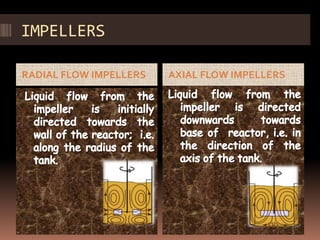
IMPELLERS

RADIAL FLOW IMPELLERS   AXIAL FLOW IMPELLERS
• DEPENDS ON REYNOLDS , FROUDE AND POWER NUMBERS.

•THE RATIO OF DIAMETERS OF IMPELLER AND VESSEL FALLS IN THE
RANGE, D/D,=0.3-0.6,


•WITH      COMMERCIALLY          AVAILABLE      MOTORS     AND   SPEED
REDUCERS,                 STANDARD                SPEEDS           ARE
37, 45, 56, 68, 84, 100, 125, 155, 190, AND 320 rpm


•EXPERT OPINIONS DIFFER SOMEWHAT ON THIS FACTOR. AS A
FIRST APPROXIMATION, THE IMPELLER CAN BE PLACED AT 1/6 THE
LIQUID LEVEL OFF THE BOTTOM.
MECHANISM OF MIXING


            DISTRIBUTION


            MECHANISM
            OF MIXING


DIFFUSION                  DISPERSION
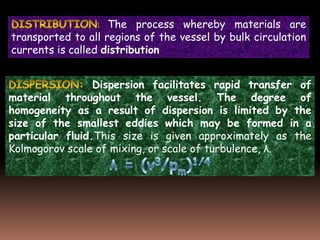
:  The process whereby materials are
transported to all regions of the vessel by bulk circulation
currents is called distribution


                 Dispersion facilitates rapid transfer of
material throughout the vessel. The degree of
homogeneity as a result of dispersion is limited by the
size of the smallest eddies which may be formed in a
particular fluid.This size is given approximately as the
Kolmogorov scale of mixing, or scale of turbulence, λ.
ASSESING MIXING TIME


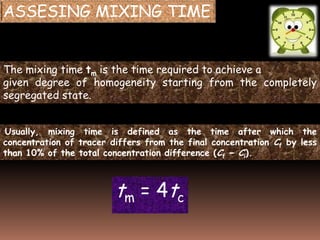
The mixing time tm is the time required to achieve a
given degree of homogeneity starting from the completely
segregated state.


Usually, mixing time is defined as the time after which the
concentration of tracer differs from the final concentration Cf by less
than 10% of the total concentration difference (Cf − Ci).


                         tm = 4 tc
REYNOLDS NUMBER


 •Where Da is the impeller (agitator) diameter in m,
 •N is rotational speed in rev/s,
 •ρ is fluid density in kg/m3,
 • μ is viscosity in kg/m · s.
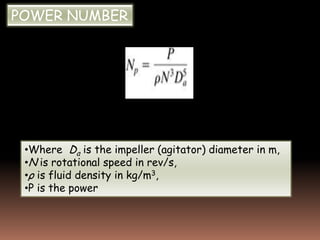
POWER NUMBER


 •Where Da is the impeller (agitator) diameter in m,
 •N is rotational speed in rev/s,
 •ρ is fluid density in kg/m3,
 •P is the power
UNGASSED NEWTONIAN FLUIDS:

Mixing power for non aerated fluid depends on:
•the stirrer speed
•the impeller diameter and geometry
•the properties of the fluid (i.e density and viscosity)

The relationship of these variables is expressed in terms of
dimensionless numbers such as Reynolds number, Re and
power number, Np :

POWER NUMBER is given by:
                    Np = P/Ni3 p Di5
Once value of Np is known, the power required is calculated
                             by:


                          P=NppNi3Di5


where:
P = power; ρ = fluid density; N = stirrer speed, D = impeller
diameter
the apparent viscosity is not constant for non-
Newtonian fluids but varies with the shear rates or
velocity gradients in the vessel. Several investigators
have used an average apparent viscosity μa, which is
used in the Reynolds number as follows:
IMPROVING MIXING IN FERMENTERS

Liquid mixing

  • 2.
    Mixing is definedas the reduction of inhomogeneinty in order to achieve a desired process result. The inhomgeneity can be one of the concentration, phase or temperature. Agitation is a mean whereby mixing of phases can be accomplished and by which mass and heat transfer can be enhanced between phases and with external surfaces.
  • 4.
  • 5.
    IMPELLERS RADIAL FLOW IMPELLERS AXIAL FLOW IMPELLERS
  • 7.
    • DEPENDS ONREYNOLDS , FROUDE AND POWER NUMBERS. •THE RATIO OF DIAMETERS OF IMPELLER AND VESSEL FALLS IN THE RANGE, D/D,=0.3-0.6, •WITH COMMERCIALLY AVAILABLE MOTORS AND SPEED REDUCERS, STANDARD SPEEDS ARE 37, 45, 56, 68, 84, 100, 125, 155, 190, AND 320 rpm •EXPERT OPINIONS DIFFER SOMEWHAT ON THIS FACTOR. AS A FIRST APPROXIMATION, THE IMPELLER CAN BE PLACED AT 1/6 THE LIQUID LEVEL OFF THE BOTTOM.
  • 8.
    MECHANISM OF MIXING DISTRIBUTION MECHANISM OF MIXING DIFFUSION DISPERSION
  • 9.
    : Theprocess whereby materials are transported to all regions of the vessel by bulk circulation currents is called distribution Dispersion facilitates rapid transfer of material throughout the vessel. The degree of homogeneity as a result of dispersion is limited by the size of the smallest eddies which may be formed in a particular fluid.This size is given approximately as the Kolmogorov scale of mixing, or scale of turbulence, λ.
  • 11.
    ASSESING MIXING TIME Themixing time tm is the time required to achieve a given degree of homogeneity starting from the completely segregated state. Usually, mixing time is defined as the time after which the concentration of tracer differs from the final concentration Cf by less than 10% of the total concentration difference (Cf − Ci). tm = 4 tc
  • 13.
    REYNOLDS NUMBER •WhereDa is the impeller (agitator) diameter in m, •N is rotational speed in rev/s, •ρ is fluid density in kg/m3, • μ is viscosity in kg/m · s.
  • 14.
    POWER NUMBER •WhereDa is the impeller (agitator) diameter in m, •N is rotational speed in rev/s, •ρ is fluid density in kg/m3, •P is the power
  • 15.
    UNGASSED NEWTONIAN FLUIDS: Mixingpower for non aerated fluid depends on: •the stirrer speed •the impeller diameter and geometry •the properties of the fluid (i.e density and viscosity) The relationship of these variables is expressed in terms of dimensionless numbers such as Reynolds number, Re and power number, Np : POWER NUMBER is given by: Np = P/Ni3 p Di5
  • 16.
    Once value ofNp is known, the power required is calculated by: P=NppNi3Di5 where: P = power; ρ = fluid density; N = stirrer speed, D = impeller diameter
  • 17.
    the apparent viscosityis not constant for non- Newtonian fluids but varies with the shear rates or velocity gradients in the vessel. Several investigators have used an average apparent viscosity μa, which is used in the Reynolds number as follows:
  • 18.