CONTENTS
Introduction
Objectives of the Pilot Plant
Reasons for pilot plant
Significance of pilot plant
Importance of the Pilot Plant
Pilot plant design for tablets
Pilot plant scale-up techniques for capsules
References
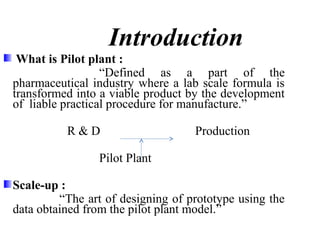
Introduction
What is Pilot plant :
“Defined as a part of the
pharmaceutical industry where a lab scale formula is
transformed into a viable product by the development
of liable practical procedure for manufacture.”
R & D Production
Pilot Plant
Scale-up :
“The art of designing of prototype using the
data obtained from the pilot plant model.”
Objectives of Pilot Plant
“Find mistakes on small scale and make profit on
large scale.”
To produce physically and chemically stable
therapeutic dosage forms.
Review of the processing equipment.
Guidelines for productions and process control.
Evaluation and validation.
To identify the critical features of the process.
To provide master manufacturing formula.
REASONS FOR BUILDING A PILOT PLANT
• To evaluate on process of large change in
scale up operation.
• To find and examine all by-products or waste .
• To produce a trail lot of quantities of material.
• Clinical studies ,analytical development
,process development, stability testing.
SIGNIFICANCE OF PILOT PLANT
• Examination of formulae.
• Review of range of relevant processing
equipments.
• production rate adjustment.
• Idea about physical space required.
• Appropriate records and reports to support
GMP.
• Identification of critical features to maintain
quality.
Importance of Pilot Plant
Examination of formulae.
Review of range of relevant processing
equipments.
The specification of the raw materials.
Production rates.
The physical space required.
Appropriate records and reports to support
GMP.
Pilot Plant design for Tablets
The primary responsibility of the pilot plant staff is to
ensure that the newly formulated tablets developed by
product development personnel will prove to be
efficiently, economically, and consistently
reproducible on a production scale.
The design and construction of the pharmaceutical
pilot plant for tablet development should incorporate
features necessary to facilitate maintenance and
cleanliness.
If possible, it should be located on the ground floor to
expedite the delivery and shipment of supplies.
Extraneous and microbiological contamination must be guarded
against by incorporating the following features in the pilot plant
design:
design:
1.
1.Fluorescent lighting fixtures should be the ceiling flush type.
Fluorescent lighting fixtures should be the ceiling flush type.
2.
2.The various operating areas should have floor drains to simplify
The various operating areas should have floor drains to simplify
cleaning.
cleaning.
3.
3.The area should be air-conditioned and humidity controlled.
The area should be air-conditioned and humidity controlled.
4.
4.High -density concrete floors should be installed.
High -density concrete floors should be installed.
5.
5.The walls in the processing and packaging areas should be
The walls in the processing and packaging areas should be
enamel cement finish on concrete.
6.
6.Equipment in the pharmaceutical pilot plant should be similar to
Equipment in the pharmaceutical pilot plant should be similar to
that used by production division- manufacture of tablets.
Material handling system
In the laboratory, materials are simply scooped or poured
by hand, but in intermediate- or large-scale operations,
handling of this materials often become necessary.
If a system is used to transfer materials for more than one
product steps must be taken to prevent cross
contamination.
Any material handling system must deliver the accurate
amount of the ingredient to the destination.
The type of system selected also depends on the
characteristics of the materials.
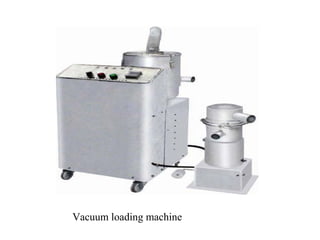
More sophisticated methods of handling materials such as
vacuum loading systems, metering pumps, screw feed
system.
Vacuum loading machine
Dry Blending
Powders to be used for encapsulation or to be
granulated must be well blended to ensure good drug
distribution.
Inadequate blending at this stage could result in discrete
portion of the batch being either high or low in potency.
Steps should also be taken to ensure that all the
ingredients are free of lumps and agglomerates.
For these reasons, screening and/or milling of the
ingredients usually makes the process more reliable and
reproducible.
The equipment used for blending are:
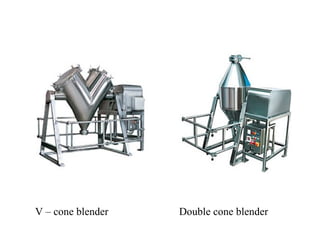
V- blender
Double cone blender
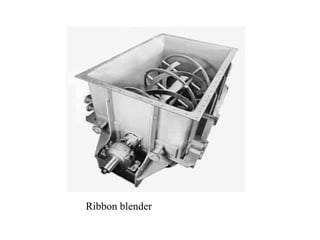
Ribbon blender
Slant cone blender
Bin blender
Orbiting screw blenders vertical and horizontal high
intensity mixers.
SCALE UP CONSIDERATIONS
 Time of blending .
Blender loading.
Size of blender.
V – cone blender Double cone blender
Ribbon blender
Granulation
The most common reasons given to justify granulating
are:
1.To impart good flow properties to the material,
2.To increase the apparent density of the powders,
3.To change the particle size distribution,
4.Uniform dispersion of active ingredient.
Traditionally, wet granulation has been carried out using,
Sigma blade mixer,
Heavy-duty planetary mixer.
Binders:
Used in tablet formulations to make powders more
compressible and to produce tablets that are more resistant
to breakage during handling.
In some instances the binding agent imparts viscosity to
the granulating solution so that transfer of fluid becomes
difficult.
This problem can be overcome by adding some or all
binding agents in the dry powder prior to granulation.
Some granulation, when prepared in
production sized equipment, take on a dough-
like consistency and may have to be
subdivided to a more granular and porous mass
to facilitate drying.
This can be accomplished by passing the wet
mass through an oscillating type granulator
with a suitably large screen or a hammer mill
with either a suitably large screen or no screen
at all.
Drying
The most common conventional method of drying a
granulation continues to be the circulating hot air oven, which
is heated by either steam or electricity.
The important factor to consider as part of scale-up of an oven
drying operation are airflow, air temperature, and the depth of
the granulation on the trays.
If the granulation bed is too deep or too dense, the drying
process will be inefficient, and if soluble dyes are involved,
migration of the dye to the surface of the granules.
Drying times at specified temperatures and airflow rates must
be established for each product, and for each particular oven
load.
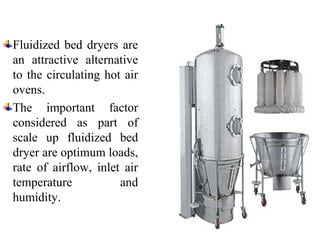
Fluidized bed dryers are
an attractive alternative
to the circulating hot air
ovens.
The important factor
considered as part of
scale up fluidized bed
dryer are optimum loads,
rate of airflow, inlet air
temperature and
humidity.
Reduction of Particle size
Compression factors that may be affected by the particle size
distribution are flowability, compressibility, uniformity of
tablet weight, content uniformity, tablet hardness, and tablet
color uniformity.
First step in this process is to determine the particle size
distribution of granulation using a series of “stacked” sieves of
decreasing mesh openings.
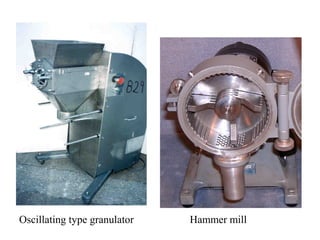
Particle size reduction of the dried granulation of production
size batches can be carried out by passing all the material
through an oscillating granulator, a hammer mill, a mechanical
sieving device, or in some cases, a screening device.
Oscillating type granulator Hammer mill
Blending
Type of blending equipment often differs from that using
in laboratory.
In any blending operation, both segregation and mixing
occur simultaneously are a function of particle size, shape,
hardness, and density, and of the dynamics of the mixing
action.
Particle abrasion is more likely to occur when high-shear
mixers with spiral screws or blades are used.
When a low dose active ingredient is to be blended it may
be sandwiched between two portions of directly
compressible excipients to avoid loss to the surface of the
blender.
Equipments used for mixing
Sigma blade mixer.
Planetary mixer.
Twin shell blender.
High shear mixer
Slugging (Dry Granulation)
A dry powder blend that cannot be directly compressed
because of poor flow or compression properties.
This is done on a tablet press designed for slugging, which
operates at pressures of about 15 tons, compared with a normal
tablet press, which operates at pressure of 4 tons or less.
Slugs range in diameter from 1 inch, for the more easily
slugged material, to ¾ inch in diameter for materials that are
more difficult to compress and require more pressure per unit
area to yield satisfactory compacts.
If an excessive amount of fine powder is generated during the
milling operation the material must be screened & fines
recycled through the slugging operation.
Dry Compaction
Granulation by dry compaction can also be achieved by
passing powders between two rollers that compact the material
at pressure of up to 10 tons per linear inch.
Materials of very low density require roller compaction to
achieve a bulk density sufficient to allow encapsulation or
compression.
One of the best examples of this process is the densification of
aluminum hydroxide.
Pilot plant personnel should determine whether the final drug
blend or the active ingredient could be more efficiently
processed in this manner than by conventional processing in
order to produce a granulation with the required tabletting or
encapsulation properties.
Compression
The ultimate test of a tablet formulation and granulation
process is whether the granulation can be compressed on a
high-speed tablet press.
During compression, the tablet press performs the
following functions:
1.Filling of empty die cavity with granulation.
2.Precompression of granulation (optional).
3.Compression of granules.
4.Ejection of the tablet from the die cavity and take-off of
compressed tablet.
When evaluating the compression characteristics of a particular
formulation, prolonged trial runs at press speeds equal to that to be
used in normal production should be tried.
Only then are potential problems such as sticking to the punch
surface, tablet hardness, capping, and weight variation detected.
High-speed tablet compression depends on the ability of the press
to interact with granulation.
Following are the parameters to be considered while choosing
speed of press.
1.Granulation feed rate.
2.Delivery system should not change the particle size distribution.
3.System should not cause segregation of coarse and fine particles,
nor it should induce static charges.
The die feed system must be able to fill the die
cavities adequately in the short period of time that
the die is passing under the feed frame.
The smaller the tablet , the more difficult it is to
get a uniform fill a high press speeds.
For high-speed machines, induced die feed
systems is necessary.
These are available with a variety of feed paddles
and with variable speed capabilities.
So that optimum feed for every granulation can
be obtained.
After the die cavities are filled ,the excess is removed
by the feed frame to the center of the die table.
Compression of the granulation usually occurs as a
single event as the heads of the punches pass over the
lower and under the upper pressure rollers.
This cause the punches to the penetrate the die to a
preset depth, compacting the granulation to the
thickness of the gap set between the punches.
The rapidity and dwell time in between this press event
occurs is determined by the speed at which the press is
rotating and by the size of compression rollers.
Larger the compressions roller, the more gradually
Pilot Plant scale-up techniques for
Capsule
Capsules are solid dosage forms in which the drug
substance is enclosed in either a hard or soft soluble
container or shell of a suitable form of gelatin.
Steps in capsule production
1.Mixing of ingredient
2.Granulation and lubrication
3.Making of capsules
4.Filling of capsules
5.Uniformity testing
6.Packing and labeling
The manufacturing process for capsulated products
often same to that tablets.
Both tablets & capsules are produced from ingredients
that may be either dry blended or wet granulated to
produce a dry powder or granule mix with uniformly
dispersed active ingredients.
To produce capsules on high speed equipment ,the
powder blend must have the uniform particle size
distribution, bulk density & compressibility required
to promote good flow properties & result in the
formation of compact of the right size and sufficient
cohesiveness to be filled in to capsule shells.
Manufacture of Hard Gelatin Capsules
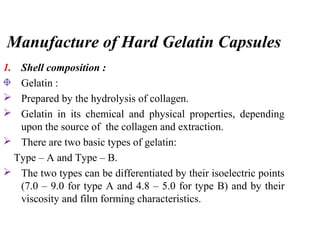
1. Shell composition :
Gelatin :
 Prepared by the hydrolysis of collagen.
 Gelatin in its chemical and physical properties, depending
upon the source of the collagen and extraction.
 There are two basic types of gelatin:
Type – A and Type – B.
 The two types can be differentiated by their isoelectric points
(7.0 – 9.0 for type A and 4.8 – 5.0 for type B) and by their
viscosity and film forming characteristics.
Combination of pork skin and bone gelatin are often used to
optimize shell characteristics.
The physicochemical properties of gelatin of most interest to
shell manufactures are the bloom strength and viscosity.
Colorants :
Various soluble synthetic dyes (“coal tar dyes”) and insoluble
pigments are used.
Not only play a role in identifying the product, but also may
play a role in improving patient compliance.
E.g., white, analgesia; lavender, hallucinogenic effects; orange or
yellow, stimulants and antidepressants.
Opaquing agents :
Titanium dioxide may be included to render
the shell opaque.
Opaque capsules may be employed to provide
protection against light or to conceal the
contents.
Preservatives :
When preservatives are employed, parabens
are often selected.
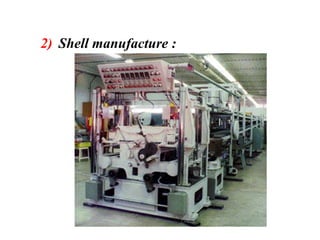
2) Shell manufacture :
I.
I. Dipping :
Dipping :
 Pairs of the stainless steel pins are dipped into the dipping
Pairs of the stainless steel pins are dipped into the dipping
solution to simultaneously form the caps and bodies.
 The pins are at ambient temperature; whereas the dipping
The pins are at ambient temperature; whereas the dipping
solution is maintained at a temperature of about 50
solution is maintained at a temperature of about 500
0
C in a
C in a
heated, jacketed dipping pan.
 The length of time to cast the film has been reported to be
The length of time to cast the film has been reported to be
about 12 sec.
about 12 sec.
II.
II. Rotation :
Rotation :
 After dipping, pins are elevated and rotated 2-1/2 times until
After dipping, pins are elevated and rotated 2-1/2 times until
they are facing upward.
 This rotation helps to distribute the gelatin over the pins
This rotation helps to distribute the gelatin over the pins
uniformly and to avoid the formation of a bead at the capsule
ends.
ends.
III.Drying :
 The racks of gelatin coated pins then pass into a
series of four drying oven.
 Drying is mainly done by dehumidification.
 A temperature elevation of only a less degrees is
permissible to prevent film melting.
 Under drying will leave the films too sticky for
subsequent operation.
IV. Stripping :
 A series of bronze jaws strip the cap and body
portions of the capsules from the pins.
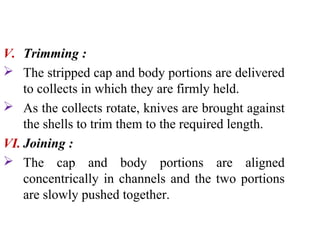
V. Trimming :
 The stripped cap and body portions are delivered
to collects in which they are firmly held.
 As the collects rotate, knives are brought against
the shells to trim them to the required length.
VI. Joining :
 The cap and body portions are aligned
concentrically in channels and the two portions
are slowly pushed together.
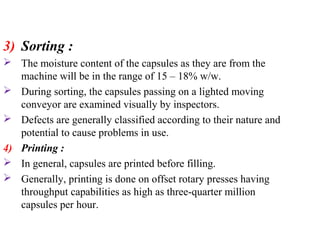
3) Sorting :
 The moisture content of the capsules as they are from the
machine will be in the range of 15 – 18% w/w.
 During sorting, the capsules passing on a lighted moving
conveyor are examined visually by inspectors.
 Defects are generally classified according to their nature and
potential to cause problems in use.
4) Printing :
 In general, capsules are printed before filling.
 Generally, printing is done on offset rotary presses having
throughput capabilities as high as three-quarter million
capsules per hour.
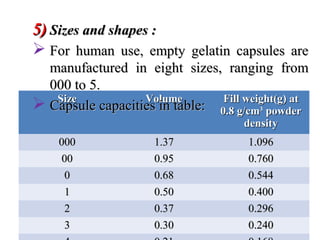
Size
Size Volume
Volume Fill weight(g) at
Fill weight(g) at
0.8 g/cm
0.8 g/cm3
3
powder
powder
density
density
000
000 1.37
1.37 1.096
1.096
00
00 0.95
0.95 0.760
0.760
0
0 0.68
0.68 0.544
0.544
1
1 0.50
0.50 0.400
0.400
2
2 0.37
0.37 0.296
0.296
3
3 0.30
0.30 0.240
0.240
5)
5) Sizes and shapes :
Sizes and shapes :
 For human use, empty gelatin capsules are
For human use, empty gelatin capsules are
manufactured in eight sizes, ranging from
000 to 5.
000 to 5.
 Capsule capacities in table:
Capsule capacities in table:
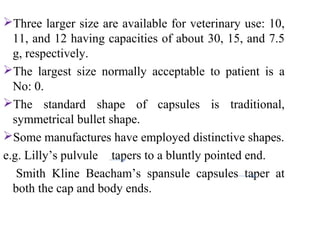
Three larger size are available for veterinary use: 10,
11, and 12 having capacities of about 30, 15, and 7.5
g, respectively.
The largest size normally acceptable to patient is a
No: 0.
The standard shape of capsules is traditional,
symmetrical bullet shape.
Some manufactures have employed distinctive shapes.
e.g. Lilly’s pulvule tapers to a bluntly pointed end.
Smith Kline Beacham’s spansule capsules taper at
both the cap and body ends.
6) Sealing :
 Capsules are sealed and somewhat reshaped in
the Etaseal process.
 This thermal welding process forms an indented
ring around the waist of the capsule where the
cap overlaps the body.
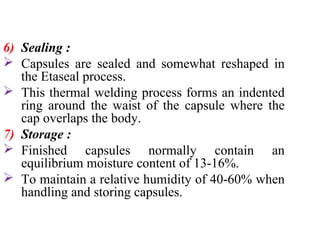
7) Storage :
 Finished capsules normally contain an
equilibrium moisture content of 13-16%.
 To maintain a relative humidity of 40-60% when
handling and storing capsules.
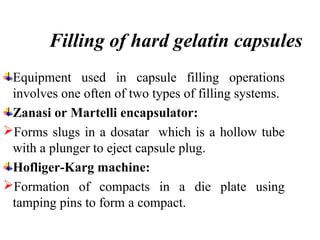
Filling of hard gelatin capsules
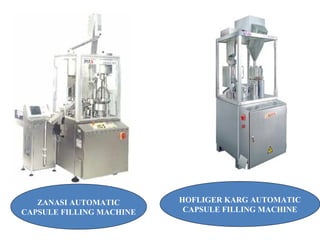
Equipment used in capsule filling operations
involves one often of two types of filling systems.
Zanasi or Martelli encapsulator:
Forms slugs in a dosatar which is a hollow tube
with a plunger to eject capsule plug.
Hofliger-Karg machine:
Formation of compacts in a die plate using
tamping pins to form a compact.
HOFLIGER KARG AUTOMATIC
CAPSULE FILLING MACHINE
ZANASI AUTOMATIC
CAPSULE FILLING MACHINE
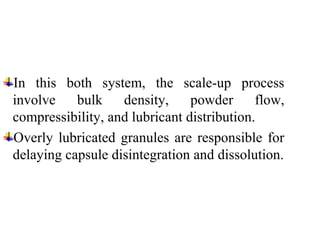
In this both system, the scale-up process
involve bulk density, powder flow,
compressibility, and lubricant distribution.
Overly lubricated granules are responsible for
delaying capsule disintegration and dissolution.
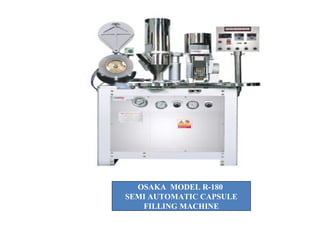
OSAKA MODEL R-180
SEMI AUTOMATIC CAPSULE
FILLING MACHINE
Manufacture of Soft Gelatin
Capsules
I. Composition of the shell:
 Similar to hard gelatin shells, the basic component of
soft gelatin shell is gelatin; however, the shell has been
plasticized.
 The ratio of dry plasticizer to dry gelatin determines the
“hardness” of the shell and can vary from 0.3-1.0 for
very hard shell to 1.0-1.8 for very soft shell.
 Up to 5% sugar may be included to give a “chewable”
quality to the shell.
 The residual shell moisture content of finished capsules
will be in the range of 6-10%.
II.
II. Formulation :
Formulation :
 Formulation for soft gelatin capsules involves
Formulation for soft gelatin capsules involves
liquid, rather than powder technology.
 Materials are generally formulated to produce the
Materials are generally formulated to produce the
smallest possible capsule consistent with maximum
stability, therapeutic effectiveness and manufacture
efficiency.
efficiency.
 The liquids are limited to those that do not have an
The liquids are limited to those that do not have an
adverse effect on gelatin walls.
 The pH of the lipid can be between 2.5 and 7.5.
The pH of the lipid can be between 2.5 and 7.5.
 Emulsion can not be filled because water will be
Emulsion can not be filled because water will be
released that will affect the shell.
The types of vehicles used in soft gelatin capsules fall in to two
main groups:
1. Water immiscible, volatile or more likely more volatile
liquids such as vegetable oils, mineral oils, medium-chain
triglycerides and acetylated glycerides.
2. Water miscible, nonvolatile liquids such as low molecular
weight PEG have come in to use more recently because
of their ability to mix with water readily and accelerate
dissolution of dissolved or suspended drugs.
All liquids used for filling must flow by gravity at a
temperature of 350
c or less.
The sealing temperature of gelatin films is 37-400
C.
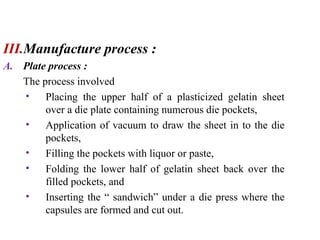
III.Manufacture process :
A. Plate process :
The process involved
• Placing the upper half of a plasticized gelatin sheet
over a die plate containing numerous die pockets,
• Application of vacuum to draw the sheet in to the die
pockets,
• Filling the pockets with liquor or paste,
• Folding the lower half of gelatin sheet back over the
filled pockets, and
• Inserting the “ sandwich” under a die press where the
capsules are formed and cut out.
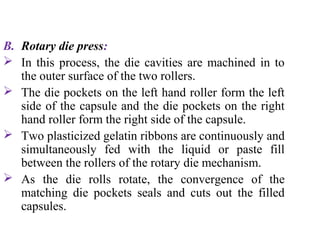
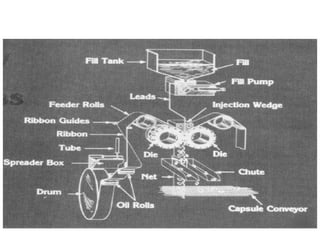
B. Rotary die press:
 In this process, the die cavities are machined in to
the outer surface of the two rollers.
 The die pockets on the left hand roller form the left
side of the capsule and the die pockets on the right
hand roller form the right side of the capsule.
 Two plasticized gelatin ribbons are continuously and
simultaneously fed with the liquid or paste fill
between the rollers of the rotary die mechanism.
 As the die rolls rotate, the convergence of the
matching die pockets seals and cuts out the filled
capsules.
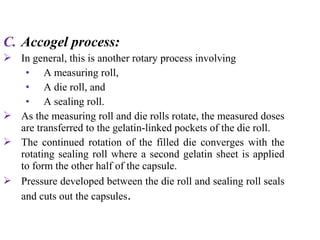
C. Accogel process:
 In general, this is another rotary process involving
• A measuring roll,
• A die roll, and
• A sealing roll.
 As the measuring roll and die rolls rotate, the measured doses
are transferred to the gelatin-linked pockets of the die roll.
 The continued rotation of the filled die converges with the
rotating sealing roll where a second gelatin sheet is applied
to form the other half of the capsule.
 Pressure developed between the die roll and sealing roll seals
and cuts out the capsules.
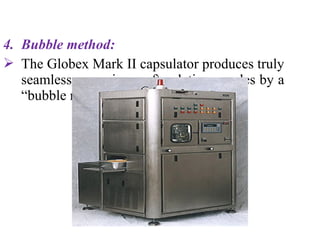
4. Bubble method:
 The Globex Mark II capsulator produces truly
seamless, one-piece soft gelatin capsules by a
“bubble method”.
 A concentric tube dispenser simultaneously
discharges the molten gelatin from the outer annulus
and the liquid content from the tube.
 By means of a pulsating pump mechanism, the
liquids are discharged from the concentric tube
orifice into a chilled-oil column as droplets that
consists of a liquid medicament core within a molten
gelatin envelop.
 The droplets assume a spherical shape under surface
tension forces and the gelatin congeals on cooling.
 The finished capsules must be degreased and dried.
IV. Soft/Liquid-filled hard gelatin capsules:
 Important reason: the standard for liquid filled
capsules was inability to prevent leakage from hard
gelatin capsules.
 As banding and of self-locking hard gelatin
capsules, together with the development of high-
resting state viscosity fills, has now made
liquid/semisolid-filled hard gelatin capsules.
 As with soft gelatin capsules, any materials filled
into hard capsules must not dissolve, alter or
otherwise adversely affect the integrity of the shell.
 Generally, the fill material must be pumpable.
Three formulation strategies based on having a high resting
viscosity after filling have been described.
1. Thixotropic formulations,
2. Thermal-setting formulations,
3. Mixed thermal-Thixotropic systems.
The more lipophilic contents, the slower the release rate.
Thus, by selecting excipients with varying HLB balance,
varying release rate may be achieved.
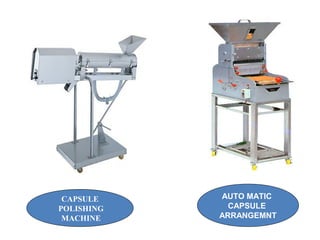
CAPSULE
POLISHING
MACHINE
AUTO MATIC
CAPSULE
ARRANGEMNT

pilotplantdesignfortabletsandcapsules-140930004246-phpapp01 (1).pdf

  • 2.
    CONTENTS Introduction Objectives of thePilot Plant Reasons for pilot plant Significance of pilot plant Importance of the Pilot Plant Pilot plant design for tablets Pilot plant scale-up techniques for capsules References
  • 3.
    Introduction What is Pilotplant : “Defined as a part of the pharmaceutical industry where a lab scale formula is transformed into a viable product by the development of liable practical procedure for manufacture.” R & D Production Pilot Plant Scale-up : “The art of designing of prototype using the data obtained from the pilot plant model.”
  • 4.
    Objectives of PilotPlant “Find mistakes on small scale and make profit on large scale.” To produce physically and chemically stable therapeutic dosage forms. Review of the processing equipment. Guidelines for productions and process control. Evaluation and validation. To identify the critical features of the process. To provide master manufacturing formula.
  • 5.
    REASONS FOR BUILDINGA PILOT PLANT • To evaluate on process of large change in scale up operation. • To find and examine all by-products or waste . • To produce a trail lot of quantities of material. • Clinical studies ,analytical development ,process development, stability testing.
  • 6.
    SIGNIFICANCE OF PILOTPLANT • Examination of formulae. • Review of range of relevant processing equipments. • production rate adjustment. • Idea about physical space required. • Appropriate records and reports to support GMP. • Identification of critical features to maintain quality.
  • 7.
    Importance of PilotPlant Examination of formulae. Review of range of relevant processing equipments. The specification of the raw materials. Production rates. The physical space required. Appropriate records and reports to support GMP.
  • 8.
    Pilot Plant designfor Tablets The primary responsibility of the pilot plant staff is to ensure that the newly formulated tablets developed by product development personnel will prove to be efficiently, economically, and consistently reproducible on a production scale. The design and construction of the pharmaceutical pilot plant for tablet development should incorporate features necessary to facilitate maintenance and cleanliness. If possible, it should be located on the ground floor to expedite the delivery and shipment of supplies.
  • 9.
    Extraneous and microbiologicalcontamination must be guarded Extraneous and microbiological contamination must be guarded against by incorporating the following features in the pilot plant against by incorporating the following features in the pilot plant design: design: 1. 1.Fluorescent lighting fixtures should be the ceiling flush type. Fluorescent lighting fixtures should be the ceiling flush type. 2. 2.The various operating areas should have floor drains to simplify The various operating areas should have floor drains to simplify cleaning. cleaning. 3. 3.The area should be air-conditioned and humidity controlled. The area should be air-conditioned and humidity controlled. 4. 4.High -density concrete floors should be installed. High -density concrete floors should be installed. 5. 5.The walls in the processing and packaging areas should be The walls in the processing and packaging areas should be enamel cement finish on concrete. enamel cement finish on concrete. 6. 6.Equipment in the pharmaceutical pilot plant should be similar to Equipment in the pharmaceutical pilot plant should be similar to that used by production division- manufacture of tablets. that used by production division- manufacture of tablets.
  • 10.
    Material handling system Inthe laboratory, materials are simply scooped or poured by hand, but in intermediate- or large-scale operations, handling of this materials often become necessary. If a system is used to transfer materials for more than one product steps must be taken to prevent cross contamination. Any material handling system must deliver the accurate amount of the ingredient to the destination. The type of system selected also depends on the characteristics of the materials. More sophisticated methods of handling materials such as vacuum loading systems, metering pumps, screw feed system.
  • 11.
  • 12.
    Dry Blending Powders tobe used for encapsulation or to be granulated must be well blended to ensure good drug distribution. Inadequate blending at this stage could result in discrete portion of the batch being either high or low in potency. Steps should also be taken to ensure that all the ingredients are free of lumps and agglomerates. For these reasons, screening and/or milling of the ingredients usually makes the process more reliable and reproducible.
  • 13.
    The equipment usedfor blending are: V- blender Double cone blender Ribbon blender Slant cone blender Bin blender Orbiting screw blenders vertical and horizontal high intensity mixers. SCALE UP CONSIDERATIONS  Time of blending . Blender loading. Size of blender.
  • 14.
    V – coneblender Double cone blender
  • 15.
  • 16.
    Granulation The most commonreasons given to justify granulating are: 1.To impart good flow properties to the material, 2.To increase the apparent density of the powders, 3.To change the particle size distribution, 4.Uniform dispersion of active ingredient. Traditionally, wet granulation has been carried out using, Sigma blade mixer, Heavy-duty planetary mixer.
  • 17.
    Binders: Used in tabletformulations to make powders more compressible and to produce tablets that are more resistant to breakage during handling. In some instances the binding agent imparts viscosity to the granulating solution so that transfer of fluid becomes difficult. This problem can be overcome by adding some or all binding agents in the dry powder prior to granulation.
  • 18.
    Some granulation, whenprepared in production sized equipment, take on a dough- like consistency and may have to be subdivided to a more granular and porous mass to facilitate drying. This can be accomplished by passing the wet mass through an oscillating type granulator with a suitably large screen or a hammer mill with either a suitably large screen or no screen at all.
  • 19.
    Drying The most commonconventional method of drying a granulation continues to be the circulating hot air oven, which is heated by either steam or electricity. The important factor to consider as part of scale-up of an oven drying operation are airflow, air temperature, and the depth of the granulation on the trays. If the granulation bed is too deep or too dense, the drying process will be inefficient, and if soluble dyes are involved, migration of the dye to the surface of the granules. Drying times at specified temperatures and airflow rates must be established for each product, and for each particular oven load.
  • 20.
    Fluidized bed dryersare an attractive alternative to the circulating hot air ovens. The important factor considered as part of scale up fluidized bed dryer are optimum loads, rate of airflow, inlet air temperature and humidity.
  • 21.
    Reduction of Particlesize Compression factors that may be affected by the particle size distribution are flowability, compressibility, uniformity of tablet weight, content uniformity, tablet hardness, and tablet color uniformity. First step in this process is to determine the particle size distribution of granulation using a series of “stacked” sieves of decreasing mesh openings. Particle size reduction of the dried granulation of production size batches can be carried out by passing all the material through an oscillating granulator, a hammer mill, a mechanical sieving device, or in some cases, a screening device.
  • 22.
  • 23.
    Blending Type of blendingequipment often differs from that using in laboratory. In any blending operation, both segregation and mixing occur simultaneously are a function of particle size, shape, hardness, and density, and of the dynamics of the mixing action. Particle abrasion is more likely to occur when high-shear mixers with spiral screws or blades are used. When a low dose active ingredient is to be blended it may be sandwiched between two portions of directly compressible excipients to avoid loss to the surface of the blender.
  • 24.
    Equipments used formixing Sigma blade mixer. Planetary mixer. Twin shell blender. High shear mixer
  • 25.
    Slugging (Dry Granulation) Adry powder blend that cannot be directly compressed because of poor flow or compression properties. This is done on a tablet press designed for slugging, which operates at pressures of about 15 tons, compared with a normal tablet press, which operates at pressure of 4 tons or less. Slugs range in diameter from 1 inch, for the more easily slugged material, to ¾ inch in diameter for materials that are more difficult to compress and require more pressure per unit area to yield satisfactory compacts. If an excessive amount of fine powder is generated during the milling operation the material must be screened & fines recycled through the slugging operation.
  • 26.
    Dry Compaction Granulation bydry compaction can also be achieved by passing powders between two rollers that compact the material at pressure of up to 10 tons per linear inch. Materials of very low density require roller compaction to achieve a bulk density sufficient to allow encapsulation or compression. One of the best examples of this process is the densification of aluminum hydroxide. Pilot plant personnel should determine whether the final drug blend or the active ingredient could be more efficiently processed in this manner than by conventional processing in order to produce a granulation with the required tabletting or encapsulation properties.
  • 27.
    Compression The ultimate testof a tablet formulation and granulation process is whether the granulation can be compressed on a high-speed tablet press. During compression, the tablet press performs the following functions: 1.Filling of empty die cavity with granulation. 2.Precompression of granulation (optional). 3.Compression of granules. 4.Ejection of the tablet from the die cavity and take-off of compressed tablet.
  • 28.
    When evaluating thecompression characteristics of a particular formulation, prolonged trial runs at press speeds equal to that to be used in normal production should be tried. Only then are potential problems such as sticking to the punch surface, tablet hardness, capping, and weight variation detected. High-speed tablet compression depends on the ability of the press to interact with granulation. Following are the parameters to be considered while choosing speed of press. 1.Granulation feed rate. 2.Delivery system should not change the particle size distribution. 3.System should not cause segregation of coarse and fine particles, nor it should induce static charges.
  • 29.
    The die feedsystem must be able to fill the die cavities adequately in the short period of time that the die is passing under the feed frame. The smaller the tablet , the more difficult it is to get a uniform fill a high press speeds. For high-speed machines, induced die feed systems is necessary. These are available with a variety of feed paddles and with variable speed capabilities. So that optimum feed for every granulation can be obtained.
  • 30.
    After the diecavities are filled ,the excess is removed by the feed frame to the center of the die table. Compression of the granulation usually occurs as a single event as the heads of the punches pass over the lower and under the upper pressure rollers. This cause the punches to the penetrate the die to a preset depth, compacting the granulation to the thickness of the gap set between the punches. The rapidity and dwell time in between this press event occurs is determined by the speed at which the press is rotating and by the size of compression rollers. Larger the compressions roller, the more gradually
  • 31.
    Pilot Plant scale-uptechniques for Capsule Capsules are solid dosage forms in which the drug substance is enclosed in either a hard or soft soluble container or shell of a suitable form of gelatin. Steps in capsule production 1.Mixing of ingredient 2.Granulation and lubrication 3.Making of capsules 4.Filling of capsules 5.Uniformity testing 6.Packing and labeling
  • 32.
    The manufacturing processfor capsulated products often same to that tablets. Both tablets & capsules are produced from ingredients that may be either dry blended or wet granulated to produce a dry powder or granule mix with uniformly dispersed active ingredients. To produce capsules on high speed equipment ,the powder blend must have the uniform particle size distribution, bulk density & compressibility required to promote good flow properties & result in the formation of compact of the right size and sufficient cohesiveness to be filled in to capsule shells.
  • 33.
    Manufacture of HardGelatin Capsules 1. Shell composition : Gelatin :  Prepared by the hydrolysis of collagen.  Gelatin in its chemical and physical properties, depending upon the source of the collagen and extraction.  There are two basic types of gelatin: Type – A and Type – B.  The two types can be differentiated by their isoelectric points (7.0 – 9.0 for type A and 4.8 – 5.0 for type B) and by their viscosity and film forming characteristics.
  • 34.
    Combination of porkskin and bone gelatin are often used to optimize shell characteristics. The physicochemical properties of gelatin of most interest to shell manufactures are the bloom strength and viscosity. Colorants : Various soluble synthetic dyes (“coal tar dyes”) and insoluble pigments are used. Not only play a role in identifying the product, but also may play a role in improving patient compliance. E.g., white, analgesia; lavender, hallucinogenic effects; orange or yellow, stimulants and antidepressants.
  • 35.
    Opaquing agents : Titaniumdioxide may be included to render the shell opaque. Opaque capsules may be employed to provide protection against light or to conceal the contents. Preservatives : When preservatives are employed, parabens are often selected.
  • 36.
  • 37.
    I. I. Dipping : Dipping:  Pairs of the stainless steel pins are dipped into the dipping Pairs of the stainless steel pins are dipped into the dipping solution to simultaneously form the caps and bodies. solution to simultaneously form the caps and bodies.  The pins are at ambient temperature; whereas the dipping The pins are at ambient temperature; whereas the dipping solution is maintained at a temperature of about 50 solution is maintained at a temperature of about 500 0 C in a C in a heated, jacketed dipping pan. heated, jacketed dipping pan.  The length of time to cast the film has been reported to be The length of time to cast the film has been reported to be about 12 sec. about 12 sec. II. II. Rotation : Rotation :  After dipping, pins are elevated and rotated 2-1/2 times until After dipping, pins are elevated and rotated 2-1/2 times until they are facing upward. they are facing upward.  This rotation helps to distribute the gelatin over the pins This rotation helps to distribute the gelatin over the pins uniformly and to avoid the formation of a bead at the capsule uniformly and to avoid the formation of a bead at the capsule ends. ends.
  • 38.
    III.Drying :  Theracks of gelatin coated pins then pass into a series of four drying oven.  Drying is mainly done by dehumidification.  A temperature elevation of only a less degrees is permissible to prevent film melting.  Under drying will leave the films too sticky for subsequent operation. IV. Stripping :  A series of bronze jaws strip the cap and body portions of the capsules from the pins.
  • 39.
    V. Trimming : The stripped cap and body portions are delivered to collects in which they are firmly held.  As the collects rotate, knives are brought against the shells to trim them to the required length. VI. Joining :  The cap and body portions are aligned concentrically in channels and the two portions are slowly pushed together.
  • 40.
    3) Sorting : The moisture content of the capsules as they are from the machine will be in the range of 15 – 18% w/w.  During sorting, the capsules passing on a lighted moving conveyor are examined visually by inspectors.  Defects are generally classified according to their nature and potential to cause problems in use. 4) Printing :  In general, capsules are printed before filling.  Generally, printing is done on offset rotary presses having throughput capabilities as high as three-quarter million capsules per hour.
  • 41.
    Size Size Volume Volume Fillweight(g) at Fill weight(g) at 0.8 g/cm 0.8 g/cm3 3 powder powder density density 000 000 1.37 1.37 1.096 1.096 00 00 0.95 0.95 0.760 0.760 0 0 0.68 0.68 0.544 0.544 1 1 0.50 0.50 0.400 0.400 2 2 0.37 0.37 0.296 0.296 3 3 0.30 0.30 0.240 0.240 5) 5) Sizes and shapes : Sizes and shapes :  For human use, empty gelatin capsules are For human use, empty gelatin capsules are manufactured in eight sizes, ranging from manufactured in eight sizes, ranging from 000 to 5. 000 to 5.  Capsule capacities in table: Capsule capacities in table:
  • 42.
    Three larger sizeare available for veterinary use: 10, 11, and 12 having capacities of about 30, 15, and 7.5 g, respectively. The largest size normally acceptable to patient is a No: 0. The standard shape of capsules is traditional, symmetrical bullet shape. Some manufactures have employed distinctive shapes. e.g. Lilly’s pulvule tapers to a bluntly pointed end. Smith Kline Beacham’s spansule capsules taper at both the cap and body ends.
  • 43.
    6) Sealing : Capsules are sealed and somewhat reshaped in the Etaseal process.  This thermal welding process forms an indented ring around the waist of the capsule where the cap overlaps the body. 7) Storage :  Finished capsules normally contain an equilibrium moisture content of 13-16%.  To maintain a relative humidity of 40-60% when handling and storing capsules.
  • 44.
    Filling of hardgelatin capsules Equipment used in capsule filling operations involves one often of two types of filling systems. Zanasi or Martelli encapsulator: Forms slugs in a dosatar which is a hollow tube with a plunger to eject capsule plug. Hofliger-Karg machine: Formation of compacts in a die plate using tamping pins to form a compact.
  • 45.
    HOFLIGER KARG AUTOMATIC CAPSULEFILLING MACHINE ZANASI AUTOMATIC CAPSULE FILLING MACHINE
  • 46.
    In this bothsystem, the scale-up process involve bulk density, powder flow, compressibility, and lubricant distribution. Overly lubricated granules are responsible for delaying capsule disintegration and dissolution.
  • 47.
    OSAKA MODEL R-180 SEMIAUTOMATIC CAPSULE FILLING MACHINE
  • 48.
    Manufacture of SoftGelatin Capsules I. Composition of the shell:  Similar to hard gelatin shells, the basic component of soft gelatin shell is gelatin; however, the shell has been plasticized.  The ratio of dry plasticizer to dry gelatin determines the “hardness” of the shell and can vary from 0.3-1.0 for very hard shell to 1.0-1.8 for very soft shell.  Up to 5% sugar may be included to give a “chewable” quality to the shell.  The residual shell moisture content of finished capsules will be in the range of 6-10%.
  • 49.
    II. II. Formulation : Formulation:  Formulation for soft gelatin capsules involves Formulation for soft gelatin capsules involves liquid, rather than powder technology. liquid, rather than powder technology.  Materials are generally formulated to produce the Materials are generally formulated to produce the smallest possible capsule consistent with maximum smallest possible capsule consistent with maximum stability, therapeutic effectiveness and manufacture stability, therapeutic effectiveness and manufacture efficiency. efficiency.  The liquids are limited to those that do not have an The liquids are limited to those that do not have an adverse effect on gelatin walls. adverse effect on gelatin walls.  The pH of the lipid can be between 2.5 and 7.5. The pH of the lipid can be between 2.5 and 7.5.  Emulsion can not be filled because water will be Emulsion can not be filled because water will be released that will affect the shell. released that will affect the shell.
  • 50.
    The types ofvehicles used in soft gelatin capsules fall in to two main groups: 1. Water immiscible, volatile or more likely more volatile liquids such as vegetable oils, mineral oils, medium-chain triglycerides and acetylated glycerides. 2. Water miscible, nonvolatile liquids such as low molecular weight PEG have come in to use more recently because of their ability to mix with water readily and accelerate dissolution of dissolved or suspended drugs. All liquids used for filling must flow by gravity at a temperature of 350 c or less. The sealing temperature of gelatin films is 37-400 C.
  • 51.
    III.Manufacture process : A.Plate process : The process involved • Placing the upper half of a plasticized gelatin sheet over a die plate containing numerous die pockets, • Application of vacuum to draw the sheet in to the die pockets, • Filling the pockets with liquor or paste, • Folding the lower half of gelatin sheet back over the filled pockets, and • Inserting the “ sandwich” under a die press where the capsules are formed and cut out.
  • 52.
    B. Rotary diepress:  In this process, the die cavities are machined in to the outer surface of the two rollers.  The die pockets on the left hand roller form the left side of the capsule and the die pockets on the right hand roller form the right side of the capsule.  Two plasticized gelatin ribbons are continuously and simultaneously fed with the liquid or paste fill between the rollers of the rotary die mechanism.  As the die rolls rotate, the convergence of the matching die pockets seals and cuts out the filled capsules.
  • 54.
    C. Accogel process: In general, this is another rotary process involving • A measuring roll, • A die roll, and • A sealing roll.  As the measuring roll and die rolls rotate, the measured doses are transferred to the gelatin-linked pockets of the die roll.  The continued rotation of the filled die converges with the rotating sealing roll where a second gelatin sheet is applied to form the other half of the capsule.  Pressure developed between the die roll and sealing roll seals and cuts out the capsules.
  • 55.
    4. Bubble method: The Globex Mark II capsulator produces truly seamless, one-piece soft gelatin capsules by a “bubble method”.
  • 56.
     A concentrictube dispenser simultaneously discharges the molten gelatin from the outer annulus and the liquid content from the tube.  By means of a pulsating pump mechanism, the liquids are discharged from the concentric tube orifice into a chilled-oil column as droplets that consists of a liquid medicament core within a molten gelatin envelop.  The droplets assume a spherical shape under surface tension forces and the gelatin congeals on cooling.  The finished capsules must be degreased and dried.
  • 57.
    IV. Soft/Liquid-filled hardgelatin capsules:  Important reason: the standard for liquid filled capsules was inability to prevent leakage from hard gelatin capsules.  As banding and of self-locking hard gelatin capsules, together with the development of high- resting state viscosity fills, has now made liquid/semisolid-filled hard gelatin capsules.  As with soft gelatin capsules, any materials filled into hard capsules must not dissolve, alter or otherwise adversely affect the integrity of the shell.  Generally, the fill material must be pumpable.
  • 58.
    Three formulation strategiesbased on having a high resting viscosity after filling have been described. 1. Thixotropic formulations, 2. Thermal-setting formulations, 3. Mixed thermal-Thixotropic systems. The more lipophilic contents, the slower the release rate. Thus, by selecting excipients with varying HLB balance, varying release rate may be achieved.
  • 59.