01/25/13   DEPT OF PHARMACEUTICS   1
CONTENTS

 Definition
 Significance
 General Considerations
 GMP Considerations
 Product Considerations
 Advantages
 Disadvantages
 References
01/25/13         DEPT OF PHARMACEUTICS   2
DEFINITIONS

 Plant:- It is a place where the 3 M’s that are Man,
    Material and Money are brought together for the
    manufacturing of products.

 Pilot Plant:- It is the part of the pharmaceutical industry
    where a lab scale formula is transformed into a viable
    product by development of liable practical procedure of
    manufacturing.

 Scale-up:- The art for designing of prototype using the
    data obtained from the pilot plant model.

01/25/13             DEPT OF PHARMACEUTICS                  3
SIGNIFICANCE

 Permits close examination of formulae to determine its
  ability to withstand batch scale and process
  modification.
 Review of Equipment - most compatible with the
  formulation & most economical, simple and reliable in
  producing product.
 Raw materials - consistently meet the specifications
  required to produce the product can be determined.
 Production rate adjustment after considering marketing
  requirements.
 Give rough idea about physical space required and of
  related functions.
01/25/13           DEPT OF PHARMACEUTICS                   4
Cont….

 Appropriate records and reports are issued to support
  good manufacturing practices.
 Procedure can be developed and validated.


01/25/13           DEPT OF PHARMACEUTICS              5
GENERAL
 CONSIDERATIONS
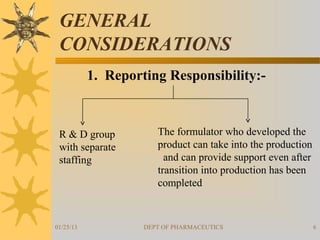
           1. Reporting Responsibility:-


 R & D group           The formulator who developed the
 with separate         product can take into the production
 staffing                and can provide support even after
                       transition into production has been
                       completed


01/25/13            DEPT OF PHARMACEUTICS                     6
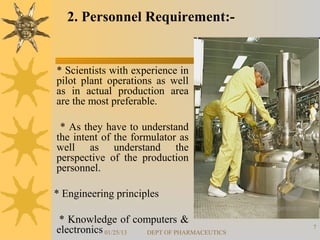
2. Personnel Requirement:-


* Scientists with experience in
pilot plant operations as well
as in actual production area
are the most preferable.

 * As they have to understand
the intent of the formulator as
well as understand the
perspective of the production
personnel.

* Engineering principles

 * Knowledge of computers &
electronics 01/25/13 DEPT OF PHARMACEUTICS
                                             7
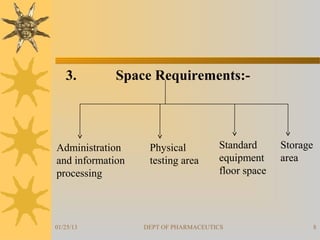
3.        Space Requirements:-


Administration     Physical          Standard      Storage
and information    testing area      equipment     area
processing                           floor space


01/25/13          DEPT OF PHARMACEUTICS                      8
a) Administration And Information Process:-


  Adequate office and desk space should be provided for
   both scientist and technicians.
  The space should be adjacent to the working area.
  Computers.


                                                           9
 01/25/13             DEPT OF PHARMACEUTICS
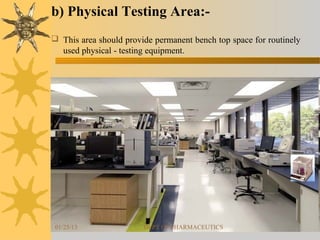
b) Physical Testing Area:-
 This area should provide permanent bench top space for routinely
   used physical - testing equipment.


 01/25/13                DEPT OF PHARMACEUTICS                       10
c) Standard Pilot-plant Equipment Floor

       Space :-

 Discreet pilot plant space, where the equipment needed
  for manufacturing all types of dosage form is located.
 Intermediate – sized and full scale production equipment
  is essential in evaluating the effects of scale-up of
  research formulations and processes.
 Equipments used should be made portable where ever
  possible. So that after use it can be stored in the small
  store room.
 Space for cleaning of the equipment should be also
  provided.
01/25/13            DEPT OF PHARMACEUTICS                11
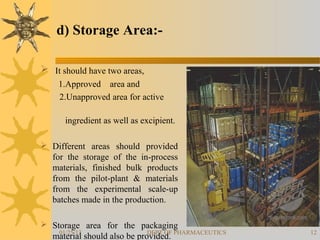
d) Storage Area:-

 It should have two areas,
    1.Approved area and
    2.Unapproved area for active

      ingredient as well as excipient.

 Different areas should provided
   for the storage of the in-process
   materials, finished bulk products
   from the pilot-plant & materials
   from the experimental scale-up
   batches made in the production.

 Storage area for the packaging
   material should also be provided. PHARMACEUTICS
    01/25/13                  DEPT OF                12
4. Review of the formula:-


 A thorough review of the each aspect of formulation is
    important.

 The purpose of each ingredient and it’s contribution to
    the final product manufactured on the small-scale
    laboratory equipment should be understood.

 Then the effect of scale-up using equipment that may
    subject the product to stresses of different types and
    degrees can more readily be predicted or recognized.
01/25/13            DEPT OF PHARMACEUTICS               13
5. Raw materials :-


 One purpose/responsibility of the pilot-plant is the
  approval & validation of the active ingredient &
  excipients raw materials.

 Raw materials used in the small scale production cannot
  necessarily be the representative for the large scale
  production.

 Ingredients may change in particle size, shape or
    morphology which result in differences in bulk density,
    static charges, rate of solubility, flow properties, color,
    etc.
01/25/13               DEPT OF PHARMACEUTICS                 14
6. Equipment:-


 The most economical, simplest & efficient equipment
    which are capable of producing product within the
    proposed specifications are used.
   The size of the equipment should be such that the
    experimental trials run should be relevant to the
    production sized batches.
   If too small the process developed will not scale up.
   If too big then the wastage of the expensive active
    ingredients.
   Ease of cleaning
   Time of cleaning
01/25/13            DEPT OF PHARMACEUTICS              15
7. Production Rates:-


 The immediate as well as the future market trends /
   requirements are considered while determining the
   production rates.


01/25/13          DEPT OF PHARMACEUTICS            16
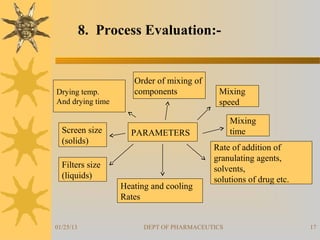
8. Process Evaluation:-


                     Order of mixing of
Drying temp.         components            Mixing
And drying time                            speed

                                                Mixing
  Screen size       PARAMETERS                  time
  (solids)
                                          Rate of addition of
                                          granulating agents,
  Filters size                            solvents,
  (liquids)                               solutions of drug etc.
                  Heating and cooling
                  Rates


01/25/13                DEPT OF PHARMACEUTICS                      17
 Why to carry out process evaluation????


 The knowledge of the effects of various process
   parameters on in-process and finished product quality is
   the basis for process optimization and validation.

 The purpose of process validation is to confirm that the
   selected manufacturing procedure assure the quality of the
   product at various critical stages in the process and in
   finished form.


01/25/13             DEPT OF PHARMACEUTICS                 18
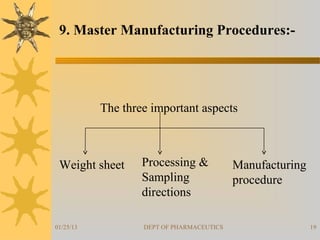
9. Master Manufacturing Procedures:-


           The three important aspects


 Weight sheet      Processing &            Manufacturing
                   Sampling                procedure
                   directions

01/25/13           DEPT OF PHARMACEUTICS                   19
Cont….

 The weight sheet should clearly identify the chemicals
  required in a batch. To prevent confusion the names and
  identifying numbers for the ingredients should be used on
  batch records.
 The process directions should be precise and explicit.
 A manufacturing procedure should be written by the
  actual operator.
 Various specifications like addition rates, mixing time,
  mixing speed, heating, and cooling rates, temperature,
  storing of the finished product samples should be
  mentioned in the batch record directions.
01/25/13            DEPT OF PHARMACEUTICS                20
Transfer of Analytical Method
to Quality Assurance
 During the scale-up of a new product, the analytic test
   methods developed in research must be transferred to the
   quality assurance department.

 Early in the transfer process, the quality assurance staff
   should review the process to make sure that the proper
   analytic instrumentation is available and that personnel
   are trained to perform the tests.


01/25/13            DEPT OF PHARMACEUTICS                 21
10. Product Stability And Uniformity:-


 The primary objective of the pilot plant is the physical as
   well as chemical stability of the products.

 Hence each pilot batch representing the final formulation
   and manufacturing procedure should be studied for
   stability.

 Stability studies should be carried out in finished
   packages as well.

01/25/13               DEPT OF PHARMACEUTICS               22
GMP CONSIDERATION

 Equipment qualification
 Process validation
 Regularly process review & revalidation
 Relevant written standard operating procedures
 The use of competent technically qualified personnel
 Adequate provision for training of personnel
 A well-defined technology transfer system
 Validated cleaning procedures
 An orderly arrangement of equipment so as to ease
   material flow & prevent cross-contamination
01/25/13             DEPT OF PHARMACEUTICS               23
ADVANTAGES

 Members of the production and quality control divisions
    can readily observe scale up runs.

 Supplies of excipients & drugs, cleared by the quality
    control division, can be drawn from the more spacious
    areas provided to the production division.

 Access to engineering department personnel is provided
    for equipment installation, maintenance and repair.

01/25/13              DEPT OF PHARMACEUTICS                 24
DISADVANTAGES

 The frequency of direct interaction of the formulator
    with the production personnel in the manufacturing area
    will be reduced.


 Any problem in manufacturing will be directed towards
    it’s own pilot-plant personnel.


01/25/13              DEPT OF PHARMACEUTICS                   25
01/25/13   DEPT OF PHARMACEUTICS   26
         SOLID DOSAGE FORM
           1. Material Handling

 Laboratory Scale

 Deliver accurate amount to the destination

 Large Scale
     * Lifting drums
     * More Sophisticated Methods
       -Vacuum Loading System
       -Metering Pumps

 Prevent Cross Contamination by Validation Cleaning
 Procedures.
01/25/13             DEPT OF PHARMACEUTICS             27
2. Dry Blending

Powders should be used for encapsulation or to be
 granulated prior to tabletting must be well blend to
 ensure good drug distribution.

Inadequate blending could result in drug content
 uniformity variation, especially when the tablet or capsule
 is small & the drug concentration is relatively low.

Ingredients should be lumps free, otherwise it could cause
 flow problems.

01/25/13            DEPT OF PHARMACEUTICS                  28
3. Granulations
 Reasons :-
     * To improve the flow properties.
     * To increase the apparent density of the powder.
     * To change the particle size distribution so that the
         binding properties on compaction can be improved.
 Types :-
    a) Wet Granulation
    b) Dry Granulation
    c) Direct Compression Method
 A small amount potent active ingredient can be dispersed
    most effectively in a carrier granulation, when the drug is
    dissolved in granulating solution and added during the
    granulating process.
01/25/13                                                      29
                     DEPT OF PHARMACEUTICS
Cont….

  Wet granulation has been carried out by using,
   - Sigma Blades
   - Heavy-duty planetary mixture
   -Tumble Blenders
   -High Speed Chopper Blades used in mixing of light
    powders.
  Multifunctional Processors,
    dry blending, wet granulation, drying, sizing &
    lubricating.
  Effect of Binding Agent.


01/25/13           DEPT OF PHARMACEUTICS                30
4. Drying

  Hot Air Oven
   * air temperature
   * rate of air flow
   * depth of granulation on the trays
  Fluidized Bed Dryer
   * optimum loads
   * rate of airflow
   * inlet air temperature
   * humidity
 Data used for small scale batches(1-5 kg) cannot be
  extrapolate processing conditions for intermediated scale
  (100 kg) or large batches.
01/25/13            DEPT OF PHARMACEUTICS                 31
5. Reduction In Particle Size
 Particle size to particle size distribution is important to
  the compression characteristics of a granulation.
 Compression factors that may affected by the particle
  size distribution are flow ability, compressibility,
  uniformity of tablet weight, content uniformity, tablet
  hardness, tablet color uniformity.
 Equipments :-
  * oscillating granulator a mechanical sieving device
  * a hammer mill
  * screening device
 If too large particle size :-
  * weight variation
  * mottling
01/25/13              DEPT OF PHARMACEUTICS                     32
Cont….

  If too fines particle size,
   * weight variation
   * capping

  Both oversized and undersized granulation can adversely
   affect tablet content uniformity.

  Lubricants & Gildants are added at final blend


01/25/13              DEPT OF PHARMACEUTICS              33
6. Blending

 Consequent attention should be paid to scale up of the
   right design is used and blender loads, mixing speeds,
   mixing timing are properly established.
 In any blending operation segregation and mixing occurs
  simultaneously, both processes are a function a particle
  size, shape, hardness, density and dynamics of the mixing
  action.
 Low dose active ingredients – directly compressed.
 Equipments :-
  * Planetory type mixer
  * Twin shell mixture
  * Cone type
01/25/13            DEPT OF PHARMACEUTICS                 34
Cont….
 Over loading in blender –
  * retards the free flow of granules
  * reduce the efficiency
  * cause content un-uniformity

 If the load is to small –
  * powder blend slides rather than roll in blender
  * improper mixing


01/25/13            DEPT OF PHARMACEUTICS             35
7. Slugging

 A dry powder blend that can not be directly compressed
  because of poor flow properties may in some instances be
  processed using a slugging operation.

 Instruments :-

    * Tablet press – which operates at pressure of 15 tons,
    compared with a normal tablet press, which operates at
    pressure of 4 tons or less.


01/25/13             DEPT OF PHARMACEUTICS                    36
8. Compression

  The ultimate test of the tablet formulation and
   granulation can be compressed on a high-speed tablet
   press.
  Steps involved during compression,
   * Filling empty die cavity with granulation
   * Pre compression of granules
   * Compression of granules
   * Ejection of tablet from the die cavity
  Compression characteristics can be evaluated by press
   speed equal to normal production speed.

01/25/13            DEPT OF PHARMACEUTICS                  37
Cont….

 Then detect the problems such as,
  * sticking to punch surface
  * tablet hardness
  * capping
  * weight variation

 Granules must be delivered at adequate rate.

 During compression, the granules are compacted, and in
  order for a tablet to form, bonds within the compressible
  materials must be formed.
01/25/13            DEPT OF PHARMACEUTICS                     38
TABLET COATING

 Equipments :-
  * conventional coating pan
  * perforated pans of fluidized-bed coating column
 Types :-
   1. Sugar coating
   2. Film coating
 Tablet must be sufficiently hard to withstand the the
  tumbling to which they are subjected while coating.
 Operation conditions to be established for pan or column
  operation are optimum tablet load, operating tablet, bed
  temperature, drying air flow rate, temperature, solution
  application rate.
01/25/13            DEPT OF PHARMACEUTICS                    39
CAPSULES
 To produce capsules on high-speed equipment, the
  powder blend must have,
  * uniform particle size distribution
  * bulk density
  * formation of compact of the right size and of sufficient
    cohesiveness to be filled into capsule shells.
 Equipments :-
  1. Zanasi or Mertalli – Dosator(hollow tube)
  2. Hoflinger – Karg – Tamping pins
 Weight variation problem can be encountered with these
  two methods.
 Overly lubricated granules – delaying disintegration.
01/25/13            DEPT OF PHARMACEUTICS                      40
Cont….

 Humidity affect moisture content of –
  * granulation
  * on the empty gelatin capsules
 Empty gelatin capsules have a recommended storage
  condition of 15-25 ºC temperature & humidity 35-65 %
  RH.
 At high humidity – capsule swells make separation of the
  capsule parts difficult to interfere with the transport of the
  capsule through the process.
 At low humidity – capsule brittle increased static charge
  interfere with the encapsulation operation.
01/25/13             DEPT OF PHARMACEUTICS                    41
LIQUID ORALS

 Simple solutions are the straight forward to scale up but
  they require tanks of adequate size and suitable mixing
  capability.
 Most equipment has heating or cooling capabilities to
  effect rapid disollution of components of the system.
 All the equipments must be made up of suitable non-
  reactive material and be designed and constructed to
  facilitate easy cleaning.
 Liquid pharmaceutical processing tank, kettles, pipes,
  mills, filter houses etc. are most frequently fabricated
  from stainless steel
01/25/13            DEPT OF PHARMACEUTICS                     42
Cont….

 Two types of steel –
  1. 308
  2. 316
 Stainless steel is most non reactive, however it does react
  with some acidic pharmaceutical liquids, this problem can
  be minimized by PASSIVATION.
 Interaction with metallic surfaces can be minimized by
  use of glass or Teflon coating.
 Although they are highly inert materials, they have the
  disadvantages of cracking, breaking and flaking with
  resultant product contamination.
01/25/13            DEPT OF PHARMACEUTICS                  43
PARENTERALS


01/25/13   DEPT OF PHARMACEUTICS
                     44
Cont….
 Equipments :-
 * tankage
 * piping
 * ancillary equipment for liquid mixing
 * filteration, transfer and related equipments.
 The majority of the equipments are composed of 300
  series austenitic stainless steel, with glass lined
  vessels employed for preparation of formulations
  sensitive to iron and other metal ions.
 The vessels can be equiped with external jackets for
  heating and/or cooling and various types of agitators,
  depending upon the mixing requirements of the
  individual formulation.
01/25/13            DEPT OF PHARMACEUTICS                  45
SUSPENSIONS
 Suspensions require more attention during scale up than
  simple solutions because of additional processing needs.
 Equipments :-
  * vibrating feed system and power for production scale.
  * high shear mixing equipment
 Slurries facilitate rapid and complete hydration of
  suspending agent when added to large portion of the
  vehicle.
 Active ingredients must be uniformly dispersed
  throughout the batch.
 Mixing at too high speed can result in entrapment of air,
  which may affect physical or chemical stability of the
  product.
01/25/13            DEPT OF PHARMACEUTICS                 46
VACUUM UNIT VERSATOR
 Filteration – remove unwanted particles.

 Screens of 150 mesh, having 100 microns are used.

 Active ingredients – particle size 10 – 25 microns.

 Transfer and filling of finished suspension should be
  carefully monitored.

 It should be constantly mixed during transfer to maintain
  uniform distribution of the active ingredients.

01/25/13             DEPT OF PHARMACEUTICS                47
EMULSIONS
 Manufacturing of liquid emulsion products entails
  specialized procedures as result scale up into production
  equipment involves extensive process development and
  validation.
 Equipments :-
  * mixing equipment
  * homogenizing equipment
  * screens
  * pumps
  * filling equipment
 High shear mixers may lead to air entrapment, this
  problem can be avoid by carrying out operation under
  controlled vacuum.
01/25/13            DEPT OF PHARMACEUTICS                     48
SEMI SOLID PRODUCTS
 The main difference of semi solid formulation with
  comparison to suspensions, liquids and emulsions is their
  higher viscosity.
 Viscosity renders certain aspects of the scale-up of semi
  solid products more critical.
 Equipments :-
  * blenders
  * mixers
  * pressure filling equipments


01/25/13            DEPT OF PHARMACEUTICS                 49
SUPPOSITORIES
 The manufacturing of suppositories on a laboratory scale
usually involves,
   * the preparation of a molten mass

  * the dispersion of drug in the molten base

  * casting of suppositories in a suitable mold

  * cooling of the mold

  * opened & remove the suppositories

 More no. of moulds & large size Pan for melting of drug
  & base.
01/25/13                  DEPT OF PHARMACEUTICS          50
CONTRACT MANUFACTURE

 On occasional, scale-up or manufacture of a product
  may need to be done at an outside, contract
  manufacturer.

 The reasons for considering contract manufacture
  include the needs for additional manufacturing
  capacity, high specialized technology or specialized
  equipments.


01/25/13            DEPT OF PHARMACEUTICS                51
IMPORTANT QUESTIONS
I.   What do you mean by pilot plant scale up and give
     examples ? (May ‘06)
II. What is the significance of pilot plant scale up with routine
     production procedure ? (May ‘07)
III. Explain the procedure for pilot plant scale up for liquid orals.
     (Sep ‘07 & Apr ‘08)
IV. Pilot plant scale up for tablets. (May ‘09)
V. Pilot plant scale up for liquid dosage forms. (Oct ‘09)
VI. Write in detail pilot plant scale up concepts & techniques for
     parenterals. (May ‘11)
VII. Explain the concepts of pilot plant scale up for tablets.
      (Nov ‘11)
01/25/13               DEPT OF PHARMACEUTICS                       52
REFERENCE

1. The theory & practice of industrial pharmacy

         by Leon Lachman, Herbert A. Lieberman,
      Joseph L. Kenig, 3rd edition, published by
      Varghese Publishing house.

2. www.google.co.in


01/25/13          DEPT OF PHARMACEUTICS           53
01/25/13   DEPT OF PHARMACEUTICS   54