PHARMACEUTICAL ENGINEERING
MANAGEMENT & SCIENCE UNIVERSITY
JOSAI UNIVERSITY
BACHELOR OF PHARMACY (BPH)
05 NOVEMBER 2015
AHDA S (012014052233) ∙ ANNISA H (012014052438) ∙ CC JET (012014052225) ∙ IFFAH U
(012014052231) ∙ M SHAFIQ (012014052491) ∙ N NABIHAH (012014052223)
M I X I N G
T A B L E O F C O N T E N T S
A. I N T R O D U C T I O N
B. T Y P E S & M E C H A N I S M S
C. M I X I N G O F L I Q U I D
D. M I X I N G O F S O L I D S
E. M I X I N G O F S E M I – S O L I D S
E X I T
I N T R O D U C T I O N
A.INTRODUCTIO
N
Operation in which two or
more components in a
separate or roughly mixed
condition are treated so
that each particle lies as
nearly as possible in contact
with a particle of each of
the other ingredient.
D E F I
N I T I O N
O B J E C
T I V E S
1. Produce simple
physical mixture
2. Produce physical
change
3. Produce dispersion
4. Promote chemical
reaction
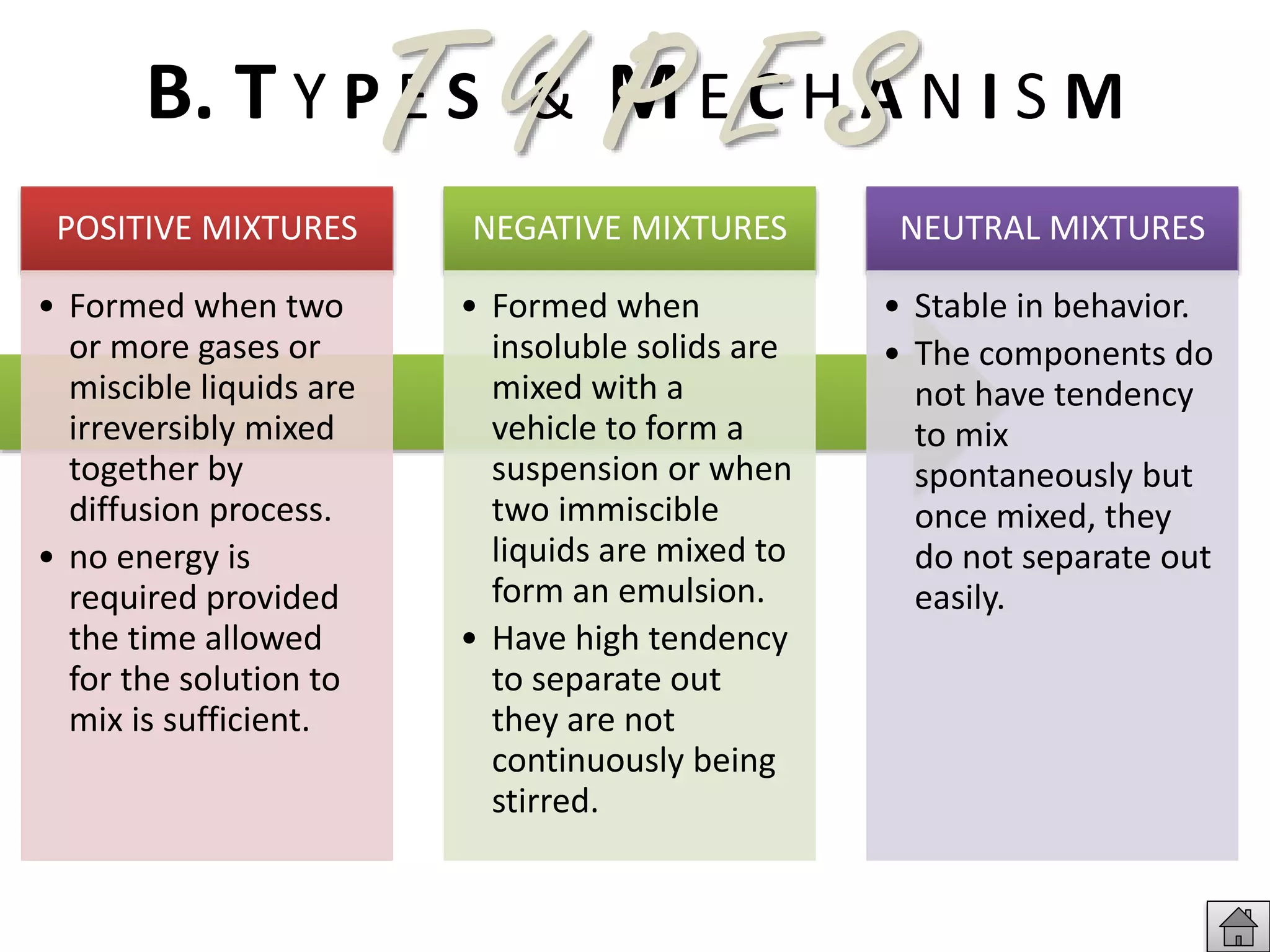
POSITIVE MIXTURES
• Formed when two
or more gases or
miscible liquids are
irreversibly mixed
together by
diffusion process.
• no energy is
required provided
the time allowed
for the solution to
mix is sufficient.
NEGATIVE MIXTURES
• Formed when
insoluble solids are
mixed with a
vehicle to form a
suspension or when
two immiscible
liquids are mixed to
form an emulsion.
• Have high tendency
to separate out
they are not
continuously being
stirred.
NEUTRAL MIXTURES
• Stable in behavior.
• The components do
not have tendency
to mix
spontaneously but
once mixed, they
do not separate out
easily.
B. T Y P E S & M E C H A N I S MT Y P E S
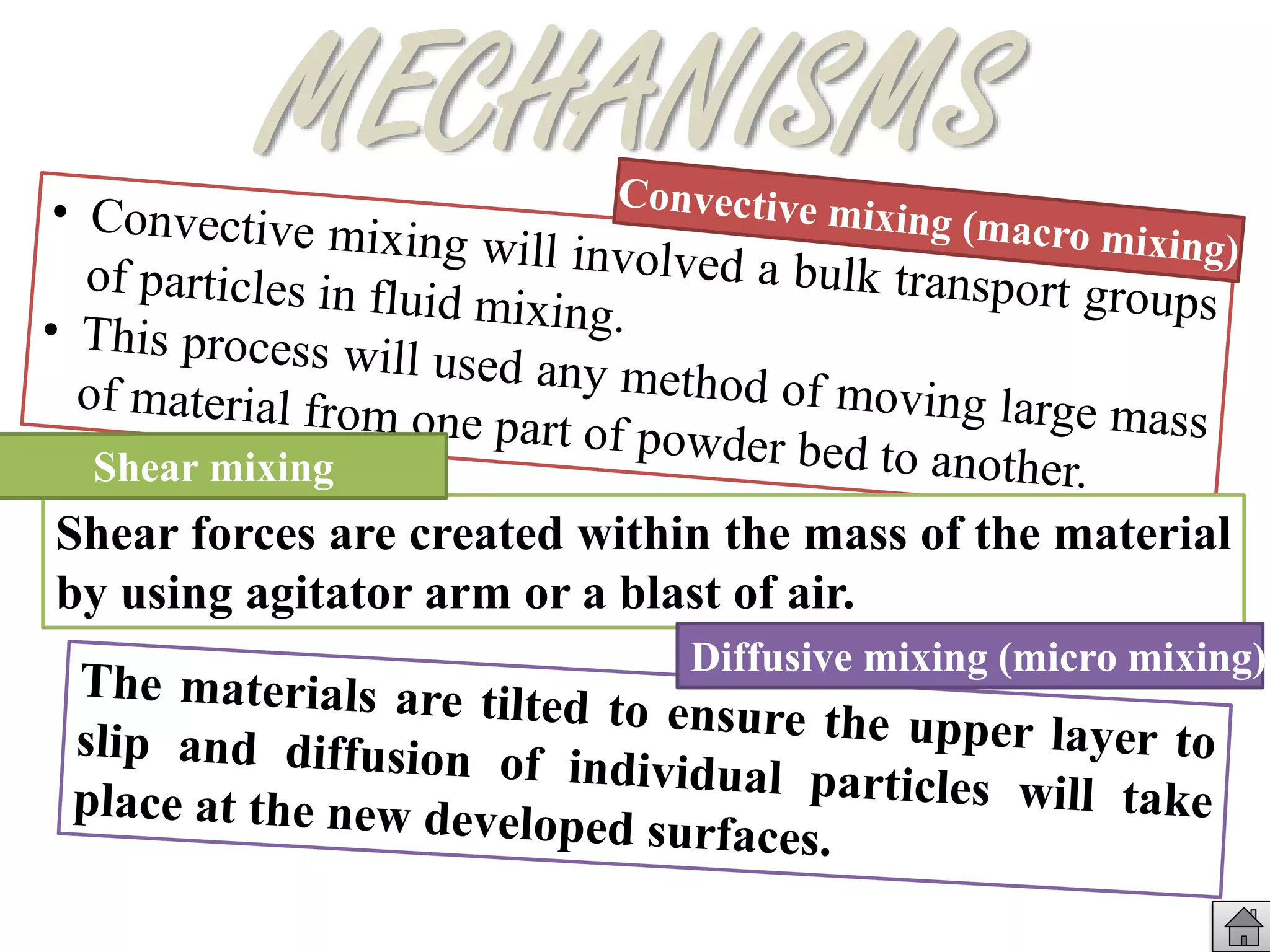
MECHANISMS
Shear forces are created within the mass of the material
by using agitator arm or a blast of air.
Shear mixing
Freud-vector (high
shear granulator)
Diffusive mixing (micro mixing)
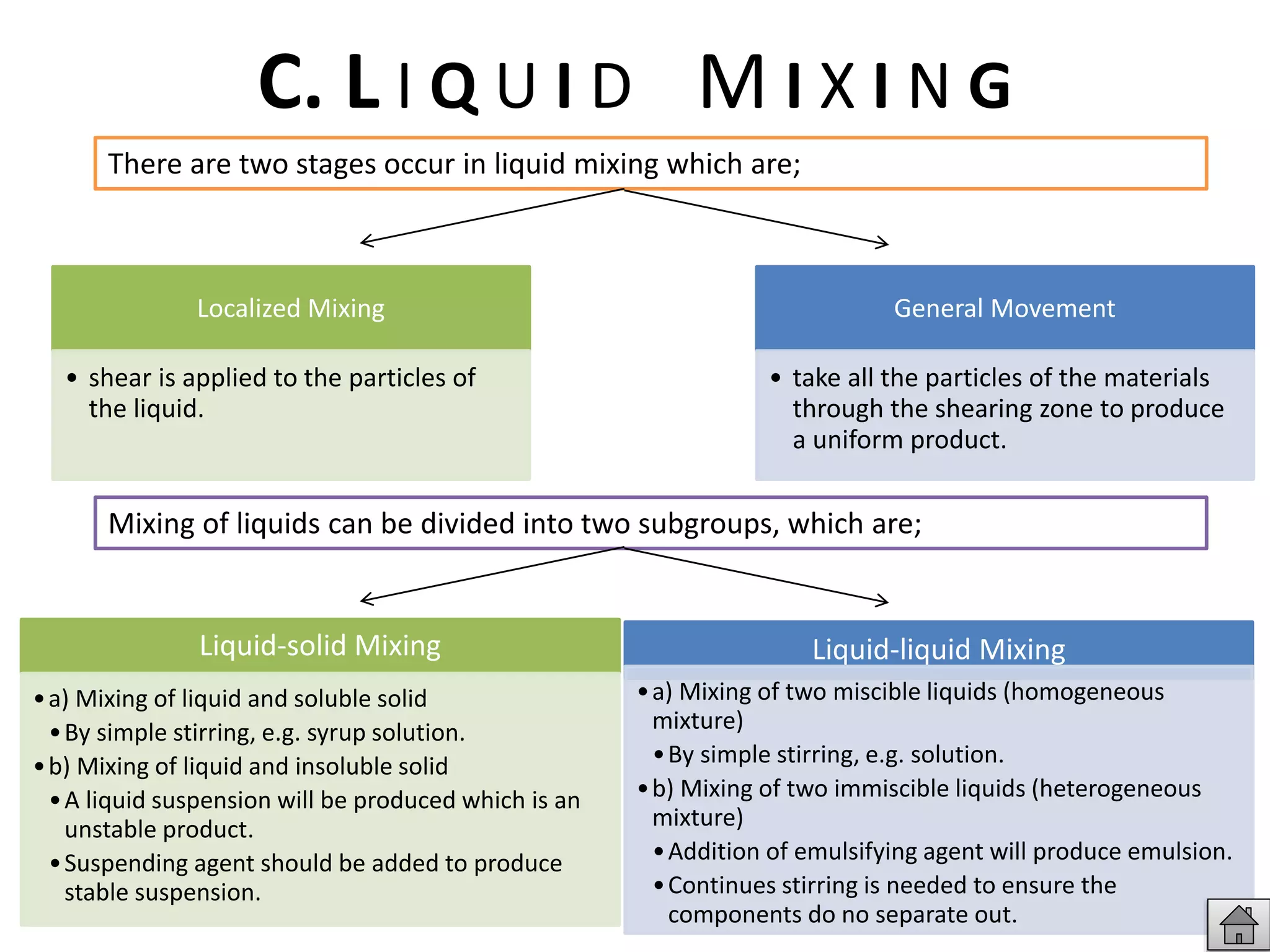
C. L I Q U I D M I X I N G
There are two stages occur in liquid mixing which are;
Localized Mixing
• shear is applied to the particles of
the liquid.
General Movement
• take all the particles of the materials
through the shearing zone to produce
a uniform product.
Mixing of liquids can be divided into two subgroups, which are;
Liquid-solid Mixing
•a) Mixing of liquid and soluble solid
•By simple stirring, e.g. syrup solution.
•b) Mixing of liquid and insoluble solid
•A liquid suspension will be produced which is an
unstable product.
•Suspending agent should be added to produce
stable suspension.
Liquid-liquid Mixing
•a) Mixing of two miscible liquids (homogeneous
mixture)
•By simple stirring, e.g. solution.
•b) Mixing of two immiscible liquids (heterogeneous
mixture)
•Addition of emulsifying agent will produce emulsion.
•Continues stirring is needed to ensure the
components do no separate out.
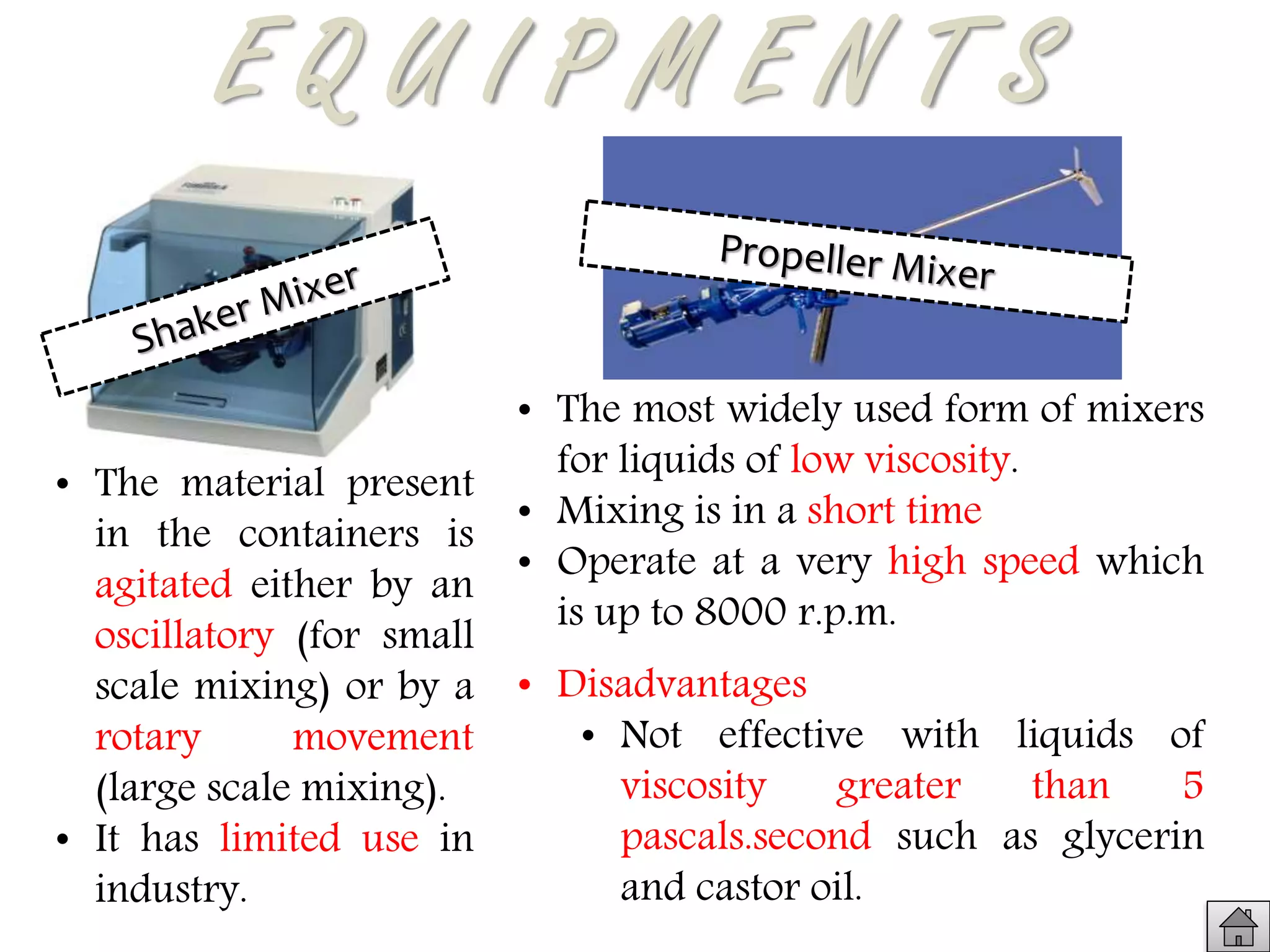
• The most widely used form of mixers
for liquids of low viscosity.
• Mixing is in a short time
• Operate at a very high speed which
is up to 8000 r.p.m.
• Disadvantages
• Not effective with liquids of
viscosity greater than 5
pascals.second such as glycerin
and castor oil.
E Q U I P M E N T S
• The material present
in the containers is
agitated either by an
oscillatory (for small
scale mixing) or by a
rotary movement
(large scale mixing).
• It has limited use in
industry.
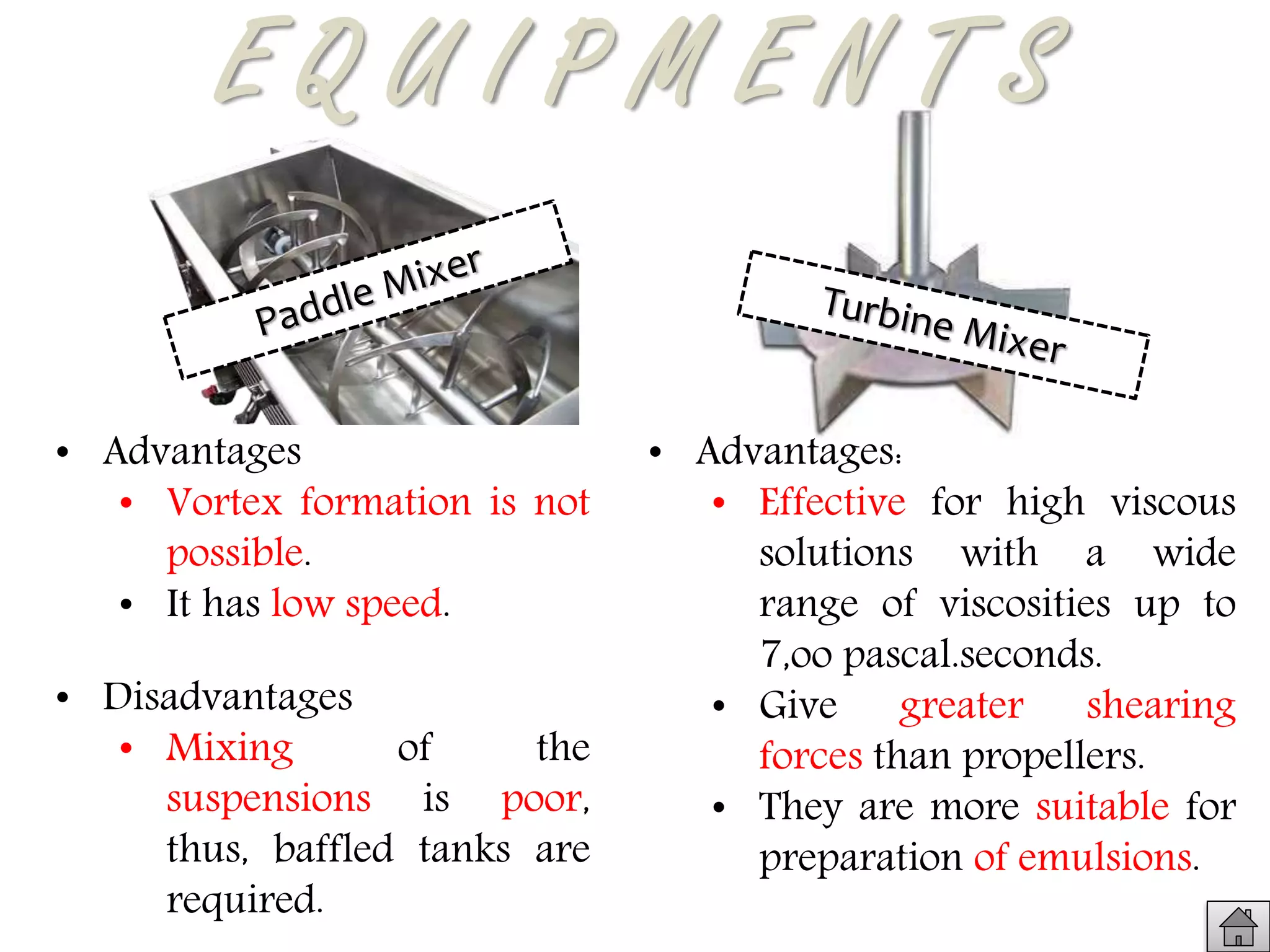
• Advantages:
• Effective for high viscous
solutions with a wide
range of viscosities up to
7,oo pascal.seconds.
• Give greater shearing
forces than propellers.
• They are more suitable for
preparation of emulsions.
E Q U I P M E N T S
• Advantages
• Vortex formation is not
possible.
• It has low speed.
• Disadvantages
• Mixing of the
suspensions is poor,
thus, baffled tanks are
required.
• Definition: Process in which two
or more solid substances are
combine together to produce a
homogenous mixture or continuous
movement of the particles.
• Main objective: Produce a bulk
mixture which when divide into
different doses, every unit of
divided doses must contain the
correct proportion of each
ingredient.
Improper mixing process results in non-
homogenous product that lacks of
consistency like chemical composition,
texture, flavor, color, particle size and the
most important is pharmacological effect.
M I X I N G
D.
S O L I D
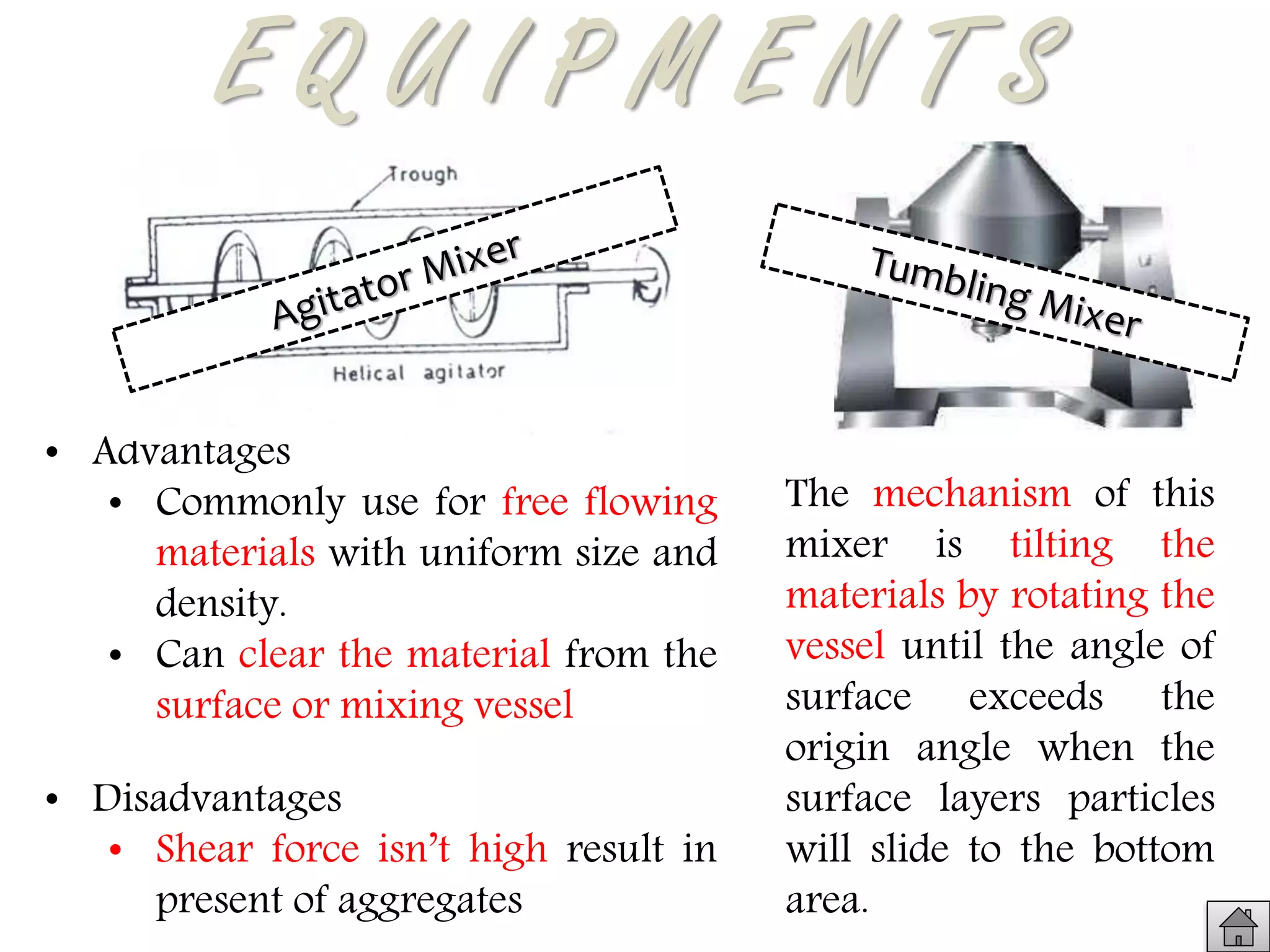
The mechanism of this
mixer is tilting the
materials by rotating the
vessel until the angle of
surface exceeds the
origin angle when the
surface layers particles
will slide to the bottom
area.
E Q U I P M E N T S
• Advantages
• Commonly use for free flowing
materials with uniform size and
density.
• Can clear the material from the
surface or mixing vessel
• Disadvantages
• Shear force isn’t high result in
present of aggregates
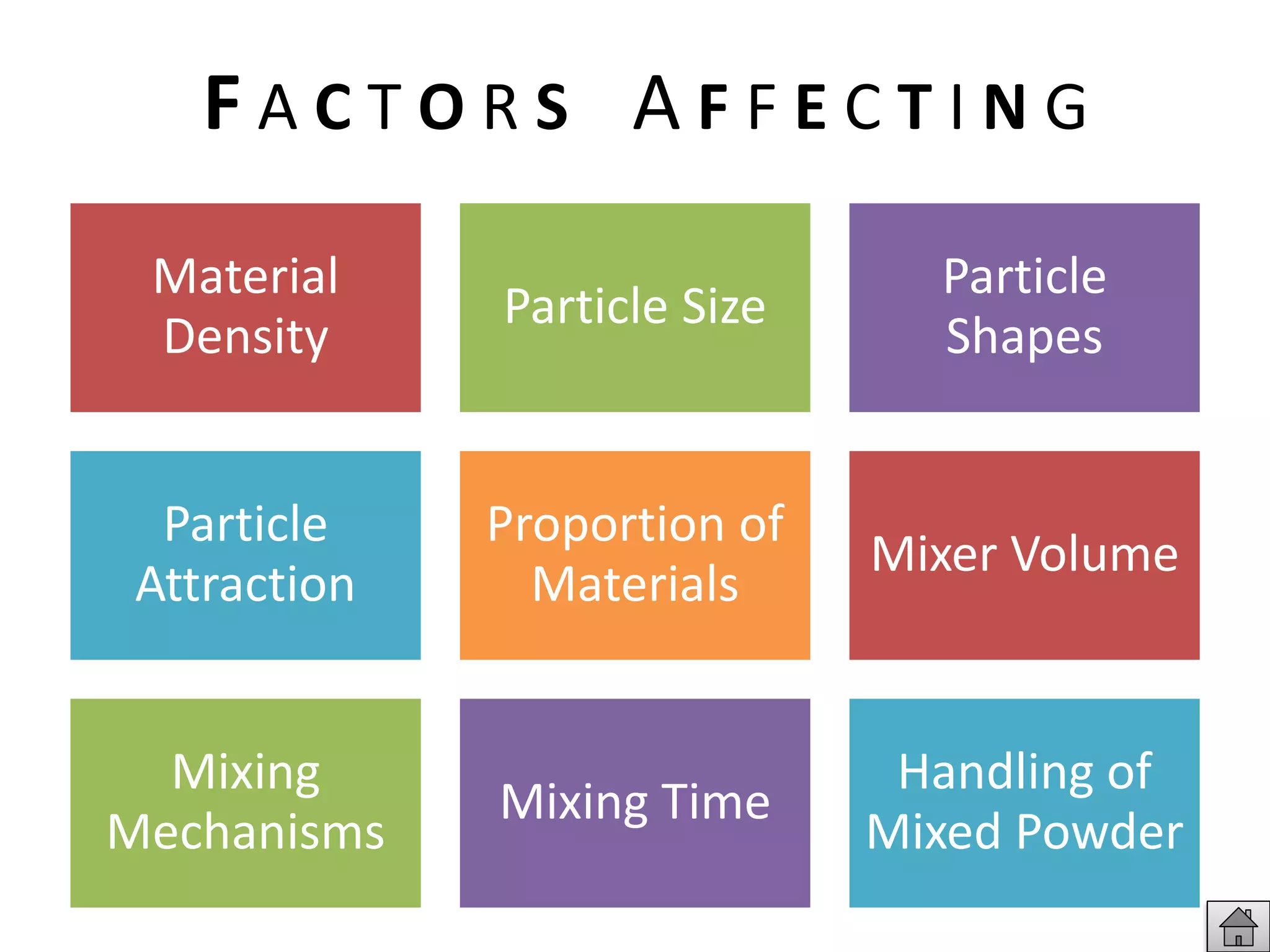
Material
Density
Particle Size
Particle
Shapes
Particle
Attraction
Proportion of
Materials
Mixer Volume
Mixing
Mechanisms
Mixing Time
Handling of
Mixed Powder
F A C T O R S A F F E C T I N G
E. S E M I - S O L I D M I X I N G
T h e o r i e s
PELLET & POWDER STATE
•Small amount amount of
liquid is added to a bulk of dry
powder it cause the solid to
ball up and form small pellets.
•The pellets are embedded in a
matrix of dry powder, which
has a cushioning effect and
makes the pellets difficult to
break up.
•The solid is free-flowing and
rate of homogenization is low.
PELLET STATE
•Further addition of liquids
results in conversion of all the
dry powder to pellets.
•The mass has coarse granular
appearance but the pellet do
not cohere and agitation will
cause aggregates to break
down into smaller granules.
•Homogenization is even lower
than in the pellet and powder.
•This stage is for moistening
powders for tablet
granulation.
PLASTIC STATE
•Liquid content is increased
further, the character of the
mixture changes markedly:
•aggregates of the material
adhere,
•The granular appearance is
lost,
•The mixture becomes more or
less homogeneous and of a
day-like consistency.
•Plastic properties are shown,
•The mixture being difficult to
shear, flowing at low stresses
but breaking under high
stresses. Homogenization can
be achieved much more
rapidly than in previous cases.
•This is the state obtained
when making a pill-mass.
E. S E M I - S O L I D M I X I N G
T h e o r i e s
STICKY STATE
• Continual incorporation of
liquid causes the mixture to
attain the sticky state;
• The appearance becomes
paste-like with shiny surface
• The mass adheres to the solid
surfaces.
• The mass flow easily even
under low stresses, but
homogeneity is attained only
slowly.
• Kaolin Poultice exemplifies
the sticky state
LIQUID STATE
• Addition of liquids results in a
decrease of consistency until
a fluid state is reached.
• In this state the mixture flows
under its own weight and will
drain off vertical surfaces.
• The rate of homogenization is
rapid.
E Q U I P M E N T S
1. Agitator Mixers
• Advantages
• Creates a minimum dead space
during mixing.
• There is close tolerance between
the blades and the sidewalls as
well as the bottom of the mixer
shell.
• Disadvantage
• Sigma mixers work at a fixed
speed.
• Advantage
• Work at varying speeds.
• More useful for wet granulation
• Disadvantages
• Planetary mixers require high
power.
• Mechanical heat is built up
within the powder mix.
• Use is limited to batch work
only
E Q U I P M E N T S
2. Shear Mixers
• Advantages
• Extremely fine particle
distribution through optimal
shear force.
• High capacity with minimal
space requirements.
• Rapid handling and easy
cleaning.
• Virtually unlimited application
due to highly flexible
• Rollers are fitted in such a way that
they come in close contact with each
other and rotate at different speeds.
• The material which comes in-
between the rollers is crushed and
reduced in particle size.
• Advantages: The triple roller mill
produces very uniform dispersion
and is suitable for continuous
processes.
E Q U I P M E N T S
3. Ultrasonic Mixers
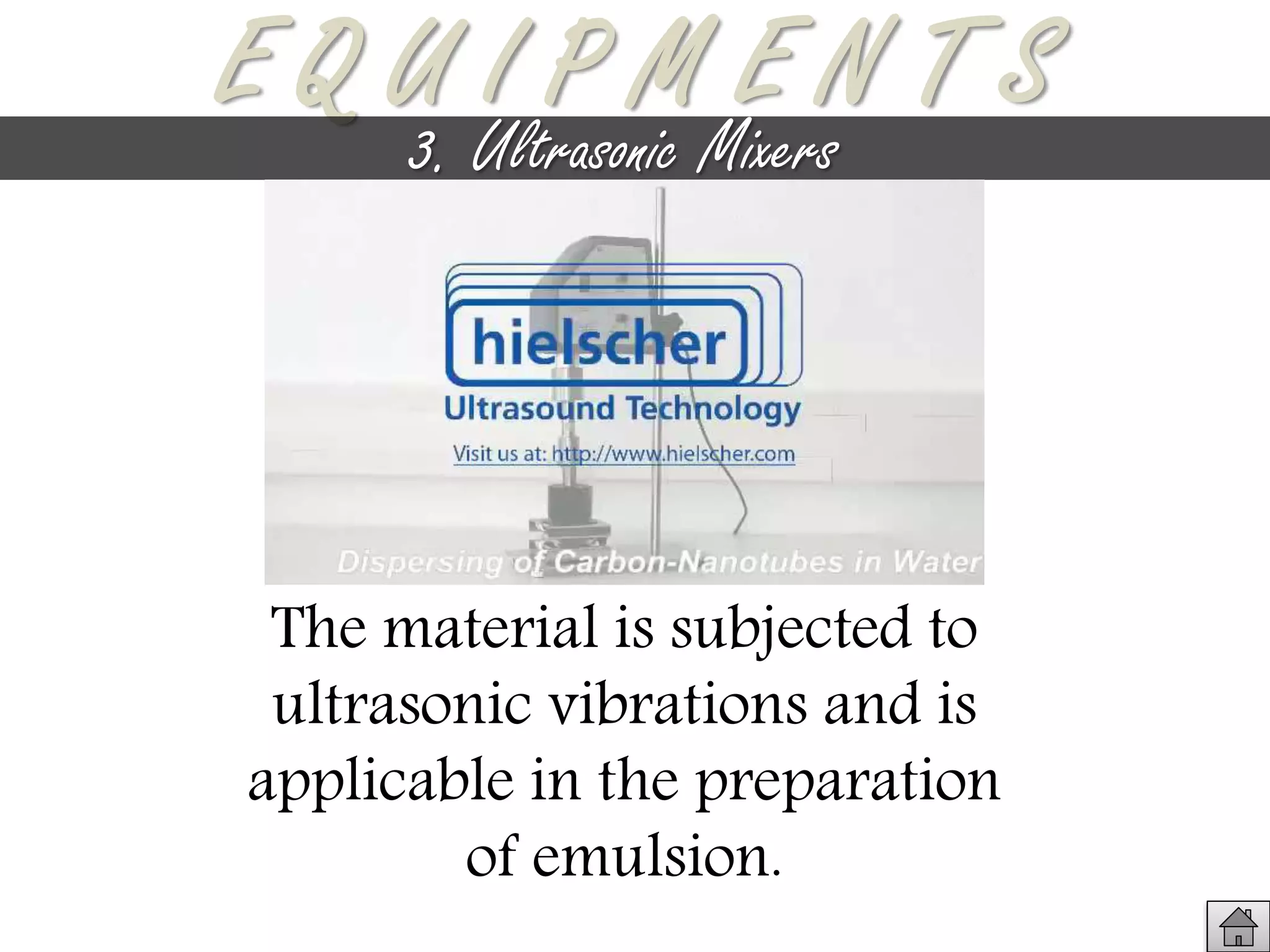
The material is subjected to
ultrasonic vibrations and is
applicable in the preparation
of emulsion.
[Power Point] Mixing - Pharmaceutical Engineering

[Power Point] Mixing - Pharmaceutical Engineering

  • 1.
    PHARMACEUTICAL ENGINEERING MANAGEMENT &SCIENCE UNIVERSITY JOSAI UNIVERSITY BACHELOR OF PHARMACY (BPH) 05 NOVEMBER 2015 AHDA S (012014052233) ∙ ANNISA H (012014052438) ∙ CC JET (012014052225) ∙ IFFAH U (012014052231) ∙ M SHAFIQ (012014052491) ∙ N NABIHAH (012014052223) M I X I N G
  • 2.
    T A BL E O F C O N T E N T S A. I N T R O D U C T I O N B. T Y P E S & M E C H A N I S M S C. M I X I N G O F L I Q U I D D. M I X I N G O F S O L I D S E. M I X I N G O F S E M I – S O L I D S E X I T
  • 3.
    I N TR O D U C T I O N A.INTRODUCTIO N Operation in which two or more components in a separate or roughly mixed condition are treated so that each particle lies as nearly as possible in contact with a particle of each of the other ingredient. D E F I N I T I O N O B J E C T I V E S 1. Produce simple physical mixture 2. Produce physical change 3. Produce dispersion 4. Promote chemical reaction
  • 4.
    POSITIVE MIXTURES • Formedwhen two or more gases or miscible liquids are irreversibly mixed together by diffusion process. • no energy is required provided the time allowed for the solution to mix is sufficient. NEGATIVE MIXTURES • Formed when insoluble solids are mixed with a vehicle to form a suspension or when two immiscible liquids are mixed to form an emulsion. • Have high tendency to separate out they are not continuously being stirred. NEUTRAL MIXTURES • Stable in behavior. • The components do not have tendency to mix spontaneously but once mixed, they do not separate out easily. B. T Y P E S & M E C H A N I S MT Y P E S
  • 5.
    MECHANISMS Shear forces arecreated within the mass of the material by using agitator arm or a blast of air. Shear mixing Freud-vector (high shear granulator) Diffusive mixing (micro mixing)
  • 6.
    C. L IQ U I D M I X I N G There are two stages occur in liquid mixing which are; Localized Mixing • shear is applied to the particles of the liquid. General Movement • take all the particles of the materials through the shearing zone to produce a uniform product. Mixing of liquids can be divided into two subgroups, which are; Liquid-solid Mixing •a) Mixing of liquid and soluble solid •By simple stirring, e.g. syrup solution. •b) Mixing of liquid and insoluble solid •A liquid suspension will be produced which is an unstable product. •Suspending agent should be added to produce stable suspension. Liquid-liquid Mixing •a) Mixing of two miscible liquids (homogeneous mixture) •By simple stirring, e.g. solution. •b) Mixing of two immiscible liquids (heterogeneous mixture) •Addition of emulsifying agent will produce emulsion. •Continues stirring is needed to ensure the components do no separate out.
  • 7.
    • The mostwidely used form of mixers for liquids of low viscosity. • Mixing is in a short time • Operate at a very high speed which is up to 8000 r.p.m. • Disadvantages • Not effective with liquids of viscosity greater than 5 pascals.second such as glycerin and castor oil. E Q U I P M E N T S • The material present in the containers is agitated either by an oscillatory (for small scale mixing) or by a rotary movement (large scale mixing). • It has limited use in industry.
  • 8.
    • Advantages: • Effectivefor high viscous solutions with a wide range of viscosities up to 7,oo pascal.seconds. • Give greater shearing forces than propellers. • They are more suitable for preparation of emulsions. E Q U I P M E N T S • Advantages • Vortex formation is not possible. • It has low speed. • Disadvantages • Mixing of the suspensions is poor, thus, baffled tanks are required.
  • 9.
    • Definition: Processin which two or more solid substances are combine together to produce a homogenous mixture or continuous movement of the particles. • Main objective: Produce a bulk mixture which when divide into different doses, every unit of divided doses must contain the correct proportion of each ingredient. Improper mixing process results in non- homogenous product that lacks of consistency like chemical composition, texture, flavor, color, particle size and the most important is pharmacological effect. M I X I N G D. S O L I D
  • 10.
    The mechanism ofthis mixer is tilting the materials by rotating the vessel until the angle of surface exceeds the origin angle when the surface layers particles will slide to the bottom area. E Q U I P M E N T S • Advantages • Commonly use for free flowing materials with uniform size and density. • Can clear the material from the surface or mixing vessel • Disadvantages • Shear force isn’t high result in present of aggregates
  • 11.
    Material Density Particle Size Particle Shapes Particle Attraction Proportion of Materials MixerVolume Mixing Mechanisms Mixing Time Handling of Mixed Powder F A C T O R S A F F E C T I N G
  • 12.
    E. S EM I - S O L I D M I X I N G T h e o r i e s PELLET & POWDER STATE •Small amount amount of liquid is added to a bulk of dry powder it cause the solid to ball up and form small pellets. •The pellets are embedded in a matrix of dry powder, which has a cushioning effect and makes the pellets difficult to break up. •The solid is free-flowing and rate of homogenization is low. PELLET STATE •Further addition of liquids results in conversion of all the dry powder to pellets. •The mass has coarse granular appearance but the pellet do not cohere and agitation will cause aggregates to break down into smaller granules. •Homogenization is even lower than in the pellet and powder. •This stage is for moistening powders for tablet granulation. PLASTIC STATE •Liquid content is increased further, the character of the mixture changes markedly: •aggregates of the material adhere, •The granular appearance is lost, •The mixture becomes more or less homogeneous and of a day-like consistency. •Plastic properties are shown, •The mixture being difficult to shear, flowing at low stresses but breaking under high stresses. Homogenization can be achieved much more rapidly than in previous cases. •This is the state obtained when making a pill-mass.
  • 13.
    E. S EM I - S O L I D M I X I N G T h e o r i e s STICKY STATE • Continual incorporation of liquid causes the mixture to attain the sticky state; • The appearance becomes paste-like with shiny surface • The mass adheres to the solid surfaces. • The mass flow easily even under low stresses, but homogeneity is attained only slowly. • Kaolin Poultice exemplifies the sticky state LIQUID STATE • Addition of liquids results in a decrease of consistency until a fluid state is reached. • In this state the mixture flows under its own weight and will drain off vertical surfaces. • The rate of homogenization is rapid.
  • 14.
    E Q UI P M E N T S 1. Agitator Mixers • Advantages • Creates a minimum dead space during mixing. • There is close tolerance between the blades and the sidewalls as well as the bottom of the mixer shell. • Disadvantage • Sigma mixers work at a fixed speed. • Advantage • Work at varying speeds. • More useful for wet granulation • Disadvantages • Planetary mixers require high power. • Mechanical heat is built up within the powder mix. • Use is limited to batch work only
  • 15.
    E Q UI P M E N T S 2. Shear Mixers • Advantages • Extremely fine particle distribution through optimal shear force. • High capacity with minimal space requirements. • Rapid handling and easy cleaning. • Virtually unlimited application due to highly flexible • Rollers are fitted in such a way that they come in close contact with each other and rotate at different speeds. • The material which comes in- between the rollers is crushed and reduced in particle size. • Advantages: The triple roller mill produces very uniform dispersion and is suitable for continuous processes.
  • 16.
    E Q UI P M E N T S 3. Ultrasonic Mixers The material is subjected to ultrasonic vibrations and is applicable in the preparation of emulsion.