Gene Pool
• The sum total of genes of all individuals of a
Genetic population constitute the gene pool.
• Therefore, a genetic population is an array of
genes, temporarily embodied in individuals but
endlessly combining and recombining by the
process of sexual reproduction.
• If the gene pool of a population is described
completely, it tells us not only the kinds of
genes present in the population, but also the
way in which these genes are distributed
among the individuals of the population in
question.
Gene Pool contd…..
For example, if we want to know the genetic
information about the smoothness and
wrinkling of the pea seeds in the gene pool of
pea population, it is possible to know exactly
the proportions of the smooth alleles and the
wrinkle alleles and how these alleles are
distributed among the individuals –
i.e. the proportion of homozygous smooth,
the proportion of heterozygous smooth and
the proportion of homozygous wrinkled
pea plants.
Gene Pool contd….
• Suppose, if these are present in equal
proportions, i.e. half the genes are for
smoothness and half the genes are for
wrinkleness and these genes are represented by
W and w,
• the gene pool in the state of equilibrium will
contain ¼ WW, ½ Ww and ¼ ww,
• and this will be maintained as long as random
mating occurs.
Gene frequency
• The gene frequency refers to the proportion of an
allele in the gene pool as compared with other
alleles at the same locus, with no regards to their
distribution in the population.
• For example, if we consider a hypothetical
population in which there are just two alleles Aa
on a particular locus out of which A is dominant
and a is recessive.
• Hence, according to genotype three types of
individuals may exist in the population.
AA, Aa and aa
Gene frequency
• Suppose there are 100 individuals in a population
out of which there are 40 homozygous dominant
(AA), 40 heterozygous (Aa) and 20 homozygous
recessive (aa), then -
The frequency of gene ‘A’ will be (80+40)/200 =0.6
The frequency of gene ‘a’ will be (40+40)/200 =0.4
• Therefore, the gene frequency can be calculated
by dividing the number of a particular gene under
consideration with the total number of genes
present on that locus in the population.
Gene frequency
• Now, if the frequency of gene ‘A’ is
represented by ‘p’ and the frequency of gene
‘a’ is represented by ‘q’, then at equilibrium
condition there total frequency is represented
by ‘1’.
• Or, in other words, at equilibrium
p+ q = 1
Genotype frequency
• Genotype frequency is the total number of a
kind of individuals in a population all of which
exhibit similar character with respect to the
locus under consideration.
• Suppose in a population there are 2 alleles at
one gene locus (A and a) and they are related
as dominant and recessive. Naturally, 3 kinds
of individuals will occur in the population, i.e.
‘AA’, ‘Aa’ and ‘aa’
Genotype frequency
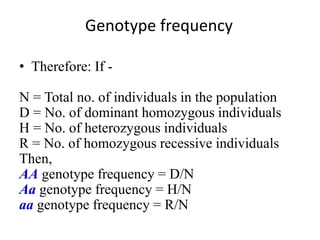
• Therefore: If -
N = Total no. of individuals in the population
D = No. of dominant homozygous individuals
H = No. of heterozygous individuals
R = No. of homozygous recessive individuals
Then,
AA genotype frequency = D/N
Aa genotype frequency = H/N
aa genotype frequency = R/N
Genotype frequency
It means that the genotype frequency
for a particular gene combination on
the same locus can be determined by
dividing the number of individuals
with that genotype by the total
number of individuals in the
population.
Hardy-Weinberg law of Equilibrium
• The Hardy-Weinberg Law states that –
‘The relative frequencies of various kinds of
genes in a large and randomly mating
population tend to remain constant from
generation to generation in the absence of
mutation, selection and gene flow’.
This law -
Describes a theoretical situation in which a population is
undergoing no evolutionary change.
It explains that if
 the evolutionary forces are absent,
 the population is large,
 the individuals have random mating,
 each parent produces roughly equal number of gametes &
 the gametes produced by the mates combine at random,
 and the gene frequency remains constant,
then-
Then -
The genetic equilibrium of the genes in
question is maintained and the variability
present in the population is preserved.
For example,
• If a gene with two alleles A and a with known
frequencies (e.g. A = 0.6, a = 0.4.) and their
respective frequencies are represented by p
and q.
Then the combined frequencies of both the
alleles will be equal to unit. In other words,
p + q = 1
Further,
• Using allele frequencies we can predict the
expected frequencies of genotypes in the next
generation.
• With two alleles only three genotypes are
possible: AA, Aa and aa
Hardy-Weinberg Equilibrium
• Assume alleles A and a are present in eggs
and sperm in proportion to their frequency in
population (i.e. 0.6 and 0.4)
• Also assume that sperm and eggs meet at
random (one big gene pool).
Hardy-Weinberg Equilibrium
• Then we can calculate expected genotype
frequencies.
• AA: To produce an AA individual, egg and
sperm must each contain an A allele.
• This probability is 0.6 x 0.6 = 0.36 (probability
sperm contains A times probability egg
contains A).
Hardy-Weinberg Equilibrium
• Similarly, we can calculate frequency of aa.
• 0.4 x 04 = 0.16.
Hardy-Weinberg Equilibrium
• Probability of Aa is given by probability sperm
contains A (0.6) times probability egg contains
a (0.4).
0.6 x 0.4 = 0.24
• probability egg contains A (0.6) times
probability sperm contains a (0.4). 0.6 x 0.4 =
0.24.
Hardy-Weinberg Equilibrium
• But, there’s a second way to produce an Aa
individual (egg contains A and sperm contains
a). Same probability as before: 0.6 x 0.4=
0.24.
• Hence the overall probability of Aa = 0.24 +
0.24 = 0.48.
Hardy-Weinberg Equilibrium
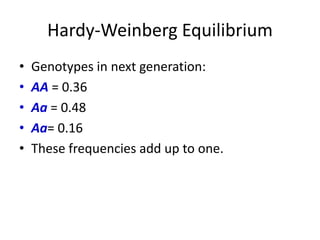
• Genotypes in next generation:
• AA = 0.36
• Aa = 0.48
• Aa= 0.16
• These frequencies add up to one.
Hardy-Weinberg Equilibrium
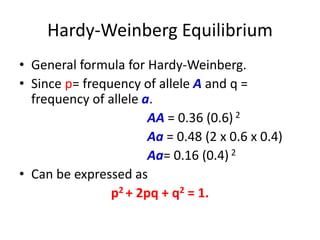
• General formula for Hardy-Weinberg.
• Since p= frequency of allele A and q =
frequency of allele a.
AA = 0.36 (0.6) 2
Aa = 0.48 (2 x 0.6 x 0.4)
Aa= 0.16 (0.4) 2
• Can be expressed as
p2 + 2pq + q2 = 1.
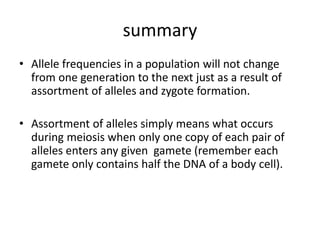
summary
• Allele frequencies in a population will not change
from one generation to the next just as a result of
assortment of alleles and zygote formation.
• Assortment of alleles simply means what occurs
during meiosis when only one copy of each pair of
alleles enters any given gamete (remember each
gamete only contains half the DNA of a body cell).
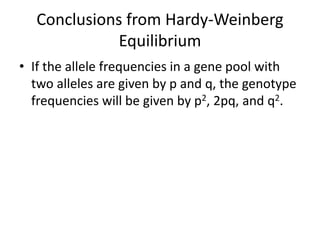
Conclusions from Hardy-Weinberg
Equilibrium
• If the allele frequencies in a gene pool with
two alleles are given by p and q, the genotype
frequencies will be given by p2, 2pq, and q2.
Question
• If 9 of 100 individuals in a population suffer from a
homozygous recessive disorder can you calculate the
frequency of the disease-causing allele?
• Can you calculate how many heterozygotes are in the
population?
Solution
• p2 + 2pq + q2 = 1. The terms in the equation represent the
frequencies of individual genotypes. [A genotype is possessed
by an individual organism so there are two alleles present in
each case.]
• p and q are allele frequencies. Allele frequencies are
estimates of how common alleles are in the whole population.
• It is vital that you understand the difference between allele
and genotye frequencies.
Solution
• 9 of 100 (frequency = 0.09) of individuals are
homozygous for the recessive allele. What
term in the H-W equation is that equal to?
Working with the H-W equation
• It’s q2.
• If q2 = 0.09, what’s q? Get square root of q2, which is
0.3, which is the frequency of the allele a.
• If q=0.3 then p=0.7. Now plug p and q into equation
to calculate frequencies of other genotypes.
Working with the H-W equation
• p2 = (0.7)(0.7) = 0.49 -- frequency of AA
• 2pq = 2 (0.3)(0.7) = 0.42 – frequency of Aa.
• To calculate the actual number of heterozygotes
simply multiply 0.42 by the population size =
(0.42)(100) = 42.
Assumptions of Hardy-Weinberg
• 1. No selection.
– When individuals with certain genotypes survive
better than others, allele frequencies may change
from one generation to the next.
Assumptions of Hardy-Weinberg
• 2. No mutation
– If new alleles are produced by mutation or alleles
mutate at different rates, allele frequencies may
change from one generation to the next.
Assumptions of Hardy-Weinberg
• 3. No migration
– Movement of individuals in or out of a population
will alter allele and genotype frequencies.
Assumptions of Hardy-Weinberg
• 4. No chance events.
– Luck plays no role. Eggs and sperm collide at same
frequencies as the actual frequencies of p and q.
– When assumption is violated, and by chance some
individuals contribute more alleles than others to next
generation, allele frequencies may change. This
mechanism of allele frequency change is called Genetic
Drift.
Assumptions of Hardy-Weinberg
• 5. Individuals select mates at random.
– If this assumption is violated allele frequencies will
not change, but genotype frequencies may.

Gene pool and h w law

  • 1.
    Gene Pool • Thesum total of genes of all individuals of a Genetic population constitute the gene pool. • Therefore, a genetic population is an array of genes, temporarily embodied in individuals but endlessly combining and recombining by the process of sexual reproduction. • If the gene pool of a population is described completely, it tells us not only the kinds of genes present in the population, but also the way in which these genes are distributed among the individuals of the population in question.
  • 2.
    Gene Pool contd….. Forexample, if we want to know the genetic information about the smoothness and wrinkling of the pea seeds in the gene pool of pea population, it is possible to know exactly the proportions of the smooth alleles and the wrinkle alleles and how these alleles are distributed among the individuals – i.e. the proportion of homozygous smooth, the proportion of heterozygous smooth and the proportion of homozygous wrinkled pea plants.
  • 3.
    Gene Pool contd…. •Suppose, if these are present in equal proportions, i.e. half the genes are for smoothness and half the genes are for wrinkleness and these genes are represented by W and w, • the gene pool in the state of equilibrium will contain ¼ WW, ½ Ww and ¼ ww, • and this will be maintained as long as random mating occurs.
  • 4.
    Gene frequency • Thegene frequency refers to the proportion of an allele in the gene pool as compared with other alleles at the same locus, with no regards to their distribution in the population. • For example, if we consider a hypothetical population in which there are just two alleles Aa on a particular locus out of which A is dominant and a is recessive. • Hence, according to genotype three types of individuals may exist in the population. AA, Aa and aa
  • 5.
    Gene frequency • Supposethere are 100 individuals in a population out of which there are 40 homozygous dominant (AA), 40 heterozygous (Aa) and 20 homozygous recessive (aa), then - The frequency of gene ‘A’ will be (80+40)/200 =0.6 The frequency of gene ‘a’ will be (40+40)/200 =0.4 • Therefore, the gene frequency can be calculated by dividing the number of a particular gene under consideration with the total number of genes present on that locus in the population.
  • 6.
    Gene frequency • Now,if the frequency of gene ‘A’ is represented by ‘p’ and the frequency of gene ‘a’ is represented by ‘q’, then at equilibrium condition there total frequency is represented by ‘1’. • Or, in other words, at equilibrium p+ q = 1
  • 7.
    Genotype frequency • Genotypefrequency is the total number of a kind of individuals in a population all of which exhibit similar character with respect to the locus under consideration. • Suppose in a population there are 2 alleles at one gene locus (A and a) and they are related as dominant and recessive. Naturally, 3 kinds of individuals will occur in the population, i.e. ‘AA’, ‘Aa’ and ‘aa’
  • 8.
    Genotype frequency • Therefore:If - N = Total no. of individuals in the population D = No. of dominant homozygous individuals H = No. of heterozygous individuals R = No. of homozygous recessive individuals Then, AA genotype frequency = D/N Aa genotype frequency = H/N aa genotype frequency = R/N
  • 9.
    Genotype frequency It meansthat the genotype frequency for a particular gene combination on the same locus can be determined by dividing the number of individuals with that genotype by the total number of individuals in the population.
  • 10.
    Hardy-Weinberg law ofEquilibrium • The Hardy-Weinberg Law states that – ‘The relative frequencies of various kinds of genes in a large and randomly mating population tend to remain constant from generation to generation in the absence of mutation, selection and gene flow’.
  • 11.
    This law - Describesa theoretical situation in which a population is undergoing no evolutionary change. It explains that if  the evolutionary forces are absent,  the population is large,  the individuals have random mating,  each parent produces roughly equal number of gametes &  the gametes produced by the mates combine at random,  and the gene frequency remains constant, then-
  • 12.
    Then - The geneticequilibrium of the genes in question is maintained and the variability present in the population is preserved.
  • 13.
    For example, • Ifa gene with two alleles A and a with known frequencies (e.g. A = 0.6, a = 0.4.) and their respective frequencies are represented by p and q. Then the combined frequencies of both the alleles will be equal to unit. In other words, p + q = 1
  • 14.
    Further, • Using allelefrequencies we can predict the expected frequencies of genotypes in the next generation. • With two alleles only three genotypes are possible: AA, Aa and aa
  • 15.
    Hardy-Weinberg Equilibrium • Assumealleles A and a are present in eggs and sperm in proportion to their frequency in population (i.e. 0.6 and 0.4) • Also assume that sperm and eggs meet at random (one big gene pool).
  • 16.
    Hardy-Weinberg Equilibrium • Thenwe can calculate expected genotype frequencies. • AA: To produce an AA individual, egg and sperm must each contain an A allele. • This probability is 0.6 x 0.6 = 0.36 (probability sperm contains A times probability egg contains A).
  • 17.
    Hardy-Weinberg Equilibrium • Similarly,we can calculate frequency of aa. • 0.4 x 04 = 0.16.
  • 18.
    Hardy-Weinberg Equilibrium • Probabilityof Aa is given by probability sperm contains A (0.6) times probability egg contains a (0.4). 0.6 x 0.4 = 0.24 • probability egg contains A (0.6) times probability sperm contains a (0.4). 0.6 x 0.4 = 0.24.
  • 19.
    Hardy-Weinberg Equilibrium • But,there’s a second way to produce an Aa individual (egg contains A and sperm contains a). Same probability as before: 0.6 x 0.4= 0.24. • Hence the overall probability of Aa = 0.24 + 0.24 = 0.48.
  • 20.
    Hardy-Weinberg Equilibrium • Genotypesin next generation: • AA = 0.36 • Aa = 0.48 • Aa= 0.16 • These frequencies add up to one.
  • 21.
    Hardy-Weinberg Equilibrium • Generalformula for Hardy-Weinberg. • Since p= frequency of allele A and q = frequency of allele a. AA = 0.36 (0.6) 2 Aa = 0.48 (2 x 0.6 x 0.4) Aa= 0.16 (0.4) 2 • Can be expressed as p2 + 2pq + q2 = 1.
  • 22.
    summary • Allele frequenciesin a population will not change from one generation to the next just as a result of assortment of alleles and zygote formation. • Assortment of alleles simply means what occurs during meiosis when only one copy of each pair of alleles enters any given gamete (remember each gamete only contains half the DNA of a body cell).
  • 23.
    Conclusions from Hardy-Weinberg Equilibrium •If the allele frequencies in a gene pool with two alleles are given by p and q, the genotype frequencies will be given by p2, 2pq, and q2.
  • 24.
    Question • If 9of 100 individuals in a population suffer from a homozygous recessive disorder can you calculate the frequency of the disease-causing allele? • Can you calculate how many heterozygotes are in the population?
  • 25.
    Solution • p2 +2pq + q2 = 1. The terms in the equation represent the frequencies of individual genotypes. [A genotype is possessed by an individual organism so there are two alleles present in each case.] • p and q are allele frequencies. Allele frequencies are estimates of how common alleles are in the whole population. • It is vital that you understand the difference between allele and genotye frequencies.
  • 26.
    Solution • 9 of100 (frequency = 0.09) of individuals are homozygous for the recessive allele. What term in the H-W equation is that equal to?
  • 27.
    Working with theH-W equation • It’s q2. • If q2 = 0.09, what’s q? Get square root of q2, which is 0.3, which is the frequency of the allele a. • If q=0.3 then p=0.7. Now plug p and q into equation to calculate frequencies of other genotypes.
  • 28.
    Working with theH-W equation • p2 = (0.7)(0.7) = 0.49 -- frequency of AA • 2pq = 2 (0.3)(0.7) = 0.42 – frequency of Aa. • To calculate the actual number of heterozygotes simply multiply 0.42 by the population size = (0.42)(100) = 42.
  • 29.
    Assumptions of Hardy-Weinberg •1. No selection. – When individuals with certain genotypes survive better than others, allele frequencies may change from one generation to the next.
  • 30.
    Assumptions of Hardy-Weinberg •2. No mutation – If new alleles are produced by mutation or alleles mutate at different rates, allele frequencies may change from one generation to the next.
  • 31.
    Assumptions of Hardy-Weinberg •3. No migration – Movement of individuals in or out of a population will alter allele and genotype frequencies.
  • 32.
    Assumptions of Hardy-Weinberg •4. No chance events. – Luck plays no role. Eggs and sperm collide at same frequencies as the actual frequencies of p and q. – When assumption is violated, and by chance some individuals contribute more alleles than others to next generation, allele frequencies may change. This mechanism of allele frequency change is called Genetic Drift.
  • 33.
    Assumptions of Hardy-Weinberg •5. Individuals select mates at random. – If this assumption is violated allele frequencies will not change, but genotype frequencies may.