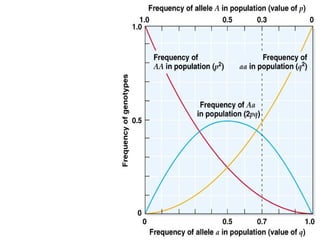
Population genetics studies how allele and gene frequencies change over time in a population. It examines genotypic and allelic frequencies to determine how common certain combinations and individual alleles are. The Hardy-Weinberg principle states that allele and genotype frequencies will remain in equilibrium in a large, randomly mating population with no evolutionary influences. Factors like mutation, genetic drift, migration and selection can cause frequencies to change from this equilibrium over time. Population variation is quantified by measuring heterozygosity and the proportion of polymorphic loci between individuals.