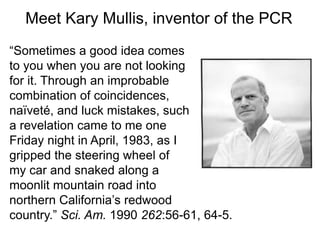
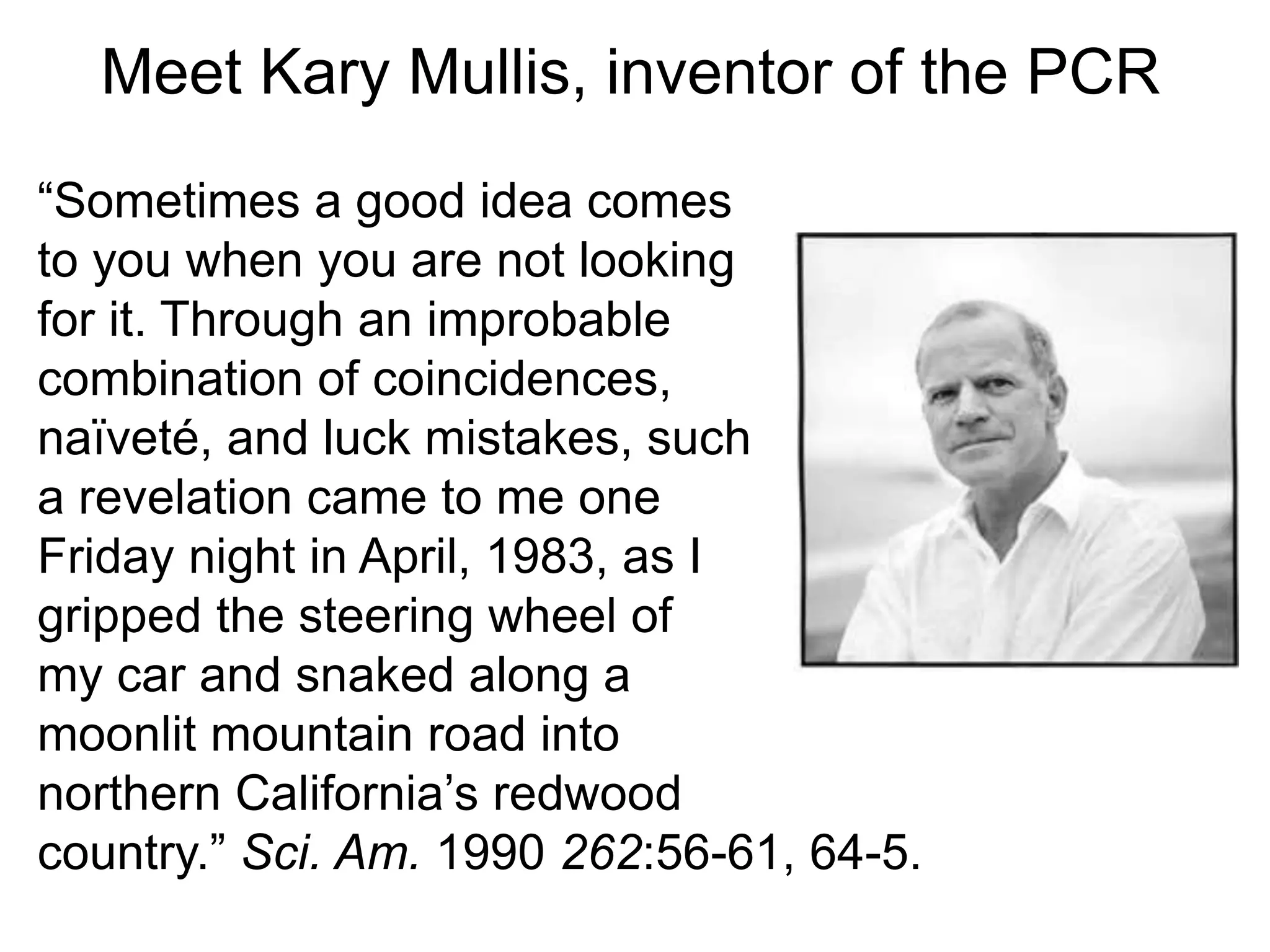
Meet Kary Mullis, inventor of the PCR 
“Sometimes a good idea comes 
to you when you are not looking 
for it. Through an improbable 
combination of coincidences, 
naïveté, and luck mistakes, such 
a revelation came to me one 
Friday night in April, 1983, as I 
gripped the steering wheel of 
my car and snaked along a 
moonlit mountain road into 
northern California’s redwood 
country.” Sci. Am. 1990 262:56-61, 64-5.
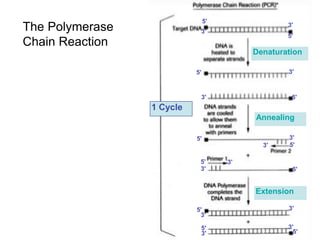
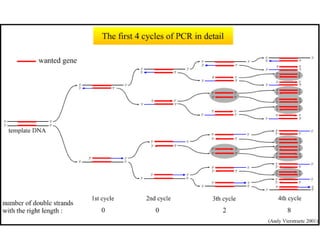
Denaturation 
Annealing 
3' 
Extension 
1 Cycle 
5' 
5' 
5' 
3' 
3' 
5' 
5' 3' 
3' 5' 
5' 
5' 
3' 
3' 
3' 
5' 
5' 
5' 
3' 
3' 
3' 
3' 
The Polymerase 
Chain Reaction
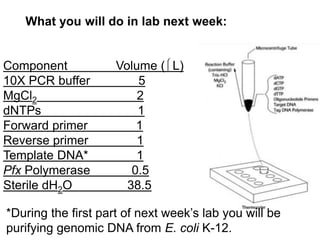
What you will do in lab next week: 
Component Volume (L) 
10X PCR buffer 5 
MgCl2 2 
dNTPs 1 
Forward primer 1 
Reverse primer 1 
Template DNA* 1 
Pfx Polymerase 0.5 
Sterile dH2O 38.5 
*During the first part of next week’s lab you will be 
purifying genomic DNA from E. coli K-12.
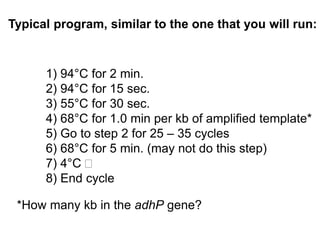
Typical program, similar to the one that you will run: 
1) 94°C for 2 min. 
2) 94°C for 15 sec. 
3) 55°C for 30 sec. 
4) 68°C for 1.0 min per kb of amplified template* 
5) Go to step 2 for 25 – 35 cycles 
6) 68°C for 5 min. (may not do this step) 
7) 4°C  
8) End cycle 
*How many kb in the adhP gene?
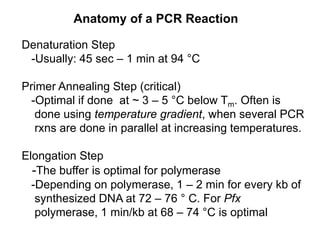
Anatomy of a PCR Reaction 
Denaturation Step 
-Usually: 45 sec – 1 min at 94 °C 
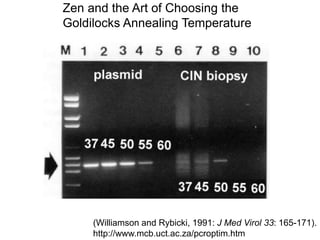
Primer Annealing Step (critical) 
-Optimal if done at ~ 3 – 5 °C below Tm. Often is 
done using temperature gradient, when several PCR 
rxns are done in parallel at increasing temperatures. 
Elongation Step 
-The buffer is optimal for polymerase 
-Depending on polymerase, 1 – 2 min for every kb of 
synthesized DNA at 72 – 76 ° C. For Pfx 
polymerase, 1 min/kb at 68 – 74 °C is optimal
Zen and the Art of Choosing the 
Goldilocks Annealing Temperature 
(Williamson and Rybicki, 1991: J Med Virol 33: 165-171). 
http://www.mcb.uct.ac.za/pcroptim.htm
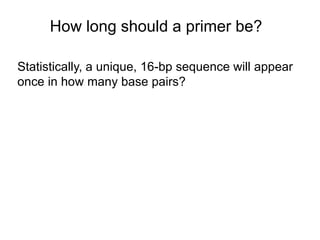
How long should a primer be? 
Statistically, a unique, 16-bp sequence will appear 
once in how many base pairs?
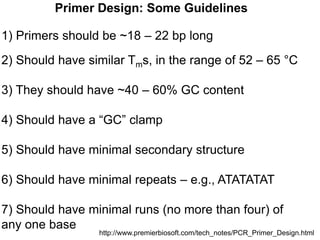
Primer Design: Some Guidelines 
1) Primers should be ~18 – 22 bp long 
2) Should have similar Tms, in the range of 52 – 65 °C 
3) They should have ~40 – 60% GC content 
4) Should have a “GC” clamp 
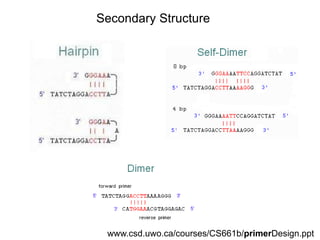
5) Should have minimal secondary structure 
6) Should have minimal repeats – e.g., ATATATAT 
7) Should have minimal runs (no more than four) of 
any one base 
http://www.premierbiosoft.com/tech_notes/PCR_Primer_Design.html
Secondary Structure 
www.csd.uwo.ca/courses/CS661b/primerDesign.ppt
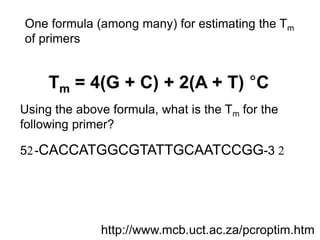
One formula (among many) for estimating the Tm 
of primers 
Tm = 4(G + C) + 2(A + T) °C 
Using the above formula, what is the Tm for the 
following primer? 
5 -CACCATGGCGTATTGCAATCCGG-3  
http://www.mcb.uct.ac.za/pcroptim.htm
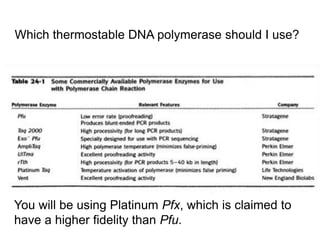
Which thermostable DNA polymerase should I use? 
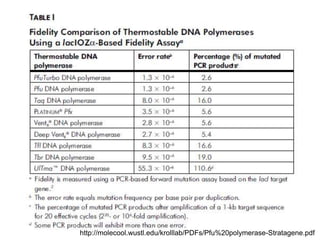
You will be using Platinum Pfx, which is claimed to 
have a higher fidelity than Pfu.
http://molecool.wustl.edu/krolllab/PDFs/Pfu%20polymerase-Stratagene.pdf
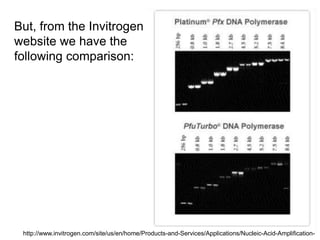
But, from the Invitrogen 
website we have the 
following comparison: 
http://www.invitrogen.com/site/us/en/home/Products-and-Services/Applications/Nucleic-Acid-Amplification-

Polymerase Chain Reaction (PCR) Lecture

  • 1.
    Meet Kary Mullis,inventor of the PCR “Sometimes a good idea comes to you when you are not looking for it. Through an improbable combination of coincidences, naïveté, and luck mistakes, such a revelation came to me one Friday night in April, 1983, as I gripped the steering wheel of my car and snaked along a moonlit mountain road into northern California’s redwood country.” Sci. Am. 1990 262:56-61, 64-5.
  • 2.
    Denaturation Annealing 3' Extension 1 Cycle 5' 5' 5' 3' 3' 5' 5' 3' 3' 5' 5' 5' 3' 3' 3' 5' 5' 5' 3' 3' 3' 3' The Polymerase Chain Reaction
  • 5.
    What you willdo in lab next week: Component Volume (L) 10X PCR buffer 5 MgCl2 2 dNTPs 1 Forward primer 1 Reverse primer 1 Template DNA* 1 Pfx Polymerase 0.5 Sterile dH2O 38.5 *During the first part of next week’s lab you will be purifying genomic DNA from E. coli K-12.
  • 6.
    Typical program, similarto the one that you will run: 1) 94°C for 2 min. 2) 94°C for 15 sec. 3) 55°C for 30 sec. 4) 68°C for 1.0 min per kb of amplified template* 5) Go to step 2 for 25 – 35 cycles 6) 68°C for 5 min. (may not do this step) 7) 4°C  8) End cycle *How many kb in the adhP gene?
  • 7.
    Anatomy of aPCR Reaction Denaturation Step -Usually: 45 sec – 1 min at 94 °C Primer Annealing Step (critical) -Optimal if done at ~ 3 – 5 °C below Tm. Often is done using temperature gradient, when several PCR rxns are done in parallel at increasing temperatures. Elongation Step -The buffer is optimal for polymerase -Depending on polymerase, 1 – 2 min for every kb of synthesized DNA at 72 – 76 ° C. For Pfx polymerase, 1 min/kb at 68 – 74 °C is optimal
  • 8.
    Zen and theArt of Choosing the Goldilocks Annealing Temperature (Williamson and Rybicki, 1991: J Med Virol 33: 165-171). http://www.mcb.uct.ac.za/pcroptim.htm
  • 9.
    How long shoulda primer be? Statistically, a unique, 16-bp sequence will appear once in how many base pairs?
  • 10.
    Primer Design: SomeGuidelines 1) Primers should be ~18 – 22 bp long 2) Should have similar Tms, in the range of 52 – 65 °C 3) They should have ~40 – 60% GC content 4) Should have a “GC” clamp 5) Should have minimal secondary structure 6) Should have minimal repeats – e.g., ATATATAT 7) Should have minimal runs (no more than four) of any one base http://www.premierbiosoft.com/tech_notes/PCR_Primer_Design.html
  • 11.
  • 12.
    One formula (amongmany) for estimating the Tm of primers Tm = 4(G + C) + 2(A + T) °C Using the above formula, what is the Tm for the following primer? 5 -CACCATGGCGTATTGCAATCCGG-3  http://www.mcb.uct.ac.za/pcroptim.htm
  • 13.
    Which thermostable DNApolymerase should I use? You will be using Platinum Pfx, which is claimed to have a higher fidelity than Pfu.
  • 14.
  • 15.
    But, from theInvitrogen website we have the following comparison: http://www.invitrogen.com/site/us/en/home/Products-and-Services/Applications/Nucleic-Acid-Amplification-