Presented By:Group 8
Muhammad Islam Ashfaq 1021
Waseem Akhtar 1001
Adeel Saleem 1003
Khalid Mehmood 1025
Shahzad Haider 1035
Arslan Aslam 1011
Khurram Shahzada Anjum 1079
Human Genome Project
Contents:
 Human Genome Project
 What is Human Genome ?
 Introduction to Human Genome Project
 Objectives of HGP
 Techniques
 Application and Proposed Benenfits
 Outcomes
 Ethical, Legal & Social Issues
 Future Prespectives
 References
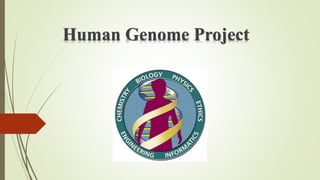
Human Genome Project
Human Genome Project:
The Human Genome Project (HGP) was an
international scientific research project with the
goal of determining the sequence of chemical base
pairs which make up human DNA, and of
identifying and mapping all of the genes of the
human genome from both a physical and functional
standpoint.
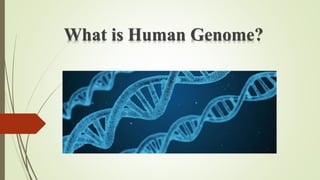
What is Human Genome?
A genome is an organism’s complete set of DNA,
including all of its genes.Each genome contains all
of the information needed to build and maintain
that organism. In humans, a copy of the entire
genome—more than 3 billion DNAbase pairs—is
contained in all cells that have a nucleus.
What is Human Genome?
 The entire genetic makeup of the human cell nucleus.
 Genes carry the information for making all of the proteins
required by the body for
 growth and maintenance.
 The genome also encodes rRNA and tRNA which are involved
in protein synthesis.
 Made up of "'35,000-50,000 genes which code for
functional proteins in the body.
 Includes non-coding sequences located between genes,
which makes up the vast majority of DNA in the genome
(~90)
Introduction to
Human Genome Project
Introduction:
 It is the world's largest collaborative biological
project.
 The Project was coordinated by the National
Institutes of Health and the U.S.Department of
Energy.
 Additional contributors included universities
across the United States and international
partners in the United Kingdom, France,Germany,
Japan, and China.
Introduction:
After the idea was picked up in 1984 by the US
government when the planning started, The Human
Genome Project formally began in USA in October
1990 by the US department of Energy (DOE) and
National institute of health (NIH).
Itwas completed in 2003, 2 years ahead of its
original schedule.
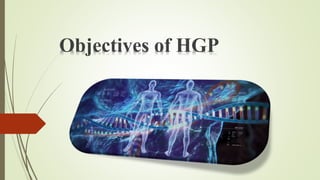
Objectives of HGP
Objectives of HGP:
 To make all the data generated by HGP, freely
and rapidly available on the internet.
 To study some model organism like fruit fly,
earthworm etc for comparison.
 Map genomes of select non-human organisms.
 Address the ethical, legal, and social issues
(ELSI) that may arise from the project.
Objectives of HGP:
Identify all the approximate 30,000 genes in
human DNA.
Determine the sequences of the 3 billion
chemical base pairs that make up human DNA.
Store this information in databases.
To develop New, faster, more efficient DNA
sequencing technology.
Develop Improve tools for data analysis.
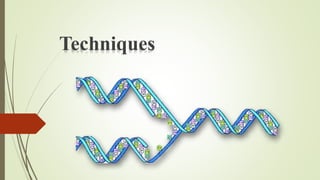
Techniques
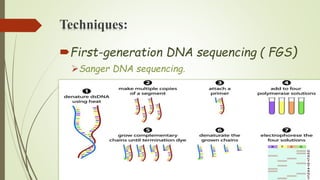
Techniques:
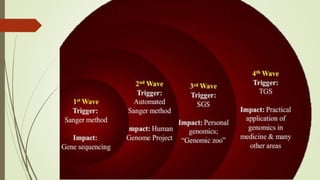
First-generation DNA sequencing ( FGS)
Sanger DNA sequencing.
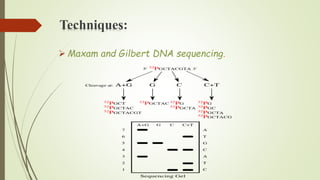
Techniques:
 Maxam and Gilbert DNA sequencing.
Techniques:
Second-generation DNA sequencing (SGS)
 Roche 454 DNA sequencing
 lllumina Solexa DNA sequencing
 AB SOLiD DNA sequencing
Third- genera t ion DNA s equenc ing (TGS)
 Hellcos Bioscience
 Pacific Bioscience
 Oxford Nanopore
Application and Proposed
Benenfits
Application and Proposed Benenfits:
Molecular Medicine
 Improve diagnosis of disease
 Detect genetic predispositions to disease
 Create drugs based on molecular information
 Use gene therapy and control systems as drugs
 Design "rustom drugs• (pharmaoogenomics) based on individual genetic profiles
Microbial Genomics
 Rapidly detect and treat pathogens (disease-causing microbes) in clinical practioe
 Develop new energy sou roes (biofuels)
 Monitor environments to detect pollutants
 Protect citizenry from biological and chemical warfare
 Clean up toxic waste safely and efficiently
Application and Proposed Benenfits:
Risk Assessment
 Evaluate the health risks faoed by individuals who may be exposed to
radiation (including low levels in industrial areas) and to cancer causing
chemicals and toxns.
Agriculture, Livestock Breeding, and
Bioprocessing
 Grow disease-, insect-, and drought-resistant crops
 Breed healthier, more productive, disease-resistant farm animals
 Grow more nutritious produce
 Develop biopesticides
 Incorporate edible vaccines incorporated into food products
 Develop new environmental cleanup uses for plants like tobacco
Application and Proposed Benenfits:
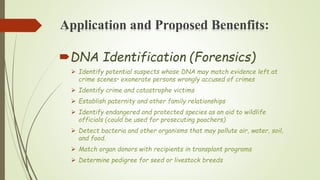
DNA Identification (Forensics)
 Identify potential suspects whose DNA may match evidence left at
crime scenes• exonerate persons wrongly accused of crimes
 Identify crime and catastrophe victims
 Establish paternity and other family relationships
 Identify endangered and protected species as an aid to wildlife
officials (could be used for prosecuting poachers)
 Detect bacteria and other organisms that may pollute air, water, soil,
and food.
 Match organ donors with recipients in transplant programs
 Determine pedigree for seed or livestock breeds
Outcomes:
Outcomes:
The human genome sequence was found to
be almost the same (99.9%) in all the human
beings.
Only 0.1% variations being responsible or
the phenotype and disease susceptibility.
Human genome is very much similar to many
other organisms.
Outcomes:
More than 1800 disease genes have been
identified.
More than 1000 genetic tests have been
devised for diagnosis.
The study of mitochondrial DNA has revealed
that the origin of the human
race is from central Africa, in other words
mankind took origin from an African woman.
Outcomes:
There are approximately 20,500 genes in
human beings, the same range as in mice.
The human genome has significantly more
segmental duplications (nearly
identical, repeated sections of DNA) than had
been previously suspected.
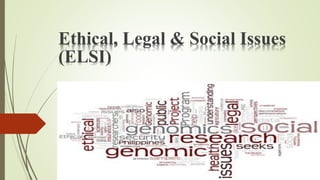
Ethical, Legal & Social Issues
(ELSI)
Ethical, Legal & Social Issues
(ELSI):
The Ethical, Legal, and Social Implications
(ELSI) program was founded in1990 as an
integral part of the Human Genome Project.
The mission of theELSI program was to
identify and address issues raised by
genomic researchthat would affect
individuals, families, and society.
Ethical, Legal & Social Issues
(ELSI):
 The ELSI program focused on the possible consequences of
genomic researchin four main areas:
 Privacy and fairness in the use of genetic information, including
thepotential for genetic discrimination in employment and insurance.
 The integration of new genetic technologies, such as genetic testing,into the
practice of clinical medicine.
 Ethical issues surrounding the design and conduct of genetic researchwith
people, including the process of informed consent.
 The education of healthcare professionals, policy makers, students,and the
public about genetics and the complex issues that result fromgenomic
research.
Ethical, Legal & Social Issues
(ELSI)
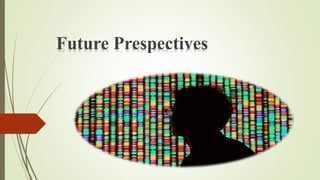
Future Prespectives
Future Prespectives:
 It will speed up the identification of all human genes.
 It will help to determine the function of genes and the elements that
regulate the genes.
 It will help to understand role of environmental as well as genetic factors
in development of disease.
 Diagnosis of various genetic disorders via cloning.
Future Prespectives:
 To develope and apply genome based strategies for early detection,
diagnosis and treatment of disease.
 Sequencing the genome of other organisms such as mouse, chimpanzee,will
help in better understanding by comparing similar genes between species.
 To help in understanding of polygenic disorder(interaction of gene at
more than one locus) such as cancer and diabetes.
 To develop new technologies to study genes and improvement in gene
therapy.
References:
 An introduction to the human genome is available from the NationalHuman Genome Research Institute in
A Brief Guide to Genomics (https://www.genome.gov/about-genomics/fact-sheets/A-Brief-Guide-to-
Genomics).
 The National Human Genome Research Institute offers a fact sheet about theHuman Genome Project
(https://www.genome.gov/human-genome-project) anda list of frequently asked questions
(https://www.genome.gov/human-genome-project/Completion-FAQ).
 The National Human Genome Research Institute details the goals andaccomplishments
(https://www.genome.gov/11006945/human-genome-project-goals) of the Human Genome Project.
 The National Human Genome Research Institute provides a fact sheet aboutDNA sequencing
(https://www.genome.gov/about-genomics/fact-sheets/DNA-Sequencing-Fact-Sheet).
 http://www.slideshare.net/Rv_252/human-genome-project-94452193?from_m_app=android
 http://www.slideshare.net/sahilbiswas/the-human-genome-project-20209635?from_m_app=android
Human Genome Project

Human Genome Project

  • 1.
    Presented By:Group 8 MuhammadIslam Ashfaq 1021 Waseem Akhtar 1001 Adeel Saleem 1003 Khalid Mehmood 1025 Shahzad Haider 1035 Arslan Aslam 1011 Khurram Shahzada Anjum 1079 Human Genome Project
  • 2.
    Contents:  Human GenomeProject  What is Human Genome ?  Introduction to Human Genome Project  Objectives of HGP  Techniques  Application and Proposed Benenfits  Outcomes  Ethical, Legal & Social Issues  Future Prespectives  References
  • 3.
  • 4.
    Human Genome Project: TheHuman Genome Project (HGP) was an international scientific research project with the goal of determining the sequence of chemical base pairs which make up human DNA, and of identifying and mapping all of the genes of the human genome from both a physical and functional standpoint.
  • 5.
  • 6.
    What is HumanGenome? A genome is an organism’s complete set of DNA, including all of its genes.Each genome contains all of the information needed to build and maintain that organism. In humans, a copy of the entire genome—more than 3 billion DNAbase pairs—is contained in all cells that have a nucleus.
  • 7.
    What is HumanGenome?  The entire genetic makeup of the human cell nucleus.  Genes carry the information for making all of the proteins required by the body for  growth and maintenance.  The genome also encodes rRNA and tRNA which are involved in protein synthesis.  Made up of "'35,000-50,000 genes which code for functional proteins in the body.  Includes non-coding sequences located between genes, which makes up the vast majority of DNA in the genome (~90)
  • 8.
  • 9.
    Introduction:  It isthe world's largest collaborative biological project.  The Project was coordinated by the National Institutes of Health and the U.S.Department of Energy.  Additional contributors included universities across the United States and international partners in the United Kingdom, France,Germany, Japan, and China.
  • 10.
    Introduction: After the ideawas picked up in 1984 by the US government when the planning started, The Human Genome Project formally began in USA in October 1990 by the US department of Energy (DOE) and National institute of health (NIH). Itwas completed in 2003, 2 years ahead of its original schedule.
  • 11.
  • 12.
    Objectives of HGP: To make all the data generated by HGP, freely and rapidly available on the internet.  To study some model organism like fruit fly, earthworm etc for comparison.  Map genomes of select non-human organisms.  Address the ethical, legal, and social issues (ELSI) that may arise from the project.
  • 13.
    Objectives of HGP: Identifyall the approximate 30,000 genes in human DNA. Determine the sequences of the 3 billion chemical base pairs that make up human DNA. Store this information in databases. To develop New, faster, more efficient DNA sequencing technology. Develop Improve tools for data analysis.
  • 14.
  • 15.
    Techniques: First-generation DNA sequencing( FGS) Sanger DNA sequencing.
  • 16.
    Techniques:  Maxam andGilbert DNA sequencing.
  • 17.
    Techniques: Second-generation DNA sequencing(SGS)  Roche 454 DNA sequencing  lllumina Solexa DNA sequencing  AB SOLiD DNA sequencing Third- genera t ion DNA s equenc ing (TGS)  Hellcos Bioscience  Pacific Bioscience  Oxford Nanopore
  • 19.
  • 20.
    Application and ProposedBenenfits: Molecular Medicine  Improve diagnosis of disease  Detect genetic predispositions to disease  Create drugs based on molecular information  Use gene therapy and control systems as drugs  Design "rustom drugs• (pharmaoogenomics) based on individual genetic profiles Microbial Genomics  Rapidly detect and treat pathogens (disease-causing microbes) in clinical practioe  Develop new energy sou roes (biofuels)  Monitor environments to detect pollutants  Protect citizenry from biological and chemical warfare  Clean up toxic waste safely and efficiently
  • 21.
    Application and ProposedBenenfits: Risk Assessment  Evaluate the health risks faoed by individuals who may be exposed to radiation (including low levels in industrial areas) and to cancer causing chemicals and toxns. Agriculture, Livestock Breeding, and Bioprocessing  Grow disease-, insect-, and drought-resistant crops  Breed healthier, more productive, disease-resistant farm animals  Grow more nutritious produce  Develop biopesticides  Incorporate edible vaccines incorporated into food products  Develop new environmental cleanup uses for plants like tobacco
  • 22.
    Application and ProposedBenenfits: DNA Identification (Forensics)  Identify potential suspects whose DNA may match evidence left at crime scenes• exonerate persons wrongly accused of crimes  Identify crime and catastrophe victims  Establish paternity and other family relationships  Identify endangered and protected species as an aid to wildlife officials (could be used for prosecuting poachers)  Detect bacteria and other organisms that may pollute air, water, soil, and food.  Match organ donors with recipients in transplant programs  Determine pedigree for seed or livestock breeds
  • 24.
  • 25.
    Outcomes: The human genomesequence was found to be almost the same (99.9%) in all the human beings. Only 0.1% variations being responsible or the phenotype and disease susceptibility. Human genome is very much similar to many other organisms.
  • 26.
    Outcomes: More than 1800disease genes have been identified. More than 1000 genetic tests have been devised for diagnosis. The study of mitochondrial DNA has revealed that the origin of the human race is from central Africa, in other words mankind took origin from an African woman.
  • 27.
    Outcomes: There are approximately20,500 genes in human beings, the same range as in mice. The human genome has significantly more segmental duplications (nearly identical, repeated sections of DNA) than had been previously suspected.
  • 28.
    Ethical, Legal &Social Issues (ELSI)
  • 29.
    Ethical, Legal &Social Issues (ELSI): The Ethical, Legal, and Social Implications (ELSI) program was founded in1990 as an integral part of the Human Genome Project. The mission of theELSI program was to identify and address issues raised by genomic researchthat would affect individuals, families, and society.
  • 30.
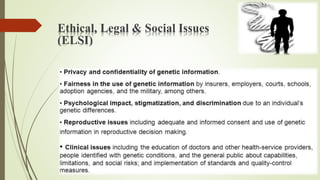
    Ethical, Legal &Social Issues (ELSI):  The ELSI program focused on the possible consequences of genomic researchin four main areas:  Privacy and fairness in the use of genetic information, including thepotential for genetic discrimination in employment and insurance.  The integration of new genetic technologies, such as genetic testing,into the practice of clinical medicine.  Ethical issues surrounding the design and conduct of genetic researchwith people, including the process of informed consent.  The education of healthcare professionals, policy makers, students,and the public about genetics and the complex issues that result fromgenomic research.
  • 31.
    Ethical, Legal &Social Issues (ELSI)
  • 32.
  • 33.
    Future Prespectives:  Itwill speed up the identification of all human genes.  It will help to determine the function of genes and the elements that regulate the genes.  It will help to understand role of environmental as well as genetic factors in development of disease.  Diagnosis of various genetic disorders via cloning.
  • 34.
    Future Prespectives:  Todevelope and apply genome based strategies for early detection, diagnosis and treatment of disease.  Sequencing the genome of other organisms such as mouse, chimpanzee,will help in better understanding by comparing similar genes between species.  To help in understanding of polygenic disorder(interaction of gene at more than one locus) such as cancer and diabetes.  To develop new technologies to study genes and improvement in gene therapy.
  • 35.
    References:  An introductionto the human genome is available from the NationalHuman Genome Research Institute in A Brief Guide to Genomics (https://www.genome.gov/about-genomics/fact-sheets/A-Brief-Guide-to- Genomics).  The National Human Genome Research Institute offers a fact sheet about theHuman Genome Project (https://www.genome.gov/human-genome-project) anda list of frequently asked questions (https://www.genome.gov/human-genome-project/Completion-FAQ).  The National Human Genome Research Institute details the goals andaccomplishments (https://www.genome.gov/11006945/human-genome-project-goals) of the Human Genome Project.  The National Human Genome Research Institute provides a fact sheet aboutDNA sequencing (https://www.genome.gov/about-genomics/fact-sheets/DNA-Sequencing-Fact-Sheet).  http://www.slideshare.net/Rv_252/human-genome-project-94452193?from_m_app=android  http://www.slideshare.net/sahilbiswas/the-human-genome-project-20209635?from_m_app=android