Presenting By-
Biplob Dey
M.Pharm (Pharmacology)
1st Semester
DNA Micro Array Technique
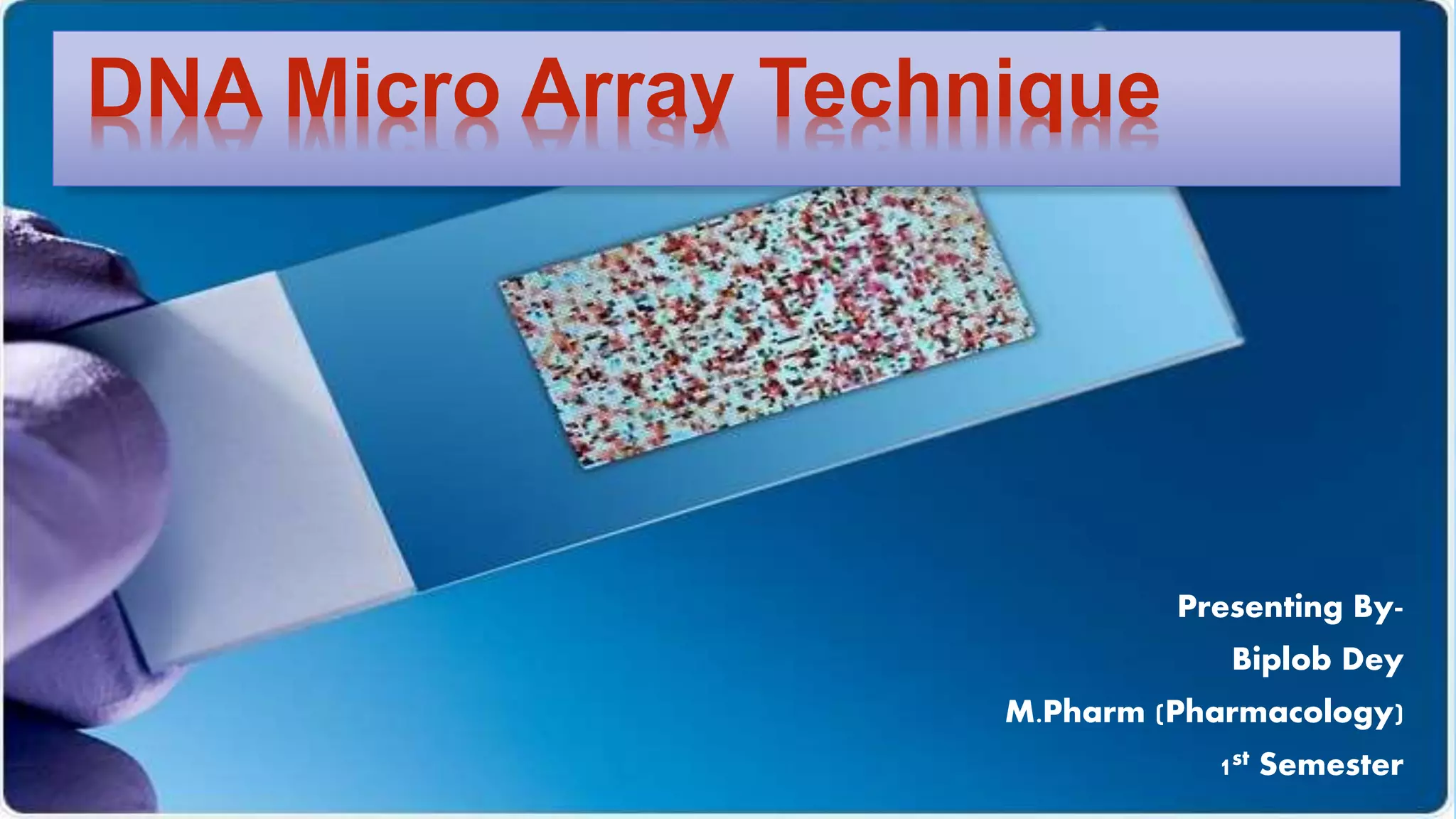
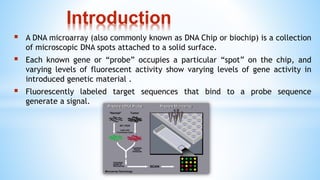
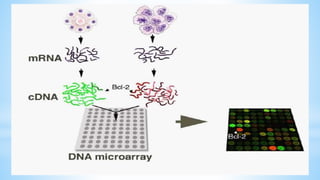
 A DNA microarray (also commonly known as DNA Chip or biochip) is a collection
of microscopic DNA spots attached to a solid surface.
 Each known gene or “probe” occupies a particular “spot” on the chip, and
varying levels of fluorescent activity show varying levels of gene activity in
introduced genetic material .
 Fluorescently labeled target sequences that bind to a probe sequence
generate a signal.
Introduction
• The concept of DNA microarrays began in the mid 1980s.
•“Quantitative Monitoring of Gene Expression Patterns with a complementary DNA
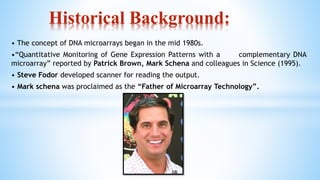
microarray” reported by Patrick Brown, Mark Schena and colleagues in Science (1995).
• Steve Fodor developed scanner for reading the output.
• Mark schena was proclaimed as the “Father of Microarray Technology”.
Historical Background:
 The core principle behind microarrays is hybridization.
 Samples are labelled using fluorescent dyes.
 At least two samples are hybridized to chip.
 Complementary nucleic acid sequences get pair via hydrogen bonds.
 Washing off of non-specific bonding sequences .
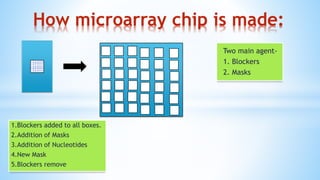
How microarray chip is made:
Two main agent-
1. Blockers
2. Masks
1.Blockers added to all boxes.
2.Addition of Masks
3.Addition of Nucleotides
4.New Mask
5.Blockers remove
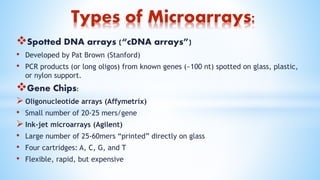
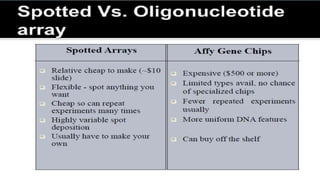
Spotted DNA arrays (“cDNA arrays”)
• Developed by Pat Brown (Stanford)
• PCR products (or long oligos) from known genes (~100 nt) spotted on glass, plastic,
or nylon support.
Gene Chips:
 Oligonucleotide arrays (Affymetrix)
• Small number of 20-25 mers/gene
 Ink-jet microarrays (Agilent)
• Large number of 25-60mers “printed” directly on glass
• Four cartridges: A, C, G, and T
• Flexible, rapid, but expensive
Types of Microarrays:
Application:
1. In detecting Cancer cells.
2. In Antibiotic
DNA MICRO ARRAY TECHNIQUE

DNA MICRO ARRAY TECHNIQUE

  • 1.
    Presenting By- Biplob Dey M.Pharm(Pharmacology) 1st Semester DNA Micro Array Technique
  • 2.
     A DNAmicroarray (also commonly known as DNA Chip or biochip) is a collection of microscopic DNA spots attached to a solid surface.  Each known gene or “probe” occupies a particular “spot” on the chip, and varying levels of fluorescent activity show varying levels of gene activity in introduced genetic material .  Fluorescently labeled target sequences that bind to a probe sequence generate a signal. Introduction
  • 3.
    • The conceptof DNA microarrays began in the mid 1980s. •“Quantitative Monitoring of Gene Expression Patterns with a complementary DNA microarray” reported by Patrick Brown, Mark Schena and colleagues in Science (1995). • Steve Fodor developed scanner for reading the output. • Mark schena was proclaimed as the “Father of Microarray Technology”. Historical Background:
  • 4.
     The coreprinciple behind microarrays is hybridization.  Samples are labelled using fluorescent dyes.  At least two samples are hybridized to chip.  Complementary nucleic acid sequences get pair via hydrogen bonds.  Washing off of non-specific bonding sequences .
  • 6.
    How microarray chipis made: Two main agent- 1. Blockers 2. Masks 1.Blockers added to all boxes. 2.Addition of Masks 3.Addition of Nucleotides 4.New Mask 5.Blockers remove
  • 7.
    Spotted DNA arrays(“cDNA arrays”) • Developed by Pat Brown (Stanford) • PCR products (or long oligos) from known genes (~100 nt) spotted on glass, plastic, or nylon support. Gene Chips:  Oligonucleotide arrays (Affymetrix) • Small number of 20-25 mers/gene  Ink-jet microarrays (Agilent) • Large number of 25-60mers “printed” directly on glass • Four cartridges: A, C, G, and T • Flexible, rapid, but expensive Types of Microarrays:
  • 9.
    Application: 1. In detectingCancer cells. 2. In Antibiotic