Centrifugation in biochemical research 
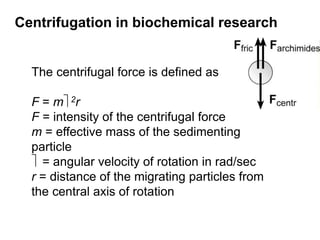
The centrifugal force is defined as 
F = m 2r 
F = intensity of the centrifugal force 
m = effective mass of the sedimenting 
particle 
 = angular velocity of rotation in rad/sec 
r = distance of the migrating particles from 
the central axis of rotation
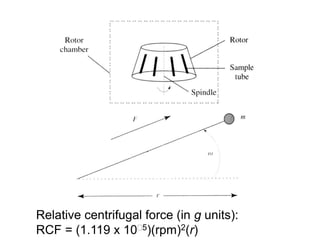
Relative centrifugal force (in g units): 
RCF = (1.119 x 105)(rpm)2(r)
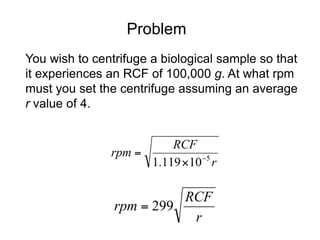
Problem 
You wish to centrifuge a biological sample so that 
it experiences an RCF of 100,000 g. At what rpm 
must you set the centrifuge assuming an average 
r value of 4.
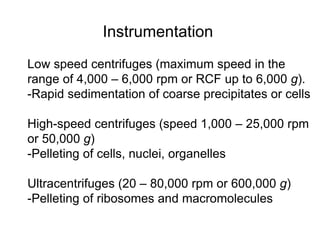
Instrumentation 
Low speed centrifuges (maximum speed in the 
range of 4,000 – 6,000 rpm or RCF up to 6,000 g). 
-Rapid sedimentation of coarse precipitates or cells 
High-speed centrifuges (speed 1,000 – 25,000 rpm 
or 50,000 g) 
-Pelleting of cells, nuclei, organelles 
Ultracentrifuges (20 – 80,000 rpm or 600,000 g) 
-Pelleting of ribosomes and macromolecules
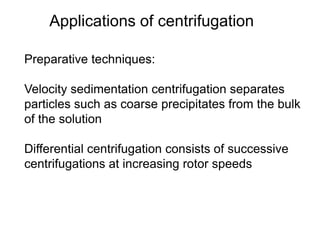
Applications of centrifugation 
Preparative techniques: 
Velocity sedimentation centrifugation separates 
particles such as coarse precipitates from the bulk 
of the solution 
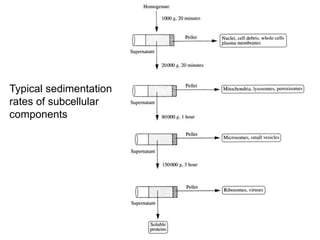
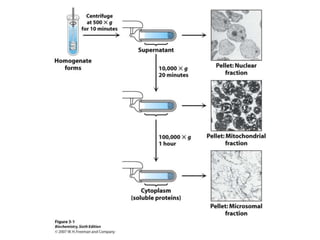
Differential centrifugation consists of successive 
centrifugations at increasing rotor speeds
Typical sedimentation 
rates of subcellular 
components
Applications of centrifugation 
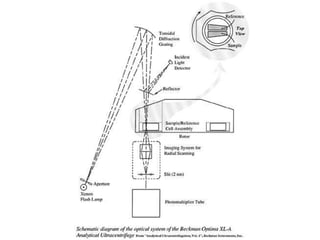
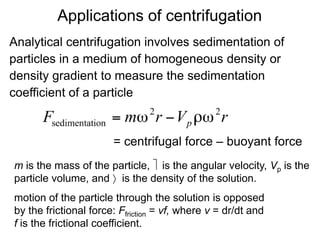
Analytical centrifugation involves sedimentation of 
particles in a medium of homogeneous density or 
density gradient to measure the sedimentation 
coefficient of a particle 
= centrifugal force – buoyant force 
m is the mass of the particle,  is the angular velocity, Vp is the 
particle volume, and  is the density of the solution. 
motion of the particle through the solution is opposed 
by the frictional force: Ffriction = vf, where v = dr/dt and 
f is the frictional coefficient.
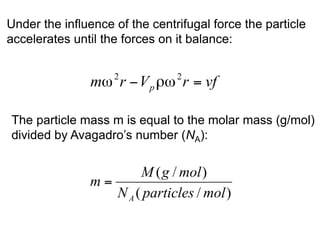
Under the influence of the centrifugal force the particle 
accelerates until the forces on it balance: 
The particle mass m is equal to the molar mass (g/mol) 
divided by Avagadro’s number (NA):
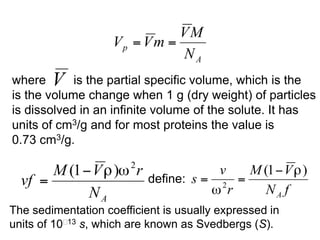
where is the partial specific volume, which is the 
is the volume change when 1 g (dry weight) of particles 
is dissolved in an infinite volume of the solute. It has 
units of cm3/g and for most proteins the value is 
0.73 cm3/g. 
define: 
The sedimentation coefficient is usually expressed in 
units of 1013 s, which are known as Svedbergs (S).
Prior to 1970 most molecular mass determinations 
of macromolecules were made via analytical 
ultracentrifugation techniques. This method of 
estimating molar mass has largely been replaced 
by simpler methods such as? 
The technique still enjoys application to help 
researchers answer questions about macromolecular 
association and for purification of nucleic acids in CsCl 
gradients.
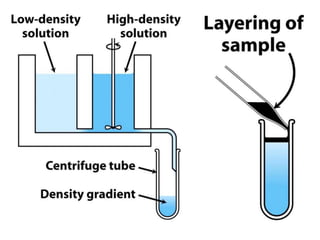
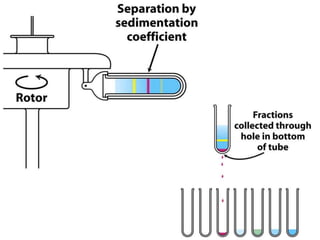
Use of density gradients greatly enhances resolving 
power, which leads to two approaches: 
1) zonal centrifugation – macromolecular solution is 
layered on top of a preformed density gradient. 
2) isopycnic or equilibrium density – spinning of 
sample in a concentrated solution of a dense, fast-diffusing 
substance (e.g., CsCl) causes the substance 
to form a steep gradient such that sample molecules 
sediment to positions where their density equals that 
of the surrounding portion of the solution. 
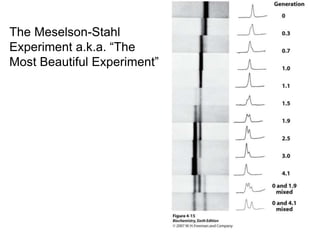
-famous example: The Meselson-Stahl Expt.
The Meselson-Stahl 
Experiment a.k.a. “The 
Most Beautiful Experiment”
Centrifugation lecture

Centrifugation lecture

  • 1.
    Centrifugation in biochemicalresearch The centrifugal force is defined as F = m 2r F = intensity of the centrifugal force m = effective mass of the sedimenting particle  = angular velocity of rotation in rad/sec r = distance of the migrating particles from the central axis of rotation
  • 2.
    Relative centrifugal force(in g units): RCF = (1.119 x 105)(rpm)2(r)
  • 4.
    Problem You wishto centrifuge a biological sample so that it experiences an RCF of 100,000 g. At what rpm must you set the centrifuge assuming an average r value of 4.
  • 5.
    Instrumentation Low speedcentrifuges (maximum speed in the range of 4,000 – 6,000 rpm or RCF up to 6,000 g). -Rapid sedimentation of coarse precipitates or cells High-speed centrifuges (speed 1,000 – 25,000 rpm or 50,000 g) -Pelleting of cells, nuclei, organelles Ultracentrifuges (20 – 80,000 rpm or 600,000 g) -Pelleting of ribosomes and macromolecules
  • 6.
    Applications of centrifugation Preparative techniques: Velocity sedimentation centrifugation separates particles such as coarse precipitates from the bulk of the solution Differential centrifugation consists of successive centrifugations at increasing rotor speeds
  • 7.
    Typical sedimentation ratesof subcellular components
  • 9.
    Applications of centrifugation Analytical centrifugation involves sedimentation of particles in a medium of homogeneous density or density gradient to measure the sedimentation coefficient of a particle = centrifugal force – buoyant force m is the mass of the particle,  is the angular velocity, Vp is the particle volume, and  is the density of the solution. motion of the particle through the solution is opposed by the frictional force: Ffriction = vf, where v = dr/dt and f is the frictional coefficient.
  • 10.
    Under the influenceof the centrifugal force the particle accelerates until the forces on it balance: The particle mass m is equal to the molar mass (g/mol) divided by Avagadro’s number (NA):
  • 11.
    where is thepartial specific volume, which is the is the volume change when 1 g (dry weight) of particles is dissolved in an infinite volume of the solute. It has units of cm3/g and for most proteins the value is 0.73 cm3/g. define: The sedimentation coefficient is usually expressed in units of 1013 s, which are known as Svedbergs (S).
  • 13.
    Prior to 1970most molecular mass determinations of macromolecules were made via analytical ultracentrifugation techniques. This method of estimating molar mass has largely been replaced by simpler methods such as? The technique still enjoys application to help researchers answer questions about macromolecular association and for purification of nucleic acids in CsCl gradients.
  • 14.
    Use of densitygradients greatly enhances resolving power, which leads to two approaches: 1) zonal centrifugation – macromolecular solution is layered on top of a preformed density gradient. 2) isopycnic or equilibrium density – spinning of sample in a concentrated solution of a dense, fast-diffusing substance (e.g., CsCl) causes the substance to form a steep gradient such that sample molecules sediment to positions where their density equals that of the surrounding portion of the solution. -famous example: The Meselson-Stahl Expt.
  • 17.
    The Meselson-Stahl Experimenta.k.a. “The Most Beautiful Experiment”