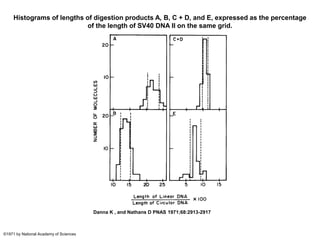
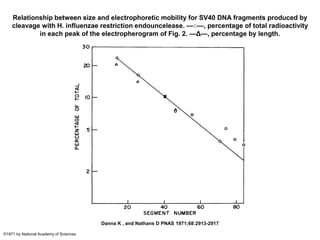
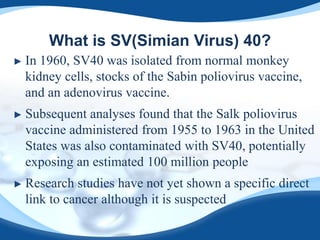
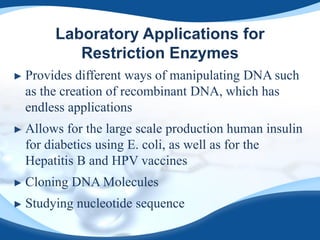
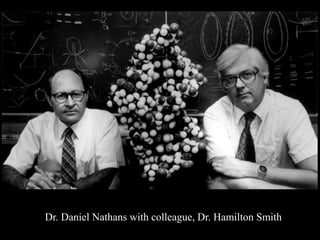
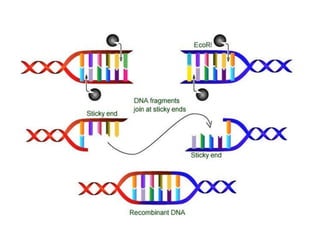
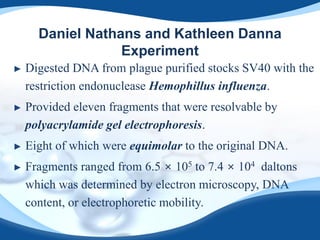
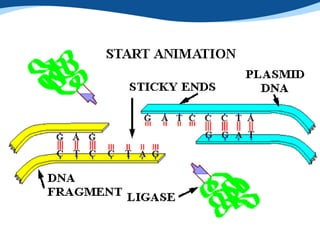
Restriction enzymes are molecules that cut DNA at specific sequences. They were discovered in the 1970s and have become important tools in biotechnology. Restriction enzymes cut both strands of DNA in the same place and generate sticky or blunt ends. Daniel Nathans and colleagues were the first to isolate and characterize a restriction enzyme from Haemophilus influenzae that generates 11 fragments when cutting the SV40 virus DNA. Their work helped establish restriction enzymes as useful tools and earned them the 1978 Nobel Prize. Restriction enzymes are now widely used for cloning genes and studying DNA.

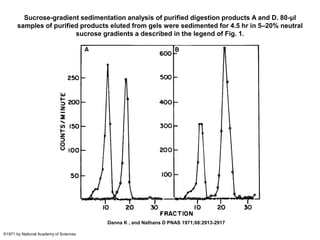
![Sucrose-gradient sedimentation of SV40 DNA digested with H. influenzae restriction
endonuclease. 27 ng of SV40 [3H]DNA I (3.9 × 10⁴ cpm/μg) was incubated at 37°C for 30 min
in 50 μl of TMSH–40 mM NaCl, either with no enzyme, with 1 μl (0.016 units) of enzym...
Danna K , and Nathans D PNAS 1971;68:2913-2917
©1971 by National Academy of Sciences](https://image.slidesharecdn.com/674bbc2c-8406-4e14-99eb-a07c68e87f21-150222120200-conversion-gate02/85/Restriction-Enzymes-12-320.jpg)
![Electrophoresis of SV40 DNA digested with H. influenzae restriction endonuclease. 2 μg of
SV40 [32P]DNA I (8200 cpm/μg) in 0.09 ml of TMSH–50 mM NaCl was digested at 35°C.
Danna K , and Nathans D PNAS 1971;68:2913-2917
©1971 by National Academy of Sciences](https://image.slidesharecdn.com/674bbc2c-8406-4e14-99eb-a07c68e87f21-150222120200-conversion-gate02/85/Restriction-Enzymes-13-320.jpg)
![Radioautographic analysis of SV40 DNA digested with H. influenzae restriction endonuclease.
1 μg of SV40 [14C]DNA I (3 × 10⁴ cpm/μg) was digested (see Fig. 2) for 6 hr in a volume of 55
μl; 0.0015 unit of enzyme was added at 0 time and at 1, 2, 3, 4, and 5 ...
Danna K , and Nathans D PNAS 1971;68:2913-2917
©1971 by National Academy of Sciences](https://image.slidesharecdn.com/674bbc2c-8406-4e14-99eb-a07c68e87f21-150222120200-conversion-gate02/85/Restriction-Enzymes-14-320.jpg)