   To the average person:
     Being polite means showing good
      manners and thinking about other
      people’s feelings
   For the sociolinguist:
     The way that people choose to speak
      and how their listeners react to what they
      say
 Ideas of politeness vary between
  cultures
 What is polite in one culture is not
  necessarily polite in another
   Saying to a woman “You’ve gained
    weight.”
     Compliment in Africa and Arab
      cultures
       • Means that you’re looking healthy.
     Very rude in America, Europe and
      most of Asia
     Better to say the opposite “Have you
      lost weight?”
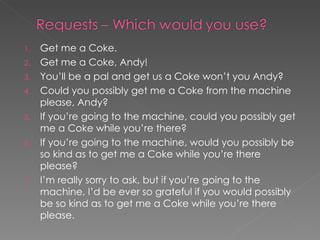
1.   Get me a Coke.
2.   Get me a Coke, Andy!
3.   You’ll be a pal and get us a Coke won’t you Andy?
4.   Could you possibly get me a Coke from the machine
     please, Andy?
5.   If you’re going to the machine, could you possibly get
     me a Coke while you’re there?
6.   If you’re going to the machine, would you possibly be
     so kind as to get me a Coke while you’re there
     please?
7.   I’m really sorry to ask, but if you’re going to the
     machine, I’d be ever so grateful if you would possibly
     be so kind as to get me a Coke while you’re there
     please.
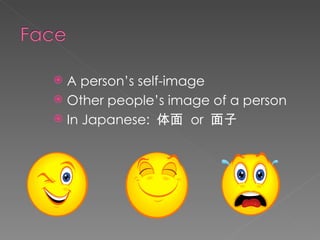
 A person’s self-image
 Other people’s image of a person
 In Japanese: 体面 or 面子
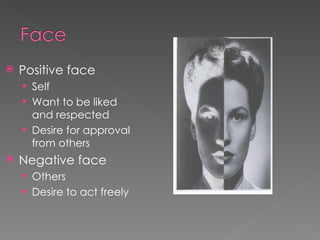
   Positive face
     Self
     Want to be liked
      and respected
     Desire for approval
      from others
   Negative face
     Others
     Desire to act freely
   Politeness is used when your face is
    threatened
     When you might lose other’s respect
     When you can’t act freely
   Called face threatening acts (FTA)
   Request: Asking for money
       “Could I borrow 5,000?”
   Compliment: Man complimenting a
    woman
       “You’re really beautiful.”
   Expressing thanks
       “Thank you for your help.”
   Taboo topic
     “How old are you?”
   Apology
     “I’m sorry for being late.”
   Social distance
     Friends have more flexibility than strangers
   Social status
     Equals have more flexibility than unequals
   Nature of the threat
     Some threats may be bigger
 Politeness is a way to show awareness of
  another person’s face
 Face-saving act: saying something that
  lessens the possible threat to another’s
  face
   Shut the door!
     Does not leave the hearer with any choice
     Makes the speaker sound more powerful
 Please: “Shut the door please.”
 Hedges: “If it isn’t too much trouble, shut
  the door.”
 Questions: “Could you pass the salt?”
 Provisional language: Using if, would,
  can, etc.
     Make refusing easier
 In general terms, politeness is being nice
  to other people.
 More formally, politeness is concern for
  someone’s face.
     Negative face: be able to act freely
     Positive face: be liked and admired
 Interaction with people can threaten
  people’s face
 People avoid face threatening acts with
  polite strategies

Politeness

  • 2.
    To the average person:  Being polite means showing good manners and thinking about other people’s feelings  For the sociolinguist:  The way that people choose to speak and how their listeners react to what they say
  • 3.
     Ideas ofpoliteness vary between cultures  What is polite in one culture is not necessarily polite in another
  • 5.
    Saying to a woman “You’ve gained weight.”  Compliment in Africa and Arab cultures • Means that you’re looking healthy.  Very rude in America, Europe and most of Asia  Better to say the opposite “Have you lost weight?”
  • 6.
    1. Get me a Coke. 2. Get me a Coke, Andy! 3. You’ll be a pal and get us a Coke won’t you Andy? 4. Could you possibly get me a Coke from the machine please, Andy? 5. If you’re going to the machine, could you possibly get me a Coke while you’re there? 6. If you’re going to the machine, would you possibly be so kind as to get me a Coke while you’re there please? 7. I’m really sorry to ask, but if you’re going to the machine, I’d be ever so grateful if you would possibly be so kind as to get me a Coke while you’re there please.
  • 7.
     A person’sself-image  Other people’s image of a person  In Japanese: 体面 or 面子
  • 8.
    Positive face  Self  Want to be liked and respected  Desire for approval from others  Negative face  Others  Desire to act freely
  • 9.
    Politeness is used when your face is threatened  When you might lose other’s respect  When you can’t act freely  Called face threatening acts (FTA)
  • 10.
    Request: Asking for money  “Could I borrow 5,000?”  Compliment: Man complimenting a woman  “You’re really beautiful.”  Expressing thanks  “Thank you for your help.”
  • 11.
    Taboo topic  “How old are you?”  Apology  “I’m sorry for being late.”
  • 12.
    Social distance  Friends have more flexibility than strangers  Social status  Equals have more flexibility than unequals  Nature of the threat  Some threats may be bigger
  • 13.
     Politeness isa way to show awareness of another person’s face  Face-saving act: saying something that lessens the possible threat to another’s face
  • 14.
    Shut the door!  Does not leave the hearer with any choice  Makes the speaker sound more powerful
  • 15.
     Please: “Shutthe door please.”  Hedges: “If it isn’t too much trouble, shut the door.”  Questions: “Could you pass the salt?”  Provisional language: Using if, would, can, etc.  Make refusing easier
  • 16.
     In generalterms, politeness is being nice to other people.  More formally, politeness is concern for someone’s face.  Negative face: be able to act freely  Positive face: be liked and admired  Interaction with people can threaten people’s face  People avoid face threatening acts with polite strategies

Editor's Notes

  • #3 Average person: Using please and thank you; giving your seat to older people; not interrupting when someone is talking
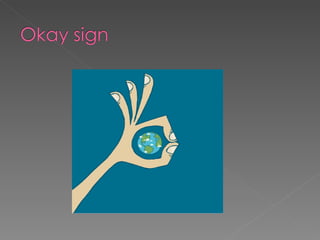
  • #5 Acceptable in American and most of western Europe, but extremely rude in Greece and Turkey
  • #7 Depends on who you are asking, how well you know them, how much power they have over you, how much effort it costs them to get the can of Coke, and if there is a benefit for them.
  • #9 Positive face – how others view you (self) Negative face – how free you are to act, what you think you can do
  • #11 The hearer may need the money and not really be able to be able to lend the money, but feel obliged because the person requesting is a close friend. The woman may feel obliged to talk the men when she doesn’t really want to. Thanking someone for something obliges you to sometime return the favor.
  • #12 In some cultures asking someone’s age is a sign of disrespect. An apology is an admission that you have made a mistake.
  • #13 It is easier to ask a friend or family member for money than an acquaintance Asking your boss for money is more difficult than asking a co-worker Borrowing \\5,000 is easier than \\50,000