Face Negotiation TheoryTeaching Practice 1: COMS 620Jenny A. Armentrout
Development of FNTFace - Negotiation Theory (FNT) was      developed by Stella Ting-Toomey     (1985), a communication professor at     California State University, Fullerton“Face” according to sociologist Erving Goffman                         (1967, p. 5), is “the positive social                         value a person effectively claims for                         her/himself by the line others assume                         s/he has taken during a particular                         contact.”
Face-workFace is a metaphor for the image of oneself that we want others to see and believe.Every culture is always negotiating face.FNT states that people from individualistic, low context cultures interact differently from collectivistic, high context cultures.
High/Low Context Cultures
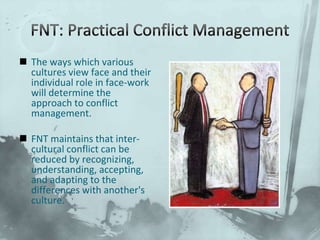
FNT: Practical Conflict ManagementThe ways which various cultures view face and their individual role in face-work will determine the approach to conflict management.FNT maintains that inter-cultural conflict can be reduced by recognizing, understanding, accepting, and adapting to the differences with another's culture.
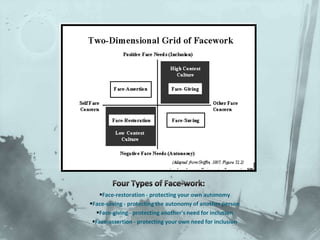
Four Types of Face-work:Face-restoration - protecting your own autonomy
Face-saving - protecting the autonomy of another person
Face-giving - protecting another's need for inclusion
Face-assertion - protecting your own need for inclusionFace MovementsObliging- accommodating
Compromising- bargaining

Face negotiation theory

  • 1.
    Face Negotiation TheoryTeachingPractice 1: COMS 620Jenny A. Armentrout
  • 2.
    Development of FNTFace- Negotiation Theory (FNT) was developed by Stella Ting-Toomey (1985), a communication professor at California State University, Fullerton“Face” according to sociologist Erving Goffman (1967, p. 5), is “the positive social value a person effectively claims for her/himself by the line others assume s/he has taken during a particular contact.”
  • 3.
    Face-workFace is ametaphor for the image of oneself that we want others to see and believe.Every culture is always negotiating face.FNT states that people from individualistic, low context cultures interact differently from collectivistic, high context cultures.
  • 4.
  • 5.
    FNT: Practical ConflictManagementThe ways which various cultures view face and their individual role in face-work will determine the approach to conflict management.FNT maintains that inter-cultural conflict can be reduced by recognizing, understanding, accepting, and adapting to the differences with another's culture.
  • 6.
    Four Types ofFace-work:Face-restoration - protecting your own autonomy
  • 7.
    Face-saving - protectingthe autonomy of another person
  • 8.
    Face-giving - protectinganother's need for inclusion
  • 9.
    Face-assertion - protectingyour own need for inclusionFace MovementsObliging- accommodating
  • 10.