WELCOME TO OUR PRESENTATION:
         GROUP 5

       POLITENESS

      Indra Gunawan
        Ias Septima
            Dina
WHAT IS POLITENESS?
 According to Brown and Levinson (1987) everyone
  has self-public image which has relation to
  emotional and social sense of self and expects
  everyone else to recognize.
 This theory forms a term of “Face”.

 Politeness    (Brown and Levinson:1987) in
  interaction can be defined as the means employed
  to show awareness of another person’s face.
EXAMPLE OF POLITENESS
 A student to teacher
 Student      : Excuse me Mr. Buckingham, but can I
  talk to you for a minute?


 Friend to friend
 Hey Bucky, got a minute?
FACE WANTS
   Within their everyday social interactions, people
    generally behave as if their expectations concerning
    their public self-image, or their face wants, will be
    respected.
   Meanwhile if some actions might be interpreted as a
    threat to another’s face, the speaker can say something
    to lessen the possible threat, this is called face saving
    act (FSA).
   If a speaker says something that represents a threat to
    another individual’s expectations regarding self-image it
    is described as face threatening act (FTA).
FTA AND FSA
•   Face Threatening Act = speaker says something that
    represents a threat to another individual's
   expectations regarding self-image.
•   Face Saving Act = speaker says something to lessen a
    possible threat or to maintaining a good self image.

   Situation: Young neighbor is playing loud music late at
    night. Older couple cannot sleep.
   A: I'm going to tell him to stop that awful noise right now!
   B: Perhaps you could just ask him if he's going to stop
    soon because it's getting a
   bit late and people need to get to sleep.
KINDS OF FACE SAVING ACT
   Negative and positive face
   Negative face is the need to be independent to have a
    freedom of action and not to be imposed by others.
   Example: Your friend asks for a ride to the airport
   Negative face needs: You think, this is not favorable, I don't
    feel like driving this guy to the airport. I have other stuff that I
    could be doing, like sleeping, or saving the gasoline in my
    car. He can find his own ride (Goffman: 1967).
POSITIVE FACE
   Positive face is the need to be accepted, even liked
    by others, to be treated as a member of the group and
    to know that his or her wants are shared by others.
   Example: Your friend asks for a ride to the airport.
   Positive face needs: You think, I better take him
    because I want him to like me, and I want the
    reputation of being a reliable person (Goffman: 1967).
   In conclusion, we can say that negative face is the
    need to be independent and positive face is the need
    to be connected.
SELF AND OTHER; SAY NOTHING
   Many people seems to prefer to have their needs recognized
    by others without having to express those needs in language.
   Example: you arrive at an important lecture pull out your
    notebook to take notes, but discover that you don’t have
    anything to write with. You think that the person sitting next to
    you may provide the solution. In this scenario you’re going to
    be “Self”, and other people next to you is going to be “Other”.
   You           : (Look in bag).
   Other: (Offers pen) Here, use this.
SAY SOMETHING; OFF AND ON RECORD
 Even if you decide to say something, you don’t
  have actually to ask for anything. You can (perhaps
  after you search through your bag) simply produce
  a statement below:
 A. Uh, I forgot my pen.

 B. Hemm, I forgot where I put my pen.

 The example above is the example of Off Record,
  because the other can act as if the statements have
  not ever been heard.
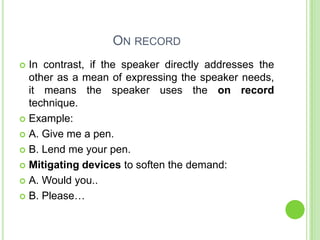
ON RECORD
 In contrast, if the speaker directly addresses the
  other as a mean of expressing the speaker needs,
  it means the speaker uses the on record
  technique.
 Example:

 A. Give me a pen.

 B. Lend me your pen.

 Mitigating devices to soften the demand:

 A. Would you..

 B. Please…
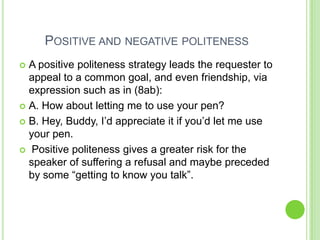
POSITIVE AND NEGATIVE POLITENESS
 A positive politeness strategy leads the requester to
  appeal to a common goal, and even friendship, via
  expression such as in (8ab):
 A. How about letting me to use your pen?

 B. Hey, Buddy, I’d appreciate it if you’d let me use
  your pen.
 Positive politeness gives a greater risk for the
  speaker of suffering a refusal and maybe preceded
  by some “getting to know you talk”.
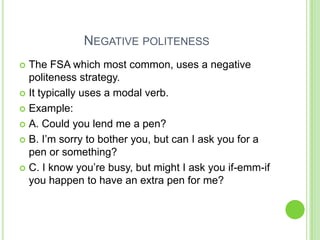
NEGATIVE POLITENESS
 The FSA which most common, uses a negative
  politeness strategy.
 It typically uses a modal verb.

 Example:

 A. Could you lend me a pen?

 B. I’m sorry to bother you, but can I ask you for a
  pen or something?
 C. I know you’re busy, but might I ask you if-emm-if
  you happen to have an extra pen for me?
Thank   you…

Pragmatic politeness

  • 1.
    WELCOME TO OURPRESENTATION: GROUP 5 POLITENESS Indra Gunawan Ias Septima Dina
  • 2.
    WHAT IS POLITENESS? According to Brown and Levinson (1987) everyone has self-public image which has relation to emotional and social sense of self and expects everyone else to recognize.  This theory forms a term of “Face”.  Politeness (Brown and Levinson:1987) in interaction can be defined as the means employed to show awareness of another person’s face.
  • 3.
    EXAMPLE OF POLITENESS A student to teacher  Student : Excuse me Mr. Buckingham, but can I talk to you for a minute?  Friend to friend  Hey Bucky, got a minute?
  • 4.
    FACE WANTS  Within their everyday social interactions, people generally behave as if their expectations concerning their public self-image, or their face wants, will be respected.  Meanwhile if some actions might be interpreted as a threat to another’s face, the speaker can say something to lessen the possible threat, this is called face saving act (FSA).  If a speaker says something that represents a threat to another individual’s expectations regarding self-image it is described as face threatening act (FTA).
  • 5.
    FTA AND FSA • Face Threatening Act = speaker says something that represents a threat to another individual's  expectations regarding self-image. • Face Saving Act = speaker says something to lessen a possible threat or to maintaining a good self image.  Situation: Young neighbor is playing loud music late at night. Older couple cannot sleep.  A: I'm going to tell him to stop that awful noise right now!  B: Perhaps you could just ask him if he's going to stop soon because it's getting a  bit late and people need to get to sleep.
  • 6.
    KINDS OF FACESAVING ACT  Negative and positive face  Negative face is the need to be independent to have a freedom of action and not to be imposed by others.  Example: Your friend asks for a ride to the airport  Negative face needs: You think, this is not favorable, I don't feel like driving this guy to the airport. I have other stuff that I could be doing, like sleeping, or saving the gasoline in my car. He can find his own ride (Goffman: 1967).
  • 7.
    POSITIVE FACE  Positive face is the need to be accepted, even liked by others, to be treated as a member of the group and to know that his or her wants are shared by others.  Example: Your friend asks for a ride to the airport.  Positive face needs: You think, I better take him because I want him to like me, and I want the reputation of being a reliable person (Goffman: 1967).  In conclusion, we can say that negative face is the need to be independent and positive face is the need to be connected.
  • 8.
    SELF AND OTHER;SAY NOTHING  Many people seems to prefer to have their needs recognized by others without having to express those needs in language.  Example: you arrive at an important lecture pull out your notebook to take notes, but discover that you don’t have anything to write with. You think that the person sitting next to you may provide the solution. In this scenario you’re going to be “Self”, and other people next to you is going to be “Other”.  You : (Look in bag).  Other: (Offers pen) Here, use this.
  • 9.
    SAY SOMETHING; OFFAND ON RECORD  Even if you decide to say something, you don’t have actually to ask for anything. You can (perhaps after you search through your bag) simply produce a statement below:  A. Uh, I forgot my pen.  B. Hemm, I forgot where I put my pen.  The example above is the example of Off Record, because the other can act as if the statements have not ever been heard.
  • 10.
    ON RECORD  Incontrast, if the speaker directly addresses the other as a mean of expressing the speaker needs, it means the speaker uses the on record technique.  Example:  A. Give me a pen.  B. Lend me your pen.  Mitigating devices to soften the demand:  A. Would you..  B. Please…
  • 11.
    POSITIVE AND NEGATIVEPOLITENESS  A positive politeness strategy leads the requester to appeal to a common goal, and even friendship, via expression such as in (8ab):  A. How about letting me to use your pen?  B. Hey, Buddy, I’d appreciate it if you’d let me use your pen.  Positive politeness gives a greater risk for the speaker of suffering a refusal and maybe preceded by some “getting to know you talk”.
  • 12.
    NEGATIVE POLITENESS  TheFSA which most common, uses a negative politeness strategy.  It typically uses a modal verb.  Example:  A. Could you lend me a pen?  B. I’m sorry to bother you, but can I ask you for a pen or something?  C. I know you’re busy, but might I ask you if-emm-if you happen to have an extra pen for me?
  • 13.
    Thank you…