LUCIA PRATAMA
1210733003
The interpretation of what is
uttered usually
goes beyond what was intended
to be expressed, and includes
evaluations in terms of politeness.
Therefore, one can clearly
observe that much more is
communicated than is said during
a sociolinguistic interaction (Yule,
1996).
 Brown and Levinson (1978) suggest that a
need to be polite is common to all cultures.
In a common sense being polite -
showing good manners and
consideration for other people (e.g.
open the door for a lady, give your
seat to an elderly person in public
transport).
Linguistic politeness: the way people
choose to speak and how the hearers
react to their speech.
Brown and Levinson (1978) have
concluded that, in order to enter into
social relationships, all people must
acknowledge the face of other
people.
As a technical term, face means the
public self-image of a person. It
refers to that emotional and social
sense of self that every one has and
expects everyone else to recognize.
People generally behave as if their
expectations concerning their public
self-image, or their face wants, will be
respected.
o if a speaker says something that
represents a threat to another
individual’s expectations regarding
self-image, it is described as a face
threatening act.
The speaker can say something to
FACE SAVING ACTPerhaps you could just ask
him if he is going to stop
soon because it’s getting a
bit late and people need to
get to sleep.
I’m going to tell him to stop that awful noise
right now!
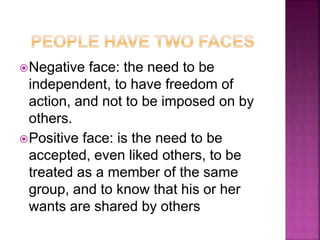
Negative face: the need to be
independent, to have freedom of
action, and not to be imposed on by
others.
Positive face: is the need to be
accepted, even liked others, to be
treated as a member of the same
group, and to know that his or her
wants are shared by others
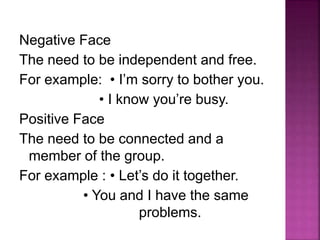
Negative Face
The need to be independent and free.
For example: • I’m sorry to bother you.
• I know you’re busy.
Positive Face
The need to be connected and a
member of the group.
For example : • Let’s do it together.
• You and I have the same
problems.
 Politeness – “showing awareness of another
person’s face” (Yule, 1996: 134).
 Face-threatening act – “a threat to another
person’s self - image” (Yule, 1996:134).
 Face-saving act – “saying something that
lessens the possible threat to another’s
face”.

Politeness - Pragmatic

  • 1.
  • 2.
    The interpretation ofwhat is uttered usually goes beyond what was intended to be expressed, and includes evaluations in terms of politeness. Therefore, one can clearly observe that much more is communicated than is said during a sociolinguistic interaction (Yule, 1996).
  • 3.
     Brown andLevinson (1978) suggest that a need to be polite is common to all cultures.
  • 4.
    In a commonsense being polite - showing good manners and consideration for other people (e.g. open the door for a lady, give your seat to an elderly person in public transport). Linguistic politeness: the way people choose to speak and how the hearers react to their speech.
  • 5.
    Brown and Levinson(1978) have concluded that, in order to enter into social relationships, all people must acknowledge the face of other people. As a technical term, face means the public self-image of a person. It refers to that emotional and social sense of self that every one has and expects everyone else to recognize.
  • 7.
    People generally behaveas if their expectations concerning their public self-image, or their face wants, will be respected. o if a speaker says something that represents a threat to another individual’s expectations regarding self-image, it is described as a face threatening act. The speaker can say something to
  • 8.
    FACE SAVING ACTPerhapsyou could just ask him if he is going to stop soon because it’s getting a bit late and people need to get to sleep.
  • 9.
    I’m going totell him to stop that awful noise right now!
  • 10.
    Negative face: theneed to be independent, to have freedom of action, and not to be imposed on by others. Positive face: is the need to be accepted, even liked others, to be treated as a member of the same group, and to know that his or her wants are shared by others
  • 11.
    Negative Face The needto be independent and free. For example: • I’m sorry to bother you. • I know you’re busy. Positive Face The need to be connected and a member of the group. For example : • Let’s do it together. • You and I have the same problems.
  • 12.
     Politeness –“showing awareness of another person’s face” (Yule, 1996: 134).  Face-threatening act – “a threat to another person’s self - image” (Yule, 1996:134).  Face-saving act – “saying something that lessens the possible threat to another’s face”.