INTRODUCTION TO
SOCIOLINGUISTICS
• What is sociolinguistics?
• What do sociolinguists study?
• Why does someone use one language instead
of another?
• What are varieties?
• Can a language become extinct?
• What can we do to keep a language alive?
• Do men and women talk differently
Macro Linguistics and Micro Linguistics
• Microlinguistics deals with phonetics, grammar,
etc. on the individual example level;
Macrolinguistics deals with comparative studies
among languages, language families, large
influences on language development.
• Microlinguistics refers to phonetics, phonology,
grammar and semantics , whereas
macrolinguistics covers sociolinguistics, discourse
analysis and other related disciplines.
Linguistics and Sociolinguistics
• In pure linguistics, the object of the study is
the language alone, independent of the
speakers and other social factors.
• Pure linguistics is about learning the grammar
and how the language works
WHAT IS SOCIOLINGUISTICS?
• Sociolinguistics is the study of the complex
relationship between language and society
1. explaining why we speak differently in
different social contexts
2. identifying the social functions of language
and the ways it is used to convey social
meaning.
• It also studies how language varieties differ
between groups separated by certain
social variables, e.g., ethnicity, religion,
status, gender, level of education, age, etc.,
and how creation and adherence to these rules
is used to categorize individuals in social or
socioeconomic classes
• The language used by the participants is
influenced by a number of social factors
• What is social factors?
SOCIAL FACTORS
What language people choose to speak in an
exchange is determined by social factors:
 The Participants: e.g. age, ranks, relationships;
 The Setting: e.g. at home, in a formal meeting,
etc.
 The Topic: e.g. my tennis skills, cooking, exams;
 The Function: e.g. getting a loan, hiring a maid,
asking permission to leave the room, etc.
Sociolinguistics vs. the Sociology of
language
• Sociolinguistics
investigating the relationships between language
and society with the goal of a better
understanding of the structure of language and of
how languages function in communication
• Sociology of language
to discover how social structure can be better
understood through the study of language, e.g.
how certain linguistic features serve to
characterize particular social arrangement
Sociolinguistics vs. the Sociology of
language
Hudson, 1980: 4-5
a. Sociolinguistics is the study of language in
relation to society’,
b. Sociology of language: the study of society in
relation to language
Similarity:
a. Both require systematic study of language.
In short…
• Sociolinguistics : It’s main focus is “Society on
Language
• Sociology : It’s main focus is “Language effects
on society
The relationship between language and
society
(wardaugh, : 10)

1. Social

structure → linguistic structure and/or behavior
a. age-grading phenomenon
young children speak differently from older children
and in turn, children speak differently from
mature
adults.
b. studies → the varieties of language that speakers use
reflect
such matters; their regional, social,
or
ethnic origin and possible sex.
c. other studies → particular ways of speaking, choices
of words, and rules for conversing are determined by
social requirement
The relationship between language
and society
(wardaugh, : 10)

2. Linguistic structure and/or behavior may
either influence or determine social
structure (behind Whorfian hypothesis)
3. The influence is bi-directional; language and
society may influence each other.
4. There is no relationship at all.
Social factors
• The participants
Who is talking to whom (wife-husband, customershopkeeper, boss-worker)
• The social setting and function of interaction
e.g. home, work, school

• The aim or purpose of the interaction
(informative, social)
• The topic; What is being talked about?
Example I
Ray : Hi mum.
Mum: Hi. You’re late.
Ray : Yeah, that bastard Sootbucket kept us in
again.
Mum: Nana’s here.
Ray : Oh sorry. Where is she?
Analysis I
• Language serves a range of functions; to ask
for and give people information, to express
indignation and annoyance, as well as
admiration and express feelings.
Example II
Ray
: Good afternoon, sir.
Principle : What are you doing here at this
time?
Ray
: Mr. Sutton kept us in, sir.
For the analysis, see Holmes, 1995: 2-3
Example III
• Every afternoon my friend packs her bag and leaves
her Cardiff office at about 5 o’clock. As she leaves,
her business partner says goodbye Margaret, (she
replies goodbye Mike) her secretary says goodbye Ms
Walker, (she replies goodbye Jill) and the caretaker
says Bye Mrs. Walker (to which she responds
goodbye Andy). As she arrives home she is greeted
by Hi mum from her son, Jamie, hello dear, have a
good day?, from her mother, and simply you’re late
again! from her husband.
Example III
• Later in the evening the president of the local
flower club calls to ask if she would like to
join. Good evening, is that Mrs. Billington? she
asks. No, it’s Ms Walker, but my husband’s
name is David Billington, she answers. What
can I do for you? Finally a friend calls Boradar
Meg, how’s thing?
Example IV
Sam : You seen our ‘enry’s new ‘ouse
yet?
It’s in ‘alton you know.
Jim : I have indeed. I could hardly
miss it Sam. Your Henry now
owns the biggest house in Halton.
It illustrated a range of social influences on
language choice.
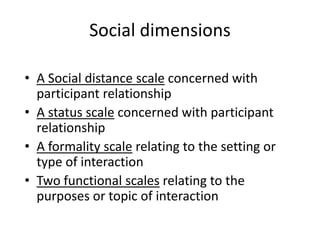
Social dimensions
• A Social distance scale concerned with
participant relationship
• A status scale concerned with participant
relationship
• A formality scale relating to the setting or
type of interaction
• Two functional scales relating to the
purposes or topic of interaction
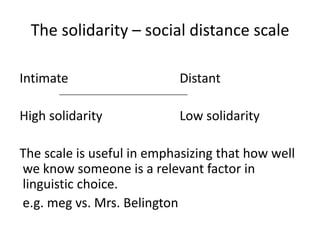
The solidarity – social distance scale
Intimate

Distant

High solidarity

Low solidarity

The scale is useful in emphasizing that how well
we know someone is a relevant factor in
linguistic choice.
e.g. meg vs. Mrs. Belington
The status scale
Superior

high status

Subordinate

low status

e.g.
1. The use of ‘sir’, ‘Mrs.’, to the lecturer by the
students
2. The [h]-dropping reflect someone’s lower
social group
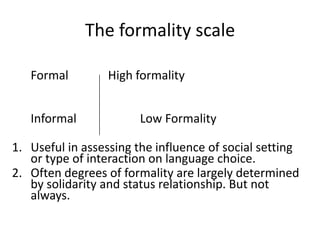
The formality scale
Formal
Informal

High formality
Low Formality

1. Useful in assessing the influence of social setting
or type of interaction on language choice.
2. Often degrees of formality are largely determined
by solidarity and status relationship. But not
always.
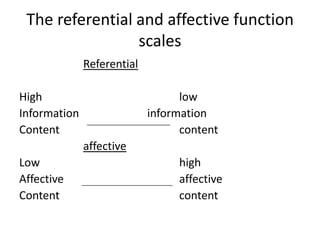
The referential and affective function
scales
Referential
High
Information
Content

low
information
content
affective

Low
Affective
Content

high
affective
content
The referential and affective function
scales
1. The more referentially oriented an interaction
is, the less it tends to express the feelings of
the speaker.
• Chaika ( 1988, 10)
the context determines meaning,
1. the social status of speakers
2. the speech event and social conventions
governing it;
3. the social-cultural and physical environment
4. previous discourse between the speakers or
known to them
5. the intent of the speaker.
Conclusion
• Our word choices depend on who we are
talking to.
• Language choices convey information about
the social relationships between people as
well as about the topic of discussion.
• Linguistic variation occurs at other levels of
linguistic analysis: sounds, word-structure,
grammar as well as vocabulary.
• Sociolinguistics is a field of study that research
on how language is used in the community.
• The way a person speak to another depends
on some social factors (the participants,
setting, topic, and function) and social
dimensions (solidarity scale, status scale,
formality scale, and functional scales).
WILLIAM LABOV
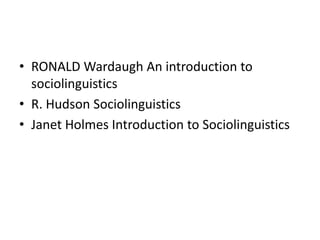
• RONALD Wardaugh An introduction to
sociolinguistics
• R. Hudson Sociolinguistics
• Janet Holmes Introduction to Sociolinguistics
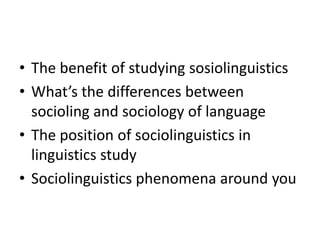
• The benefit of studying sosiolinguistics
• What’s the differences between
socioling and sociology of language
• The position of sociolinguistics in
linguistics study
• Sociolinguistics phenomena around you

Introduction to sosiolinguistics

  • 1.
  • 2.
    • What issociolinguistics? • What do sociolinguists study? • Why does someone use one language instead of another? • What are varieties? • Can a language become extinct? • What can we do to keep a language alive? • Do men and women talk differently
  • 3.
    Macro Linguistics andMicro Linguistics • Microlinguistics deals with phonetics, grammar, etc. on the individual example level; Macrolinguistics deals with comparative studies among languages, language families, large influences on language development. • Microlinguistics refers to phonetics, phonology, grammar and semantics , whereas macrolinguistics covers sociolinguistics, discourse analysis and other related disciplines.
  • 4.
    Linguistics and Sociolinguistics •In pure linguistics, the object of the study is the language alone, independent of the speakers and other social factors. • Pure linguistics is about learning the grammar and how the language works
  • 5.
    WHAT IS SOCIOLINGUISTICS? •Sociolinguistics is the study of the complex relationship between language and society 1. explaining why we speak differently in different social contexts 2. identifying the social functions of language and the ways it is used to convey social meaning.
  • 6.
    • It alsostudies how language varieties differ between groups separated by certain social variables, e.g., ethnicity, religion, status, gender, level of education, age, etc., and how creation and adherence to these rules is used to categorize individuals in social or socioeconomic classes
  • 7.
    • The languageused by the participants is influenced by a number of social factors • What is social factors?
  • 8.
    SOCIAL FACTORS What languagepeople choose to speak in an exchange is determined by social factors:  The Participants: e.g. age, ranks, relationships;  The Setting: e.g. at home, in a formal meeting, etc.  The Topic: e.g. my tennis skills, cooking, exams;  The Function: e.g. getting a loan, hiring a maid, asking permission to leave the room, etc.
  • 9.
    Sociolinguistics vs. theSociology of language • Sociolinguistics investigating the relationships between language and society with the goal of a better understanding of the structure of language and of how languages function in communication • Sociology of language to discover how social structure can be better understood through the study of language, e.g. how certain linguistic features serve to characterize particular social arrangement
  • 10.
    Sociolinguistics vs. theSociology of language Hudson, 1980: 4-5 a. Sociolinguistics is the study of language in relation to society’, b. Sociology of language: the study of society in relation to language Similarity: a. Both require systematic study of language.
  • 11.
    In short… • Sociolinguistics: It’s main focus is “Society on Language • Sociology : It’s main focus is “Language effects on society
  • 12.
    The relationship betweenlanguage and society (wardaugh, : 10) 1. Social structure → linguistic structure and/or behavior a. age-grading phenomenon young children speak differently from older children and in turn, children speak differently from mature adults. b. studies → the varieties of language that speakers use reflect such matters; their regional, social, or ethnic origin and possible sex. c. other studies → particular ways of speaking, choices of words, and rules for conversing are determined by social requirement
  • 13.
    The relationship betweenlanguage and society (wardaugh, : 10) 2. Linguistic structure and/or behavior may either influence or determine social structure (behind Whorfian hypothesis) 3. The influence is bi-directional; language and society may influence each other. 4. There is no relationship at all.
  • 14.
    Social factors • Theparticipants Who is talking to whom (wife-husband, customershopkeeper, boss-worker) • The social setting and function of interaction e.g. home, work, school • The aim or purpose of the interaction (informative, social) • The topic; What is being talked about?
  • 15.
    Example I Ray :Hi mum. Mum: Hi. You’re late. Ray : Yeah, that bastard Sootbucket kept us in again. Mum: Nana’s here. Ray : Oh sorry. Where is she?
  • 16.
    Analysis I • Languageserves a range of functions; to ask for and give people information, to express indignation and annoyance, as well as admiration and express feelings.
  • 17.
    Example II Ray : Goodafternoon, sir. Principle : What are you doing here at this time? Ray : Mr. Sutton kept us in, sir. For the analysis, see Holmes, 1995: 2-3
  • 18.
    Example III • Everyafternoon my friend packs her bag and leaves her Cardiff office at about 5 o’clock. As she leaves, her business partner says goodbye Margaret, (she replies goodbye Mike) her secretary says goodbye Ms Walker, (she replies goodbye Jill) and the caretaker says Bye Mrs. Walker (to which she responds goodbye Andy). As she arrives home she is greeted by Hi mum from her son, Jamie, hello dear, have a good day?, from her mother, and simply you’re late again! from her husband.
  • 19.
    Example III • Laterin the evening the president of the local flower club calls to ask if she would like to join. Good evening, is that Mrs. Billington? she asks. No, it’s Ms Walker, but my husband’s name is David Billington, she answers. What can I do for you? Finally a friend calls Boradar Meg, how’s thing?
  • 20.
    Example IV Sam :You seen our ‘enry’s new ‘ouse yet? It’s in ‘alton you know. Jim : I have indeed. I could hardly miss it Sam. Your Henry now owns the biggest house in Halton. It illustrated a range of social influences on language choice.
  • 21.
    Social dimensions • ASocial distance scale concerned with participant relationship • A status scale concerned with participant relationship • A formality scale relating to the setting or type of interaction • Two functional scales relating to the purposes or topic of interaction
  • 22.
    The solidarity –social distance scale Intimate Distant High solidarity Low solidarity The scale is useful in emphasizing that how well we know someone is a relevant factor in linguistic choice. e.g. meg vs. Mrs. Belington
  • 23.
    The status scale Superior highstatus Subordinate low status e.g. 1. The use of ‘sir’, ‘Mrs.’, to the lecturer by the students 2. The [h]-dropping reflect someone’s lower social group
  • 24.
    The formality scale Formal Informal Highformality Low Formality 1. Useful in assessing the influence of social setting or type of interaction on language choice. 2. Often degrees of formality are largely determined by solidarity and status relationship. But not always.
  • 25.
    The referential andaffective function scales Referential High Information Content low information content affective Low Affective Content high affective content
  • 26.
    The referential andaffective function scales 1. The more referentially oriented an interaction is, the less it tends to express the feelings of the speaker.
  • 27.
    • Chaika (1988, 10) the context determines meaning, 1. the social status of speakers 2. the speech event and social conventions governing it; 3. the social-cultural and physical environment 4. previous discourse between the speakers or known to them 5. the intent of the speaker.
  • 28.
    Conclusion • Our wordchoices depend on who we are talking to. • Language choices convey information about the social relationships between people as well as about the topic of discussion. • Linguistic variation occurs at other levels of linguistic analysis: sounds, word-structure, grammar as well as vocabulary.
  • 29.
    • Sociolinguistics isa field of study that research on how language is used in the community. • The way a person speak to another depends on some social factors (the participants, setting, topic, and function) and social dimensions (solidarity scale, status scale, formality scale, and functional scales).
  • 30.
  • 31.
    • RONALD WardaughAn introduction to sociolinguistics • R. Hudson Sociolinguistics • Janet Holmes Introduction to Sociolinguistics
  • 32.
    • The benefitof studying sosiolinguistics • What’s the differences between socioling and sociology of language • The position of sociolinguistics in linguistics study • Sociolinguistics phenomena around you