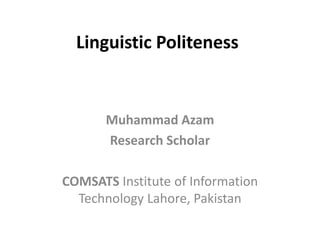
Linguistic Politeness
Muhammad Azam
Research Scholar
COMSATS Institute of Information
Technology Lahore, Pakistan
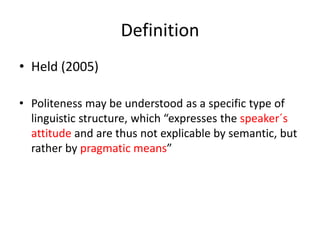
Definition
• Held (2005)
• Politeness may be understood as a specific type of
linguistic structure, which “expresses the speaker´s
attitude and are thus not explicable by semantic, but
rather by pragmatic means”
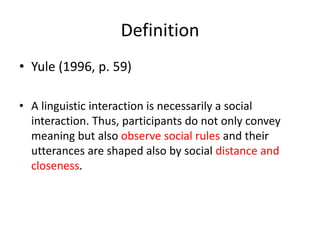
Definition
• Yule (1996, p. 59)
• A linguistic interaction is necessarily a social
interaction. Thus, participants do not only convey
meaning but also observe social rules and their
utterances are shaped also by social distance and
closeness.
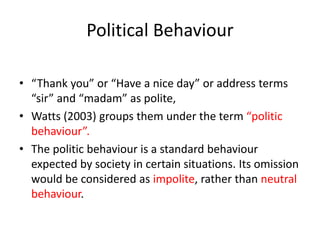
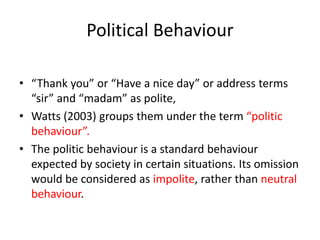
Political Behaviour
• “Thank you” or “Have a nice day” or address terms
“sir” and “madam” as polite,
• Watts (2003) groups them under the term “politic
behaviour”.
• The politic behaviour is a standard behaviour
expected by society in certain situations. Its omission
would be considered as impolite, rather than neutral
behaviour.
Political Behaviour
• “Thank you” or “Have a nice day” or address terms
“sir” and “madam” as polite,
• Watts (2003) groups them under the term “politic
behaviour”.
• The politic behaviour is a standard behaviour
expected by society in certain situations. Its omission
would be considered as impolite, rather than neutral
behaviour.
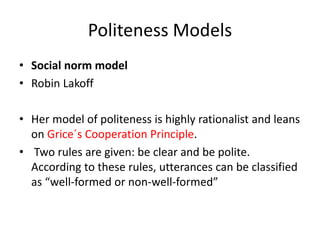
Politeness Models
• Social norm model
• Robin Lakoff
• Her model of politeness is highly rationalist and leans
on Grice´s Cooperation Principle.
• Two rules are given: be clear and be polite.
According to these rules, utterances can be classified
as “well-formed or non-well-formed”
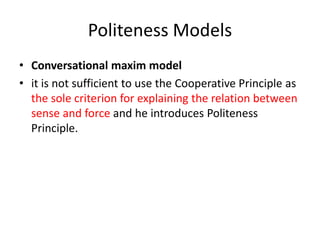
Politeness Models
• Conversational maxim model
• it is not sufficient to use the Cooperative Principle as
the sole criterion for explaining the relation between
sense and force and he introduces Politeness
Principle.
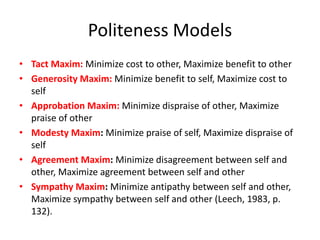
Politeness Models
• Tact Maxim: Minimize cost to other, Maximize benefit to other
• Generosity Maxim: Minimize benefit to self, Maximize cost to
self
• Approbation Maxim: Minimize dispraise of other, Maximize
praise of other
• Modesty Maxim: Minimize praise of self, Maximize dispraise of
self
• Agreement Maxim: Minimize disagreement between self and
other, Maximize agreement between self and other
• Sympathy Maxim: Minimize antipathy between self and other,
Maximize sympathy between self and other (Leech, 1983, p.
132).
Politeness Models
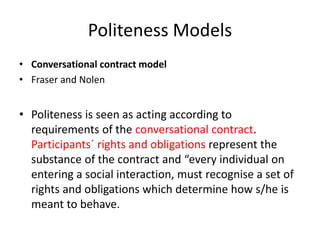
• Conversational contract model
• Fraser and Nolen
• Politeness is seen as acting according to
requirements of the conversational contract.
Participants´ rights and obligations represent the
substance of the contract and “every individual on
entering a social interaction, must recognise a set of
rights and obligations which determine how s/he is
meant to behave.
Brown and Levinson´s Politeness
Theory
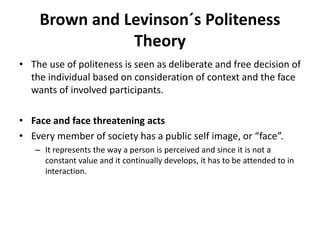
• The use of politeness is seen as deliberate and free decision of
the individual based on consideration of context and the face
wants of involved participants.
• Face and face threatening acts
• Every member of society has a public self image, or “face”.
– It represents the way a person is perceived and since it is not a
constant value and it continually develops, it has to be attended to in
interaction.
Brown and Levinson´s Politeness
Theory
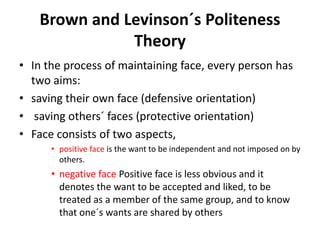
• In the process of maintaining face, every person has
two aims:
• saving their own face (defensive orientation)
• saving others´ faces (protective orientation)
• Face consists of two aspects,
• positive face is the want to be independent and not imposed on by
others.
• negative face Positive face is less obvious and it
denotes the want to be accepted and liked, to be
treated as a member of the same group, and to know
that one´s wants are shared by others
Negative politeness strategies
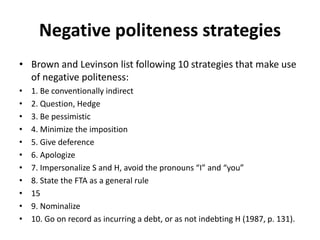
• Brown and Levinson list following 10 strategies that make use
of negative politeness:
• 1. Be conventionally indirect
• 2. Question, Hedge
• 3. Be pessimistic
• 4. Minimize the imposition
• 5. Give deference
• 6. Apologize
• 7. Impersonalize S and H, avoid the pronouns “I” and “you”
• 8. State the FTA as a general rule
• 15
• 9. Nominalize
• 10. Go on record as incurring a debt, or as not indebting H (1987, p. 131).
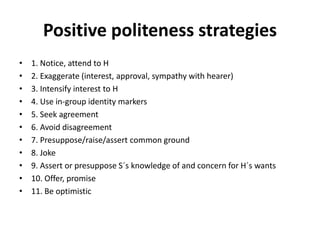
Positive politeness strategies
• 1. Notice, attend to H
• 2. Exaggerate (interest, approval, sympathy with hearer)
• 3. Intensify interest to H
• 4. Use in-group identity markers
• 5. Seek agreement
• 6. Avoid disagreement
• 7. Presuppose/raise/assert common ground
• 8. Joke
• 9. Assert or presuppose S´s knowledge of and concern for H´s wants
• 10. Offer, promise
• 11. Be optimistic
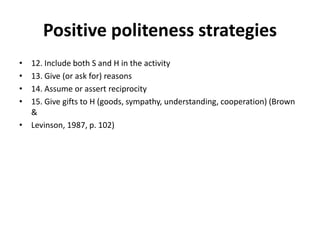
Positive politeness strategies
• 12. Include both S and H in the activity
• 13. Give (or ask for) reasons
• 14. Assume or assert reciprocity
• 15. Give gifts to H (goods, sympathy, understanding, cooperation) (Brown
&
• Levinson, 1987, p. 102)

Politeness

  • 1.
    Linguistic Politeness Muhammad Azam ResearchScholar COMSATS Institute of Information Technology Lahore, Pakistan
  • 2.
    Definition • Held (2005) •Politeness may be understood as a specific type of linguistic structure, which “expresses the speaker´s attitude and are thus not explicable by semantic, but rather by pragmatic means”
  • 3.
    Definition • Yule (1996,p. 59) • A linguistic interaction is necessarily a social interaction. Thus, participants do not only convey meaning but also observe social rules and their utterances are shaped also by social distance and closeness.
  • 4.
    Political Behaviour • “Thankyou” or “Have a nice day” or address terms “sir” and “madam” as polite, • Watts (2003) groups them under the term “politic behaviour”. • The politic behaviour is a standard behaviour expected by society in certain situations. Its omission would be considered as impolite, rather than neutral behaviour.
  • 5.
    Political Behaviour • “Thankyou” or “Have a nice day” or address terms “sir” and “madam” as polite, • Watts (2003) groups them under the term “politic behaviour”. • The politic behaviour is a standard behaviour expected by society in certain situations. Its omission would be considered as impolite, rather than neutral behaviour.
  • 6.
    Politeness Models • Socialnorm model • Robin Lakoff • Her model of politeness is highly rationalist and leans on Grice´s Cooperation Principle. • Two rules are given: be clear and be polite. According to these rules, utterances can be classified as “well-formed or non-well-formed”
  • 7.
    Politeness Models • Conversationalmaxim model • it is not sufficient to use the Cooperative Principle as the sole criterion for explaining the relation between sense and force and he introduces Politeness Principle.
  • 8.
    Politeness Models • TactMaxim: Minimize cost to other, Maximize benefit to other • Generosity Maxim: Minimize benefit to self, Maximize cost to self • Approbation Maxim: Minimize dispraise of other, Maximize praise of other • Modesty Maxim: Minimize praise of self, Maximize dispraise of self • Agreement Maxim: Minimize disagreement between self and other, Maximize agreement between self and other • Sympathy Maxim: Minimize antipathy between self and other, Maximize sympathy between self and other (Leech, 1983, p. 132).
  • 9.
    Politeness Models • Conversationalcontract model • Fraser and Nolen • Politeness is seen as acting according to requirements of the conversational contract. Participants´ rights and obligations represent the substance of the contract and “every individual on entering a social interaction, must recognise a set of rights and obligations which determine how s/he is meant to behave.
  • 10.
    Brown and Levinson´sPoliteness Theory • The use of politeness is seen as deliberate and free decision of the individual based on consideration of context and the face wants of involved participants. • Face and face threatening acts • Every member of society has a public self image, or “face”. – It represents the way a person is perceived and since it is not a constant value and it continually develops, it has to be attended to in interaction.
  • 11.
    Brown and Levinson´sPoliteness Theory • In the process of maintaining face, every person has two aims: • saving their own face (defensive orientation) • saving others´ faces (protective orientation) • Face consists of two aspects, • positive face is the want to be independent and not imposed on by others. • negative face Positive face is less obvious and it denotes the want to be accepted and liked, to be treated as a member of the same group, and to know that one´s wants are shared by others
  • 12.
    Negative politeness strategies •Brown and Levinson list following 10 strategies that make use of negative politeness: • 1. Be conventionally indirect • 2. Question, Hedge • 3. Be pessimistic • 4. Minimize the imposition • 5. Give deference • 6. Apologize • 7. Impersonalize S and H, avoid the pronouns “I” and “you” • 8. State the FTA as a general rule • 15 • 9. Nominalize • 10. Go on record as incurring a debt, or as not indebting H (1987, p. 131).
  • 13.
    Positive politeness strategies •1. Notice, attend to H • 2. Exaggerate (interest, approval, sympathy with hearer) • 3. Intensify interest to H • 4. Use in-group identity markers • 5. Seek agreement • 6. Avoid disagreement • 7. Presuppose/raise/assert common ground • 8. Joke • 9. Assert or presuppose S´s knowledge of and concern for H´s wants • 10. Offer, promise • 11. Be optimistic
  • 14.
    Positive politeness strategies •12. Include both S and H in the activity • 13. Give (or ask for) reasons • 14. Assume or assert reciprocity • 15. Give gifts to H (goods, sympathy, understanding, cooperation) (Brown & • Levinson, 1987, p. 102)