Communication between men and women
can be like cross cultural communication,
prey to a clash of conversational styles.
Deborah Tannen (1990)
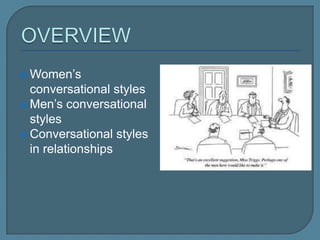
 Women’s
conversational styles
 Men’s
conversational styles
 Conversational
styles in
relationships
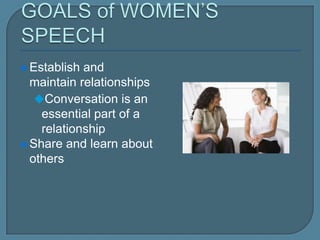
 Establish and maintain
relationships
Conversation is an
essential part of a
relationship
 Share and learn about
others
 Show equality
 Show support
 Include others
 Tell about themselves
 Are tentative
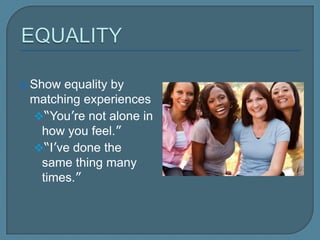
 Show equality by
matching
experiences
“You’re not alone in
how you feel.”
“I’ve done the same
thing many times.”
 Women respond and build on each other’s
ideas
Rather than “you-tell-your-idea-then-I’ll-
tell-mine,” voices weave together to
create conversations.
 Make others feel valued
 Understand the other person’s feelings
“Tell me about what happened.”
“How did you feel when it occurred?”
“Do you think it was deliberate?”
 Express sympathy
“Oh, you must feel terrible.”
“I think you did the right thing.”
“I really hear what you are saying.”
 Make others feel valued and included
 Women often start topics for others
“How was your day”
“Tell me about your meeting”
“Did anything interesting happen on your
trip”
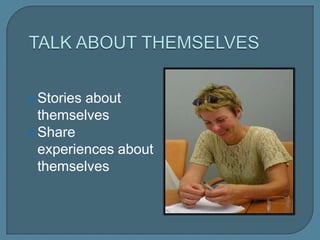
 Stories about
themselves
 Share experiences
about themselves
 Verbal Hedges
“I kind of feel you may be overreacting”
“I’m not the best judge of this, but...”
 Use tag questions that invite responses
“That was a pretty good movie, wasn’t it?”
“We should get out this weekend, don’t
you think?”
 Achieve goals
Solve a problem
Win an argument
Make someone
laugh
Get information
 Improve status.
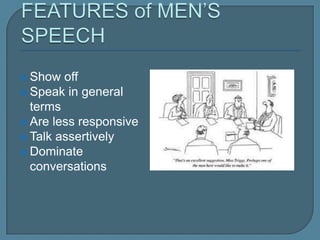
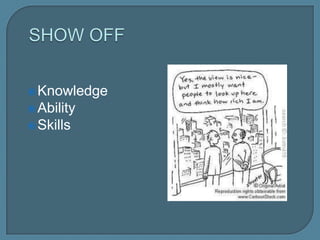
 Show off
 Speak in general
terms
 Are less
responsive
 Talk assertively
 Dominate
conversations
 Knowledge
 Ability
 Skills
 Offer few concrete experiences and personal
feelings
 Talk less about themselves
 Talking about personal problems shows that
you are weak
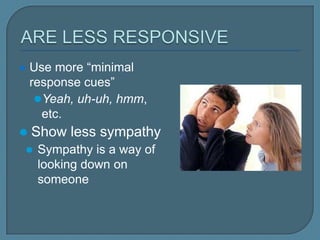
 Use more “minimal
response cues”
Yeah, uh-uh, hmm,
etc.
 Show less
sympathy
 Sympathy is a way of
looking down on
someone
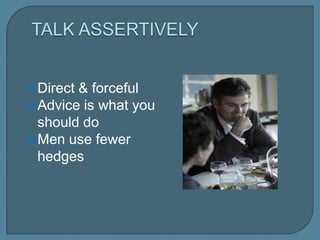
 Direct & forceful
 Advice is what you
should do
 Men use fewer
hedges
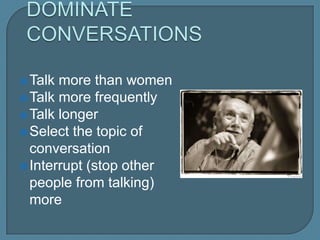
 Talk more than women
 Talk more frequently
 Talk longer
 Select the topic of
conversation
 Interrupt (stop other
people from talking)
more
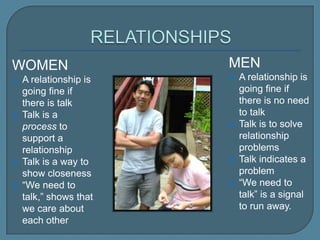
WOMEN
 A relationship is
going fine if
there is talk
 Talk is a process
to support a
relationship
 Talk is a way to
show closeness
 “We need to talk,”
shows that we
care about each
other
MEN
 A relationship is
going fine if
there is no need
to talk
 Talk is to solve
relationship
problems
 Talk indicates a
problem
 “We need to talk”
is a signal to run
away.

Conversational styles take 2012

  • 1.
    Communication between menand women can be like cross cultural communication, prey to a clash of conversational styles. Deborah Tannen (1990)
  • 3.
     Women’s conversational styles Men’s conversational styles  Conversational styles in relationships
  • 4.
     Establish andmaintain relationships Conversation is an essential part of a relationship  Share and learn about others
  • 5.
     Show equality Show support  Include others  Tell about themselves  Are tentative
  • 6.
     Show equalityby matching experiences “You’re not alone in how you feel.” “I’ve done the same thing many times.”
  • 7.
     Women respondand build on each other’s ideas Rather than “you-tell-your-idea-then-I’ll- tell-mine,” voices weave together to create conversations.  Make others feel valued
  • 8.
     Understand theother person’s feelings “Tell me about what happened.” “How did you feel when it occurred?” “Do you think it was deliberate?”  Express sympathy “Oh, you must feel terrible.” “I think you did the right thing.” “I really hear what you are saying.”
  • 9.
     Make othersfeel valued and included  Women often start topics for others “How was your day” “Tell me about your meeting” “Did anything interesting happen on your trip”
  • 10.
     Stories about themselves Share experiences about themselves
  • 11.
     Verbal Hedges “Ikind of feel you may be overreacting” “I’m not the best judge of this, but...”  Use tag questions that invite responses “That was a pretty good movie, wasn’t it?” “We should get out this weekend, don’t you think?”
  • 13.
     Achieve goals Solvea problem Win an argument Make someone laugh Get information  Improve status.
  • 14.
     Show off Speak in general terms  Are less responsive  Talk assertively  Dominate conversations
  • 15.
  • 16.
     Offer fewconcrete experiences and personal feelings  Talk less about themselves  Talking about personal problems shows that you are weak
  • 17.
     Use more“minimal response cues” Yeah, uh-uh, hmm, etc.  Show less sympathy  Sympathy is a way of looking down on someone
  • 18.
     Direct &forceful  Advice is what you should do  Men use fewer hedges
  • 19.
     Talk morethan women  Talk more frequently  Talk longer  Select the topic of conversation  Interrupt (stop other people from talking) more
  • 20.
    WOMEN  A relationshipis going fine if there is talk  Talk is a process to support a relationship  Talk is a way to show closeness  “We need to talk,” shows that we care about each other MEN  A relationship is going fine if there is no need to talk  Talk is to solve relationship problems  Talk indicates a problem  “We need to talk” is a signal to run away.