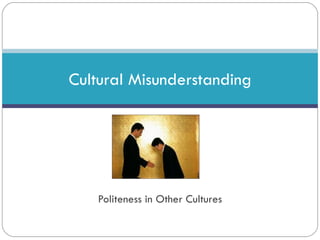
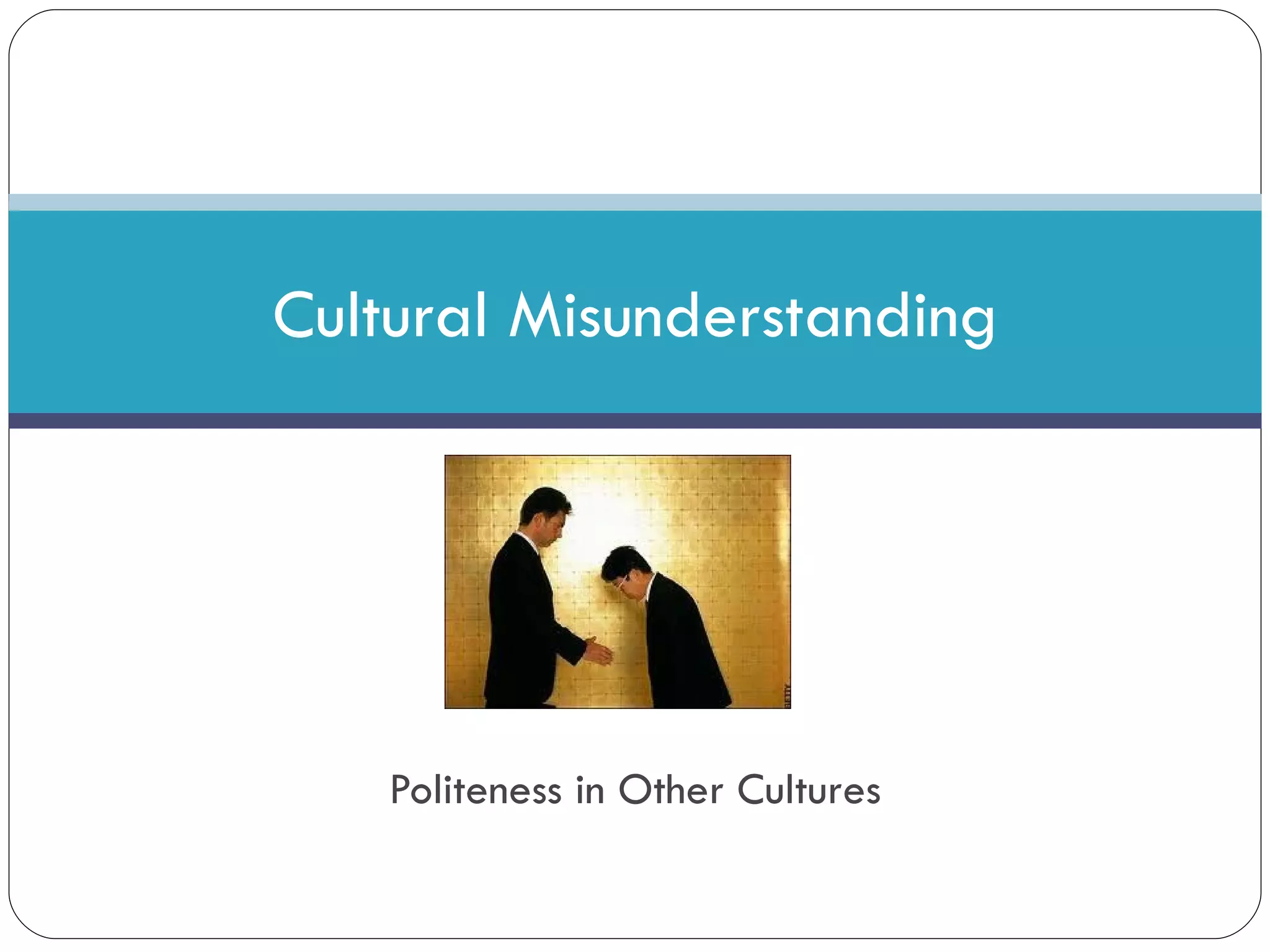
Politeness in Other Cultures
Cultural Misunderstanding
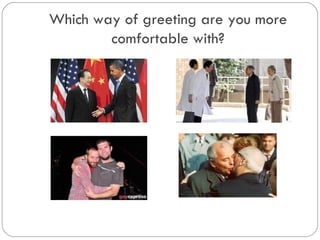
Which way of greeting are you more
comfortable with?
Cultural misunderstanding
Cultures differ in what they think
politeness is
People think that politeness equals
good manners and good character
People assume that othercultures
are polite in the same way
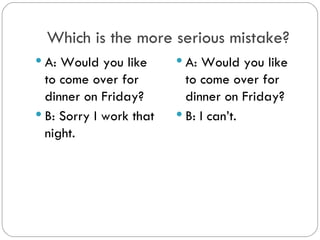
Which is the more serious
mistake?
A: Would you like
to come over for
dinner on Friday?
B: Sorry I working
that night.
A: Would you like
to come over for
dinner on Friday?
B: I can’t.
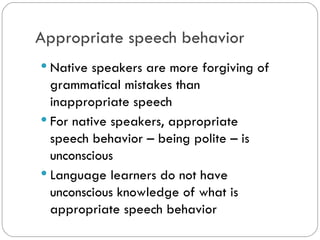
Appropriate speech behavior
Native speakers are more forgiving
of grammatical mistakes than
inappropriate speech
Fornative speakers, appropriate
speech behavior– being polite – is
unconscious
Language learners do not have
unconscious knowledge of what is
appropriate speech behavior
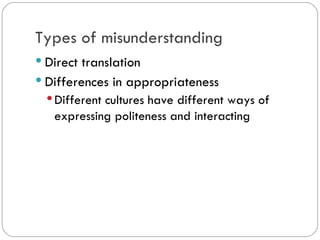
Types of misunderstanding
Direct translation
Differences in appropriateness
Different cultures have different ways of
expressing politeness and interacting
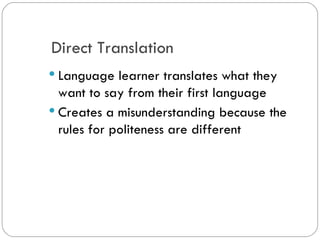
Direct Translation
Language learner translates what
they want to say from their first
language
Creates a misunderstanding because
the rules for politeness are different
Are these the same?
Can you play the piano?
Can you run fast?
Can you speak French?
Can you pass the salt?
“Can you pass the salt?”
This is a request in English. It is not asking about
the other person’s ability to pass the salt
However, if directly translated into Russian, it is a
question for information
Thus, the English-speaking learner of Russian
would fail to communicate his or her meaning
Telephone conversation
P: Hello, is Mr. Simatapung there
please?
S: Yes.
P: Oh…may I speak to him please?
S: Yes.
P: Oh…are you Mr. Simatapung?
S: Yes, this is Mr. Simatapung.
Telephone conversation
The foreign student fails to understand
that the professor’s first question
Is not asking if he is there or not
Is a request to talk to him
Differences in Appropriateness
This type of misunderstanding is
directly related to cultural differences
What is appropriate in one culture is
not always appropriate in another
culture
American invitations
Americans often end invitations with a phrase like
“Come if you want to.”
Americans do not want to force people to accept
unwanted invitations
Japanese reactions
Japanese expect that the person who
invites another will urge the potential
guest to accept the invitation
When Japanese hear expressions like
“Come if you want to,” they feel hurt and
are uncertain about the sincerity of the
invitation
Other cultures, e.g., Arabs, also have
the same difficulty with American
invitations
What’s the difference?
It was nice talking to you. I’ve got to go, but let’s
get together Friday night.
It was nice talking to you. I’ve got to go, but let’s
get together sometime.
American offers
If you go to an American’s home, you
will probably be offered something to eat
or drink
If you refuse the first time, you will
probably be offered again.
You will probably not be offered more
than three times.
American offers
Guests who refuse may or may not be
seen as rude
Guests will be taken at their word. If
they refuse a third time, the host will
assume that they have refused because
they do not want something to eat or
drink
Reactions by people from other
cultures
Arabs are taught to refuse again and
again.
When they visit American homes,
they often leave confused and hungry
An Arab visited an American home
and was served some delicious
sandwiches. The hostess offered him
seconds, but he refused. The hostess
didn’t repeat the offer and so he had to
sit there looking at the delicious
Reactions by people from other
cultures
Malaysians feel that offers of food or
drink are inappropriate.
A host should serve something whether
the guest wants it or not.
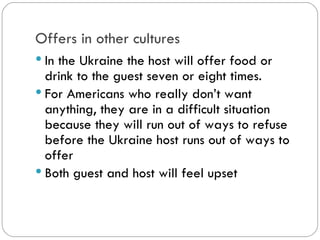
Offers in other cultures
In the Ukraine the host will offer food or
drink to the guest seven or eight times.
For Americans who really don’t want
anything, they are in a difficult situation
because they will run out of ways to
refuse before the Ukraine host runs out
of ways to offer.
Both guest and host will feel upset.
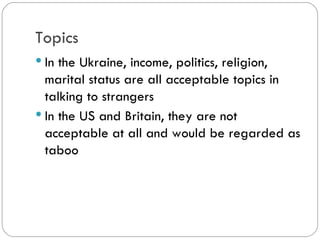
Topics
In the Ukraine, income, politics, religion,
marital status are all acceptable topics
in talking to strangers
In the US and Britain, they are not
acceptable at all and would be regarded
as taboo
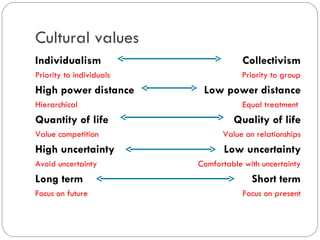
Cultural values
Individualism
Priority to individuals
High powerdistance
Hierarchical
Quantity of life
Value competition
High uncertainty
Avoid uncertainty
Long term
Focus on future
Collectivism
Priority to group
Low powerdistance
Equal treatment
Quality of life
Value on relationships
Low uncertainty
Comfortable with uncertainty
Short term
Focus on present
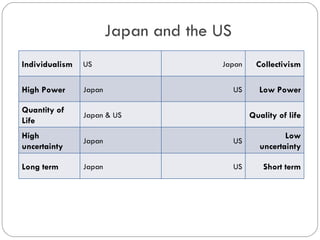
Japan and the US
Individualism US Japan Collectivism
High Power Japan US Low Power
Quantity of
Life
Japan & US
Quality of
life
High
uncertainty
Japan US
Low
uncertainty
Long term Japan US Short term
Cross-cultural differences
Each culture will have values that are
more important than others
In one culture hierarchy may be more
important
In another individualism may be more
important
In yet another avoiding uncertainty may be
more important
Status
Status in Japan depends to a large
degree on the prestige of the
organization one belongs to
Independent businessmen may have
less prestige than a manager in a large
well-known company
Wrong impressions
An American businessman created a bad
impression because at a business meeting he
paid more attention to a man who started and
developed his own company than to the middle
level executives of a big Japanese corporation
American & Japanese
businessmen
Japan value hierarchy
Hierarchy is very strong in business
American have a sense of hierarchy, but
it is not as strong
Americans value individualism
Americans respect people who have
made it on their own, e.g., Bill Gates &
Steve Jobs
Japanese respect individuality, e.g.,
Morita Akio & Matsushita Konosuke
Eliminating misunderstandings
Values that are important will often be
reflected in speech in speech behavior
Misunderstandings can work both ways
Have to have open mind
When learners of a language make
inappropriate questions, do not apologize
when they should, give compliments to the
wrong person, offer something too
frequently, etc. they are not necessarily
being impolite.
Have an open mind
When learners of a language
 Make inappropriate questions
 Do not apologize when they should
 Give compliments to the wrong person
 Offer something too frequently
They are not necessarily being impolite. They
using their own culture’s values for being
polite.

Cultural misunderstanding

  • 1.
    Politeness in OtherCultures Cultural Misunderstanding
  • 2.
    Which way ofgreeting are you more comfortable with?
  • 3.
    Cultural misunderstanding Cultures differin what they think politeness is People think that politeness equals good manners and good character People assume that othercultures are polite in the same way
  • 4.
    Which is themore serious mistake? A: Would you like to come over for dinner on Friday? B: Sorry I working that night. A: Would you like to come over for dinner on Friday? B: I can’t.
  • 5.
    Appropriate speech behavior Nativespeakers are more forgiving of grammatical mistakes than inappropriate speech Fornative speakers, appropriate speech behavior– being polite – is unconscious Language learners do not have unconscious knowledge of what is appropriate speech behavior
  • 6.
    Types of misunderstanding Directtranslation Differences in appropriateness Different cultures have different ways of expressing politeness and interacting
  • 7.
    Direct Translation Language learnertranslates what they want to say from their first language Creates a misunderstanding because the rules for politeness are different
  • 8.
    Are these thesame? Can you play the piano? Can you run fast? Can you speak French? Can you pass the salt?
  • 9.
    “Can you passthe salt?” This is a request in English. It is not asking about the other person’s ability to pass the salt However, if directly translated into Russian, it is a question for information Thus, the English-speaking learner of Russian would fail to communicate his or her meaning
  • 10.
    Telephone conversation P: Hello,is Mr. Simatapung there please? S: Yes. P: Oh…may I speak to him please? S: Yes. P: Oh…are you Mr. Simatapung? S: Yes, this is Mr. Simatapung.
  • 11.
    Telephone conversation The foreignstudent fails to understand that the professor’s first question Is not asking if he is there or not Is a request to talk to him
  • 12.
    Differences in Appropriateness Thistype of misunderstanding is directly related to cultural differences What is appropriate in one culture is not always appropriate in another culture
  • 13.
    American invitations Americans oftenend invitations with a phrase like “Come if you want to.” Americans do not want to force people to accept unwanted invitations
  • 14.
    Japanese reactions Japanese expectthat the person who invites another will urge the potential guest to accept the invitation When Japanese hear expressions like “Come if you want to,” they feel hurt and are uncertain about the sincerity of the invitation Other cultures, e.g., Arabs, also have the same difficulty with American invitations
  • 15.
    What’s the difference? Itwas nice talking to you. I’ve got to go, but let’s get together Friday night. It was nice talking to you. I’ve got to go, but let’s get together sometime.
  • 16.
    American offers If yougo to an American’s home, you will probably be offered something to eat or drink If you refuse the first time, you will probably be offered again. You will probably not be offered more than three times.
  • 17.
    American offers Guests whorefuse may or may not be seen as rude Guests will be taken at their word. If they refuse a third time, the host will assume that they have refused because they do not want something to eat or drink
  • 18.
    Reactions by peoplefrom other cultures Arabs are taught to refuse again and again. When they visit American homes, they often leave confused and hungry An Arab visited an American home and was served some delicious sandwiches. The hostess offered him seconds, but he refused. The hostess didn’t repeat the offer and so he had to sit there looking at the delicious
  • 19.
    Reactions by peoplefrom other cultures Malaysians feel that offers of food or drink are inappropriate. A host should serve something whether the guest wants it or not.
  • 20.
    Offers in othercultures In the Ukraine the host will offer food or drink to the guest seven or eight times. For Americans who really don’t want anything, they are in a difficult situation because they will run out of ways to refuse before the Ukraine host runs out of ways to offer. Both guest and host will feel upset.
  • 21.
    Topics In the Ukraine,income, politics, religion, marital status are all acceptable topics in talking to strangers In the US and Britain, they are not acceptable at all and would be regarded as taboo
  • 22.
    Cultural values Individualism Priority toindividuals High powerdistance Hierarchical Quantity of life Value competition High uncertainty Avoid uncertainty Long term Focus on future Collectivism Priority to group Low powerdistance Equal treatment Quality of life Value on relationships Low uncertainty Comfortable with uncertainty Short term Focus on present
  • 23.
    Japan and theUS Individualism US Japan Collectivism High Power Japan US Low Power Quantity of Life Japan & US Quality of life High uncertainty Japan US Low uncertainty Long term Japan US Short term
  • 24.
    Cross-cultural differences Each culturewill have values that are more important than others In one culture hierarchy may be more important In another individualism may be more important In yet another avoiding uncertainty may be more important
  • 25.
    Status Status in Japandepends to a large degree on the prestige of the organization one belongs to Independent businessmen may have less prestige than a manager in a large well-known company
  • 26.
    Wrong impressions An Americanbusinessman created a bad impression because at a business meeting he paid more attention to a man who started and developed his own company than to the middle level executives of a big Japanese corporation
  • 27.
    American & Japanese businessmen Japanvalue hierarchy Hierarchy is very strong in business American have a sense of hierarchy, but it is not as strong Americans value individualism Americans respect people who have made it on their own, e.g., Bill Gates & Steve Jobs Japanese respect individuality, e.g., Morita Akio & Matsushita Konosuke
  • 28.
    Eliminating misunderstandings Values thatare important will often be reflected in speech in speech behavior Misunderstandings can work both ways Have to have open mind When learners of a language make inappropriate questions, do not apologize when they should, give compliments to the wrong person, offer something too frequently, etc. they are not necessarily being impolite.
  • 29.
    Have an openmind When learners of a language  Make inappropriate questions  Do not apologize when they should  Give compliments to the wrong person  Offer something too frequently They are not necessarily being impolite. They using their own culture’s values for being polite.

Editor's Notes

  • #3 If the pairs were women? If the pairs were men & women?
  • #5 Left: there is a grammatical mistake Right: Response is inappropriate. Refusal requires expression of regret and reason.
  • #6 Mistakes related to grammar and strategic competence do not reflect character or good manners. Speakers are more forgiving for these kind of errors.
  • #8 Transfer from L1 to L2
  • #10 Shio wo watasu koto ga dekimasu ka?
  • #14 After Americans invite people and tell them when and where a social gathering will take place, they often end the invitation with a phrase like “Come if you want to.”
  • #16 Let’s get together sometime is a closing and not an invitation
  • #21 Americans expect to be believed
  • #23 Hofstede’s cultural dimensions theory Individualism (IDV) vs. collectivism: “The degree to which individuals are integrated into groups”. In individualistic societies, the stress is put on personal achievements and individual rights. People are expected to stand up for themselves and their immediate family, and to choose their own affiliations. In contrast, in collectivist societies, individuals act predominantly as members of a life-long and cohesive group or organization. Power distance index (PDI): “Power distance is the extent to which the less powerful members of organizations and institutions (like the family) accept and expect that power is distributed unequally.” Cultures that endorse low power distance expect and accept power relations that are more consultative or democratic. People relate to one another more as equals regardless of formal positions. Subordinates are more comfortable with and demand the right to contribute to and critique the decision making of those in power. In high power distance countries, less powerful accept power relations that are more autocratic and paternalistic. Subordinates acknowledge the power of others simply based on where they are situated in certain formal, hierarchical positions. Quantity (MAS), vs. Quality of life: “The distribution of emotional roles between the genders”. Quantity’ values are competitiveness, assertiveness, materialism, ambition and power, whereas feminine cultures place more value on relationships and quality of life. In masculine cultures, the differences between gender roles are more dramatic and less fluid than in feminine cultures where men and women have the same values emphasizing modesty and caring. Uncertainty avoidance index (UAI): “a society's tolerance for uncertainty and ambiguity”. It reflects the extent to which members of a society attempt to cope with anxiety by minimizing uncertainty. People in cultures with high uncertainty avoidance tend to be more emotional. They try to minimize the occurrence of unknown and unusual circumstances and to proceed with careful changes step by step by planning and by implementing rules, laws and regulations. In contrast, low uncertainty avoidance cultures accept and feel comfortable in unstructured situations or changeable environments and try to have as few rules as possible. People in these cultures tend to be more pragmatic, they are more tolerant of change. Long term orientation (LTO), vs. short term orientation: First called “Confucian dynamism”, it describes societies’ time horizon. Long term oriented societies attach more importance to the future. They foster pragmatic values oriented towards rewards, including persistence, saving and capacity for adaptation. In short term oriented societies, values promoted are related to the past and the present, including steadiness, respect for tradition, preservation of one’s face, reciprocation and fulfilling social obligations.
  • #24 No country is 100% on one scale For each country some values are more important; some less AND individuals in a country will vary as well.
  • #25 Americans value directness and their offers and refusals reflect this. They will offer only once or twice and “no” means no. Japanese value status and keigo is evidence of this value. It does not mean that Americans do not value hierarchy or that Japanese do not value directness.
  • #26 Manager at Sony vs. the owner of a small company in Osaka