Positive and negative
politeness
The concept of „face“ and
FTAs
Concepts of Politeness
Politeness...
• “ … is one of the constraints of human

interaction, whose purpose is to consider
other`s feelings, establish levels of mutual
comfort, and promote rapport.” Hill et al. (1986:
282)

• “ … what we think is appropriate behaviour in

particular situations in an attempt to achieve and
maintain successful social relationships with
others.“ (Lakoff 1972: 910)
Concept of "face"
"face"
• public self-image that every member of society
wants to claim for itself
•

negative face refers to the want of every
competent adult member that his actions be
unimpeded by others

•

positive face refers to the want of every member
that his wants be desirable to at least some others
Face-Threatening-Activity
FTAs
= those acts that by their nature run contrary to the
face wants of the addressee and/or of the
speaker`s
The negative face is threatened by...
…acts that appear to impede the addressee´s
independence of movement and freedom of action
The positive face is threatened by…
…acts which appear as disapproving of their
wants
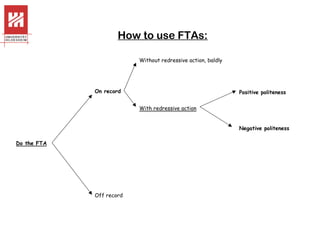
How to use FTAs:
Without redressive action, baldly

On record

Positive politeness
With redressive action
Negative politeness

Do the FTA

Off record
Positive Politeness
• Positive Politeness is redress directed to the
addressee's positive face, his desire that his wants
should be thought of as desirable.
• Redress consists in partially satisfying that desire
by communicating that one's own wants are in some
respects similar to the addressee’s wants.
• The linguistic realizations of Positive Politeness are
in many respects representative of the normal
linguistic behavior between intimates
Categories of pp
1.)Claim common ground
S can claiming ´common ground` with H, by indicating S and H
belongs to the same set of persons, who share specific wants,
including goals and values.
Three ways of making this claim:
a) S may convey that some want (goal) of H´s is
admirable or interesting to S too. (strategy 1-3)
b) S may stress common membership in a group or
category. (strategy 4)
c) S can claim common perspective with H without
necessarily referring to in- group membership. (strategy 58)
Strategies
St. 1 Notice, attend to H
Suggests that S should take notice of aspects of H’s conditions.
Examples:
“Goodness you cut your hair! … By the way I came to borrow
some sugar.”
“What a beautiful dress! Where was it bought?”
“We ate too many beans tonight, didn’t we?”
St. 2 Exaggerate
This often done with exaggerated intonation, stress, and other
aspects of prosodic.
Examples:
“You are a fantastic cook, the lunch was great!”
“How absolutely marvelous/ extraordinary/…..”
Strategies
St. 3 Intensify interest to H
S intensify the interest of his own contribution, by “making a
good story” and draw H as a participant into the conversation
with direct questions and expressions like you know, see what
Examples:
“I mean and isn’t it .”
“I come into his room, and what do you think I see? – a huge mess
all over the place and right in the middle, a naked….”
St. 4 Use in- group identity makers
Using any of the innumerable ways to convey in- group
membership: address forms, language or dialect, jargon or
slang and ellipses
Examples:
“Honey, can you give me the beer?”
“Hey brother, what’s going on?”
“How about a drink?”
Strategies
St.5 Seek agreement
S seeks ways in which it is possible to agree with H.
Examples:
“I hate this politicians, they know nothing about the small citizen, they
earn….”
“She had an accident last week.
- Oh my good, an accident!”
St.6 Avoid disagreement
The desire to agree or appear to agree with H leads also to mechanisms
for pretending to agree: white lies and hedges.
Examples:
“Have you got friends?-I have friends. So- called friends. I had friends.
Let it put me this way. “
“It’s really beautiful in a way.”
Strategies
St. 7 Presuppose/ raise/ assert common ground
The value of S’s spending time and effort on being with H, as a mark of
friendship or interest in him, by talking for a while about unrelated
topics.
Examples:
“Isn’t it a beautiful day?”
And she says to Jim, ’I love you!’, and he says…
“How are you?”
St.8 Joke
Jokes are based on mutual shared background and values and putting
H “at ease”.
Example:
“How about lending me this old heap of junk? “(H’s new cadillac)
Categories of pp
2.)Convey that S and H are cooperators
This category derives from the want to convey that S and H
are cooperatively involved in the relevant activity.
Three ways of convey cooperation:
a) S’s may indicate his knowledge of and sensitivity to H’s
wants. (strategy 9)
b) S and H can claim some kind of reflexivity between their
wants. (strategy 10-13)
c) S may indicate, that he believes reciprocity to be
prevailed between H and himself, thus that they are
somehow locked into
a state of mutual helping.
(strategy 14)
Strategies
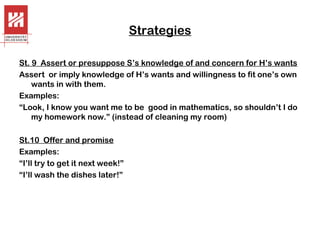
St. 9 Assert or presuppose S’s knowledge of and concern for H’s wants
Assert or imply knowledge of H’s wants and willingness to fit one’s own
wants in with them.
Examples:
“Look, I know you want me to be good in mathematics, so shouldn’t I do
my homework now.” (instead of cleaning my room)
St.10 Offer and promise
Examples:
“I’ll try to get it next week!”
“I’ll wash the dishes later!”
Strategies
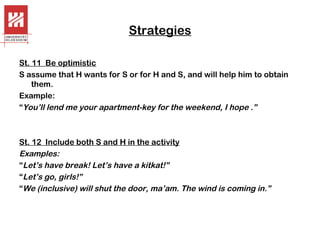
St. 11 Be optimistic
S assume that H wants for S or for H and S, and will help him to obtain
them.
Example:
“You’ll lend me your apartment-key for the weekend, I hope .”

St. 12 Include both S and H in the activity
Examples:
“Let’s have break! Let’s have a kitkat!”
“Let’s go, girls!”
“We (inclusive) will shut the door, ma’am. The wind is coming in.”
Strategies
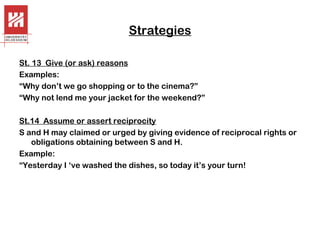
St. 13 Give (or ask) reasons
Examples:
“Why don’t we go shopping or to the cinema?”
“Why not lend me your jacket for the weekend?”
St.14 Assume or assert reciprocity
S and H may claimed or urged by giving evidence of reciprocal rights or
obligations obtaining between S and H.
Example:
“Yesterday I ‘ve washed the dishes, so today it’s your turn!
categories of pp
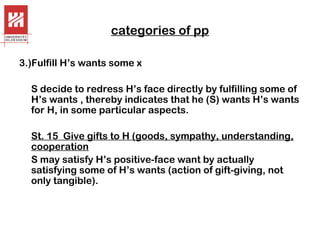
3.)Fulfill H’s wants some x
S decide to redress H’s face directly by fulfilling some of
H’s wants , thereby indicates that he (S) wants H’s wants
for H, in some particular aspects.
St. 15 Give gifts to H (goods, sympathy, understanding,
cooperation
S may satisfy H’s positive-face want by actually
satisfying some of H’s wants (action of gift-giving, not
only tangible).
Negative politeness
• Redressive action addressed to the addressee´s
negative face
• Addressee wants to have his freedom unhindered
and his attention unimpeded
• Specific and focused to minimize the particular
imposition that the FTA effects
• Politeness in Western cultures is always considered
with negative politeness behaviour
• The most elaborated and the most conventionalized
set of linguistic strategies for FTA redress (“Knigge“)
Strategy 1: Be conventionally indirect
• Opposing tensions: desire to give H an “out“ by
being indirect, and the desire to go on record
• Solved by the compromise of conventional
indirectness, the use of phrases and sentences
that have contextually unambiguous meanings
which are different from their literal meaning
• Examples:
• “Can you please shut the door?“
• “You couldn´t possibly tell me the time, please?“
Strategy 2: Question, hedge
•
•
•

•
•
•
•
•
•

Derives from the want not to presume or coerce H.
In literature, a “hedge“ is a particle, word or phrase that modifies
the degree of membership of a predicate or noun phrase in a set
It says of that membership that it is partial,or true only in certain
respects, or that it is more true and complete than perhaps might
be expected
Examples:
“I´m pretty sure, I´ve seen that movie before.“
“I rather think you shouldn´t do that.“
“Mary is a true friend.“
“A salmon is a sort of fish.“
“You´re quite right.“
Strategy 3: Be pessimistic
• Gives redress to H´s negative face by explicitly
expressing doubt that the conditions for the
appropriateness of S´s speech act obtain.
• Examples:
• “You don´t have any exotic plants, do you by any
chance?“
• “I don´t imagine there´d be any chance of...“
• “You couldn´t give me a cigarette, could you?“
Strategy 4: Minimize the imposition, Rx
• Defusing the FTA by indicating that Rx, the intrinsic
seriousness of the imposition, is not itself great
 you leave only D (social distance between S and H)
and P (relative power of H over S) as possible
weighty factors
• So indirectly this may pay H deference
• Examples:
• “Just a moment“
• “Could I have a tiny bit of ...“?
• “I just want to ask if I can borrow a single sheet of
paper.“
Strategy 5: Give deference
• 2 different possibilities to realize the deference:
• 1.) S humbles and abases himself
• 2.) S raises H (pays him positive face of a particular
namely that which satisfies H´s want to be treated
superior.
• Examples:
• “We look forward very much to see you again.“
• “Did you move my luggage?“
“Yes, sir, I thought perhaps you wouldn´t mind and...“
Strategy 6: Apologize
• By apologizing for doing an FTA, the speaker can
indicate his reluctance to impinge on H´s negative
face
=> partially redress the impingement
• Examples:
• “I hope this isn´t going to bother you too much:...“
• “I hate to impose, but...“
• “I´m absolutely lost...“
• “Please forgive me if...“
Strategy 7: Impersonalize S and H
• Phrase the FTA as if the agent were other than S and the
addressee were other than H
• Examples:
• “ Do this for me“
• “It looks to me like“
• “It would be appreciated if...“
• “One shouldn´t do things like that“
• “We feel obligated to inform you about...“
• “We cannot help you“
• “His majesty is not amused“
• “I was kind of interested in knowing if...“
Strategy 8: State the FTA as a general rule
• To dissociate S and H from the particular imposition
in the FTA (S doesn´t want to impinge H, but is merely
forced to by circumstances), it can be generalized as
a social rule/regulation/obligation
• Examples:
• “Passengers will please refrain from smoking in this
room“
• “The commitee requests the President...“
• “We don´t sit on tables, we sit on chairs, XY“
Strategy 9: Normalize
• The more you normalize an expression, the more you
dissociate from it
• Examples:
• “ You performed well on the examinations and that
impressed us favourably.“
• “Your performing well on the examinations was
impressive to us.“
• “Your good performance on the examinations
impressed us favourably.“
Strategy 10: Go on record as incurring a
debt, or as not indebting H
• S can redress an FTA by explicitly claiming his
indebtedness to H, or by disclaiming any
indebtedness of H
• Examples:
• “I´ll never be able to repay you if..“
• “I could easily do this for you- no problem!“
Politeness across cultures

China
• high value of harmony in social relationships
England
• relatively high value on social distance
=> negative and off-record strategies
Greece
• intimacy & solidarity are valued more than distance
=> positive and bald-on-record politeness strategies
Apologies

Hungarians
• “Don`t be angry”, “Forgive me”
• blame themselves
Polish
• apportionment of blame
• offer their help to great extend
Compliments

US-Americans
• pay compliments frequently
• handle them in an easy manner and accept them
less sincere

Germans
• offer compliments more sparingly
• value modesty and tend to play them down
Invitations and Thanks

North Americans
“let`s get together for lunch sometime!”
• invitations are accepted at once but usually
neither taken nor meant serious
Korean
• expect rejections on the first instance before
accepting without showing enthusiasm
South Asia
• do not verbalize their gratitude or indebtedness to
family members
Back channel cues

Japanese
• … students use back-channel cues, such as “uh”
or “yeah”, smile and nod, lean forward and murmur
“yessss” at the appropriate places to show
attention
• irrespective of whether or not one agrees with the
content
English
• … students do so to show that they have
understood and agree
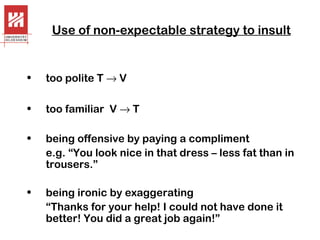
Use of non-expectable strategy to insult

•

too polite T → V

•

too familiar V → T

•

being offensive by paying a compliment
e.g. “You look nice in that dress – less fat than in
trousers.”

•

being ironic by exaggerating
“Thanks for your help! I could not have done it
better! You did a great job again!”

Politeness

  • 2.
    Positive and negative politeness Theconcept of „face“ and FTAs
  • 3.
    Concepts of Politeness Politeness... •“ … is one of the constraints of human interaction, whose purpose is to consider other`s feelings, establish levels of mutual comfort, and promote rapport.” Hill et al. (1986: 282) • “ … what we think is appropriate behaviour in particular situations in an attempt to achieve and maintain successful social relationships with others.“ (Lakoff 1972: 910)
  • 4.
    Concept of "face" "face" •public self-image that every member of society wants to claim for itself • negative face refers to the want of every competent adult member that his actions be unimpeded by others • positive face refers to the want of every member that his wants be desirable to at least some others
  • 5.
    Face-Threatening-Activity FTAs = those actsthat by their nature run contrary to the face wants of the addressee and/or of the speaker`s The negative face is threatened by... …acts that appear to impede the addressee´s independence of movement and freedom of action The positive face is threatened by… …acts which appear as disapproving of their wants
  • 6.
    How to useFTAs: Without redressive action, baldly On record Positive politeness With redressive action Negative politeness Do the FTA Off record
  • 7.
    Positive Politeness • PositivePoliteness is redress directed to the addressee's positive face, his desire that his wants should be thought of as desirable. • Redress consists in partially satisfying that desire by communicating that one's own wants are in some respects similar to the addressee’s wants. • The linguistic realizations of Positive Politeness are in many respects representative of the normal linguistic behavior between intimates
  • 8.
    Categories of pp 1.)Claimcommon ground S can claiming ´common ground` with H, by indicating S and H belongs to the same set of persons, who share specific wants, including goals and values. Three ways of making this claim: a) S may convey that some want (goal) of H´s is admirable or interesting to S too. (strategy 1-3) b) S may stress common membership in a group or category. (strategy 4) c) S can claim common perspective with H without necessarily referring to in- group membership. (strategy 58)
  • 9.
    Strategies St. 1 Notice,attend to H Suggests that S should take notice of aspects of H’s conditions. Examples: “Goodness you cut your hair! … By the way I came to borrow some sugar.” “What a beautiful dress! Where was it bought?” “We ate too many beans tonight, didn’t we?” St. 2 Exaggerate This often done with exaggerated intonation, stress, and other aspects of prosodic. Examples: “You are a fantastic cook, the lunch was great!” “How absolutely marvelous/ extraordinary/…..”
  • 10.
    Strategies St. 3 Intensifyinterest to H S intensify the interest of his own contribution, by “making a good story” and draw H as a participant into the conversation with direct questions and expressions like you know, see what Examples: “I mean and isn’t it .” “I come into his room, and what do you think I see? – a huge mess all over the place and right in the middle, a naked….” St. 4 Use in- group identity makers Using any of the innumerable ways to convey in- group membership: address forms, language or dialect, jargon or slang and ellipses Examples: “Honey, can you give me the beer?” “Hey brother, what’s going on?” “How about a drink?”
  • 11.
    Strategies St.5 Seek agreement Sseeks ways in which it is possible to agree with H. Examples: “I hate this politicians, they know nothing about the small citizen, they earn….” “She had an accident last week. - Oh my good, an accident!” St.6 Avoid disagreement The desire to agree or appear to agree with H leads also to mechanisms for pretending to agree: white lies and hedges. Examples: “Have you got friends?-I have friends. So- called friends. I had friends. Let it put me this way. “ “It’s really beautiful in a way.”
  • 12.
    Strategies St. 7 Presuppose/raise/ assert common ground The value of S’s spending time and effort on being with H, as a mark of friendship or interest in him, by talking for a while about unrelated topics. Examples: “Isn’t it a beautiful day?” And she says to Jim, ’I love you!’, and he says… “How are you?” St.8 Joke Jokes are based on mutual shared background and values and putting H “at ease”. Example: “How about lending me this old heap of junk? “(H’s new cadillac)
  • 13.
    Categories of pp 2.)Conveythat S and H are cooperators This category derives from the want to convey that S and H are cooperatively involved in the relevant activity. Three ways of convey cooperation: a) S’s may indicate his knowledge of and sensitivity to H’s wants. (strategy 9) b) S and H can claim some kind of reflexivity between their wants. (strategy 10-13) c) S may indicate, that he believes reciprocity to be prevailed between H and himself, thus that they are somehow locked into a state of mutual helping. (strategy 14)
  • 14.
    Strategies St. 9 Assertor presuppose S’s knowledge of and concern for H’s wants Assert or imply knowledge of H’s wants and willingness to fit one’s own wants in with them. Examples: “Look, I know you want me to be good in mathematics, so shouldn’t I do my homework now.” (instead of cleaning my room) St.10 Offer and promise Examples: “I’ll try to get it next week!” “I’ll wash the dishes later!”
  • 15.
    Strategies St. 11 Beoptimistic S assume that H wants for S or for H and S, and will help him to obtain them. Example: “You’ll lend me your apartment-key for the weekend, I hope .” St. 12 Include both S and H in the activity Examples: “Let’s have break! Let’s have a kitkat!” “Let’s go, girls!” “We (inclusive) will shut the door, ma’am. The wind is coming in.”
  • 16.
    Strategies St. 13 Give(or ask) reasons Examples: “Why don’t we go shopping or to the cinema?” “Why not lend me your jacket for the weekend?” St.14 Assume or assert reciprocity S and H may claimed or urged by giving evidence of reciprocal rights or obligations obtaining between S and H. Example: “Yesterday I ‘ve washed the dishes, so today it’s your turn!
  • 17.
    categories of pp 3.)FulfillH’s wants some x S decide to redress H’s face directly by fulfilling some of H’s wants , thereby indicates that he (S) wants H’s wants for H, in some particular aspects. St. 15 Give gifts to H (goods, sympathy, understanding, cooperation S may satisfy H’s positive-face want by actually satisfying some of H’s wants (action of gift-giving, not only tangible).
  • 18.
    Negative politeness • Redressiveaction addressed to the addressee´s negative face • Addressee wants to have his freedom unhindered and his attention unimpeded • Specific and focused to minimize the particular imposition that the FTA effects • Politeness in Western cultures is always considered with negative politeness behaviour • The most elaborated and the most conventionalized set of linguistic strategies for FTA redress (“Knigge“)
  • 19.
    Strategy 1: Beconventionally indirect • Opposing tensions: desire to give H an “out“ by being indirect, and the desire to go on record • Solved by the compromise of conventional indirectness, the use of phrases and sentences that have contextually unambiguous meanings which are different from their literal meaning • Examples: • “Can you please shut the door?“ • “You couldn´t possibly tell me the time, please?“
  • 20.
    Strategy 2: Question,hedge • • • • • • • • • Derives from the want not to presume or coerce H. In literature, a “hedge“ is a particle, word or phrase that modifies the degree of membership of a predicate or noun phrase in a set It says of that membership that it is partial,or true only in certain respects, or that it is more true and complete than perhaps might be expected Examples: “I´m pretty sure, I´ve seen that movie before.“ “I rather think you shouldn´t do that.“ “Mary is a true friend.“ “A salmon is a sort of fish.“ “You´re quite right.“
  • 21.
    Strategy 3: Bepessimistic • Gives redress to H´s negative face by explicitly expressing doubt that the conditions for the appropriateness of S´s speech act obtain. • Examples: • “You don´t have any exotic plants, do you by any chance?“ • “I don´t imagine there´d be any chance of...“ • “You couldn´t give me a cigarette, could you?“
  • 22.
    Strategy 4: Minimizethe imposition, Rx • Defusing the FTA by indicating that Rx, the intrinsic seriousness of the imposition, is not itself great  you leave only D (social distance between S and H) and P (relative power of H over S) as possible weighty factors • So indirectly this may pay H deference • Examples: • “Just a moment“ • “Could I have a tiny bit of ...“? • “I just want to ask if I can borrow a single sheet of paper.“
  • 23.
    Strategy 5: Givedeference • 2 different possibilities to realize the deference: • 1.) S humbles and abases himself • 2.) S raises H (pays him positive face of a particular namely that which satisfies H´s want to be treated superior. • Examples: • “We look forward very much to see you again.“ • “Did you move my luggage?“ “Yes, sir, I thought perhaps you wouldn´t mind and...“
  • 24.
    Strategy 6: Apologize •By apologizing for doing an FTA, the speaker can indicate his reluctance to impinge on H´s negative face => partially redress the impingement • Examples: • “I hope this isn´t going to bother you too much:...“ • “I hate to impose, but...“ • “I´m absolutely lost...“ • “Please forgive me if...“
  • 25.
    Strategy 7: ImpersonalizeS and H • Phrase the FTA as if the agent were other than S and the addressee were other than H • Examples: • “ Do this for me“ • “It looks to me like“ • “It would be appreciated if...“ • “One shouldn´t do things like that“ • “We feel obligated to inform you about...“ • “We cannot help you“ • “His majesty is not amused“ • “I was kind of interested in knowing if...“
  • 26.
    Strategy 8: Statethe FTA as a general rule • To dissociate S and H from the particular imposition in the FTA (S doesn´t want to impinge H, but is merely forced to by circumstances), it can be generalized as a social rule/regulation/obligation • Examples: • “Passengers will please refrain from smoking in this room“ • “The commitee requests the President...“ • “We don´t sit on tables, we sit on chairs, XY“
  • 27.
    Strategy 9: Normalize •The more you normalize an expression, the more you dissociate from it • Examples: • “ You performed well on the examinations and that impressed us favourably.“ • “Your performing well on the examinations was impressive to us.“ • “Your good performance on the examinations impressed us favourably.“
  • 28.
    Strategy 10: Goon record as incurring a debt, or as not indebting H • S can redress an FTA by explicitly claiming his indebtedness to H, or by disclaiming any indebtedness of H • Examples: • “I´ll never be able to repay you if..“ • “I could easily do this for you- no problem!“
  • 29.
    Politeness across cultures China •high value of harmony in social relationships England • relatively high value on social distance => negative and off-record strategies Greece • intimacy & solidarity are valued more than distance => positive and bald-on-record politeness strategies
  • 30.
    Apologies Hungarians • “Don`t beangry”, “Forgive me” • blame themselves Polish • apportionment of blame • offer their help to great extend
  • 31.
    Compliments US-Americans • pay complimentsfrequently • handle them in an easy manner and accept them less sincere Germans • offer compliments more sparingly • value modesty and tend to play them down
  • 32.
    Invitations and Thanks NorthAmericans “let`s get together for lunch sometime!” • invitations are accepted at once but usually neither taken nor meant serious Korean • expect rejections on the first instance before accepting without showing enthusiasm South Asia • do not verbalize their gratitude or indebtedness to family members
  • 33.
    Back channel cues Japanese •… students use back-channel cues, such as “uh” or “yeah”, smile and nod, lean forward and murmur “yessss” at the appropriate places to show attention • irrespective of whether or not one agrees with the content English • … students do so to show that they have understood and agree
  • 34.
    Use of non-expectablestrategy to insult • too polite T → V • too familiar V → T • being offensive by paying a compliment e.g. “You look nice in that dress – less fat than in trousers.” • being ironic by exaggerating “Thanks for your help! I could not have done it better! You did a great job again!”