POLITENESS

GROUP 9:
SANTI WIJAYANTI (A1B211007)
TITIN ROHAYATI (A1B211013)
ADE PERMATA SARI (A1B211014)
EVITA KRISTIN S. (A1B211020)

January 14

1
POLITENESS


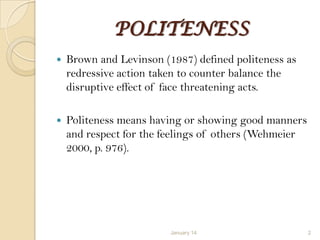
Brown and Levinson (1987) defined politeness as
redressive action taken to counter balance the
disruptive effect of face threatening acts.



Politeness means having or showing good manners
and respect for the feelings of others (Wehmeier
2000, p. 976).

January 14

2
POLITENESS THEORY
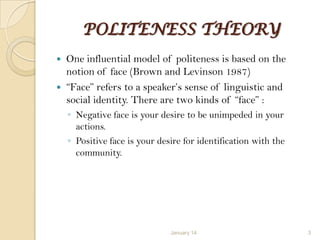
One influential model of politeness is based on the
notion of face (Brown and Levinson 1987)
 “Face” refers to a speaker‟s sense of linguistic and
social identity. There are two kinds of “face” :


◦ Negative face is your desire to be unimpeded in your
actions.
◦ Positive face is your desire for identification with the
community.

January 14

3
ACCOMODATION THEORY
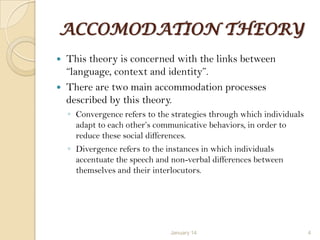
This theory is concerned with the links between
“language, context and identity”.
 There are two main accommodation processes
described by this theory.


◦ Convergence refers to the strategies through which individuals
adapt to each other‟s communicative behaviors, in order to
reduce these social differences.
◦ Divergence refers to the instances in which individuals
accentuate the speech and non-verbal differences between
themselves and their interlocutors.

January 14

4
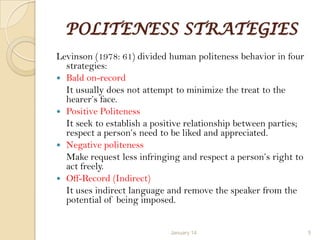
POLITENESS STRATEGIES
Levinson (1978: 61) divided human politeness behavior in four
strategies:
 Bald on-record
It usually does not attempt to minimize the treat to the
hearer‟s face.
 Positive Politeness
It seek to establish a positive relationship between parties;
respect a person‟s need to be liked and appreciated.
 Negative politeness
Make request less infringing and respect a person‟s right to
act freely.
 Off-Record (Indirect)
It uses indirect language and remove the speaker from the
potential of being imposed.

January 14

5
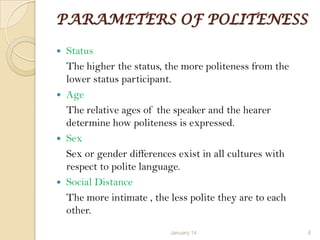
PARAMETERS OF POLITENESS
Status
The higher the status, the more politeness from the
lower status participant.
 Age
The relative ages of the speaker and the hearer
determine how politeness is expressed.
 Sex
Sex or gender differences exist in all cultures with
respect to polite language.
 Social Distance
The more intimate , the less polite they are to each
other.


January 14

6
POLITENESS IN DIFFERENT
GENDER




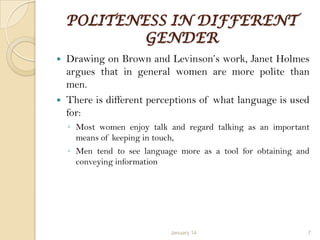
Drawing on Brown and Levinson‟s work, Janet Holmes
argues that in general women are more polite than
men.
There is different perceptions of what language is used
for:
◦ Most women enjoy talk and regard talking as an important
means of keeping in touch,
◦ Men tend to see language more as a tool for obtaining and
conveying information

January 14

7
POLITENESS IN DIFFERENT
GENDER
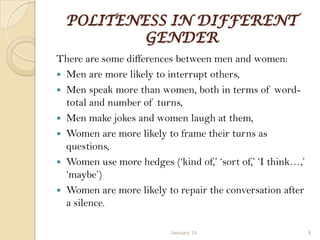
There are some differences between men and women:
 Men are more likely to interrupt others,
 Men speak more than women, both in terms of wordtotal and number of turns,
 Men make jokes and women laugh at them,
 Women are more likely to frame their turns as
questions,
 Women use more hedges („kind of,‟ „sort of,‟ „I think…,‟
„maybe‟)
 Women are more likely to repair the conversation after
a silence.
January 14

8

POLITENESS

  • 1.
    POLITENESS GROUP 9: SANTI WIJAYANTI(A1B211007) TITIN ROHAYATI (A1B211013) ADE PERMATA SARI (A1B211014) EVITA KRISTIN S. (A1B211020) January 14 1
  • 2.
    POLITENESS  Brown and Levinson(1987) defined politeness as redressive action taken to counter balance the disruptive effect of face threatening acts.  Politeness means having or showing good manners and respect for the feelings of others (Wehmeier 2000, p. 976). January 14 2
  • 3.
    POLITENESS THEORY One influentialmodel of politeness is based on the notion of face (Brown and Levinson 1987)  “Face” refers to a speaker‟s sense of linguistic and social identity. There are two kinds of “face” :  ◦ Negative face is your desire to be unimpeded in your actions. ◦ Positive face is your desire for identification with the community. January 14 3
  • 4.
    ACCOMODATION THEORY This theoryis concerned with the links between “language, context and identity”.  There are two main accommodation processes described by this theory.  ◦ Convergence refers to the strategies through which individuals adapt to each other‟s communicative behaviors, in order to reduce these social differences. ◦ Divergence refers to the instances in which individuals accentuate the speech and non-verbal differences between themselves and their interlocutors. January 14 4
  • 5.
    POLITENESS STRATEGIES Levinson (1978:61) divided human politeness behavior in four strategies:  Bald on-record It usually does not attempt to minimize the treat to the hearer‟s face.  Positive Politeness It seek to establish a positive relationship between parties; respect a person‟s need to be liked and appreciated.  Negative politeness Make request less infringing and respect a person‟s right to act freely.  Off-Record (Indirect) It uses indirect language and remove the speaker from the potential of being imposed. January 14 5
  • 6.
    PARAMETERS OF POLITENESS Status Thehigher the status, the more politeness from the lower status participant.  Age The relative ages of the speaker and the hearer determine how politeness is expressed.  Sex Sex or gender differences exist in all cultures with respect to polite language.  Social Distance The more intimate , the less polite they are to each other.  January 14 6
  • 7.
    POLITENESS IN DIFFERENT GENDER   Drawingon Brown and Levinson‟s work, Janet Holmes argues that in general women are more polite than men. There is different perceptions of what language is used for: ◦ Most women enjoy talk and regard talking as an important means of keeping in touch, ◦ Men tend to see language more as a tool for obtaining and conveying information January 14 7
  • 8.
    POLITENESS IN DIFFERENT GENDER Thereare some differences between men and women:  Men are more likely to interrupt others,  Men speak more than women, both in terms of wordtotal and number of turns,  Men make jokes and women laugh at them,  Women are more likely to frame their turns as questions,  Women use more hedges („kind of,‟ „sort of,‟ „I think…,‟ „maybe‟)  Women are more likely to repair the conversation after a silence. January 14 8