Language Bias
Gender and language
Language Bias
 Are men and women equal?
 How are sex and gender different?
 Examples of language bias
     Symmetry and asymmetry
     Unmarked and marked
     Some words are not equal
1. Are men and women equal?
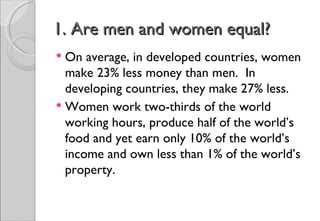
 On average, in developed countries, women
  make 23% less money than men. In
  developing countries, they make 27% less.
 Women work two-thirds of the world
  working hours, produce half of the world’s
  food and yet earn only 10% of the world’s
  income and own less than 1% of the world’s
  property.
2. Are men and women equal?
 Almost a quarter of the global population
  lives in extreme poverty – on less than ¥100
  per day. 70% of these people are women.
 Gender violence causes more deaths and
  disability among women aged 15 to 44 than
  cancer, malaria, traffic accidents or war.
3. Are men and women equal?
 In Switzerland, Japan and Belgium, for every
  100 men enrolled in higher education there
  are respectively just 53, 63 and 78 women.
 Women hold only 1% of executive positions
  in the world’s biggest international
  corporations. Women hold only 6.2% of all
  ministerial positions worldwide.
“Women are not born they are
         made.”
   Simone de Beauvoir
Sex and Gender

   Sex is something we are         Gender is socially
    born with.                       constructed.
   Sex is biologically             It is not something we
    determined.                      are born with.
    ◦ It is announced by the        It is something we do,
      doctor: “It’s a boy!” or       something we perform
      “It’s a girl!”
                                     and is created by
                                     society.
Both men and women are made.
 Gendering begins when the doctor
  announces, “It’s a boy!” or “It’s a girl!”
 Male and female children are interpreted
  differently and interacted with differently.
 Boys and girls are treated differently and so
  they learn to be different.
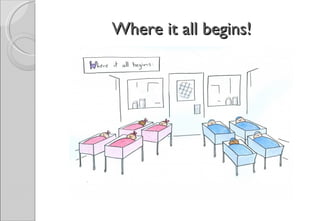
Where it all begins!
The ways in which language is
biased reinforces the making of men
             and women
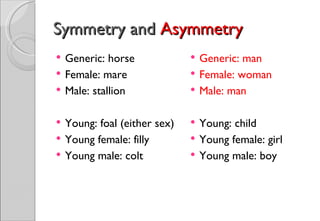
Symmetry and Asymmetry
   Generic: horse                Generic: man
   Female: mare                  Female: woman
   Male: stallion                Male: man

   Young: foal (either sex)      Young: child
   Young female: filly           Young female: girl
   Young male: colt              Young male: boy
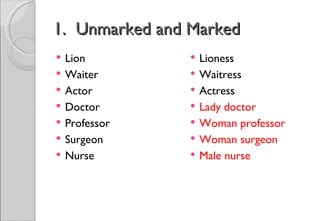
1. Unmarked and Marked
   Lion           Lioness
   Waiter         Waitress
   Actor          Actress
   Doctor         Lady doctor
   Professor      Woman professor
   Surgeon        Woman surgeon
   Nurse          Male nurse
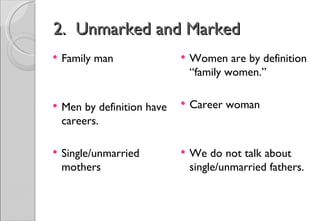
2. Unmarked and Marked
   Family man                  Women are by definition
                                 “family women.”

   Men by definition have      Career woman
    careers.

   Single/unmarried            We do not talk about
    mothers                      single/unmarried fathers.
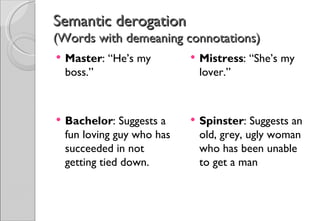
Semantic derogation
(Words with demeaning connotations)
   Master: “He’s my            Mistress: “She’s my
    boss.”                       lover.”


   Bachelor: Suggests a        Spinster: Suggests an
    fun loving guy who has       old, grey, ugly woman
    succeeded in not             who has been unable
    getting tied down.           to get a man
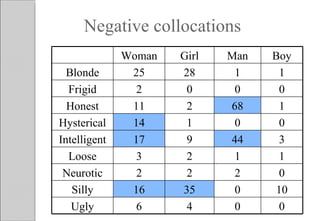
Negative collocations
              Woman   Girl   Man   Boy
  Blonde       25     28      1      1
  Frigid        2      0      0      0
  Honest       11      2     68      1
Hysterical     14      1      0      0
Intelligent    17      9     44      3
  Loose         3      2      1      1
 Neurotic       2      2      2      0
   Silly       16     35      0     10
   Ugly         6      4      0      0
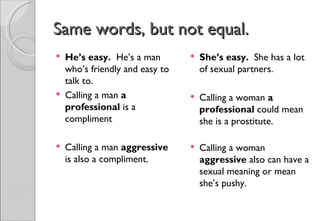
Same words, but not equal.
   He’s easy. He’s a man           She’s easy. She has a lot
    who’s friendly and easy to       of sexual partners.
    talk to.
   Calling a man a                 Calling a woman a
    professional is a                professional could mean
    compliment                       she is a prostitute.

   Calling a man aggressive        Calling a woman
    is also a compliment.            aggressive also can have a
                                     sexual meaning or mean
                                     she’s pushy.
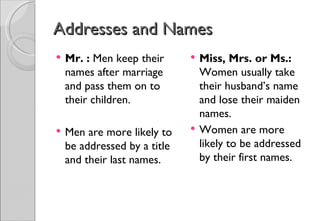
Addresses and Names
   Mr. : Men keep their         Miss, Mrs. or Ms.:
    names after marriage          Women usually take
    and pass them on to           their husband’s name
    their children.               and lose their maiden
                                  names.
   Men are more likely to       Women are more
    be addressed by a title       likely to be addressed
    and their last names.         by their first names.
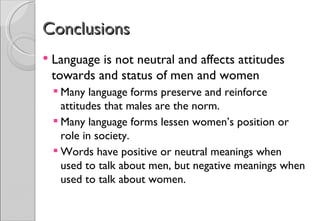
Conclusions
   Language is not neutral and affects attitudes
    towards and status of men and women
     Many language forms preserve and reinforce
      attitudes that males are the norm.
     Many language forms lessen women’s position or
      role in society.
     Words have positive or neutral meanings when
      used to talk about men, but negative meanings when
      used to talk about women.

Language and bias new

  • 1.
  • 2.
    Language Bias  Aremen and women equal?  How are sex and gender different?  Examples of language bias  Symmetry and asymmetry  Unmarked and marked  Some words are not equal
  • 3.
    1. Are menand women equal?  On average, in developed countries, women make 23% less money than men. In developing countries, they make 27% less.  Women work two-thirds of the world working hours, produce half of the world’s food and yet earn only 10% of the world’s income and own less than 1% of the world’s property.
  • 4.
    2. Are menand women equal?  Almost a quarter of the global population lives in extreme poverty – on less than ¥100 per day. 70% of these people are women.  Gender violence causes more deaths and disability among women aged 15 to 44 than cancer, malaria, traffic accidents or war.
  • 5.
    3. Are menand women equal?  In Switzerland, Japan and Belgium, for every 100 men enrolled in higher education there are respectively just 53, 63 and 78 women.  Women hold only 1% of executive positions in the world’s biggest international corporations. Women hold only 6.2% of all ministerial positions worldwide.
  • 6.
    “Women are notborn they are made.” Simone de Beauvoir
  • 7.
    Sex and Gender  Sex is something we are  Gender is socially born with. constructed.  Sex is biologically  It is not something we determined. are born with. ◦ It is announced by the  It is something we do, doctor: “It’s a boy!” or something we perform “It’s a girl!” and is created by society.
  • 8.
    Both men andwomen are made.  Gendering begins when the doctor announces, “It’s a boy!” or “It’s a girl!”  Male and female children are interpreted differently and interacted with differently.  Boys and girls are treated differently and so they learn to be different.
  • 9.
    Where it allbegins!
  • 10.
    The ways inwhich language is biased reinforces the making of men and women
  • 11.
    Symmetry and Asymmetry  Generic: horse  Generic: man  Female: mare  Female: woman  Male: stallion  Male: man  Young: foal (either sex)  Young: child  Young female: filly  Young female: girl  Young male: colt  Young male: boy
  • 12.
    1. Unmarked andMarked  Lion  Lioness  Waiter  Waitress  Actor  Actress  Doctor  Lady doctor  Professor  Woman professor  Surgeon  Woman surgeon  Nurse  Male nurse
  • 13.
    2. Unmarked andMarked  Family man  Women are by definition “family women.”  Men by definition have  Career woman careers.  Single/unmarried  We do not talk about mothers single/unmarried fathers.
  • 14.
    Semantic derogation (Words withdemeaning connotations)  Master: “He’s my  Mistress: “She’s my boss.” lover.”  Bachelor: Suggests a  Spinster: Suggests an fun loving guy who has old, grey, ugly woman succeeded in not who has been unable getting tied down. to get a man
  • 15.
    Negative collocations Woman Girl Man Boy Blonde 25 28 1 1 Frigid 2 0 0 0 Honest 11 2 68 1 Hysterical 14 1 0 0 Intelligent 17 9 44 3 Loose 3 2 1 1 Neurotic 2 2 2 0 Silly 16 35 0 10 Ugly 6 4 0 0
  • 16.
    Same words, butnot equal.  He’s easy. He’s a man  She’s easy. She has a lot who’s friendly and easy to of sexual partners. talk to.  Calling a man a  Calling a woman a professional is a professional could mean compliment she is a prostitute.  Calling a man aggressive  Calling a woman is also a compliment. aggressive also can have a sexual meaning or mean she’s pushy.
  • 17.
    Addresses and Names  Mr. : Men keep their  Miss, Mrs. or Ms.: names after marriage Women usually take and pass them on to their husband’s name their children. and lose their maiden names.  Men are more likely to  Women are more be addressed by a title likely to be addressed and their last names. by their first names.
  • 19.
    Conclusions  Language is not neutral and affects attitudes towards and status of men and women  Many language forms preserve and reinforce attitudes that males are the norm.  Many language forms lessen women’s position or role in society.  Words have positive or neutral meanings when used to talk about men, but negative meanings when used to talk about women.

Editor's Notes

  • #9 When you go to buy a present for a baby, you will be immediately asked, “boy or girl?” Overalls for a girl are okay if they are pink or flowered. A frilly dress is never acceptable for a baby boy. Today in America, pink is for girls and blue for boys, but 100 years ago the preferences were reversed. Adults hear a baby’s cry as angry if it’s a boy and fearful it it’s a girl. Baby girls are handled more gently than baby boys. Parents talk to them differently. Parents use more diminutives (kitty, doggie) with girls. They say no or don’t do that more often to boys and what is said is independent of children’s behavior. Male and female babies cry the same amount, but as they get older boys cry less and less; primarily because adults respond differently to babies crying.
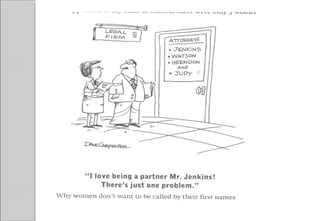
  • #10 http://whendotheyservethewine.com/ Liza Donelly Accessed on May 22, 2011
  • #12 Man can mean women, men, girls and boys or only men, and not women or children. Man is the norm.
  • #13 Unmarked = common, norm Marked = not common, not the norm The last four seem to be for both sexes, but in reality we use them as if they only applied to one gender. When we use lady doctor, woman professor, and woman surgeon, we imply that the norm for those occupations is male. Only nurse has a marked form that is male. Nurses have lower status than the other professions. British National Corpus: lady doctor 125 times, woman doctor 20 times, and female doctor 10 times vs. male doctor 14 times.
  • #14 British National Corpus: family man 94 times vs family woman 4 times; career woman 48 times, career girl 10 times, career lady once vs. career man 6 times, career boy or gentleman never. Career woman suggests that women can’t be real professionals, while as professionals British National Corpus: 153 cases of single mother and 68 cases of unmarried mother vs 2 cases of single father and 6 cases of unmarried father
  • #15 Semantic is a term that refers to meaning and derogate means to cause something to seem inferior.
  • #18 Women have choices, but in the choices that she has to make she must reveal something about herself; Miss that she is not married, Mrs. that she is married, and Ms. that she may be divorced (a common assumption) or that she is a feminist.