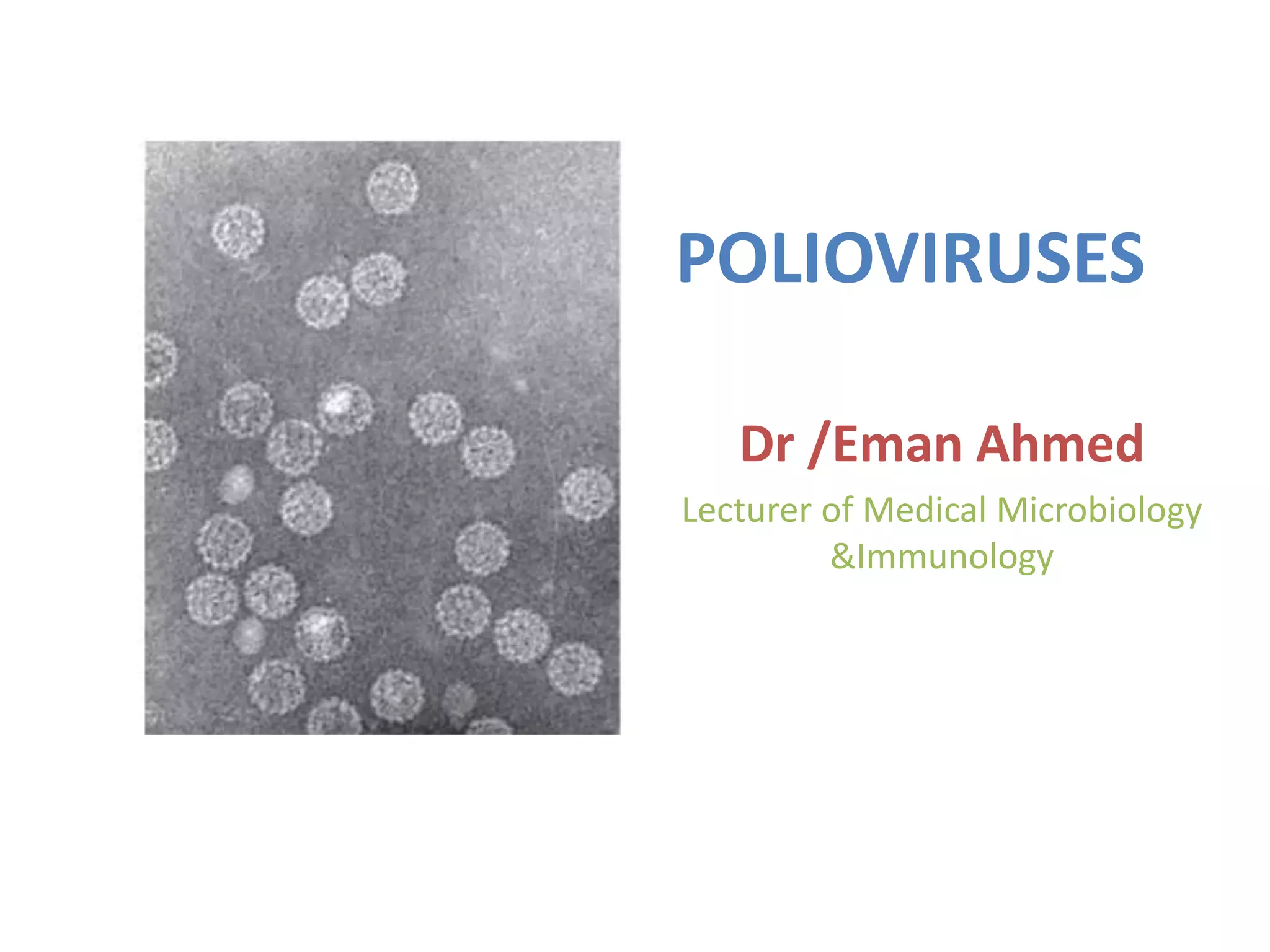
POLIOVIRUSES
Dr /Eman Ahmed
Lecturer of Medical Microbiology
&Immunology
Poliomyelitis
• Poliomyelitis is an acute infectious disease
that in its serious form affects the central
nervous system (CNS). The destruction of
motor neurons in the spinal cord results in
flaccid paralysis. However, most poliovirus
infections are subclinical.
Causative agent :Polio virus
Poliomyelitis
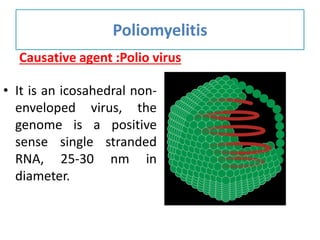
• It is an icosahedral non-
enveloped virus, the
genome is a positive
sense single stranded
RNA, 25-30 nm in
diameter.
Mode of transmission
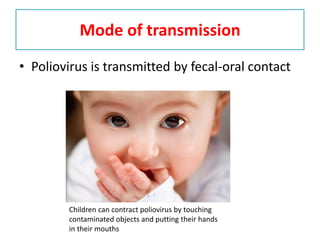
• Poliovirus is transmitted by fecal-oral contact
Children can contract poliovirus by touching
contaminated objects and putting their hands
in their mouths
Properties of the virus
• There are 3 antigenic types.
• They are inactivated when heated at 55°C for
30 minutes
• Chlorine are used to disinfect sewage
containing virus .
• The virus infects only primates, e.g. man and
monkeys as they possess specific receptors for
viral attachment.
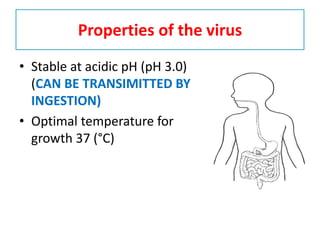
• Stable at acidic pH (pH 3.0)
(CAN BE TRANSIMITTED BY
INGESTION)
• Optimal temperature for
growth 37 (°C)
Properties of the virus
Replication cycle
Replication cycle
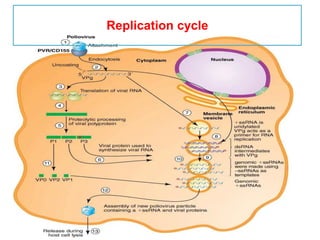
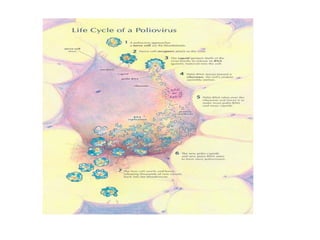
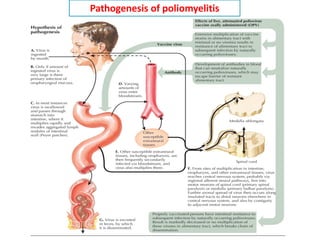
• Replication begins by attachment to specific
receptors on the cell membrane and entry into the
cell, this is followed by uncoating.
• The genome RNA functions as mRNA and is
translated into one large polypeptide, which is
cleaved by virus encoded protease into structural
proteins and enzymes.
• Replication of the genome occurs by synthesis of
a complementary negative strand, which then
serves as the template for the positive strands.
• Assembly then occurs and the virus accumulates
in the cytoplasm and is released by cell lysis.
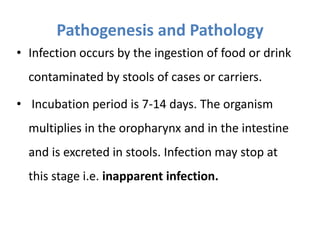
Pathogenesis of poliomyelitis
• Infection occurs by the ingestion of food or drink
contaminated by stools of cases or carriers.
• Incubation period is 7-14 days. The organism
multiplies in the oropharynx and in the intestine
and is excreted in stools. Infection may stop at
this stage i.e. inapparent infection.
Pathogenesis and Pathology
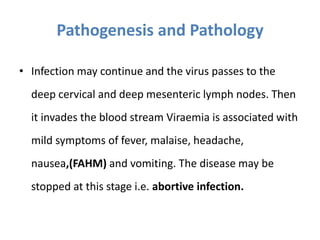
• Infection may continue and the virus passes to the
deep cervical and deep mesenteric lymph nodes. Then
it invades the blood stream Viraemia is associated with
mild symptoms of fever, malaise, headache,
nausea,(FAHM) and vomiting. The disease may be
stopped at this stage i.e. abortive infection.
Pathogenesis and Pathology
• Aseptic meningitis (non-paralytic poliomyelitis)
may occur and manifests by stiffness and pain in
the back and neck. It usually recovers but it may
progress to paralysis.
Pathogenesis and Pathology
• Paralytic poliomyelitis occurs only in 0.1-1%
of cases. The virus affects the anterior horn
cells of the spinal cord leading to flaccid
paralysis. In severe cases, it may affect the
posterior horn cells, the vestibular nuclei and
motor cortex. Death may occur due to
respiratory paralysis.
Pathogenesis and Pathology
The CNS may then be invaded by
• way of the circulating blood.
• Poliovirus can spread along axons of
peripheral nerves to the CNS
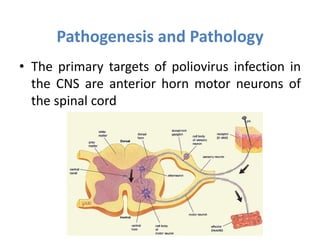
• The primary targets of poliovirus infection in
the CNS are anterior horn motor neurons of
the spinal cord
Pathogenesis and Pathology
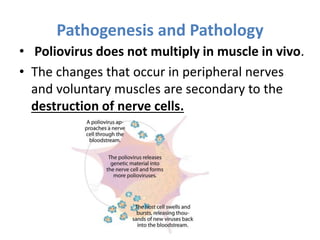
• Poliovirus does not multiply in muscle in vivo.
• The changes that occur in peripheral nerves
and voluntary muscles are secondary to the
destruction of nerve cells.
Pathogenesis and Pathology
• No permanent carrier state occurs, but virus
excretion in stools can occur for several
months. Immunity is permanent to the type
of poliovirus causing the infection
Pathogenesis and Pathology
Clinical pictures of Poliomyelitis
1) inapparent ( 95% ): the organism multiply at oropharynx &
intestine and excreted in stool
2) abortive ( 4-8% ) : the organism reach blood → viremia →
FAHM + VOMITING)
3) aseptic meningitis ( 1% ) ( non paralytic polio ) : stiffness of
back of neck
4) paralytic polio ( 0.1 - 1 % ) : involve the following forms :
a- Spinal poliomyelitis : affection of AHC → flaccid paralysis ,
intact sensations
b- Bulbar poliomyelitis : more serious , affect brain stem
c- Bulbo-spinal poliomyelitis : very poor prognosis
d- Encephalitis : very rare
Lab Diagnosis of poliomyelitis
Sample :stool or CSF and serum for detection of
Ab
1) Direct : → virus itself by immunoelectro
microscope
→ viral Ag by ELISA , RIA
→ genetic material by PCR , probe
2) Indirect : tissue culture → CPE
3) Serology : specific IgM , raising IgG , C.F
Prophylaxis
1) Active :Active immunization: There are two
vaccines that contain the three types of virus
and produce neutralizing antibodies and prevent
CNS infection.
2) Passive:Gamma globulins given early to
susceptible unimmunized contacts may be
effective in preventing paralytic poliomyelitis.
A) Active immunization
1) Sabin living attenuated oral polio-vaccine
(OPV):
• It is a living attenuated vaccine prepared from
non-paralytogenic mutants of the three types
of poliovirus grown.
• Four doses are given orally at the age of 2, 4
and 6 months and a booster dose is given at 4-
6 years.
A)Active immunization
Advantages of Sabin :
a- easily administration " orally "
b- multiplies locally in intestine → local immunity
IgA , interferons and also stimulate production of
IgG , IgM.
c- Herd immunity :- ( VIP )
Vaccine strains pass with stool & are disseminated
in the environment & can be transmitted to non
immunized children by feco-oral route →
eradication of polio virus
Disadvantages of Sabin
a- failure of vaccination due to :
→ loss of potency (
‫الفاعلية‬
) due to improper refrigeration
during storage
→ interference with replication of virus in intestine by
another enterovirus
b- vaccine may cause paralytic disease in
immunodeficient
c- VAPP " vaccine associated paralytic poliomyelitis "
due to reversion of the attenuated virus to virulent state
2)Salk vaccine : It is a formalin killed vaccine
prepared from the three types of the virus
grown in monkey kidney cell cultures. It is given
in 4 subcutaneous doses at 2, 4 and 6 months
and a booster injection is given at 4-6 years.
2)Salk vaccine
Disadvantages:
The vaccine produces neutralizing antibodies
(IgG and IgM) and prevents infection of the CNS.
However, it does not prevent virus replication
in the intestine. So, the vaccine protects against
paralytic poliomyelitis but not against non-
paralytic forms of infection.
2)Salk vaccine
Advantages
The vaccine can be safely given to
immunosuppressed children and pregnant
mothers, in whom Sabin vaccine is
contraindicated.
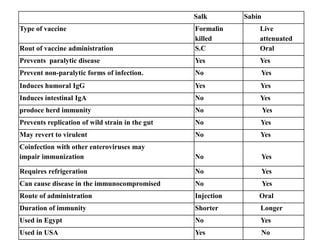
Salk Sabin
Type of vaccine Formalin
killed
Live
attenuated
Rout of vaccine administration S.C Oral
Prevents paralytic disease Yes Yes
Prevent non-paralytic forms of infection. No Yes
Induces humoral IgG Yes Yes
Induces intestinal IgA No Yes
prodoce herd immunity No Yes
Prevents replication of wild strain in the gut No Yes
May revert to virulent No Yes
Coinfection with other enteroviruses may
impair immunization No Yes
Requires refrigeration No Yes
Can cause disease in the immunocompromised No Yes
Route of administration Injection Oral
Duration of immunity Shorter Longer
Used in Egypt No Yes
Used in USA Yes No

poliomylitis.pdf

  • 1.
    POLIOVIRUSES Dr /Eman Ahmed Lecturerof Medical Microbiology &Immunology
  • 2.
    Poliomyelitis • Poliomyelitis isan acute infectious disease that in its serious form affects the central nervous system (CNS). The destruction of motor neurons in the spinal cord results in flaccid paralysis. However, most poliovirus infections are subclinical.
  • 3.
    Causative agent :Poliovirus Poliomyelitis • It is an icosahedral non- enveloped virus, the genome is a positive sense single stranded RNA, 25-30 nm in diameter.
  • 4.
    Mode of transmission •Poliovirus is transmitted by fecal-oral contact Children can contract poliovirus by touching contaminated objects and putting their hands in their mouths
  • 5.
    Properties of thevirus • There are 3 antigenic types. • They are inactivated when heated at 55°C for 30 minutes • Chlorine are used to disinfect sewage containing virus . • The virus infects only primates, e.g. man and monkeys as they possess specific receptors for viral attachment.
  • 6.
    • Stable atacidic pH (pH 3.0) (CAN BE TRANSIMITTED BY INGESTION) • Optimal temperature for growth 37 (°C) Properties of the virus
  • 7.
  • 9.
    Replication cycle • Replicationbegins by attachment to specific receptors on the cell membrane and entry into the cell, this is followed by uncoating. • The genome RNA functions as mRNA and is translated into one large polypeptide, which is cleaved by virus encoded protease into structural proteins and enzymes. • Replication of the genome occurs by synthesis of a complementary negative strand, which then serves as the template for the positive strands. • Assembly then occurs and the virus accumulates in the cytoplasm and is released by cell lysis.
  • 10.
  • 11.
    • Infection occursby the ingestion of food or drink contaminated by stools of cases or carriers. • Incubation period is 7-14 days. The organism multiplies in the oropharynx and in the intestine and is excreted in stools. Infection may stop at this stage i.e. inapparent infection. Pathogenesis and Pathology
  • 12.
    • Infection maycontinue and the virus passes to the deep cervical and deep mesenteric lymph nodes. Then it invades the blood stream Viraemia is associated with mild symptoms of fever, malaise, headache, nausea,(FAHM) and vomiting. The disease may be stopped at this stage i.e. abortive infection. Pathogenesis and Pathology
  • 13.
    • Aseptic meningitis(non-paralytic poliomyelitis) may occur and manifests by stiffness and pain in the back and neck. It usually recovers but it may progress to paralysis. Pathogenesis and Pathology
  • 14.
    • Paralytic poliomyelitisoccurs only in 0.1-1% of cases. The virus affects the anterior horn cells of the spinal cord leading to flaccid paralysis. In severe cases, it may affect the posterior horn cells, the vestibular nuclei and motor cortex. Death may occur due to respiratory paralysis. Pathogenesis and Pathology
  • 15.
    Pathogenesis and Pathology TheCNS may then be invaded by • way of the circulating blood. • Poliovirus can spread along axons of peripheral nerves to the CNS
  • 16.
    • The primarytargets of poliovirus infection in the CNS are anterior horn motor neurons of the spinal cord Pathogenesis and Pathology
  • 17.
    • Poliovirus doesnot multiply in muscle in vivo. • The changes that occur in peripheral nerves and voluntary muscles are secondary to the destruction of nerve cells. Pathogenesis and Pathology
  • 18.
    • No permanentcarrier state occurs, but virus excretion in stools can occur for several months. Immunity is permanent to the type of poliovirus causing the infection Pathogenesis and Pathology
  • 19.
    Clinical pictures ofPoliomyelitis 1) inapparent ( 95% ): the organism multiply at oropharynx & intestine and excreted in stool 2) abortive ( 4-8% ) : the organism reach blood → viremia → FAHM + VOMITING) 3) aseptic meningitis ( 1% ) ( non paralytic polio ) : stiffness of back of neck 4) paralytic polio ( 0.1 - 1 % ) : involve the following forms : a- Spinal poliomyelitis : affection of AHC → flaccid paralysis , intact sensations b- Bulbar poliomyelitis : more serious , affect brain stem c- Bulbo-spinal poliomyelitis : very poor prognosis d- Encephalitis : very rare
  • 20.
    Lab Diagnosis ofpoliomyelitis Sample :stool or CSF and serum for detection of Ab 1) Direct : → virus itself by immunoelectro microscope → viral Ag by ELISA , RIA → genetic material by PCR , probe 2) Indirect : tissue culture → CPE 3) Serology : specific IgM , raising IgG , C.F
  • 21.
    Prophylaxis 1) Active :Activeimmunization: There are two vaccines that contain the three types of virus and produce neutralizing antibodies and prevent CNS infection. 2) Passive:Gamma globulins given early to susceptible unimmunized contacts may be effective in preventing paralytic poliomyelitis.
  • 22.
    A) Active immunization 1)Sabin living attenuated oral polio-vaccine (OPV): • It is a living attenuated vaccine prepared from non-paralytogenic mutants of the three types of poliovirus grown. • Four doses are given orally at the age of 2, 4 and 6 months and a booster dose is given at 4- 6 years.
  • 23.
    A)Active immunization Advantages ofSabin : a- easily administration " orally " b- multiplies locally in intestine → local immunity IgA , interferons and also stimulate production of IgG , IgM. c- Herd immunity :- ( VIP ) Vaccine strains pass with stool & are disseminated in the environment & can be transmitted to non immunized children by feco-oral route → eradication of polio virus
  • 24.
    Disadvantages of Sabin a-failure of vaccination due to : → loss of potency ( ‫الفاعلية‬ ) due to improper refrigeration during storage → interference with replication of virus in intestine by another enterovirus b- vaccine may cause paralytic disease in immunodeficient c- VAPP " vaccine associated paralytic poliomyelitis " due to reversion of the attenuated virus to virulent state
  • 25.
    2)Salk vaccine :It is a formalin killed vaccine prepared from the three types of the virus grown in monkey kidney cell cultures. It is given in 4 subcutaneous doses at 2, 4 and 6 months and a booster injection is given at 4-6 years.
  • 26.
    2)Salk vaccine Disadvantages: The vaccineproduces neutralizing antibodies (IgG and IgM) and prevents infection of the CNS. However, it does not prevent virus replication in the intestine. So, the vaccine protects against paralytic poliomyelitis but not against non- paralytic forms of infection.
  • 27.
    2)Salk vaccine Advantages The vaccinecan be safely given to immunosuppressed children and pregnant mothers, in whom Sabin vaccine is contraindicated.
  • 28.
    Salk Sabin Type ofvaccine Formalin killed Live attenuated Rout of vaccine administration S.C Oral Prevents paralytic disease Yes Yes Prevent non-paralytic forms of infection. No Yes Induces humoral IgG Yes Yes Induces intestinal IgA No Yes prodoce herd immunity No Yes Prevents replication of wild strain in the gut No Yes May revert to virulent No Yes Coinfection with other enteroviruses may impair immunization No Yes Requires refrigeration No Yes Can cause disease in the immunocompromised No Yes Route of administration Injection Oral Duration of immunity Shorter Longer Used in Egypt No Yes Used in USA Yes No