URINARY TRACT
INFECTION
By
Dr / Eman A.Abd-Alrahman
Lecturer of Microbiology and Immunology
URINARYTRACT INFECTION
Urinary tract infection maybe:
1) Upper urinary tract infection
• Pyelonephritis
• Ureteritis
2)Lower urinary tract infection
• Cystitis
• Urethritis (usually caused by a sexually transmitted infection)
CYSTITIS
Cystitis is an infection of the bladder.
• Mode of transmission: bacteria (rarely fungi) reach the
bladder via ascent through the urethra.
This is much more common in women due to the short urethra and
close approximation of the urethra to the vagina and anus.
Risk factors for cystitis
• Anatomic abnormalities such as cystoceles, neurologic disorders such
as spinal cord injuries
• The presence of foreign bodies such as indwelling Foley catheters.
• Uncircumcised boys.
Clinical Manifestations
The most common clinical manifestations of cystitis include
dysuria (pain with urination); frequent, low volume urination;
suprapubic tenderness; and gross hematuria.
patients with cystitis do not have fever or other systemic symptoms of
infection, and when they are present, an upper urinary tract infection
(pyelonephritis) should be considered
CAUSATIVE AGENTS
❖Escherichia coli is by far the most common cause of urinary tract
infections, especially cystitis.
❖Virulence factors of uropathogenic E.coli:
fimbriae(pili)organ of adhesion, alpha hemolysi (cytotoxic) and
siderophore (iron binding protein)
❖Other enteric gram-negative rods such as Klebsiella species ,Proteus.
And Pseudomonas aeruginosa can cause urinary tract infection, but these
are most common in health care–associated infections, patients with
anatomic/ neurologic abnormalities, or heavily antibiotic-experienced
patients.
❖Gram-positive pathogens include Enterococcus species and Staphylococcus
saprophyticus.
Staphylococcus saprophyticus is common in young women
❖Candida species
❖Rarely, viruses such as adenovirus, BK virus, and cytomegalovirus can cause a
hemorrhagic cystitis. These viruses almost exclusively cause cystitis in
immunocompromised hosts such as those who have undergone stem cell
transplants
DIAGNOSIS OF CYSTITIS
The diagnosis of cystitis requires identifying a combination of:
• Pyuria : > 10 WBCs per uL of midstream urine and or positive leukocyte
esterase test
• plus positive urine cultures (> 105 bacteria per mL)
• Plus clinical symptoms
• Plus Microscopic hematuria
TREATMENT OF CYSTITIS
• . Empiric therapy ‫العالج‬
‫االبتدائي‬
‫دون‬
‫عمل‬
‫مزرعة‬
‫للبول‬
) ) in cases of
uncomplicated (simple) cystitis BY trimethoprim-sulfamethoxazole,
fosfomycin or nitrofurantoin.
• Empiric therapy for complicated cystitis is usually with a
fluoroquinolone (ciprofloxacin or levofloxacin).
PYELONEPHRITIS
• Definition: Pyelonephritis is an infection of the kidney(s).
• Uncomplicated pyelonephritis is defined as pyelonephritis in
otherwise healthy women.
• Complicated pyelonephritis is pyelonephritis in all other patients.
ROUTES OFTRANSMISSION OF INFECTION
IN PYELONEPHRITIS
• Pyelonephritis may occur either by ascension of
bacteria from the urethra to the bladder and then to
the kidney(s)
• or, less commonly, through hematogenous spread from
other sites of infection such as endocarditis.
RISK FACTORS FOR PYELONEPHRITIS
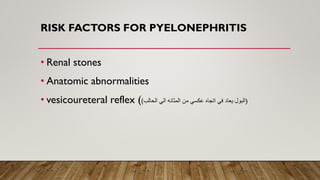
• Renal stones
• Anatomic abnormalities
• vesicoureteral reflex ( ‫الحالب‬ ‫الي‬ ‫المثانه‬ ‫من‬ ‫عكسي‬ ‫اتجاه‬ ‫في‬ ‫يعاد‬ ‫البول‬
) )
Clinical Manifestations
Patients with pyelonephritis typically present with
• fever
• flank pain
• nausea, and vomiting.
• They may or may not have signs and symptoms of lower tract infection
(dysuria, frequency, hematuria, suprapubic tenderness).
➢Escherichia coli is the most common pathogen causing
pyelonephritis.
➢Other enteric gram-negative rods such as Klebsiella, Proteus species and
Pseudomonas aeruginosa can cause pyelonephritis, but this typically occurs in
health care–associated infections, patients with anatomic/neurologic
abnormalities of urinary tract, or heavily antibiotic-experienced patients.
• Patients with recurrent Proteus pyelonephritis should be
evaluated for stones.
PATHOGENS CAUSING PYELONEPHRITIS
• Infection of the kidney following hematogenous spread of
infection can occur with essentially any organism but is seen
most commonly with Staphylococcus aureus.
• Hematogenous spread also occurs with Mycobacterium
tuberculosis
DIAGNOSIS OF PYELONEPHRITIS
• Urine test findings are similar to those seen in cystitis, but
urinaryWBC casts can be seen
• BloodWBC counts are frequently elevated, and
occasionally blood cultures can be positive.
• PLUS clinical manifestations
TREATMENT OF PYELONEPHRITIS
• Antibiotics that are able to obtain high concentrations in the
renal parenchyma and have activity against common pathogens
are required to treat pyelonephritis.
• Empiric regimens for community-onset infection(uncomplicated
pyelonephritis) include a fluoroquinolone (ciprofloxacin or
levofloxacin) or a third generation cephalosporin such as
ceftriaxone.
• Patients with heavy exposure to prior antibiotics, anatomic
abnormalities, or exposure to the health care setting should
be treated with antibiotics with reliable activity against
Pseudomonas, such as cefepime, piperacillin, or meropenem.
TREATMENT OF PYELONEPHRITIS
ASYMPTOMATIC BACTERIURIA
• Asymptomatic bacteriuria is defined as the presence of ≥1
× 105 CFU/mL of a single bacterial species on two
successive urine cultures in a patient without urinary
tract symptoms.
PATHOPHYSIOLOGY
• Asymptomatic bacteriuria is common in many populations including
persons with diabetes, patients with anatomic and neurologic
abnormalities of the urinary tract, patients with Foley catheters, and
elderly patients.
• The bacteria reach the bladder via ascension through the urethra,
not from hematogenous dissemination.
• Patients with asymptomatic bacteriuria have
NO signs or symptoms of upper or lower tract
infection.
PATHOGENS
• The same organisms that commonly cause cystitis also
cause asymptomatic bacteriuria. Asymptomatic candiduria
can occur as well.
• .
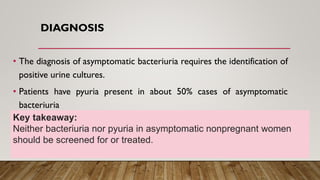
DIAGNOSIS
• The diagnosis of asymptomatic bacteriuria requires the identification of
positive urine cultures.
• Patients have pyuria present in about 50% cases of asymptomatic
bacteriuria
Key takeaway:
Neither bacteriuria nor pyuria in asymptomatic nonpregnant women
should be screened for or treated.
TREATMENT
Treatment of asymptomatic bacteriuria is
indicated in :
(1) pregnant women,
(2) adults who will undergo urinary tract surgery
(3) neutropenic patients.
STERILE PYURIA
Presence of pus in urine in absence of bacteriuria can be
caused by :
• T.B
• Fungal infection
• Sexually transmitted diseases (gonococci and
chlamydia)
PROSTATITIS
• Definition
• Prostatitis is inflammation of the prostate, most often caused by bacterial
infection.
• Pathophysiology
• Infection most frequently occurs via the urethra then into to the prostatic
ducts. However, hematogenous seeding of the prostate can occur as well.
Microabscesses may develop within the prostate.
CLINICAL MANIFESTATIONS
•Acute prostatitis may present with acute
onset of fever, dysuria, urinary frequency,
and severe pain with palpation of the
prostate.
TREATMENT OF PROSTATITIS.
•Fluoroquinolones (e.g., ciprofloxacin or
levofloxacin}

Urinary tract infection.pdf

  • 1.
    URINARY TRACT INFECTION By Dr /Eman A.Abd-Alrahman Lecturer of Microbiology and Immunology
  • 2.
    URINARYTRACT INFECTION Urinary tractinfection maybe: 1) Upper urinary tract infection • Pyelonephritis • Ureteritis 2)Lower urinary tract infection • Cystitis • Urethritis (usually caused by a sexually transmitted infection)
  • 3.
    CYSTITIS Cystitis is aninfection of the bladder. • Mode of transmission: bacteria (rarely fungi) reach the bladder via ascent through the urethra. This is much more common in women due to the short urethra and close approximation of the urethra to the vagina and anus.
  • 4.
    Risk factors forcystitis Risk factors for cystitis • Anatomic abnormalities such as cystoceles, neurologic disorders such as spinal cord injuries • The presence of foreign bodies such as indwelling Foley catheters. • Uncircumcised boys.
  • 5.
    Clinical Manifestations The mostcommon clinical manifestations of cystitis include dysuria (pain with urination); frequent, low volume urination; suprapubic tenderness; and gross hematuria. patients with cystitis do not have fever or other systemic symptoms of infection, and when they are present, an upper urinary tract infection (pyelonephritis) should be considered
  • 6.
    CAUSATIVE AGENTS ❖Escherichia coliis by far the most common cause of urinary tract infections, especially cystitis. ❖Virulence factors of uropathogenic E.coli: fimbriae(pili)organ of adhesion, alpha hemolysi (cytotoxic) and siderophore (iron binding protein)
  • 7.
    ❖Other enteric gram-negativerods such as Klebsiella species ,Proteus. And Pseudomonas aeruginosa can cause urinary tract infection, but these are most common in health care–associated infections, patients with anatomic/ neurologic abnormalities, or heavily antibiotic-experienced patients.
  • 8.
    ❖Gram-positive pathogens includeEnterococcus species and Staphylococcus saprophyticus. Staphylococcus saprophyticus is common in young women ❖Candida species ❖Rarely, viruses such as adenovirus, BK virus, and cytomegalovirus can cause a hemorrhagic cystitis. These viruses almost exclusively cause cystitis in immunocompromised hosts such as those who have undergone stem cell transplants
  • 9.
    DIAGNOSIS OF CYSTITIS Thediagnosis of cystitis requires identifying a combination of: • Pyuria : > 10 WBCs per uL of midstream urine and or positive leukocyte esterase test • plus positive urine cultures (> 105 bacteria per mL) • Plus clinical symptoms • Plus Microscopic hematuria
  • 10.
    TREATMENT OF CYSTITIS •. Empiric therapy ‫العالج‬ ‫االبتدائي‬ ‫دون‬ ‫عمل‬ ‫مزرعة‬ ‫للبول‬ ) ) in cases of uncomplicated (simple) cystitis BY trimethoprim-sulfamethoxazole, fosfomycin or nitrofurantoin. • Empiric therapy for complicated cystitis is usually with a fluoroquinolone (ciprofloxacin or levofloxacin).
  • 11.
    PYELONEPHRITIS • Definition: Pyelonephritisis an infection of the kidney(s). • Uncomplicated pyelonephritis is defined as pyelonephritis in otherwise healthy women. • Complicated pyelonephritis is pyelonephritis in all other patients.
  • 12.
    ROUTES OFTRANSMISSION OFINFECTION IN PYELONEPHRITIS • Pyelonephritis may occur either by ascension of bacteria from the urethra to the bladder and then to the kidney(s) • or, less commonly, through hematogenous spread from other sites of infection such as endocarditis.
  • 13.
    RISK FACTORS FORPYELONEPHRITIS • Renal stones • Anatomic abnormalities • vesicoureteral reflex ( ‫الحالب‬ ‫الي‬ ‫المثانه‬ ‫من‬ ‫عكسي‬ ‫اتجاه‬ ‫في‬ ‫يعاد‬ ‫البول‬ ) )
  • 14.
    Clinical Manifestations Patients withpyelonephritis typically present with • fever • flank pain • nausea, and vomiting. • They may or may not have signs and symptoms of lower tract infection (dysuria, frequency, hematuria, suprapubic tenderness).
  • 15.
    ➢Escherichia coli isthe most common pathogen causing pyelonephritis. ➢Other enteric gram-negative rods such as Klebsiella, Proteus species and Pseudomonas aeruginosa can cause pyelonephritis, but this typically occurs in health care–associated infections, patients with anatomic/neurologic abnormalities of urinary tract, or heavily antibiotic-experienced patients. • Patients with recurrent Proteus pyelonephritis should be evaluated for stones. PATHOGENS CAUSING PYELONEPHRITIS
  • 16.
    PATHOGENS CAUSING PYELONEPHRITIS •Infection of the kidney following hematogenous spread of infection can occur with essentially any organism but is seen most commonly with Staphylococcus aureus. • Hematogenous spread also occurs with Mycobacterium tuberculosis
  • 17.
    DIAGNOSIS OF PYELONEPHRITIS •Urine test findings are similar to those seen in cystitis, but urinaryWBC casts can be seen • BloodWBC counts are frequently elevated, and occasionally blood cultures can be positive. • PLUS clinical manifestations
  • 18.
    TREATMENT OF PYELONEPHRITIS •Antibiotics that are able to obtain high concentrations in the renal parenchyma and have activity against common pathogens are required to treat pyelonephritis. • Empiric regimens for community-onset infection(uncomplicated pyelonephritis) include a fluoroquinolone (ciprofloxacin or levofloxacin) or a third generation cephalosporin such as ceftriaxone.
  • 19.
    • Patients withheavy exposure to prior antibiotics, anatomic abnormalities, or exposure to the health care setting should be treated with antibiotics with reliable activity against Pseudomonas, such as cefepime, piperacillin, or meropenem. TREATMENT OF PYELONEPHRITIS
  • 20.
    ASYMPTOMATIC BACTERIURIA • Asymptomaticbacteriuria is defined as the presence of ≥1 × 10⁵ CFU/mL of a single bacterial species on two successive urine cultures in a patient without urinary tract symptoms.
  • 21.
    PATHOPHYSIOLOGY • Asymptomatic bacteriuriais common in many populations including persons with diabetes, patients with anatomic and neurologic abnormalities of the urinary tract, patients with Foley catheters, and elderly patients. • The bacteria reach the bladder via ascension through the urethra, not from hematogenous dissemination.
  • 22.
    • Patients withasymptomatic bacteriuria have NO signs or symptoms of upper or lower tract infection.
  • 23.
    PATHOGENS • The sameorganisms that commonly cause cystitis also cause asymptomatic bacteriuria. Asymptomatic candiduria can occur as well. • .
  • 24.
    DIAGNOSIS • The diagnosisof asymptomatic bacteriuria requires the identification of positive urine cultures. • Patients have pyuria present in about 50% cases of asymptomatic bacteriuria Key takeaway: Neither bacteriuria nor pyuria in asymptomatic nonpregnant women should be screened for or treated.
  • 25.
    TREATMENT Treatment of asymptomaticbacteriuria is indicated in : (1) pregnant women, (2) adults who will undergo urinary tract surgery (3) neutropenic patients.
  • 26.
    STERILE PYURIA Presence ofpus in urine in absence of bacteriuria can be caused by : • T.B • Fungal infection • Sexually transmitted diseases (gonococci and chlamydia)
  • 27.
    PROSTATITIS • Definition • Prostatitisis inflammation of the prostate, most often caused by bacterial infection. • Pathophysiology • Infection most frequently occurs via the urethra then into to the prostatic ducts. However, hematogenous seeding of the prostate can occur as well. Microabscesses may develop within the prostate.
  • 28.
    CLINICAL MANIFESTATIONS •Acute prostatitismay present with acute onset of fever, dysuria, urinary frequency, and severe pain with palpation of the prostate.
  • 29.
    TREATMENT OF PROSTATITIS. •Fluoroquinolones(e.g., ciprofloxacin or levofloxacin}