Dr Mostafa Mahmoud, MD, Ph D,
Consultant Microbiologist
Associate Prof. of Microbiology & Immunology
Faculty of Medicine, Ain Shams University
Tetanus
๏‚— Tetanus is an acute, often fatal, disease caused
by an exotoxin produced by Clostridium tetani.
๏‚— It is characterized by generalized rigidity and
convulsive spasms of skeletal muscles.
๏‚— The muscle stiffness usually involves the jaw
(lockjaw) and neck and then becomes
generalized.
๏‚— Minimal inflammation and even unnoticed
wound in most of the cases.
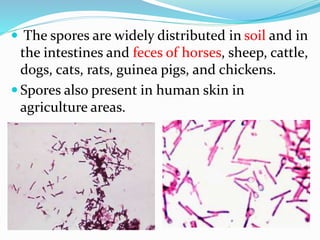
๏‚— C. tetani is a slender, gram-positive, anaerobic
rod that may develop a terminal spore, giving it
a drumstick appearance.
๏‚— The vegetative organism is sensitive to heat and
cannot survive in the presence of oxygen.
๏‚— The spores, in contrast, are very resistant to
heat and the usual antiseptics surviving
autoclaving at 121ยฐC for 10โ€“15 minutes.
๏‚— The spores are also relatively resistant to phenol
and other chemical agents.
Clostridium tetani
๏‚— The spores are widely distributed in soil and in
the intestines and feces of horses, sheep, cattle,
dogs, cats, rats, guinea pigs, and chickens.
๏‚— Spores also present in human skin in
agriculture areas.
Cl. Tetani Toxins
๏‚— 2 important toxins (tetanolysin and tetanospasmin
)are produced by vegetative organisms:-
๏‚— The function of tetanolysin is not known with
certainty.
๏‚— Tetanospasmin is a neurotoxin and causes the
clinical manifestations of tetanus.
๏‚— On the basis of weight, tetanospasmin is one of the
most potent toxins known. The human lethal dose
is 2.5 nanograms per kilogram of body (2.5 ng/Kg).
Modes of transmission:
๏‚— Contamination of wound with spores present
in soil or dust as in car accidents, in wars, and
puncture wounds e.g. gun shot.
๏‚— Postoperative tetanus occurs due to
imperfectly sterilized cat-gut.
๏‚— Contamination of uterine wound after labour
or abortion.
๏‚— Contamination of umbilical cord stump in the
newly born (tetanus neonatorum).
Pathogenesis:
๏‚— C. tetani usually enters body through a wound.
๏‚— In the presence of anaerobic conditions, the
spores germinate and produce toxins.
๏‚— Toxins disseminated via blood and lymphatics.
๏‚— Toxins act at CNS sites including peripheral
motor end plates, spinal cord, and brain, and in
the sympathetic nervous system.
๏‚— The toxin interferes with the release of inhibitor
neurotransmitters, Leading to muscle
contraction and spasm.
Clinical Picture
1. Incubation period ranges from 3 to 21 days,
(average 8 days) depending upon site from
CNS.
2. The shorter the incubation period, the higher
the chance of death.
3. In neonatal tetanus, symptoms usually appear
from 4 to 14 days after birth, (averaging 7
days).
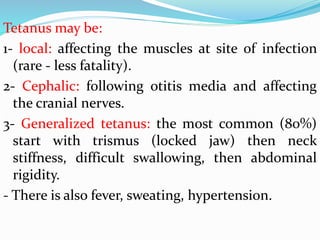
Tetanus may be:
1- local: affecting the muscles at site of infection
(rare - less fatality).
2- Cephalic: following otitis media and affecting
the cranial nerves.
3- Generalized tetanus: the most common (80%)
start with trismus (locked jaw) then neck
stiffness, difficult swallowing, then abdominal
rigidity.
- There is also fever, sweating, hypertension.
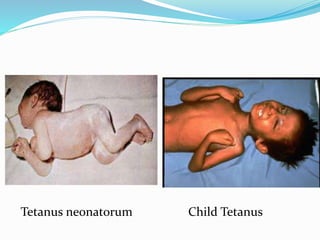
๏‚— 4- The neonatal tetanus: generalized form, in
non-immunized mother, via the umbilical cord
stump in developing countries.
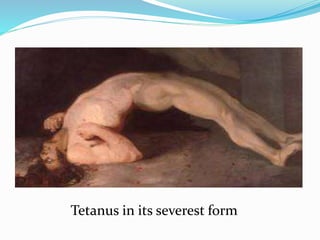
Tetanus in its severest form
Tetanus neonatorum Child Tetanus
Complications:
1- Breathing difficulties.
2- Spinal and long bone fracture.
3-Nosocomial infections due to long
hospitalization.
Laboratory Diagnosis
๏‚— There are no laboratory findings characteristic
of tetanus.
๏‚— The diagnosis is entirely clinical and does not
depend upon bacteriologic confirmation.
๏‚— C. tetani is recovered from the wound in only
30% of cases and can be isolated from patients
who do not have tetanus.
๏‚— Laboratory identification of the organism
depends most importantly on the
demonstration of toxin production in mice.
1- Sample:
Wound aspirated pus or discharge if found transported
to the lab immediately or in anaerobic transport
system.
2- Direct Gram stain: Gram-positive bacilli with
drumstick terminal spore may be seen.
3- Culture: On blood agar incubated anaerobically, or
on Robertson cooked meat medium (fluid anaerobic
medium), followed by subculture on blood agar
incubated anaerobically at 37 0C, for 48 h. The
organism produces ๏ข-hemolytic colonies (due to
production of tetanolysin); identified by Gramโ€™s
stained film, B.R and animal pathogenicity.
4- Animal pathogencity (Toxin detection):
- When a mouse is injected I.M. with isolated
organism from culture, the animal will develop
spastic paralysis starting in the tail and site of
injection and spreading to all over the body
(ascending paralysis).
- Toxin demonstration in vivo is confirmatory.
Treatment:
๏‚— Antitoxin (Drug of choice) should be given at
once in order to neutralize toxin, human or
horse antitoxin may be given (human
antitoxin 3,000-10,000 unit I.V, or horse
antitoxin 100,000 unit 1/2 I.M and 1/2 I.V.).
๏‚— Penicillin or metronidazole.
๏‚— Removal of necrotic debris from wound.
Prophylaxis: (better than cure)
๏‚— Active immunization: Alum precipitated
tetanus toxoid; given in combination with
diphtheria toxoid and pertussis vaccine (DPT). 3
I.M. doses at 2, 4, and 6 months of age, booster
dose is recommended every 10 years.
- Booster dose to pregnant women can be given to
guard against neonatal tetanus.
๏‚— Passive immunization: tetanus antitoxin; to
wounded persons without previous history of
vaccination. 250-500 units of human serum or
1500-5000 units horse serum I.M. give protection
for 2-4 weeks.
Thank you

Tetanus

  • 1.
    Dr Mostafa Mahmoud,MD, Ph D, Consultant Microbiologist Associate Prof. of Microbiology & Immunology Faculty of Medicine, Ain Shams University
  • 2.
    Tetanus ๏‚— Tetanus isan acute, often fatal, disease caused by an exotoxin produced by Clostridium tetani. ๏‚— It is characterized by generalized rigidity and convulsive spasms of skeletal muscles. ๏‚— The muscle stiffness usually involves the jaw (lockjaw) and neck and then becomes generalized. ๏‚— Minimal inflammation and even unnoticed wound in most of the cases.
  • 3.
    ๏‚— C. tetaniis a slender, gram-positive, anaerobic rod that may develop a terminal spore, giving it a drumstick appearance. ๏‚— The vegetative organism is sensitive to heat and cannot survive in the presence of oxygen. ๏‚— The spores, in contrast, are very resistant to heat and the usual antiseptics surviving autoclaving at 121ยฐC for 10โ€“15 minutes. ๏‚— The spores are also relatively resistant to phenol and other chemical agents. Clostridium tetani
  • 4.
    ๏‚— The sporesare widely distributed in soil and in the intestines and feces of horses, sheep, cattle, dogs, cats, rats, guinea pigs, and chickens. ๏‚— Spores also present in human skin in agriculture areas.
  • 5.
    Cl. Tetani Toxins ๏‚—2 important toxins (tetanolysin and tetanospasmin )are produced by vegetative organisms:- ๏‚— The function of tetanolysin is not known with certainty. ๏‚— Tetanospasmin is a neurotoxin and causes the clinical manifestations of tetanus. ๏‚— On the basis of weight, tetanospasmin is one of the most potent toxins known. The human lethal dose is 2.5 nanograms per kilogram of body (2.5 ng/Kg).
  • 6.
    Modes of transmission: ๏‚—Contamination of wound with spores present in soil or dust as in car accidents, in wars, and puncture wounds e.g. gun shot. ๏‚— Postoperative tetanus occurs due to imperfectly sterilized cat-gut. ๏‚— Contamination of uterine wound after labour or abortion. ๏‚— Contamination of umbilical cord stump in the newly born (tetanus neonatorum).
  • 7.
    Pathogenesis: ๏‚— C. tetaniusually enters body through a wound. ๏‚— In the presence of anaerobic conditions, the spores germinate and produce toxins. ๏‚— Toxins disseminated via blood and lymphatics. ๏‚— Toxins act at CNS sites including peripheral motor end plates, spinal cord, and brain, and in the sympathetic nervous system. ๏‚— The toxin interferes with the release of inhibitor neurotransmitters, Leading to muscle contraction and spasm.
  • 8.
    Clinical Picture 1. Incubationperiod ranges from 3 to 21 days, (average 8 days) depending upon site from CNS. 2. The shorter the incubation period, the higher the chance of death. 3. In neonatal tetanus, symptoms usually appear from 4 to 14 days after birth, (averaging 7 days).
  • 9.
    Tetanus may be: 1-local: affecting the muscles at site of infection (rare - less fatality). 2- Cephalic: following otitis media and affecting the cranial nerves. 3- Generalized tetanus: the most common (80%) start with trismus (locked jaw) then neck stiffness, difficult swallowing, then abdominal rigidity. - There is also fever, sweating, hypertension.
  • 10.
    ๏‚— 4- Theneonatal tetanus: generalized form, in non-immunized mother, via the umbilical cord stump in developing countries.
  • 11.
    Tetanus in itsseverest form
  • 12.
  • 13.
    Complications: 1- Breathing difficulties. 2-Spinal and long bone fracture. 3-Nosocomial infections due to long hospitalization.
  • 14.
    Laboratory Diagnosis ๏‚— Thereare no laboratory findings characteristic of tetanus. ๏‚— The diagnosis is entirely clinical and does not depend upon bacteriologic confirmation. ๏‚— C. tetani is recovered from the wound in only 30% of cases and can be isolated from patients who do not have tetanus. ๏‚— Laboratory identification of the organism depends most importantly on the demonstration of toxin production in mice.
  • 15.
    1- Sample: Wound aspiratedpus or discharge if found transported to the lab immediately or in anaerobic transport system. 2- Direct Gram stain: Gram-positive bacilli with drumstick terminal spore may be seen. 3- Culture: On blood agar incubated anaerobically, or on Robertson cooked meat medium (fluid anaerobic medium), followed by subculture on blood agar incubated anaerobically at 37 0C, for 48 h. The organism produces ๏ข-hemolytic colonies (due to production of tetanolysin); identified by Gramโ€™s stained film, B.R and animal pathogenicity.
  • 16.
    4- Animal pathogencity(Toxin detection): - When a mouse is injected I.M. with isolated organism from culture, the animal will develop spastic paralysis starting in the tail and site of injection and spreading to all over the body (ascending paralysis). - Toxin demonstration in vivo is confirmatory.
  • 17.
    Treatment: ๏‚— Antitoxin (Drugof choice) should be given at once in order to neutralize toxin, human or horse antitoxin may be given (human antitoxin 3,000-10,000 unit I.V, or horse antitoxin 100,000 unit 1/2 I.M and 1/2 I.V.). ๏‚— Penicillin or metronidazole. ๏‚— Removal of necrotic debris from wound.
  • 18.
    Prophylaxis: (better thancure) ๏‚— Active immunization: Alum precipitated tetanus toxoid; given in combination with diphtheria toxoid and pertussis vaccine (DPT). 3 I.M. doses at 2, 4, and 6 months of age, booster dose is recommended every 10 years. - Booster dose to pregnant women can be given to guard against neonatal tetanus. ๏‚— Passive immunization: tetanus antitoxin; to wounded persons without previous history of vaccination. 250-500 units of human serum or 1500-5000 units horse serum I.M. give protection for 2-4 weeks.
  • 19.