Point Biserial Correlation 
Welcome to the Point Biserial 
Correlation Conceptual Explanation
• Point biserial correlation is an estimate of the 
coherence between two variables, one of which is 
dichotomous and one of which is continuous.
• Point biserial correlation is an estimate of the 
coherence between two variables, one of which is 
dichotomous and one of which is continuous. 
Coherence means how much the 
two variables covary.
• Let’s look at an example of two variables cohering
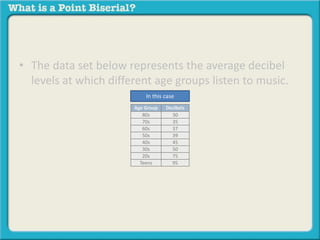
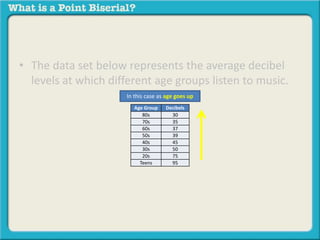
• The data set below represents the average decibel 
levels at which different age groups listen to music.
• The data set below represents the average decibel 
levels at which different age groups listen to music. 
Age Group Decibels 
80s 30 
70s 35 
60s 37 
50s 39 
40s 45 
30s 50 
20s 75 
Teens 95
• The data set below represents the average decibel 
levels at which different age groups listen to music. 
Age Group Decibels 
80s 30 
70s 35 
60s 37 
50s 39 
40s 45 
30s 50 
20s 75 
Teens 95 
The reason these two variables (age group and 
decibel level) cohere is because as one increases 
the other either increases or decreases 
commensurately.
• The data set below represents the average decibel 
levels at which different age groups listen to music. 
In this case 
Age Group Decibels 
80s 30 
70s 35 
60s 37 
50s 39 
40s 45 
30s 50 
20s 75 
Teens 95
• The data set below represents the average decibel 
levels at which different age groups listen to music. 
In this case as age goes up 
Age Group Decibels 
80s 30 
70s 35 
60s 37 
50s 39 
40s 45 
30s 50 
20s 75 
Teens 95
• The data set below represents the average decibel 
levels at which different age groups listen to music. 
In this case as age goes up 
Age Group Decibels 
80s 30 
70s 35 
60s 37 
50s 39 
40s 45 
30s 50 
20s 75 
Teens 95
• The data set below represents the average decibel 
levels at which different age groups listen to music. 
In this case as age goes up, decibels go down 
Age Group Decibels 
80s 30 
70s 35 
60s 37 
50s 39 
40s 45 
30s 50 
20s 75 
Teens 95
• The data set below represents the average decibel 
levels at which different age groups listen to music. 
In this case as age goes up, decibels go down 
Age Group Decibels 
80s 30 
70s 35 
60s 37 
50s 39 
40s 45 
30s 50 
20s 75 
Teens 95
• The data set below represents the average decibel 
levels at which different age groups listen to music. 
In this case as age goes up, decibels go down 
Age Group Decibels 
80s 30 
70s 35 
60s 37 
50s 39 
40s 45 
30s 50 
20s 75 
Teens 95 
• This is called a negative relationship.
• It is called a negative correlation or coherence, 
because when one variable increases, the other 
decreases (or vice-a-versa)
• A positive correlation would occur when as one 
variable increases, the other increases or when one 
decreases the other decreases.
• A positive correlation would occur when as one 
variable increases, the other increases or when one 
decreases the other decreases.
• A positive correlation would occur when as one 
variable increases, the other increases or when one 
decreases the other decreases. 
• Example
• A positive correlation would occur when as one 
variable increases, the other increases or when one 
decreases the other decreases. 
• Example 
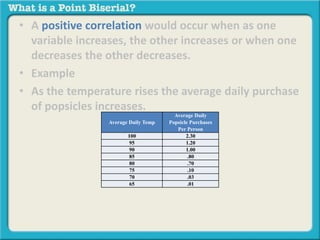
• As the temperature rises the average daily purchase 
of popsicles increases.
• A positive correlation would occur when as one 
variable increases, the other increases or when one 
decreases the other decreases. 
• Example 
• As the temperature rises the average daily purchase 
of popsicles increases. 
Average Daily Temp 
Average Daily 
Popsicle Purchases 
Per Person 
100 2.30 
95 1.20 
90 1.00 
85 .80 
80 .70 
75 .10 
70 .03 
65 .01
• A positive correlation would occur when as one 
variable increases, the other increases or when one 
decreases the other decreases. 
• Example 
• As the temperature rises the average daily purchase 
of popsicles increases. 
Average Daily Temp 
Average Daily 
Popsicle Purchases 
Per Person 
100 2.30 
95 1.20 
90 1.00 
85 .80 
80 .70 
75 .10 
70 .03 
65 .01
• A positive correlation would occur when as one 
variable increases, the other increases or when one 
decreases the other decreases. 
• Example 
• As the temperature rises the average daily purchase 
of popsicles increases. 
Average Daily Temp 
Average Daily 
Popsicle Purchases 
Per Person 
100 2.30 
95 1.20 
90 1.00 
85 .80 
80 .70 
75 .10 
70 .03 
65 .01 
• These variables are positively correlated because as 
one variable (Daily Temp) increases another variable 
(average daily popsicle purchase) increases.
• It can be stated another way:
• It can be stated another way: 
• As the average daily temperature decreases the 
average daily popsicle purchases decrease as well.
• It can be stated another way: 
• As the average daily temperature decreases the 
average daily popsicle purchases decrease as well. 
Average Daily Temp 
Average Daily 
Popsicle Purchases 
Per Person 
100 2.30 
95 1.20 
90 1.00 
85 .80 
80 .70 
75 .10 
70 .03 
65 .01
• It can be stated another way: 
• As the average daily temperature decreases the 
average daily popsicle purchases decrease as well. 
Average Daily Temp 
Average Daily 
Popsicle Purchases 
Per Person 
100 2.30 
95 1.20 
90 1.00 
85 .80 
80 .70 
75 .10 
70 .03 
65 .01
• It can be stated another way: 
• As the average daily temperature decreases the 
average daily popsicle purchases decrease as well. 
Average Daily Temp 
Average Daily 
Popsicle Purchases 
Per Person 
100 2.30 
95 1.20 
90 1.00 
85 .80 
80 .70 
75 .10 
70 .03 
65 .01 
• These variables are also positively correlated 
because as one variable (Daily Temp) decreases 
another variable (average daily popsicle purchase) 
decreases.
• Let’s return to our Point Biserial Correlation 
definition:
• Let’s return to our Point Biserial Correlation 
definition: 
• “Point biserial correlation is an estimate of the 
coherence between two variables, one of which is 
dichotomous and one of which is continuous.”
• Let’s return to our Point Biserial Correlation 
definition: 
• “Point biserial correlation is an estimate of the 
coherence between two variables, one of which is 
dichotomous and one of which is continuous.” 
We discussed coherence
• Let’s return to our Point Biserial Correlation 
definition: 
• “Point biserial correlation is an estimate of the 
coherence between two variables, one of which is 
dichotomous and one of which is continuous.” 
But, what is a dichotomous 
variable?
• A dichotomous variable is a variable that can only be 
one thing or another.
• A dichotomous variable is a variable that can only be 
one thing or another. 
• Here are some examples:
• A dichotomous variable is a variable that can only be 
one thing or another. 
• Here are some examples: 
– When you can only answer “Yes” or “No”
• A dichotomous variable is a variable that can only be 
one thing or another. 
• Here are some examples: 
– When you can only answer “Yes” or “No” 
– When your statement can only be categorized as “Fact” or “Opinion”
• A dichotomous variable is a variable that can only be 
one thing or another. 
• Here are some examples: 
– When you can only answer “Yes” or “No” 
– When your statement can only be categorized as “Fact” or “Opinion” 
– When you are either are something or you are not “Catholic” or “Not 
Catholic”
• The dichotomous variable may be naturally occurring 
as in gender
• The dichotomous variable may be naturally occurring 
as in gender
• The dichotomous variable may be naturally occurring 
as in gender 
• or may be arbitrarily dichotomized as in 
depressed/not depressed.
• The dichotomous variable may be naturally occurring 
as in gender 
• or may be arbitrarily dichotomized as in 
depressed/not depressed.
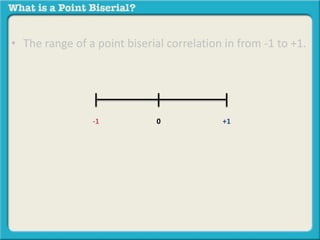
• The range of a point biserial correlation in from -1 to +1.
• The range of a point biserial correlation in from -1 to +1. 
-1 0 +1
• Let’s return again to our Point Biserial Correlation 
definition:
• Let’s return again to our Point Biserial Correlation 
definition: 
• “Point biserial correlation is an estimate of the 
coherence between two variables, one of which is 
dichotomous and one of which is continuous.”
• Let’s return again to our Point Biserial Correlation 
definition: 
• “Point biserial correlation is an estimate of the 
coherence between two variables, one of which is 
dichotomous and one of which is continuous.”
• Let’s return again to our Point Biserial Correlation 
definition: 
• “Point biserial correlation is an estimate of the 
coherence between two variables, one of which is 
dichotomous and one of which is continuous.” 
So, we now know what a 
dichotomous variable is 
(either / or)
• Let’s return again to our Point Biserial Correlation 
definition: 
• “Point biserial correlation is an estimate of the 
coherence between two variables, one of which is 
dichotomous and one of which is continuous.”
• Let’s return again to our Point Biserial Correlation 
definition: 
• “Point biserial correlation is an estimate of the 
coherence between two variables, one of which is 
dichotomous and one of which is continuous.” 
What is a continuous 
variable?
• Definition of Continuous Variable:
• Definition of Continuous Variable: 
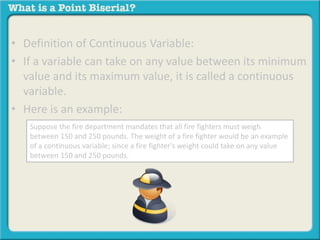
• If a variable can take on any value between its minimum 
value and its maximum value, it is called a continuous 
variable.
• Definition of Continuous Variable: 
• If a variable can take on any value between its minimum 
value and its maximum value, it is called a continuous 
variable. 
• Here is an example:
• Definition of Continuous Variable: 
• If a variable can take on any value between its minimum 
value and its maximum value, it is called a continuous 
variable. 
• Here is an example: 
Suppose the fire department mandates that all fire fighters must weigh 
between 150 and 250 pounds. The weight of a fire fighter would be an example 
of a continuous variable; since a fire fighter's weight could take on any value 
between 150 and 250 pounds.
• Definition of Continuous Variable: 
• If a variable can take on any value between its minimum 
value and its maximum value, it is called a continuous 
variable. 
• Here is an example: 
Suppose the fire department mandates that all fire fighters must weigh 
between 150 and 250 pounds. The weight of a fire fighter would be an example 
of a continuous variable; since a fire fighter's weight could take on any value 
between 150 and 250 pounds.
• The direction of the correlation depends on how the 
variables are coded.
• The direction of the correlation depends on how the 
variables are coded. 
• Let’s say we are comparing the shame scores 
(continuous variable from 1-10) and whether someone 
is depressed or not (dichotomous variable – not 
depressed = 1 and depressed = 2). .
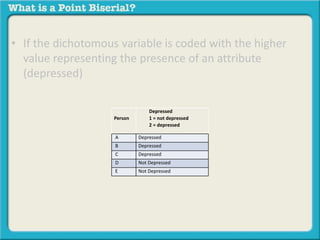
• If the dichotomous variable is coded with the higher 
value representing the presence of an attribute 
(depressed)
• If the dichotomous variable is coded with the higher 
value representing the presence of an attribute 
(depressed) 
Person 
Depressed 
1 = not depressed 
2 = depressed 
A 
B 
C 
D 
E
• If the dichotomous variable is coded with the higher 
value representing the presence of an attribute 
(depressed) 
Person 
Depressed 
1 = not depressed 
2 = depressed 
A Depressed 
B Depressed 
C Depressed 
D Not Depressed 
E Not Depressed
• If the dichotomous variable is coded with the higher 
value representing the presence of an attribute 
(depressed) 
Person 
Depressed 
1 = not depressed 
2 = depressed 
A 2 
B 2 
C 2 
D 1 
E 1
• . . . and the continuous variable is coded with higher 
values representing the increasing presence of an 
attribute (shame),
• . . . and the continuous variable is coded with higher 
values representing the increasing presence of an 
attribute (shame), 
Person 
Depressed 
1 = not depressed 
2 = depressed 
Amount of Shame 
A 2 10 
B 2 9 
C 2 10 
D 1 2 
E 1 2
• . . . and the continuous variable is coded with higher 
values representing the increasing presence of an 
attribute (shame), 
Person 
Depressed 
1 = not depressed 
2 = depressed 
Amount of Shame 
A 2 10 
B 2 9 
C 2 10 
D 1 2 
E 1 2 
• then positive values of the point-biserial would indicate 
higher shame associated with depressed status. In this 
case we would compute a phi-coefficient of +.99
• . . . and the continuous variable is coded with higher 
values representing the increasing presence of an 
attribute (shame), 
Person 
Depressed 
1 = not depressed 
2 = depressed 
Amount of Shame 
A 2 10 
B 2 9 
C 2 10 
D 1 2 
E 1 2 
• then positive values of the point-biserial would indicate 
higher shame associated with depressed status. In this 
case we would compute a Point Biserial of +.99
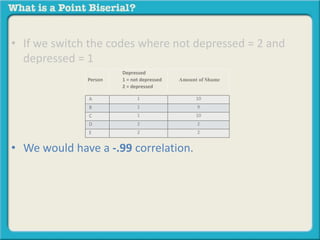
• If we switch the codes where not depressed = 2 and 
depressed = 1
• If we switch the codes where not depressed = 2 and 
depressed = 1 
Person 
Depressed 
1 = not depressed 
2 = depressed 
Amount of Shame 
A 1 10 
B 1 9 
C 1 10 
D 2 2 
E 2 2
• If we switch the codes where not depressed = 2 and 
depressed = 1 
Person 
Depressed 
1 = not depressed 
2 = depressed 
Amount of Shame 
A 1 10 
B 1 9 
C 1 10 
D 2 2 
E 2 2 
• We would have a -.99 correlation.
• If we switch the codes where not depressed = 2 and 
depressed = 1 
Person 
Depressed 
1 = not depressed 
2 = depressed 
Amount of Shame 
A 1 10 
B 1 9 
C 1 10 
D 2 2 
E 2 2 
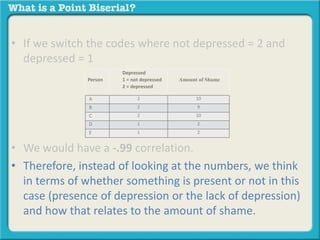
• We would have a -.99 correlation.
• If we switch the codes where not depressed = 2 and 
depressed = 1 
Person 
Depressed 
1 = not depressed 
2 = depressed 
Amount of Shame 
A 2 10 
B 2 9 
C 2 10 
D 1 2 
E 1 2 
• We would have a -.99 correlation. 
• Therefore, instead of looking at the numbers, we think 
in terms of whether something is present or not in this 
case (presence of depression or the lack of depression) 
and how that relates to the amount of shame.
• The strength of the association can be tested against 
chance just as the Pearson Product Moment Correlation 
Coefficient.

Point biserial correlation

  • 1.
    Point Biserial Correlation Welcome to the Point Biserial Correlation Conceptual Explanation
  • 2.
    • Point biserialcorrelation is an estimate of the coherence between two variables, one of which is dichotomous and one of which is continuous.
  • 3.
    • Point biserialcorrelation is an estimate of the coherence between two variables, one of which is dichotomous and one of which is continuous. Coherence means how much the two variables covary.
  • 4.
    • Let’s lookat an example of two variables cohering
  • 5.
    • The dataset below represents the average decibel levels at which different age groups listen to music.
  • 6.
    • The dataset below represents the average decibel levels at which different age groups listen to music. Age Group Decibels 80s 30 70s 35 60s 37 50s 39 40s 45 30s 50 20s 75 Teens 95
  • 7.
    • The dataset below represents the average decibel levels at which different age groups listen to music. Age Group Decibels 80s 30 70s 35 60s 37 50s 39 40s 45 30s 50 20s 75 Teens 95 The reason these two variables (age group and decibel level) cohere is because as one increases the other either increases or decreases commensurately.
  • 8.
    • The dataset below represents the average decibel levels at which different age groups listen to music. In this case Age Group Decibels 80s 30 70s 35 60s 37 50s 39 40s 45 30s 50 20s 75 Teens 95
  • 9.
    • The dataset below represents the average decibel levels at which different age groups listen to music. In this case as age goes up Age Group Decibels 80s 30 70s 35 60s 37 50s 39 40s 45 30s 50 20s 75 Teens 95
  • 10.
    • The dataset below represents the average decibel levels at which different age groups listen to music. In this case as age goes up Age Group Decibels 80s 30 70s 35 60s 37 50s 39 40s 45 30s 50 20s 75 Teens 95
  • 11.
    • The dataset below represents the average decibel levels at which different age groups listen to music. In this case as age goes up, decibels go down Age Group Decibels 80s 30 70s 35 60s 37 50s 39 40s 45 30s 50 20s 75 Teens 95
  • 12.
    • The dataset below represents the average decibel levels at which different age groups listen to music. In this case as age goes up, decibels go down Age Group Decibels 80s 30 70s 35 60s 37 50s 39 40s 45 30s 50 20s 75 Teens 95
  • 13.
    • The dataset below represents the average decibel levels at which different age groups listen to music. In this case as age goes up, decibels go down Age Group Decibels 80s 30 70s 35 60s 37 50s 39 40s 45 30s 50 20s 75 Teens 95 • This is called a negative relationship.
  • 14.
    • It iscalled a negative correlation or coherence, because when one variable increases, the other decreases (or vice-a-versa)
  • 15.
    • A positivecorrelation would occur when as one variable increases, the other increases or when one decreases the other decreases.
  • 16.
    • A positivecorrelation would occur when as one variable increases, the other increases or when one decreases the other decreases.
  • 17.
    • A positivecorrelation would occur when as one variable increases, the other increases or when one decreases the other decreases. • Example
  • 18.
    • A positivecorrelation would occur when as one variable increases, the other increases or when one decreases the other decreases. • Example • As the temperature rises the average daily purchase of popsicles increases.
  • 19.
    • A positivecorrelation would occur when as one variable increases, the other increases or when one decreases the other decreases. • Example • As the temperature rises the average daily purchase of popsicles increases. Average Daily Temp Average Daily Popsicle Purchases Per Person 100 2.30 95 1.20 90 1.00 85 .80 80 .70 75 .10 70 .03 65 .01
  • 20.
    • A positivecorrelation would occur when as one variable increases, the other increases or when one decreases the other decreases. • Example • As the temperature rises the average daily purchase of popsicles increases. Average Daily Temp Average Daily Popsicle Purchases Per Person 100 2.30 95 1.20 90 1.00 85 .80 80 .70 75 .10 70 .03 65 .01
  • 21.
    • A positivecorrelation would occur when as one variable increases, the other increases or when one decreases the other decreases. • Example • As the temperature rises the average daily purchase of popsicles increases. Average Daily Temp Average Daily Popsicle Purchases Per Person 100 2.30 95 1.20 90 1.00 85 .80 80 .70 75 .10 70 .03 65 .01 • These variables are positively correlated because as one variable (Daily Temp) increases another variable (average daily popsicle purchase) increases.
  • 22.
    • It canbe stated another way:
  • 23.
    • It canbe stated another way: • As the average daily temperature decreases the average daily popsicle purchases decrease as well.
  • 24.
    • It canbe stated another way: • As the average daily temperature decreases the average daily popsicle purchases decrease as well. Average Daily Temp Average Daily Popsicle Purchases Per Person 100 2.30 95 1.20 90 1.00 85 .80 80 .70 75 .10 70 .03 65 .01
  • 25.
    • It canbe stated another way: • As the average daily temperature decreases the average daily popsicle purchases decrease as well. Average Daily Temp Average Daily Popsicle Purchases Per Person 100 2.30 95 1.20 90 1.00 85 .80 80 .70 75 .10 70 .03 65 .01
  • 26.
    • It canbe stated another way: • As the average daily temperature decreases the average daily popsicle purchases decrease as well. Average Daily Temp Average Daily Popsicle Purchases Per Person 100 2.30 95 1.20 90 1.00 85 .80 80 .70 75 .10 70 .03 65 .01 • These variables are also positively correlated because as one variable (Daily Temp) decreases another variable (average daily popsicle purchase) decreases.
  • 27.
    • Let’s returnto our Point Biserial Correlation definition:
  • 28.
    • Let’s returnto our Point Biserial Correlation definition: • “Point biserial correlation is an estimate of the coherence between two variables, one of which is dichotomous and one of which is continuous.”
  • 29.
    • Let’s returnto our Point Biserial Correlation definition: • “Point biserial correlation is an estimate of the coherence between two variables, one of which is dichotomous and one of which is continuous.” We discussed coherence
  • 30.
    • Let’s returnto our Point Biserial Correlation definition: • “Point biserial correlation is an estimate of the coherence between two variables, one of which is dichotomous and one of which is continuous.” But, what is a dichotomous variable?
  • 31.
    • A dichotomousvariable is a variable that can only be one thing or another.
  • 32.
    • A dichotomousvariable is a variable that can only be one thing or another. • Here are some examples:
  • 33.
    • A dichotomousvariable is a variable that can only be one thing or another. • Here are some examples: – When you can only answer “Yes” or “No”
  • 34.
    • A dichotomousvariable is a variable that can only be one thing or another. • Here are some examples: – When you can only answer “Yes” or “No” – When your statement can only be categorized as “Fact” or “Opinion”
  • 35.
    • A dichotomousvariable is a variable that can only be one thing or another. • Here are some examples: – When you can only answer “Yes” or “No” – When your statement can only be categorized as “Fact” or “Opinion” – When you are either are something or you are not “Catholic” or “Not Catholic”
  • 36.
    • The dichotomousvariable may be naturally occurring as in gender
  • 37.
    • The dichotomousvariable may be naturally occurring as in gender
  • 38.
    • The dichotomousvariable may be naturally occurring as in gender • or may be arbitrarily dichotomized as in depressed/not depressed.
  • 39.
    • The dichotomousvariable may be naturally occurring as in gender • or may be arbitrarily dichotomized as in depressed/not depressed.
  • 40.
    • The rangeof a point biserial correlation in from -1 to +1.
  • 41.
    • The rangeof a point biserial correlation in from -1 to +1. -1 0 +1
  • 42.
    • Let’s returnagain to our Point Biserial Correlation definition:
  • 43.
    • Let’s returnagain to our Point Biserial Correlation definition: • “Point biserial correlation is an estimate of the coherence between two variables, one of which is dichotomous and one of which is continuous.”
  • 44.
    • Let’s returnagain to our Point Biserial Correlation definition: • “Point biserial correlation is an estimate of the coherence between two variables, one of which is dichotomous and one of which is continuous.”
  • 45.
    • Let’s returnagain to our Point Biserial Correlation definition: • “Point biserial correlation is an estimate of the coherence between two variables, one of which is dichotomous and one of which is continuous.” So, we now know what a dichotomous variable is (either / or)
  • 46.
    • Let’s returnagain to our Point Biserial Correlation definition: • “Point biserial correlation is an estimate of the coherence between two variables, one of which is dichotomous and one of which is continuous.”
  • 47.
    • Let’s returnagain to our Point Biserial Correlation definition: • “Point biserial correlation is an estimate of the coherence between two variables, one of which is dichotomous and one of which is continuous.” What is a continuous variable?
  • 48.
    • Definition ofContinuous Variable:
  • 49.
    • Definition ofContinuous Variable: • If a variable can take on any value between its minimum value and its maximum value, it is called a continuous variable.
  • 50.
    • Definition ofContinuous Variable: • If a variable can take on any value between its minimum value and its maximum value, it is called a continuous variable. • Here is an example:
  • 51.
    • Definition ofContinuous Variable: • If a variable can take on any value between its minimum value and its maximum value, it is called a continuous variable. • Here is an example: Suppose the fire department mandates that all fire fighters must weigh between 150 and 250 pounds. The weight of a fire fighter would be an example of a continuous variable; since a fire fighter's weight could take on any value between 150 and 250 pounds.
  • 52.
    • Definition ofContinuous Variable: • If a variable can take on any value between its minimum value and its maximum value, it is called a continuous variable. • Here is an example: Suppose the fire department mandates that all fire fighters must weigh between 150 and 250 pounds. The weight of a fire fighter would be an example of a continuous variable; since a fire fighter's weight could take on any value between 150 and 250 pounds.
  • 53.
    • The directionof the correlation depends on how the variables are coded.
  • 54.
    • The directionof the correlation depends on how the variables are coded. • Let’s say we are comparing the shame scores (continuous variable from 1-10) and whether someone is depressed or not (dichotomous variable – not depressed = 1 and depressed = 2). .
  • 55.
    • If thedichotomous variable is coded with the higher value representing the presence of an attribute (depressed)
  • 56.
    • If thedichotomous variable is coded with the higher value representing the presence of an attribute (depressed) Person Depressed 1 = not depressed 2 = depressed A B C D E
  • 57.
    • If thedichotomous variable is coded with the higher value representing the presence of an attribute (depressed) Person Depressed 1 = not depressed 2 = depressed A Depressed B Depressed C Depressed D Not Depressed E Not Depressed
  • 58.
    • If thedichotomous variable is coded with the higher value representing the presence of an attribute (depressed) Person Depressed 1 = not depressed 2 = depressed A 2 B 2 C 2 D 1 E 1
  • 59.
    • . .. and the continuous variable is coded with higher values representing the increasing presence of an attribute (shame),
  • 60.
    • . .. and the continuous variable is coded with higher values representing the increasing presence of an attribute (shame), Person Depressed 1 = not depressed 2 = depressed Amount of Shame A 2 10 B 2 9 C 2 10 D 1 2 E 1 2
  • 61.
    • . .. and the continuous variable is coded with higher values representing the increasing presence of an attribute (shame), Person Depressed 1 = not depressed 2 = depressed Amount of Shame A 2 10 B 2 9 C 2 10 D 1 2 E 1 2 • then positive values of the point-biserial would indicate higher shame associated with depressed status. In this case we would compute a phi-coefficient of +.99
  • 62.
    • . .. and the continuous variable is coded with higher values representing the increasing presence of an attribute (shame), Person Depressed 1 = not depressed 2 = depressed Amount of Shame A 2 10 B 2 9 C 2 10 D 1 2 E 1 2 • then positive values of the point-biserial would indicate higher shame associated with depressed status. In this case we would compute a Point Biserial of +.99
  • 63.
    • If weswitch the codes where not depressed = 2 and depressed = 1
  • 64.
    • If weswitch the codes where not depressed = 2 and depressed = 1 Person Depressed 1 = not depressed 2 = depressed Amount of Shame A 1 10 B 1 9 C 1 10 D 2 2 E 2 2
  • 65.
    • If weswitch the codes where not depressed = 2 and depressed = 1 Person Depressed 1 = not depressed 2 = depressed Amount of Shame A 1 10 B 1 9 C 1 10 D 2 2 E 2 2 • We would have a -.99 correlation.
  • 66.
    • If weswitch the codes where not depressed = 2 and depressed = 1 Person Depressed 1 = not depressed 2 = depressed Amount of Shame A 1 10 B 1 9 C 1 10 D 2 2 E 2 2 • We would have a -.99 correlation.
  • 67.
    • If weswitch the codes where not depressed = 2 and depressed = 1 Person Depressed 1 = not depressed 2 = depressed Amount of Shame A 2 10 B 2 9 C 2 10 D 1 2 E 1 2 • We would have a -.99 correlation. • Therefore, instead of looking at the numbers, we think in terms of whether something is present or not in this case (presence of depression or the lack of depression) and how that relates to the amount of shame.
  • 68.
    • The strengthof the association can be tested against chance just as the Pearson Product Moment Correlation Coefficient.