
Central Tendency, Spread, or Symmetry?
How many independent variables are there
in your question?
The independent variable is the thing doing
One Two or More Zero
Central Tendency, Spread, or Symmetry?
What is an independent variable?
The independent variable is the thing doing
Central Tendency, Spread, or Symmetry?
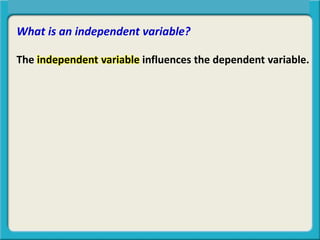
What is an independent variable?
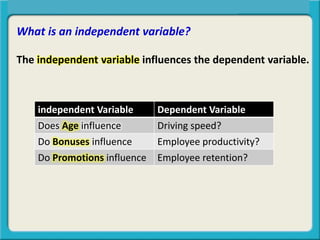
The independent variable influences the dependent variable.
Central Tendency, Spread, or Symmetry?
independent Variable Dependent Variable
Does Age influence Driving speed?
Do Bonuses influence Employee productivity?
Do Promotions influence Employee retention?
What is an independent variable?
The independent variable influences the dependent variable.
Example of a question with
ONE independent variable
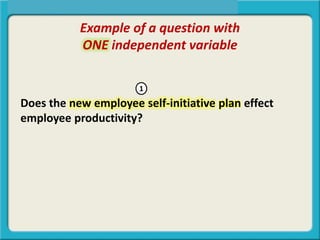
Example of a question with
ONE independent variable
Does the new employee self-initiative plan effect
employee productivity?
1
Example of a question with
TWO independent variables
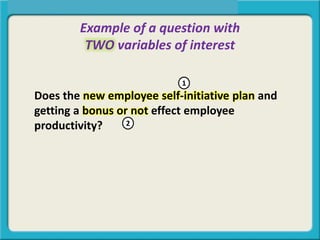
Example of a question with
TWO variables of interest
Does the new employee self-initiative plan and
getting a bonus or not effect employee
productivity?
1
2
Example of a question with
ZERO independent variables
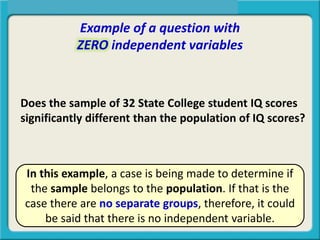
Example of a question with
ZERO independent variables
Does the sample of 32 State College student IQ scores
significantly different than the population of IQ scores?
In this example, a case is being made to determine if
the sample belongs to the population. If that is the
case there are no separate groups, therefore, it could
be said that there is no independent variable.
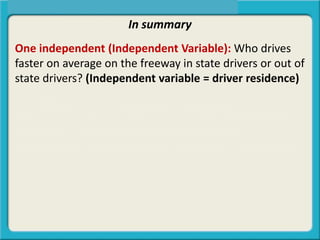
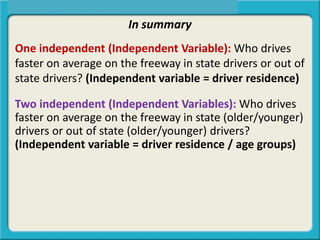
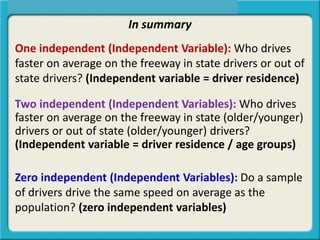
In summary
One independent (Independent Variable): Who drives
faster on average on the freeway in state drivers or out of
state drivers? (Independent variable = driver residence)
Two independent (Independent Variables): Who drives
faster on average on the freeway in state (older/younger)
drivers or out of state (older/younger) drivers?
(Independent variable = driver residence / age groups)
Zero independent (Independent Variables): Do a sample
of drivers drive the same speed on average as the
population? (zero independent variables)
In summary
One independent (Independent Variable): Who drives
faster on average on the freeway in state drivers or out of
state drivers? (Independent variable = driver residence)
Two independent (Independent Variables): Who drives
faster on average on the freeway in state (older/younger)
drivers or out of state (older/younger) drivers?
(Independent variable = driver residence / age groups)
Zero independent (Independent Variables): Do a sample
of drivers drive the same speed on average as the
population? (zero independent variables)
In summary
One independent (Independent Variable): Who drives
faster on average on the freeway in state drivers or out of
state drivers? (Independent variable = driver residence)
Two independent (Independent Variables): Who drives
faster on average on the freeway in state (older/younger)
drivers or out of state (older/younger) drivers?
(Independent variable = driver residence / age groups)
Zero independent (Independent Variables): Do a sample
of drivers drive the same speed on average as the
population? (zero independent variables)
Let’s Practice!
How many independent variables are there in
each question that follows?
One Two or More
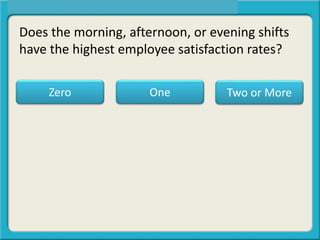
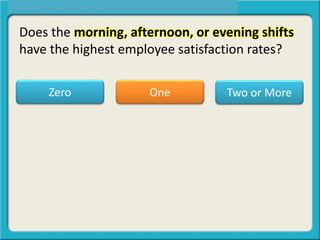
Does the morning, afternoon, or evening shifts
have the highest employee satisfaction rates?
Zero
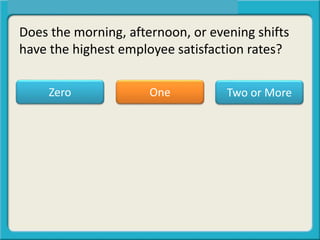
Does the morning, afternoon, or evening shifts
have the highest employee satisfaction rates?
One Two or MoreZero
Does the morning, afternoon, or evening shifts
have the highest employee satisfaction rates?
One Two or MoreZero
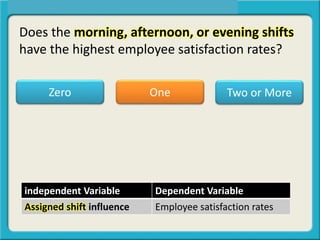
Does the morning, afternoon, or evening shifts
have the highest employee satisfaction rates?
independent Variable Dependent Variable
Assigned shift influence Employee satisfaction rates
One Two or MoreZero
Next Example
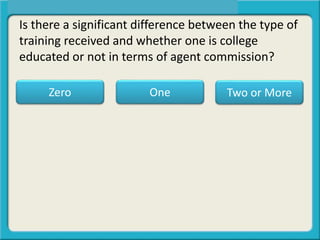
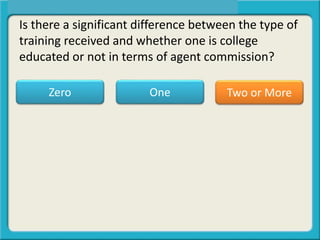
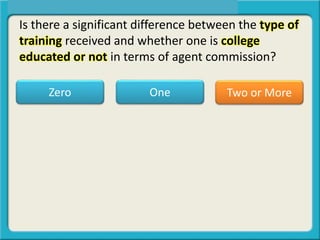
Is there a significant difference between the type of
training received and whether one is college
educated or not in terms of agent commission?
One Two or MoreZero
Is there a significant difference between the type of
training received and whether one is college
educated or not in terms of agent commission?
One Two or MoreZero
Is there a significant difference between the type of
training received and whether one is college
educated or not in terms of agent commission?
One Two or MoreZero
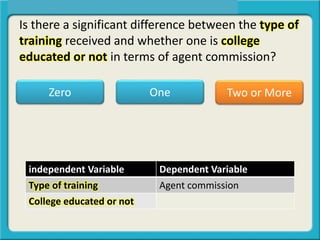
Is there a significant difference between the type of
training received and whether one is college
educated or not in terms of agent commission?
independent Variable Dependent Variable
Type of training Agent commission
College educated or not
One Two or MoreZero
Next Example
Which training method (A, B, or C) brings about
greater trainee proficiency?
One Two or MoreZero
Which training method (A, B, or C) brings about
greater trainee proficiency?
One Two or MoreZero
Which training method (A, B, or C) brings about
greater trainee proficiency?
One Two or MoreZero
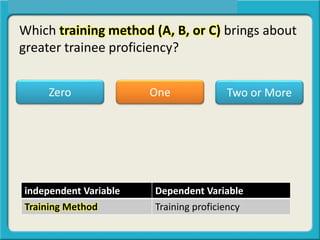
Which training method (A, B, or C) brings about
greater trainee proficiency?
independent Variable Dependent Variable
Training Method Training proficiency
One Two or MoreZero
Final Example
Does a sample of freshmen have significantly more
or less cyberbullying incidents than high school
students in general?
One Two or MoreZero
Does a sample of freshmen have significantly more
or less cyberbullying incidents than high school
students in general?
One Two or MoreZero
Does a sample of freshmen have significantly more
or less cyberbullying incidents than high school
students in general?
One Two or MoreZero
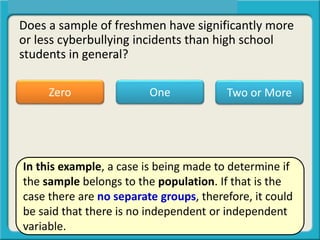
In this example, a case is being made to determine if
the sample belongs to the population. If that is the
case there are no separate groups, therefore, it could
be said that there is no independent or independent
variable.
Central Tendency, Spread, or Symmetry?
How many independent or independent
variables are there in your question?
The independent variable is the thing doing
One Two or MoreZero

Independent variables (2)

  • 1.
    Central Tendency, Spread,or Symmetry? How many independent variables are there in your question? The independent variable is the thing doing One Two or More Zero
  • 2.
    Central Tendency, Spread,or Symmetry? What is an independent variable? The independent variable is the thing doing
  • 3.
    Central Tendency, Spread,or Symmetry? What is an independent variable? The independent variable influences the dependent variable.
  • 4.
    Central Tendency, Spread,or Symmetry? independent Variable Dependent Variable Does Age influence Driving speed? Do Bonuses influence Employee productivity? Do Promotions influence Employee retention? What is an independent variable? The independent variable influences the dependent variable.
  • 5.
    Example of aquestion with ONE independent variable
  • 6.
    Example of aquestion with ONE independent variable Does the new employee self-initiative plan effect employee productivity? 1
  • 7.
    Example of aquestion with TWO independent variables
  • 8.
    Example of aquestion with TWO variables of interest Does the new employee self-initiative plan and getting a bonus or not effect employee productivity? 1 2
  • 9.
    Example of aquestion with ZERO independent variables
  • 10.
    Example of aquestion with ZERO independent variables Does the sample of 32 State College student IQ scores significantly different than the population of IQ scores? In this example, a case is being made to determine if the sample belongs to the population. If that is the case there are no separate groups, therefore, it could be said that there is no independent variable.
  • 11.
    In summary One independent(Independent Variable): Who drives faster on average on the freeway in state drivers or out of state drivers? (Independent variable = driver residence) Two independent (Independent Variables): Who drives faster on average on the freeway in state (older/younger) drivers or out of state (older/younger) drivers? (Independent variable = driver residence / age groups) Zero independent (Independent Variables): Do a sample of drivers drive the same speed on average as the population? (zero independent variables)
  • 12.
    In summary One independent(Independent Variable): Who drives faster on average on the freeway in state drivers or out of state drivers? (Independent variable = driver residence) Two independent (Independent Variables): Who drives faster on average on the freeway in state (older/younger) drivers or out of state (older/younger) drivers? (Independent variable = driver residence / age groups) Zero independent (Independent Variables): Do a sample of drivers drive the same speed on average as the population? (zero independent variables)
  • 13.
    In summary One independent(Independent Variable): Who drives faster on average on the freeway in state drivers or out of state drivers? (Independent variable = driver residence) Two independent (Independent Variables): Who drives faster on average on the freeway in state (older/younger) drivers or out of state (older/younger) drivers? (Independent variable = driver residence / age groups) Zero independent (Independent Variables): Do a sample of drivers drive the same speed on average as the population? (zero independent variables)
  • 14.
  • 15.
    How many independentvariables are there in each question that follows?
  • 16.
    One Two orMore Does the morning, afternoon, or evening shifts have the highest employee satisfaction rates? Zero
  • 17.
    Does the morning,afternoon, or evening shifts have the highest employee satisfaction rates? One Two or MoreZero
  • 18.
    Does the morning,afternoon, or evening shifts have the highest employee satisfaction rates? One Two or MoreZero
  • 19.
    Does the morning,afternoon, or evening shifts have the highest employee satisfaction rates? independent Variable Dependent Variable Assigned shift influence Employee satisfaction rates One Two or MoreZero
  • 20.
  • 21.
    Is there asignificant difference between the type of training received and whether one is college educated or not in terms of agent commission? One Two or MoreZero
  • 22.
    Is there asignificant difference between the type of training received and whether one is college educated or not in terms of agent commission? One Two or MoreZero
  • 23.
    Is there asignificant difference between the type of training received and whether one is college educated or not in terms of agent commission? One Two or MoreZero
  • 24.
    Is there asignificant difference between the type of training received and whether one is college educated or not in terms of agent commission? independent Variable Dependent Variable Type of training Agent commission College educated or not One Two or MoreZero
  • 25.
  • 26.
    Which training method(A, B, or C) brings about greater trainee proficiency? One Two or MoreZero
  • 27.
    Which training method(A, B, or C) brings about greater trainee proficiency? One Two or MoreZero
  • 28.
    Which training method(A, B, or C) brings about greater trainee proficiency? One Two or MoreZero
  • 29.
    Which training method(A, B, or C) brings about greater trainee proficiency? independent Variable Dependent Variable Training Method Training proficiency One Two or MoreZero
  • 30.
  • 31.
    Does a sampleof freshmen have significantly more or less cyberbullying incidents than high school students in general? One Two or MoreZero
  • 32.
    Does a sampleof freshmen have significantly more or less cyberbullying incidents than high school students in general? One Two or MoreZero
  • 33.
    Does a sampleof freshmen have significantly more or less cyberbullying incidents than high school students in general? One Two or MoreZero In this example, a case is being made to determine if the sample belongs to the population. If that is the case there are no separate groups, therefore, it could be said that there is no independent or independent variable.
  • 34.
    Central Tendency, Spread,or Symmetry? How many independent or independent variables are there in your question? The independent variable is the thing doing One Two or MoreZero