Parametric or Nonparametric 
Methods
This presentation is designed to help you 
determine if using parametric or non-parametric 
methods would be most appropriate with the 
relationship question you are working on.
This presentation is designed to help you 
determine if using parametric or non-parametric 
methods would be most appropriate with the 
relationship question you are working on. 
Parametric Method 
Non-Parametric Method
What are parametric methods?
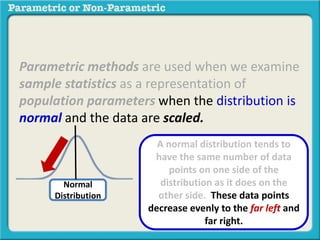
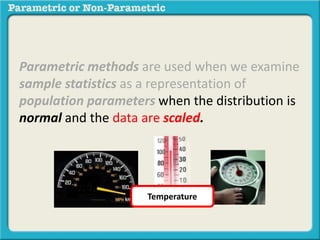
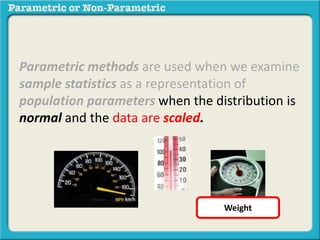
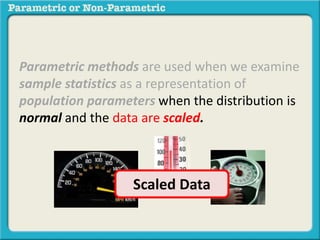
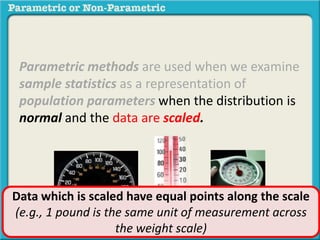
Parametric methods are used when we examine 
sample statistics
Parametric methods are used when we examine 
sample statistics as a representation of 
population parameters
Parametric methods are used when we examine 
sample statistics as a representation of 
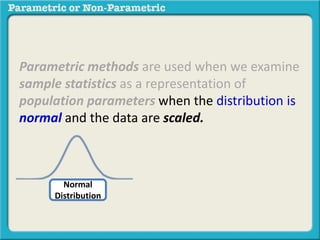
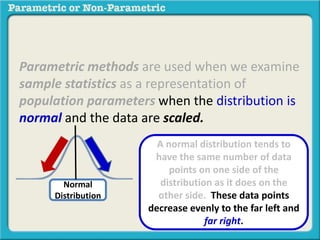
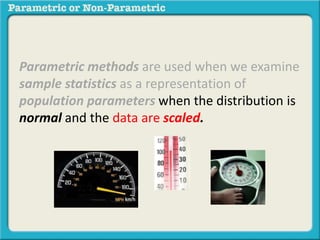
population parameters when the distribution is 
normal and the data are scaled.
Parametric methods are used when we examine 
sample statistics as a representation of 
population parameters when the distribution is 
normal and the data are scaled. 
Normal 
Distribution
Parametric methods are used when we examine 
sample statistics as a representation of 
population parameters when the distribution is 
normal and the data are scaled. 
Normal 
Distribution 
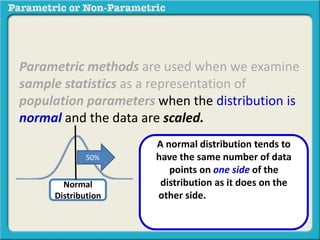
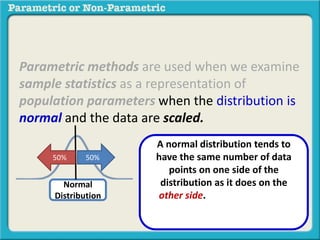
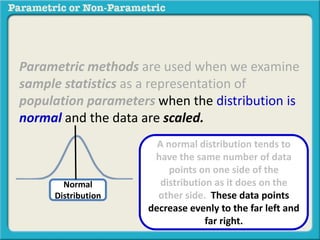
A normal distribution tends to 
have the same number of data 
points on one side of the 
distribution as it does on the 
other side. These data points 
decrease evenly to the far left and 
far right.
Parametric methods are used when we examine 
sample statistics as a representation of 
population parameters when the distribution is 
normal and the data are scaled. 
Normal 
Distribution 
A normal distribution tends to 
have the same number of data 
points on one side of the 
distribution as it does on the 
other side. These data points 
decrease evenly to the far left and 
far right. 
50%
Parametric methods are used when we examine 
sample statistics as a representation of 
population parameters when the distribution is 
normal and the data are scaled. 
Normal 
Distribution 
A normal distribution tends to 
have the same number of data 
points on one side of the 
distribution as it does on the 
other side. These data points 
decrease evenly to the far left and 
far right. 
50% 50%
Parametric methods are used when we examine 
sample statistics as a representation of 
population parameters when the distribution is 
normal and the data are scaled. 
Normal 
Distribution 
A normal distribution tends to 
have the same number of data 
points on one side of the 
distribution as it does on the 
other side. These data points 
decrease evenly to the far left and 
far right.
Parametric methods are used when we examine 
sample statistics as a representation of 
population parameters when the distribution is 
normal and the data are scaled. 
Normal 
Distribution 
A normal distribution tends to 
have the same number of data 
points on one side of the 
distribution as it does on the 
other side. These data points 
decrease evenly to the far left and 
far right.
Parametric methods are used when we examine 
sample statistics as a representation of 
population parameters when the distribution is 
normal and the data are scaled. 
Normal 
Distribution 
A normal distribution tends to 
have the same number of data 
points on one side of the 
distribution as it does on the 
other side. These data points 
decrease evenly to the far left and 
far right.
Parametric methods are used when we examine 
sample statistics as a representation of 
population parameters when the distribution is 
normal and the data are scaled.
Parametric methods are used when we examine 
sample statistics as a representation of 
population parameters when the distribution is 
normal and the data are scaled. 
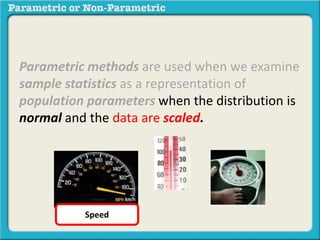
Speed
Parametric methods are used when we examine 
sample statistics as a representation of 
population parameters when the distribution is 
normal and the data are scaled. 
Temperature
Parametric methods are used when we examine 
sample statistics as a representation of 
population parameters when the distribution is 
normal and the data are scaled. 
Weight
Parametric methods are used when we examine 
sample statistics as a representation of 
population parameters when the distribution is 
normal and the data are scaled. 
Scaled Data
Parametric methods are used when we examine 
sample statistics as a representation of 
population parameters when the distribution is 
normal and the data are scaled. 
Data which is scaled have equal points along the scale 
(e.g., 1 pound is the same unit of measurement across 
the weight scale)
A parametric question that deals with 
relationships might look like this:
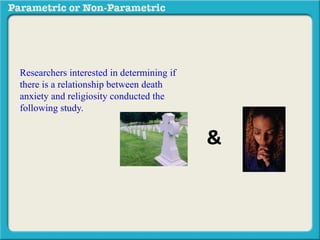
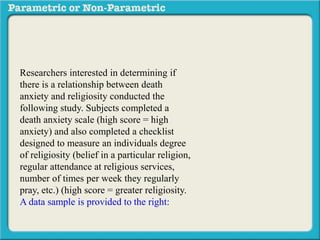
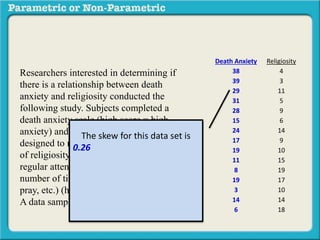
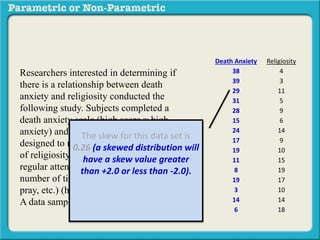
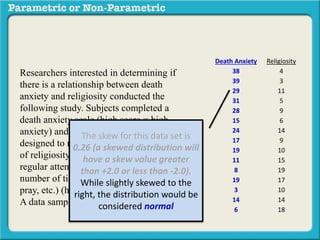
Researchers interested in determining if 
there is a relationship between death 
anxiety and religiosity conducted the 
following study. Subjects completed a 
death anxiety scale (high score = high 
anxiety) and also completed a checklist 
designed to measure an individuals degree 
of religiosity (belief in a particular religion, 
regular attendance at religious services, 
number of times per week they regularly 
pray, etc.) (high score = greater religiosity. 
A data sample is provided to the right:
Researchers interested in determining if 
there is a relationship between death 
anxiety and religiosity conducted the 
following study. Subjects completed a 
death anxiety scale (high score = high 
anxiety) and also completed a checklist 
designed to measure an individuals degree 
of religiosity (belief in a particular religion, 
regular attendance at religious services, 
number of times per week they regularly 
pray, etc.) (high score = greater religiosity. 
A data sample is provided to the right: 
&
Researchers interested in determining if 
there is a relationship between death 
anxiety and religiosity conducted the 
following study. Subjects completed a 
death anxiety scale (high score = high 
anxiety) and also completed a checklist 
designed to measure an individuals degree 
of religiosity (belief in a particular religion, 
regular attendance at religious services, 
number of times per week they regularly 
pray, etc.) (high score = greater religiosity. 
A data sample is provided to the right:
Researchers interested in determining if 
there is a relationship between death 
anxiety and religiosity conducted the 
following study. Subjects completed a 
death anxiety scale (high score = high 
anxiety) and also completed a checklist 
designed to measure an individuals degree 
of religiosity (belief in a particular religion, 
regular attendance at religious services, 
number of times per week they regularly 
pray, etc.) (high score = greater religiosity. 
A data sample is provided to the right: 
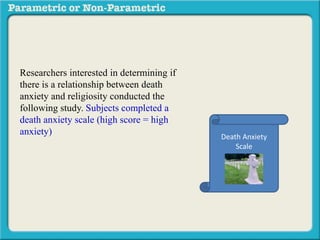
Death Anxiety 
Scale
Researchers interested in determining if 
there is a relationship between death 
anxiety and religiosity conducted the 
following study. Subjects completed a 
death anxiety scale (high score = high 
anxiety) and also completed a checklist 
designed to measure an individuals degree 
of religiosity (belief in a particular religion, 
regular attendance at religious services, 
number of times per week they regularly 
pray, etc.) (high score = greater religiosity. 
A data sample is provided to the right:
Researchers interested in determining if 
there is a relationship between death 
anxiety and religiosity conducted the 
following study. Subjects completed a 
death anxiety scale (high score = high 
anxiety) and also completed a checklist 
designed to measure an individuals degree 
of religiosity (belief in a particular religion, 
regular attendance at religious services, 
number of times per week they regularly 
pray, etc.) (high score = greater religiosity.) 
A data sample is provided to the right:
Researchers interested in determining if 
there is a relationship between death 
anxiety and religiosity conducted the 
following study. Subjects completed a 
death anxiety scale (high score = high 
anxiety) and also completed a checklist 
designed to measure an individuals degree 
of religiosity (belief in a particular religion, 
regular attendance at religious services, 
number of times per week they regularly 
pray, etc.) (high score = greater religiosity.) 
A data sample is provided to the right:
Researchers interested in determining if 
there is a relationship between death 
anxiety and religiosity conducted the 
following study. Subjects completed a 
death anxiety scale (high score = high 
anxiety) and also completed a checklist 
designed to measure an individuals degree 
of religiosity (belief in a particular religion, 
regular attendance at religious services, 
number of times per week they regularly 
pray, etc.) (high score = greater religiosity). 
A data sample is provided to the right: 
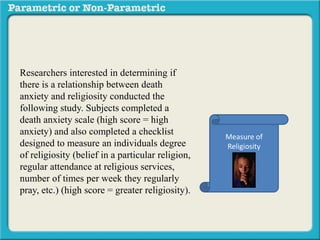
Measure of 
Religiosity
Researchers interested in determining if 
there is a relationship between death 
anxiety and religiosity conducted the 
following study. Subjects completed a 
death anxiety scale (high score = high 
anxiety) and also completed a checklist 
designed to measure an individuals degree 
of religiosity (belief in a particular religion, 
regular attendance at religious services, 
number of times per week they regularly 
pray, etc.) (high score = greater religiosity. 
A data sample is provided to the right:
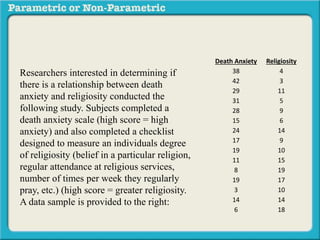
Death Anxiety Religiosity 
38 4 
42 3 
29 11 
31 5 
28 9 
15 6 
24 14 
17 9 
19 10 
11 15 
8 19 
19 17 
3 10 
14 14 
6 18 
Researchers interested in determining if 
there is a relationship between death 
anxiety and religiosity conducted the 
following study. Subjects completed a 
death anxiety scale (high score = high 
anxiety) and also completed a checklist 
designed to measure an individuals degree 
of religiosity (belief in a particular religion, 
regular attendance at religious services, 
number of times per week they regularly 
pray, etc.) (high score = greater religiosity. 
A data sample is provided to the right:
Death Anxiety Religiosity 
38 4 
42 3 
29 11 
31 5 
28 9 
15 6 
24 14 
17 9 
19 10 
11 15 
8 19 
19 17 
3 10 
14 14 
6 18 
Researchers interested in determining if 
there is a relationship between death 
anxiety and religiosity conducted the 
following study. Subjects completed a 
death anxiety scale (high score = high 
anxiety) and also completed a checklist 
designed to measure an individuals degree 
of religiosity (belief in a particular religion, 
regular attendance at religious services, 
number of times per week they regularly 
pray, etc.) (high score = greater religiosity. 
A data sample is provided to the right: 
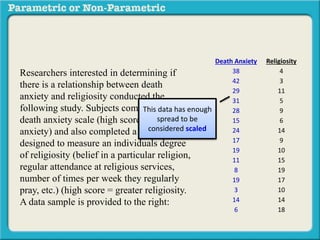
This data has enough 
spread to be 
considered scaled
Death Anxiety Religiosity 
38 4 
39 3 
29 11 
31 5 
28 9 
15 6 
24 14 
17 9 
19 10 
11 15 
8 19 
19 17 
3 10 
14 14 
6 18 
Researchers interested in determining if 
there is a relationship between death 
anxiety and religiosity conducted the 
following study. Subjects completed a 
death anxiety scale (high score = high 
anxiety) and also completed a checklist 
designed to measure an individuals degree 
of religiosity (belief in a particular religion, 
regular attendance at religious services, 
number of times per week they regularly 
pray, etc.) (high score = greater religiosity. 
A data sample is provided to the right: 
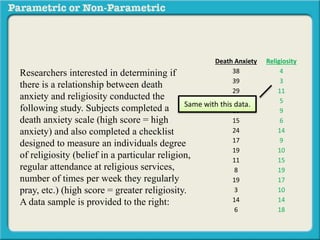
Same with this data.
Death Anxiety Religiosity 
38 4 
39 3 
29 11 
31 5 
28 9 
15 6 
24 14 
17 9 
19 10 
11 15 
8 19 
19 17 
3 10 
14 14 
6 18 
Researchers interested in determining if 
there is a relationship between death 
anxiety and religiosity conducted the 
following study. Subjects completed a 
death anxiety scale (high score = high 
anxiety) and also completed a checklist 
designed to measure an individuals degree 
of religiosity (belief in a particular religion, 
regular attendance at religious services, 
number of times per week they regularly 
pray, etc.) (high score = greater religiosity. 
A data sample is provided to the right: 
The skew for this data set is 
0.26 (a skewed distribution will 
have a skew value greater 
than +2.0 or less than -2.0). 
While slightly skewed to the 
right, the distribution would be 
considered normal
Death Anxiety Religiosity 
38 4 
39 3 
29 11 
31 5 
28 9 
15 6 
24 14 
17 9 
19 10 
11 15 
8 19 
19 17 
3 10 
14 14 
6 18 
Researchers interested in determining if 
there is a relationship between death 
anxiety and religiosity conducted the 
following study. Subjects completed a 
death anxiety scale (high score = high 
anxiety) and also completed a checklist 
designed to measure an individuals degree 
of religiosity (belief in a particular religion, 
regular attendance at religious services, 
number of times per week they regularly 
pray, etc.) (high score = greater religiosity. 
A data sample is provided to the right: 
The skew for this data set is 
0.26 (a skewed distribution will 
have a skew value greater 
than +2.0 or less than -2.0). 
While slightly skewed to the 
right, the distribution would be 
considered normal
Death Anxiety Religiosity 
38 4 
39 3 
29 11 
31 5 
28 9 
15 6 
24 14 
17 9 
19 10 
11 15 
8 19 
19 17 
3 10 
14 14 
6 18 
Researchers interested in determining if 
there is a relationship between death 
anxiety and religiosity conducted the 
following study. Subjects completed a 
death anxiety scale (high score = high 
anxiety) and also completed a checklist 
designed to measure an individuals degree 
of religiosity (belief in a particular religion, 
regular attendance at religious services, 
number of times per week they regularly 
pray, etc.) (high score = greater religiosity. 
A data sample is provided to the right: 
The skew for this data set is 
0.26 (a skewed distribution will 
have a skew value greater 
than +2.0 or less than -2.0). 
While slightly skewed to the 
right, the distribution would be 
considered normal
Death Anxiety Religiosity 
38 4 
39 3 
29 11 
31 5 
28 9 
15 6 
24 14 
17 9 
19 10 
11 15 
8 19 
19 17 
3 10 
14 14 
6 18 
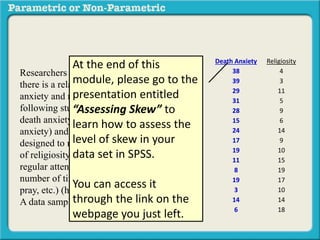
At the end of this 
module, please go to the 
presentation entitled 
“Assessing Skew” to 
learn how to assess the 
level of skew in your 
data set in SPSS. 
Researchers interested in determining if 
there is a relationship between death 
anxiety and religiosity conducted the 
following study. Subjects completed a 
death anxiety scale (high score = high 
anxiety) and also completed a checklist 
designed to measure an individuals degree 
of religiosity (belief in a particular religion, 
regular attendance at religious services, 
number of times per week they regularly 
pray, etc.) (high score = greater religiosity. 
A data sample is provided to the right: 
You can access it 
through the link on the 
webpage you just left.
Death Anxiety Religiosity 
38 4 
39 3 
29 11 
31 5 
28 9 
15 6 
24 14 
17 9 
19 10 
11 15 
8 19 
19 17 
3 10 
14 14 
6 18 
Researchers interested in determining if 
there is a relationship between death 
anxiety and religiosity conducted the 
following study. Subjects completed a 
death anxiety scale (high score = high 
anxiety) and also completed a checklist 
designed to measure an individuals degree 
of religiosity (belief in a particular religion, 
regular attendance at religious services, 
number of times per week they regularly 
pray, etc.) (high score = greater religiosity. 
A data sample is provided to the right: 
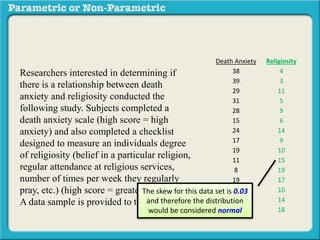
The skew for this data set is 0.03 
and therefore the distribution 
would be considered normal
Death Anxiety Religiosity 
38 4 
39 3 
29 11 
31 5 
28 9 
15 6 
24 14 
17 9 
19 10 
11 15 
8 19 
19 17 
3 10 
14 14 
6 18 
Researchers interested in determining if 
there is a relationship between death 
anxiety and religiosity conducted the 
following study. Subjects completed a 
death anxiety scale (high score = high 
anxiety) and also completed a checklist 
designed to measure an individuals degree 
of religiosity (belief in a particular religion, 
regular attendance at religious services, 
number of times per week they regularly 
pray, etc.) (high score = greater religiosity. 
A data sample is provided to the right: 
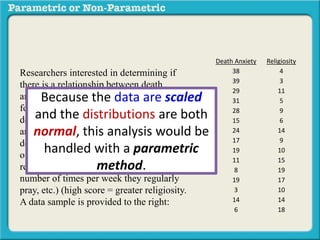
Because the data are scaled 
and the distributions are both 
normal, this analysis would be 
handled with a parametric 
method.
In summary,
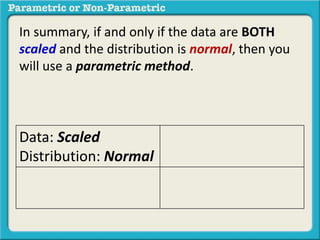
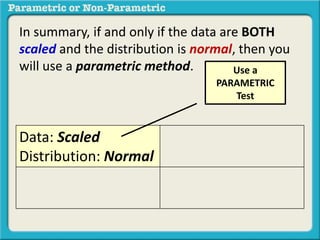
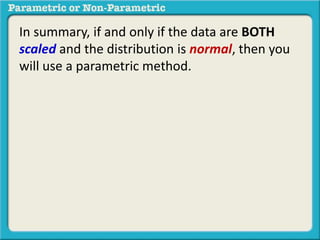
In summary, if and only if the data are BOTH 
scaled and the distribution is normal, then you 
will use a parametric method.
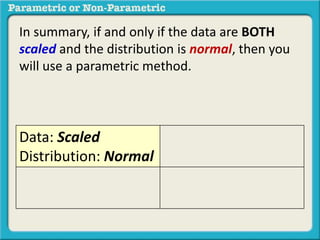
In summary, if and only if the data are BOTH 
scaled and the distribution is normal, then you 
will use a parametric method. 
Data: Scaled 
Distribution: Normal
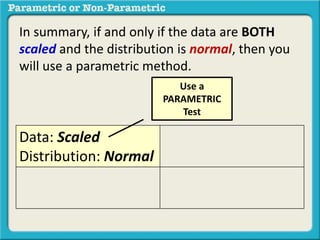
In summary, if and only if the data are BOTH 
scaled and the distribution is normal, then you 
will use a parametric method. 
Data: Scaled 
Distribution: Normal 
Use a 
PARAMETRIC 
Test
What are nonparametric methods?
Non-Parametric methods are used when we 
examine sample statistics
Non-Parametric methods are used when we 
examine sample statistics as a representation of 
population parameters
Non-Parametric methods are used when we 
examine sample statistics as a representation of 
population parameters when the distribution is 
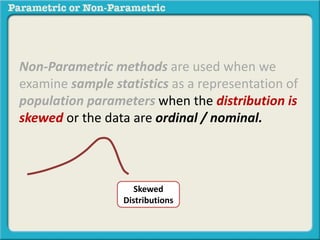
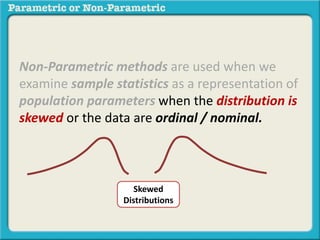
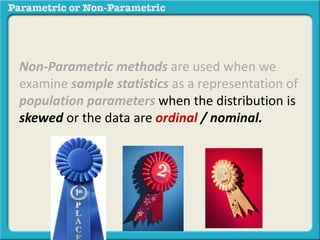
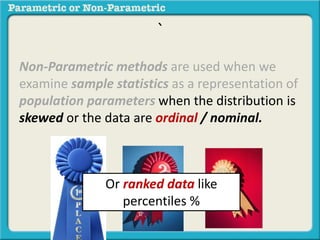
skewed or the data are ordinal / nominal.
Non-Parametric methods are used when we 
examine sample statistics as a representation of 
population parameters when the distribution is 
skewed or the data are ordinal / nominal. 
Skewed 
Distributions
Non-Parametric methods are used when we 
examine sample statistics as a representation of 
population parameters when the distribution is 
skewed or the data are ordinal / nominal. 
Skewed 
Distributions
Non-Parametric methods are used when we 
examine sample statistics as a representation of 
population parameters when the distribution is 
skewed or the data are ordinal / nominal.
` 
Non-Parametric methods are used when we 
examine sample statistics as a representation of 
population parameters when the distribution is 
skewed or the data are ordinal / nominal. 
Or ranked data like 
percentiles %
Non-Parametric methods are used when we 
examine sample statistics as a representation of 
population parameters when the distribution is 
skewed or the data are ordinal / nominal.
Non-Parametric methods are used when we 
examine sample statistics as a representation of 
population parameters when the distribution is 
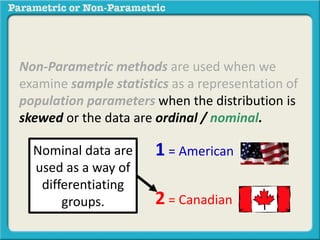
skewed or the data are ordinal / nominal. 
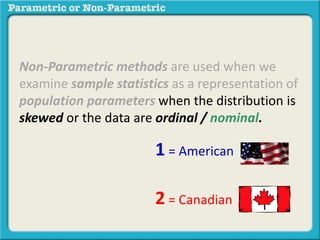
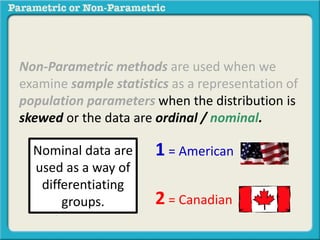
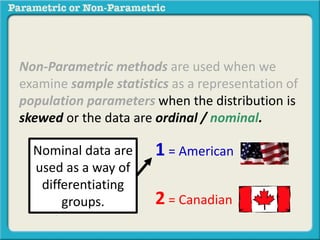
1 = American 
2 = Canadian
Non-Parametric methods are used when we 
examine sample statistics as a representation of 
population parameters when the distribution is 
skewed or the data are ordinal / nominal. 
1 = American 
2 = Canadian 
Nominal data are 
used as a way of 
differentiating 
groups.
Non-Parametric methods are used when we 
examine sample statistics as a representation of 
population parameters when the distribution is 
skewed or the data are ordinal / nominal. 
1 = American 
2 = Canadian 
Nominal data are 
used as a way of 
differentiating 
groups.
Non-Parametric methods are used when we 
examine sample statistics as a representation of 
population parameters when the distribution is 
skewed or the data are ordinal / nominal. 
1 = American 
2 = Canadian 
Nominal data are 
used as a way of 
differentiating 
groups.
Non-Parametric methods are used when we 
examine sample statistics as a representation of 
population parameters when the distribution is 
skewed or the data are ordinal / nominal. 
Or
Non-Parametric methods are used when we 
examine sample statistics as a representation of 
population parameters when the distribution is 
skewed or the data are ordinal / nominal. 
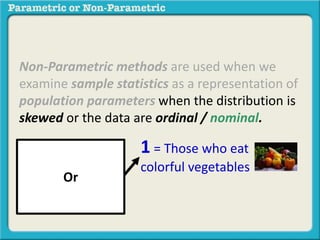
1 = Those who eat 
colorful vegetables 
Or
Non-Parametric methods are used when we 
examine sample statistics as a representation of 
population parameters when the distribution is 
skewed or the data are ordinal / nominal. 
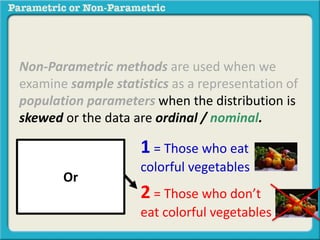
1 = Those who eat 
colorful vegetables 
2 = Those who don’t 
eat colorful vegetables 
Or
A nonparametric question that deals with 
relationships might look like this:
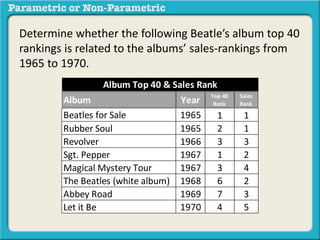
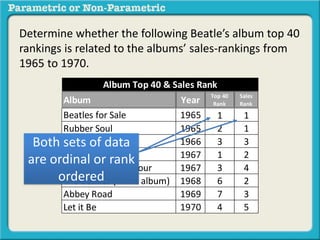
Determine whether the following Beatle’s album top 40 
rankings is related to the albums’ sales-rankings from 
1965 to 1970.
Determine whether the following Beatle’s album top 40 
rankings is related to the albums’ sales-rankings from 
1965 to 1970. 
Album Top 40 & Sales Rank 
Album Year Top 40 
Rank 
Sales 
Rank 
Beatles for Sale 1965 1 1 
Rubber Soul 1965 2 1 
Revolver 1966 3 3 
Sgt. Pepper 1967 1 2 
Magical Mystery Tour 1967 3 4 
The Beatles (white album) 1968 6 2 
Abbey Road 1969 7 3 
Let it Be 1970 4 5
Determine whether the following Beatle’s album top 40 
rankings is related to the albums’ sales-rankings from 
1965 to 1970. 
Album Top 40 & Sales Rank 
Album Year Top 40 
Rank 
Sales 
Rank 
Beatles for Sale 1965 1 1 
Rubber Soul 1965 2 1 
Revolver 1966 3 3 
Sgt. Pepper 1967 1 2 
Magical Mystery Tour 1967 3 4 
The Beatles (white album) 1968 6 2 
Abbey Road 1969 7 3 
Let it Be 1970 4 5 
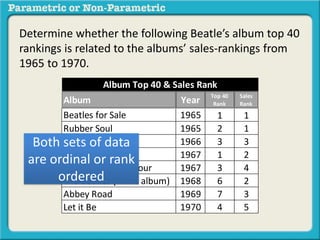
Both sets of data 
are ordinal or rank 
ordered
Determine whether the following Beatle’s album top 40 
rankings is related to the albums’ sales-rankings from 
1965 to 1970. 
Album Top 40 & Sales Rank 
Album Year Top 40 
Rank 
Sales 
Rank 
Beatles for Sale 1965 1 1 
Rubber Soul 1965 2 1 
Revolver 1966 3 3 
Sgt. Pepper 1967 1 2 
Magical Mystery Tour 1967 3 4 
The Beatles (white album) 1968 6 2 
Abbey Road 1969 7 3 
Let it Be 1970 4 5 
Both sets of data 
are ordinal or rank 
ordered
Determine whether the following Beatle’s album top 40 
rankings is related to the albums’ sales-rankings from 
1965 to 1970. 
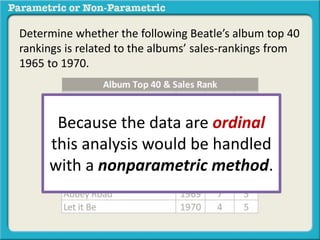
Because the data are ordinal 
this analysis would be handled 
with a nonparametric method.
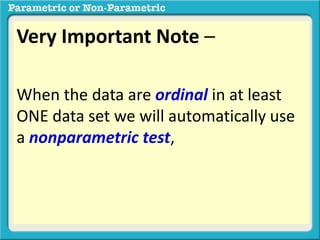
Very Important Note – 
When the data are ordinal in at least 
ONE data set we will automatically use 
a nonparametric test, regardless of 
whether the distribution is normal or 
not.regardless of whether the 
distribution is normal or not.
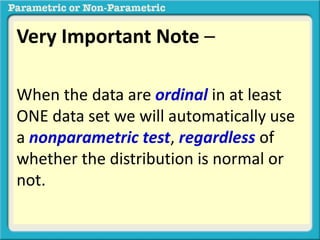
Very Important Note – 
When the data are ordinal in at least 
ONE data set we will automatically use 
a nonparametric test, regardless of 
whether the distribution is normal or 
not.regardless of whether the 
distribution is normal or not.
Very Important Note – 
When the data are ordinal in at least 
ONE data set we will automatically use 
a nonparametric test, regardless of 
whether the distribution is normal or 
not.
Here is another nonparametric-relationship 
problem:
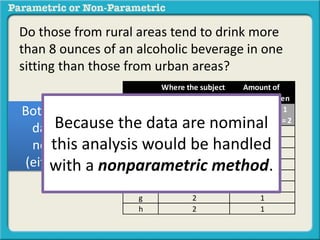
Do those from rural areas tend to drink more 
than 8 ounces of an alcoholic beverage in one 
sitting than those from urban areas?
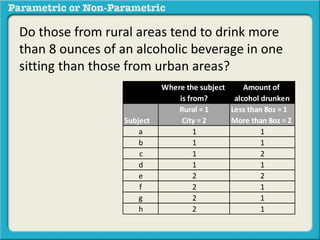
Do those from rural areas tend to drink more 
than 8 ounces of an alcoholic beverage in one 
sitting than those from urban areas? 
Where the subject 
is from? 
Amount of 
alcohol drunken 
Subject 
Rural = 1 
City = 2 
Less than 8oz = 1 
More than 8oz = 2 
a 1 1 
b 1 1 
c 1 2 
d 1 1 
e 2 2 
f 2 1 
g 2 1 
h 2 1
Do those from rural areas tend to drink more 
than 8 ounces of an alcoholic beverage in one 
sitting than those from urban areas? 
Where the subject 
is from? 
Amount of 
alcohol drunken 
Subject 
Rural = 1 
City = 2 
Less than 8oz = 1 
More than 8oz = 2 
a 1 1 
b 1 1 
c 1 2 
d 1 1 
e 2 2 
f 2 1 
g 2 1 
h 2 1 
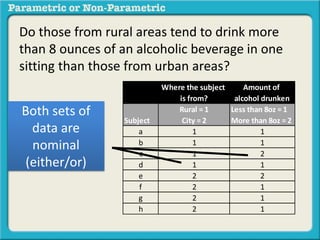
Both sets of 
data are 
nominal 
(either/or)
Do those from rural areas tend to drink more 
than 8 ounces of an alcoholic beverage in one 
sitting than those from urban areas? 
Where the subject 
is from? 
Amount of 
alcohol drunken 
Subject 
Rural = 1 
City = 2 
Less than 8oz = 1 
More than 8oz = 2 
a 1 1 
b 1 1 
c 1 2 
d 1 1 
e 2 2 
f 2 1 
g 2 1 
h 2 1 
Both sets of 
data are 
nominal 
(either/or) 
Because the data are nominal 
this analysis would be handled 
with a nonparametric method.
The Same Very Important Note – 
When the data are nominal in at least 
ONE data set we will automatically use 
a nonparametric test, regardless of 
whether the distribution is normal or 
not.regardless of whether the 
distribution is normal or not.
The Same Very Important Note – 
When the data are nominal in at least 
ONE data set we will automatically use 
a nonparametric test, regardless of 
whether the distribution is normal or 
not.regardless of whether the 
distribution is normal or not.
The Same Very Important Note – 
When the data are nominal in at least 
ONE data set we will automatically use 
a nonparametric test, regardless of 
whether the distribution is normal or 
not.
In summary,
In summary, if and only if the data are BOTH 
scaled and the distribution is normal, then you 
will use a parametric method.
In summary, if and only if the data are BOTH 
scaled and the distribution is normal, then you 
will use a parametric method. 
Data: Scaled 
Distribution: Normal
In summary, if and only if the data are BOTH 
scaled and the distribution is normal, then you 
will use a parametric method. 
Data: Scaled 
Distribution: Normal 
Use a 
PARAMETRIC 
Test
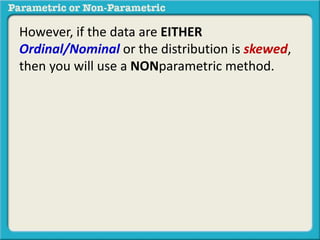
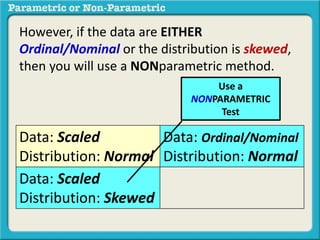
However, if the data are EITHER 
Ordinal/Nominal or the distribution is skewed, 
then you will use a NONparametric method.
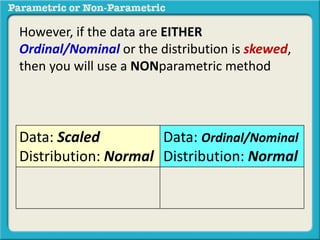
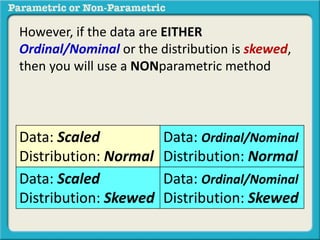
However, if the data are EITHER 
Ordinal/Nominal or the distribution is skewed, 
then you will use a NONparametric method 
Data: Scaled 
Distribution: Normal 
Data: Ordinal/Nominal 
Distribution: Normal
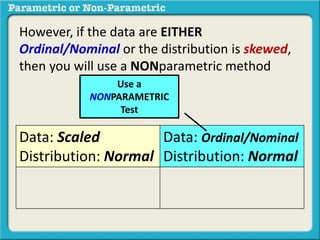
However, if the data are EITHER 
Ordinal/Nominal or the distribution is skewed, 
then you will use a NONparametric method 
Data: Scaled 
Distribution: Normal 
Data: Ordinal/Nominal 
Distribution: Normal 
Use a 
NONPARAMETRIC 
Test
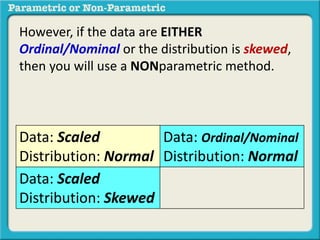
However, if the data are EITHER 
Ordinal/Nominal or the distribution is skewed, 
then you will use a NONparametric method. 
Data: Scaled 
Distribution: Normal 
Data: Ordinal/Nominal 
Distribution: Normal 
Data: Scaled 
Distribution: Skewed
However, if the data are EITHER 
Ordinal/Nominal or the distribution is skewed, 
then you will use a NONparametric method. 
Data: Scaled 
Distribution: Normal 
Data: Ordinal/Nominal 
Distribution: Normal 
Data: Scaled 
Distribution: Skewed 
Use a 
NONPARAMETRIC 
Test
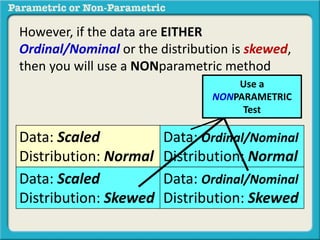
However, if the data are EITHER 
Ordinal/Nominal or the distribution is skewed, 
then you will use a NONparametric method 
Data: Scaled 
Distribution: Normal 
Data: Ordinal/Nominal 
Distribution: Normal 
Data: Scaled 
Distribution: Skewed 
Data: Ordinal/Nominal 
Distribution: Skewed
However, if the data are EITHER 
Ordinal/Nominal or the distribution is skewed, 
then you will use a NONparametric method 
Data: Scaled 
Distribution: Normal 
Use a 
NONPARAMETRIC 
Test 
Data: Ordinal/Nominal 
Distribution: Normal 
Data: Scaled 
Distribution: Skewed 
Data: Ordinal/Nominal 
Distribution: Skewed
What type of method would be most 
appropriate for the data set you are 
working with?
What type of method would be most 
appropriate for the data set you are 
working with? 
Parametric Method 
Non-Parametric Method

Is a parametric or nonparametric method appropriate with relationship-oriented questions?

  • 1.
  • 2.
    This presentation isdesigned to help you determine if using parametric or non-parametric methods would be most appropriate with the relationship question you are working on.
  • 3.
    This presentation isdesigned to help you determine if using parametric or non-parametric methods would be most appropriate with the relationship question you are working on. Parametric Method Non-Parametric Method
  • 4.
  • 5.
    Parametric methods areused when we examine sample statistics
  • 6.
    Parametric methods areused when we examine sample statistics as a representation of population parameters
  • 7.
    Parametric methods areused when we examine sample statistics as a representation of population parameters when the distribution is normal and the data are scaled.
  • 8.
    Parametric methods areused when we examine sample statistics as a representation of population parameters when the distribution is normal and the data are scaled. Normal Distribution
  • 9.
    Parametric methods areused when we examine sample statistics as a representation of population parameters when the distribution is normal and the data are scaled. Normal Distribution A normal distribution tends to have the same number of data points on one side of the distribution as it does on the other side. These data points decrease evenly to the far left and far right.
  • 10.
    Parametric methods areused when we examine sample statistics as a representation of population parameters when the distribution is normal and the data are scaled. Normal Distribution A normal distribution tends to have the same number of data points on one side of the distribution as it does on the other side. These data points decrease evenly to the far left and far right. 50%
  • 11.
    Parametric methods areused when we examine sample statistics as a representation of population parameters when the distribution is normal and the data are scaled. Normal Distribution A normal distribution tends to have the same number of data points on one side of the distribution as it does on the other side. These data points decrease evenly to the far left and far right. 50% 50%
  • 12.
    Parametric methods areused when we examine sample statistics as a representation of population parameters when the distribution is normal and the data are scaled. Normal Distribution A normal distribution tends to have the same number of data points on one side of the distribution as it does on the other side. These data points decrease evenly to the far left and far right.
  • 13.
    Parametric methods areused when we examine sample statistics as a representation of population parameters when the distribution is normal and the data are scaled. Normal Distribution A normal distribution tends to have the same number of data points on one side of the distribution as it does on the other side. These data points decrease evenly to the far left and far right.
  • 14.
    Parametric methods areused when we examine sample statistics as a representation of population parameters when the distribution is normal and the data are scaled. Normal Distribution A normal distribution tends to have the same number of data points on one side of the distribution as it does on the other side. These data points decrease evenly to the far left and far right.
  • 15.
    Parametric methods areused when we examine sample statistics as a representation of population parameters when the distribution is normal and the data are scaled.
  • 16.
    Parametric methods areused when we examine sample statistics as a representation of population parameters when the distribution is normal and the data are scaled. Speed
  • 17.
    Parametric methods areused when we examine sample statistics as a representation of population parameters when the distribution is normal and the data are scaled. Temperature
  • 18.
    Parametric methods areused when we examine sample statistics as a representation of population parameters when the distribution is normal and the data are scaled. Weight
  • 19.
    Parametric methods areused when we examine sample statistics as a representation of population parameters when the distribution is normal and the data are scaled. Scaled Data
  • 20.
    Parametric methods areused when we examine sample statistics as a representation of population parameters when the distribution is normal and the data are scaled. Data which is scaled have equal points along the scale (e.g., 1 pound is the same unit of measurement across the weight scale)
  • 21.
    A parametric questionthat deals with relationships might look like this:
  • 22.
    Researchers interested indetermining if there is a relationship between death anxiety and religiosity conducted the following study. Subjects completed a death anxiety scale (high score = high anxiety) and also completed a checklist designed to measure an individuals degree of religiosity (belief in a particular religion, regular attendance at religious services, number of times per week they regularly pray, etc.) (high score = greater religiosity. A data sample is provided to the right:
  • 23.
    Researchers interested indetermining if there is a relationship between death anxiety and religiosity conducted the following study. Subjects completed a death anxiety scale (high score = high anxiety) and also completed a checklist designed to measure an individuals degree of religiosity (belief in a particular religion, regular attendance at religious services, number of times per week they regularly pray, etc.) (high score = greater religiosity. A data sample is provided to the right: &
  • 24.
    Researchers interested indetermining if there is a relationship between death anxiety and religiosity conducted the following study. Subjects completed a death anxiety scale (high score = high anxiety) and also completed a checklist designed to measure an individuals degree of religiosity (belief in a particular religion, regular attendance at religious services, number of times per week they regularly pray, etc.) (high score = greater religiosity. A data sample is provided to the right:
  • 25.
    Researchers interested indetermining if there is a relationship between death anxiety and religiosity conducted the following study. Subjects completed a death anxiety scale (high score = high anxiety) and also completed a checklist designed to measure an individuals degree of religiosity (belief in a particular religion, regular attendance at religious services, number of times per week they regularly pray, etc.) (high score = greater religiosity. A data sample is provided to the right: Death Anxiety Scale
  • 26.
    Researchers interested indetermining if there is a relationship between death anxiety and religiosity conducted the following study. Subjects completed a death anxiety scale (high score = high anxiety) and also completed a checklist designed to measure an individuals degree of religiosity (belief in a particular religion, regular attendance at religious services, number of times per week they regularly pray, etc.) (high score = greater religiosity. A data sample is provided to the right:
  • 27.
    Researchers interested indetermining if there is a relationship between death anxiety and religiosity conducted the following study. Subjects completed a death anxiety scale (high score = high anxiety) and also completed a checklist designed to measure an individuals degree of religiosity (belief in a particular religion, regular attendance at religious services, number of times per week they regularly pray, etc.) (high score = greater religiosity.) A data sample is provided to the right:
  • 28.
    Researchers interested indetermining if there is a relationship between death anxiety and religiosity conducted the following study. Subjects completed a death anxiety scale (high score = high anxiety) and also completed a checklist designed to measure an individuals degree of religiosity (belief in a particular religion, regular attendance at religious services, number of times per week they regularly pray, etc.) (high score = greater religiosity.) A data sample is provided to the right:
  • 29.
    Researchers interested indetermining if there is a relationship between death anxiety and religiosity conducted the following study. Subjects completed a death anxiety scale (high score = high anxiety) and also completed a checklist designed to measure an individuals degree of religiosity (belief in a particular religion, regular attendance at religious services, number of times per week they regularly pray, etc.) (high score = greater religiosity). A data sample is provided to the right: Measure of Religiosity
  • 30.
    Researchers interested indetermining if there is a relationship between death anxiety and religiosity conducted the following study. Subjects completed a death anxiety scale (high score = high anxiety) and also completed a checklist designed to measure an individuals degree of religiosity (belief in a particular religion, regular attendance at religious services, number of times per week they regularly pray, etc.) (high score = greater religiosity. A data sample is provided to the right:
  • 31.
    Death Anxiety Religiosity 38 4 42 3 29 11 31 5 28 9 15 6 24 14 17 9 19 10 11 15 8 19 19 17 3 10 14 14 6 18 Researchers interested in determining if there is a relationship between death anxiety and religiosity conducted the following study. Subjects completed a death anxiety scale (high score = high anxiety) and also completed a checklist designed to measure an individuals degree of religiosity (belief in a particular religion, regular attendance at religious services, number of times per week they regularly pray, etc.) (high score = greater religiosity. A data sample is provided to the right:
  • 32.
    Death Anxiety Religiosity 38 4 42 3 29 11 31 5 28 9 15 6 24 14 17 9 19 10 11 15 8 19 19 17 3 10 14 14 6 18 Researchers interested in determining if there is a relationship between death anxiety and religiosity conducted the following study. Subjects completed a death anxiety scale (high score = high anxiety) and also completed a checklist designed to measure an individuals degree of religiosity (belief in a particular religion, regular attendance at religious services, number of times per week they regularly pray, etc.) (high score = greater religiosity. A data sample is provided to the right: This data has enough spread to be considered scaled
  • 33.
    Death Anxiety Religiosity 38 4 39 3 29 11 31 5 28 9 15 6 24 14 17 9 19 10 11 15 8 19 19 17 3 10 14 14 6 18 Researchers interested in determining if there is a relationship between death anxiety and religiosity conducted the following study. Subjects completed a death anxiety scale (high score = high anxiety) and also completed a checklist designed to measure an individuals degree of religiosity (belief in a particular religion, regular attendance at religious services, number of times per week they regularly pray, etc.) (high score = greater religiosity. A data sample is provided to the right: Same with this data.
  • 34.
    Death Anxiety Religiosity 38 4 39 3 29 11 31 5 28 9 15 6 24 14 17 9 19 10 11 15 8 19 19 17 3 10 14 14 6 18 Researchers interested in determining if there is a relationship between death anxiety and religiosity conducted the following study. Subjects completed a death anxiety scale (high score = high anxiety) and also completed a checklist designed to measure an individuals degree of religiosity (belief in a particular religion, regular attendance at religious services, number of times per week they regularly pray, etc.) (high score = greater religiosity. A data sample is provided to the right: The skew for this data set is 0.26 (a skewed distribution will have a skew value greater than +2.0 or less than -2.0). While slightly skewed to the right, the distribution would be considered normal
  • 35.
    Death Anxiety Religiosity 38 4 39 3 29 11 31 5 28 9 15 6 24 14 17 9 19 10 11 15 8 19 19 17 3 10 14 14 6 18 Researchers interested in determining if there is a relationship between death anxiety and religiosity conducted the following study. Subjects completed a death anxiety scale (high score = high anxiety) and also completed a checklist designed to measure an individuals degree of religiosity (belief in a particular religion, regular attendance at religious services, number of times per week they regularly pray, etc.) (high score = greater religiosity. A data sample is provided to the right: The skew for this data set is 0.26 (a skewed distribution will have a skew value greater than +2.0 or less than -2.0). While slightly skewed to the right, the distribution would be considered normal
  • 36.
    Death Anxiety Religiosity 38 4 39 3 29 11 31 5 28 9 15 6 24 14 17 9 19 10 11 15 8 19 19 17 3 10 14 14 6 18 Researchers interested in determining if there is a relationship between death anxiety and religiosity conducted the following study. Subjects completed a death anxiety scale (high score = high anxiety) and also completed a checklist designed to measure an individuals degree of religiosity (belief in a particular religion, regular attendance at religious services, number of times per week they regularly pray, etc.) (high score = greater religiosity. A data sample is provided to the right: The skew for this data set is 0.26 (a skewed distribution will have a skew value greater than +2.0 or less than -2.0). While slightly skewed to the right, the distribution would be considered normal
  • 37.
    Death Anxiety Religiosity 38 4 39 3 29 11 31 5 28 9 15 6 24 14 17 9 19 10 11 15 8 19 19 17 3 10 14 14 6 18 At the end of this module, please go to the presentation entitled “Assessing Skew” to learn how to assess the level of skew in your data set in SPSS. Researchers interested in determining if there is a relationship between death anxiety and religiosity conducted the following study. Subjects completed a death anxiety scale (high score = high anxiety) and also completed a checklist designed to measure an individuals degree of religiosity (belief in a particular religion, regular attendance at religious services, number of times per week they regularly pray, etc.) (high score = greater religiosity. A data sample is provided to the right: You can access it through the link on the webpage you just left.
  • 38.
    Death Anxiety Religiosity 38 4 39 3 29 11 31 5 28 9 15 6 24 14 17 9 19 10 11 15 8 19 19 17 3 10 14 14 6 18 Researchers interested in determining if there is a relationship between death anxiety and religiosity conducted the following study. Subjects completed a death anxiety scale (high score = high anxiety) and also completed a checklist designed to measure an individuals degree of religiosity (belief in a particular religion, regular attendance at religious services, number of times per week they regularly pray, etc.) (high score = greater religiosity. A data sample is provided to the right: The skew for this data set is 0.03 and therefore the distribution would be considered normal
  • 39.
    Death Anxiety Religiosity 38 4 39 3 29 11 31 5 28 9 15 6 24 14 17 9 19 10 11 15 8 19 19 17 3 10 14 14 6 18 Researchers interested in determining if there is a relationship between death anxiety and religiosity conducted the following study. Subjects completed a death anxiety scale (high score = high anxiety) and also completed a checklist designed to measure an individuals degree of religiosity (belief in a particular religion, regular attendance at religious services, number of times per week they regularly pray, etc.) (high score = greater religiosity. A data sample is provided to the right: Because the data are scaled and the distributions are both normal, this analysis would be handled with a parametric method.
  • 40.
  • 41.
    In summary, ifand only if the data are BOTH scaled and the distribution is normal, then you will use a parametric method.
  • 42.
    In summary, ifand only if the data are BOTH scaled and the distribution is normal, then you will use a parametric method. Data: Scaled Distribution: Normal
  • 43.
    In summary, ifand only if the data are BOTH scaled and the distribution is normal, then you will use a parametric method. Data: Scaled Distribution: Normal Use a PARAMETRIC Test
  • 44.
  • 45.
    Non-Parametric methods areused when we examine sample statistics
  • 46.
    Non-Parametric methods areused when we examine sample statistics as a representation of population parameters
  • 47.
    Non-Parametric methods areused when we examine sample statistics as a representation of population parameters when the distribution is skewed or the data are ordinal / nominal.
  • 48.
    Non-Parametric methods areused when we examine sample statistics as a representation of population parameters when the distribution is skewed or the data are ordinal / nominal. Skewed Distributions
  • 49.
    Non-Parametric methods areused when we examine sample statistics as a representation of population parameters when the distribution is skewed or the data are ordinal / nominal. Skewed Distributions
  • 50.
    Non-Parametric methods areused when we examine sample statistics as a representation of population parameters when the distribution is skewed or the data are ordinal / nominal.
  • 51.
    ` Non-Parametric methodsare used when we examine sample statistics as a representation of population parameters when the distribution is skewed or the data are ordinal / nominal. Or ranked data like percentiles %
  • 52.
    Non-Parametric methods areused when we examine sample statistics as a representation of population parameters when the distribution is skewed or the data are ordinal / nominal.
  • 53.
    Non-Parametric methods areused when we examine sample statistics as a representation of population parameters when the distribution is skewed or the data are ordinal / nominal. 1 = American 2 = Canadian
  • 54.
    Non-Parametric methods areused when we examine sample statistics as a representation of population parameters when the distribution is skewed or the data are ordinal / nominal. 1 = American 2 = Canadian Nominal data are used as a way of differentiating groups.
  • 55.
    Non-Parametric methods areused when we examine sample statistics as a representation of population parameters when the distribution is skewed or the data are ordinal / nominal. 1 = American 2 = Canadian Nominal data are used as a way of differentiating groups.
  • 56.
    Non-Parametric methods areused when we examine sample statistics as a representation of population parameters when the distribution is skewed or the data are ordinal / nominal. 1 = American 2 = Canadian Nominal data are used as a way of differentiating groups.
  • 57.
    Non-Parametric methods areused when we examine sample statistics as a representation of population parameters when the distribution is skewed or the data are ordinal / nominal. Or
  • 58.
    Non-Parametric methods areused when we examine sample statistics as a representation of population parameters when the distribution is skewed or the data are ordinal / nominal. 1 = Those who eat colorful vegetables Or
  • 59.
    Non-Parametric methods areused when we examine sample statistics as a representation of population parameters when the distribution is skewed or the data are ordinal / nominal. 1 = Those who eat colorful vegetables 2 = Those who don’t eat colorful vegetables Or
  • 60.
    A nonparametric questionthat deals with relationships might look like this:
  • 61.
    Determine whether thefollowing Beatle’s album top 40 rankings is related to the albums’ sales-rankings from 1965 to 1970.
  • 62.
    Determine whether thefollowing Beatle’s album top 40 rankings is related to the albums’ sales-rankings from 1965 to 1970. Album Top 40 & Sales Rank Album Year Top 40 Rank Sales Rank Beatles for Sale 1965 1 1 Rubber Soul 1965 2 1 Revolver 1966 3 3 Sgt. Pepper 1967 1 2 Magical Mystery Tour 1967 3 4 The Beatles (white album) 1968 6 2 Abbey Road 1969 7 3 Let it Be 1970 4 5
  • 63.
    Determine whether thefollowing Beatle’s album top 40 rankings is related to the albums’ sales-rankings from 1965 to 1970. Album Top 40 & Sales Rank Album Year Top 40 Rank Sales Rank Beatles for Sale 1965 1 1 Rubber Soul 1965 2 1 Revolver 1966 3 3 Sgt. Pepper 1967 1 2 Magical Mystery Tour 1967 3 4 The Beatles (white album) 1968 6 2 Abbey Road 1969 7 3 Let it Be 1970 4 5 Both sets of data are ordinal or rank ordered
  • 64.
    Determine whether thefollowing Beatle’s album top 40 rankings is related to the albums’ sales-rankings from 1965 to 1970. Album Top 40 & Sales Rank Album Year Top 40 Rank Sales Rank Beatles for Sale 1965 1 1 Rubber Soul 1965 2 1 Revolver 1966 3 3 Sgt. Pepper 1967 1 2 Magical Mystery Tour 1967 3 4 The Beatles (white album) 1968 6 2 Abbey Road 1969 7 3 Let it Be 1970 4 5 Both sets of data are ordinal or rank ordered
  • 65.
    Determine whether thefollowing Beatle’s album top 40 rankings is related to the albums’ sales-rankings from 1965 to 1970. Because the data are ordinal this analysis would be handled with a nonparametric method.
  • 66.
    Very Important Note– When the data are ordinal in at least ONE data set we will automatically use a nonparametric test, regardless of whether the distribution is normal or not.regardless of whether the distribution is normal or not.
  • 67.
    Very Important Note– When the data are ordinal in at least ONE data set we will automatically use a nonparametric test, regardless of whether the distribution is normal or not.regardless of whether the distribution is normal or not.
  • 68.
    Very Important Note– When the data are ordinal in at least ONE data set we will automatically use a nonparametric test, regardless of whether the distribution is normal or not.
  • 69.
    Here is anothernonparametric-relationship problem:
  • 70.
    Do those fromrural areas tend to drink more than 8 ounces of an alcoholic beverage in one sitting than those from urban areas?
  • 71.
    Do those fromrural areas tend to drink more than 8 ounces of an alcoholic beverage in one sitting than those from urban areas? Where the subject is from? Amount of alcohol drunken Subject Rural = 1 City = 2 Less than 8oz = 1 More than 8oz = 2 a 1 1 b 1 1 c 1 2 d 1 1 e 2 2 f 2 1 g 2 1 h 2 1
  • 72.
    Do those fromrural areas tend to drink more than 8 ounces of an alcoholic beverage in one sitting than those from urban areas? Where the subject is from? Amount of alcohol drunken Subject Rural = 1 City = 2 Less than 8oz = 1 More than 8oz = 2 a 1 1 b 1 1 c 1 2 d 1 1 e 2 2 f 2 1 g 2 1 h 2 1 Both sets of data are nominal (either/or)
  • 73.
    Do those fromrural areas tend to drink more than 8 ounces of an alcoholic beverage in one sitting than those from urban areas? Where the subject is from? Amount of alcohol drunken Subject Rural = 1 City = 2 Less than 8oz = 1 More than 8oz = 2 a 1 1 b 1 1 c 1 2 d 1 1 e 2 2 f 2 1 g 2 1 h 2 1 Both sets of data are nominal (either/or) Because the data are nominal this analysis would be handled with a nonparametric method.
  • 74.
    The Same VeryImportant Note – When the data are nominal in at least ONE data set we will automatically use a nonparametric test, regardless of whether the distribution is normal or not.regardless of whether the distribution is normal or not.
  • 75.
    The Same VeryImportant Note – When the data are nominal in at least ONE data set we will automatically use a nonparametric test, regardless of whether the distribution is normal or not.regardless of whether the distribution is normal or not.
  • 76.
    The Same VeryImportant Note – When the data are nominal in at least ONE data set we will automatically use a nonparametric test, regardless of whether the distribution is normal or not.
  • 77.
  • 78.
    In summary, ifand only if the data are BOTH scaled and the distribution is normal, then you will use a parametric method.
  • 79.
    In summary, ifand only if the data are BOTH scaled and the distribution is normal, then you will use a parametric method. Data: Scaled Distribution: Normal
  • 80.
    In summary, ifand only if the data are BOTH scaled and the distribution is normal, then you will use a parametric method. Data: Scaled Distribution: Normal Use a PARAMETRIC Test
  • 81.
    However, if thedata are EITHER Ordinal/Nominal or the distribution is skewed, then you will use a NONparametric method.
  • 82.
    However, if thedata are EITHER Ordinal/Nominal or the distribution is skewed, then you will use a NONparametric method Data: Scaled Distribution: Normal Data: Ordinal/Nominal Distribution: Normal
  • 83.
    However, if thedata are EITHER Ordinal/Nominal or the distribution is skewed, then you will use a NONparametric method Data: Scaled Distribution: Normal Data: Ordinal/Nominal Distribution: Normal Use a NONPARAMETRIC Test
  • 84.
    However, if thedata are EITHER Ordinal/Nominal or the distribution is skewed, then you will use a NONparametric method. Data: Scaled Distribution: Normal Data: Ordinal/Nominal Distribution: Normal Data: Scaled Distribution: Skewed
  • 85.
    However, if thedata are EITHER Ordinal/Nominal or the distribution is skewed, then you will use a NONparametric method. Data: Scaled Distribution: Normal Data: Ordinal/Nominal Distribution: Normal Data: Scaled Distribution: Skewed Use a NONPARAMETRIC Test
  • 86.
    However, if thedata are EITHER Ordinal/Nominal or the distribution is skewed, then you will use a NONparametric method Data: Scaled Distribution: Normal Data: Ordinal/Nominal Distribution: Normal Data: Scaled Distribution: Skewed Data: Ordinal/Nominal Distribution: Skewed
  • 87.
    However, if thedata are EITHER Ordinal/Nominal or the distribution is skewed, then you will use a NONparametric method Data: Scaled Distribution: Normal Use a NONPARAMETRIC Test Data: Ordinal/Nominal Distribution: Normal Data: Scaled Distribution: Skewed Data: Ordinal/Nominal Distribution: Skewed
  • 88.
    What type ofmethod would be most appropriate for the data set you are working with?
  • 89.
    What type ofmethod would be most appropriate for the data set you are working with? Parametric Method Non-Parametric Method