Is this question …
Inferential?Descriptive? or
Descriptive Statistics
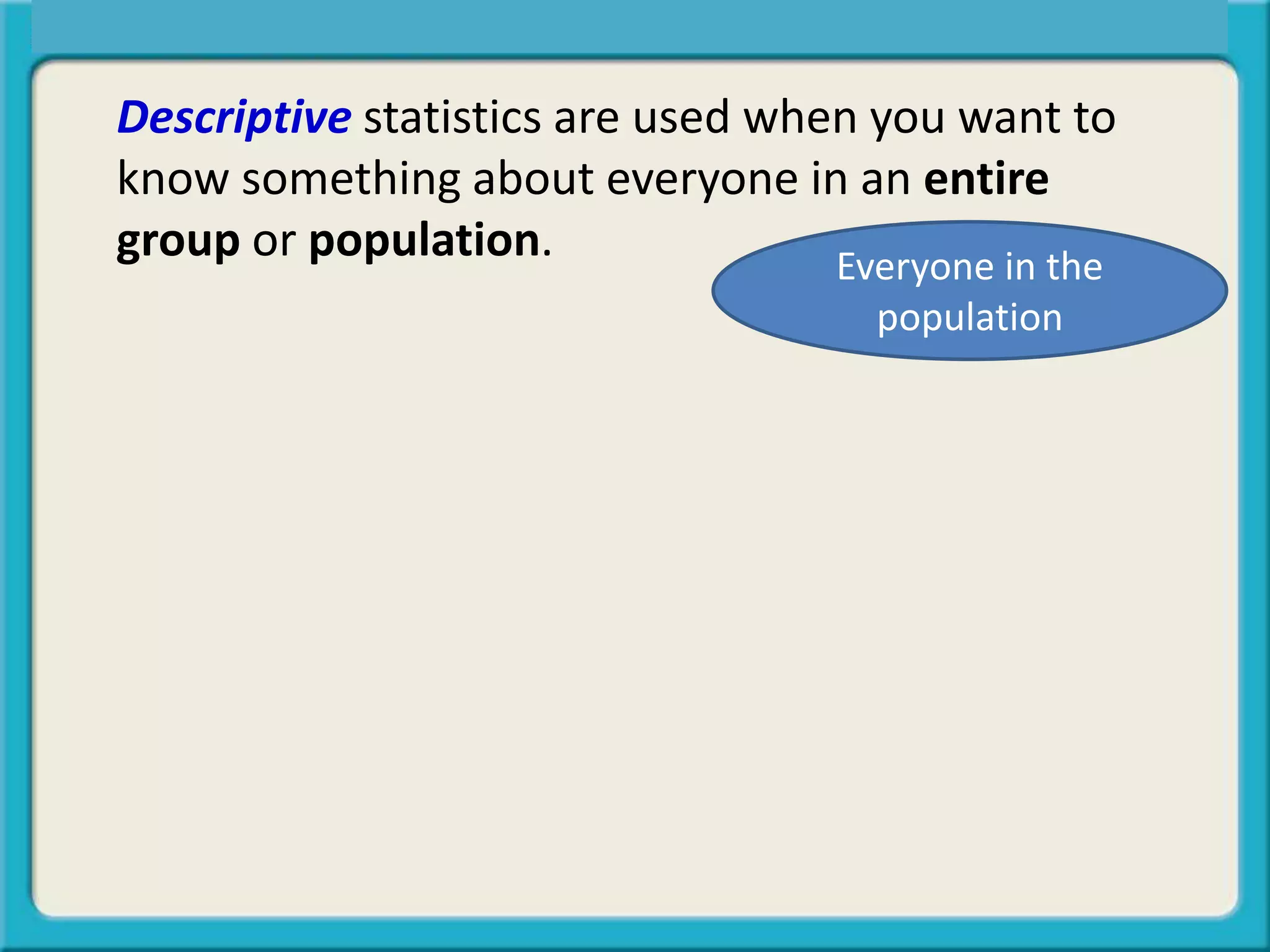
Descriptive statistics are used when you want to
know something about everyone in an entire
group or population.
Central Tendency, Spread, or Symmetry?
Everyone in the
population
A population can be
- everyone in a country (e.g., United States,
Zimbabwe, Peru, China, etc.)
- everyone in a company.
- every student in a state, in a school district, in
a school or in a class.
A population can be
- everyone in a country (e.g., United States,
Zimbabwe, Peru, China, etc.)
- everyone in a company
- every student in a state, in a school district, in a
school or in a class.
The key words you look for in your research
question are all, everyone, census, entire group…
Example
Let’s say we want to know something about all
taxi drivers in New York (e.g., how fast they
drive, how much they charge…).
Example
Let’s say we want to know something about all
taxi drivers in New York (e.g., how fast they
drive, how much they charge…).
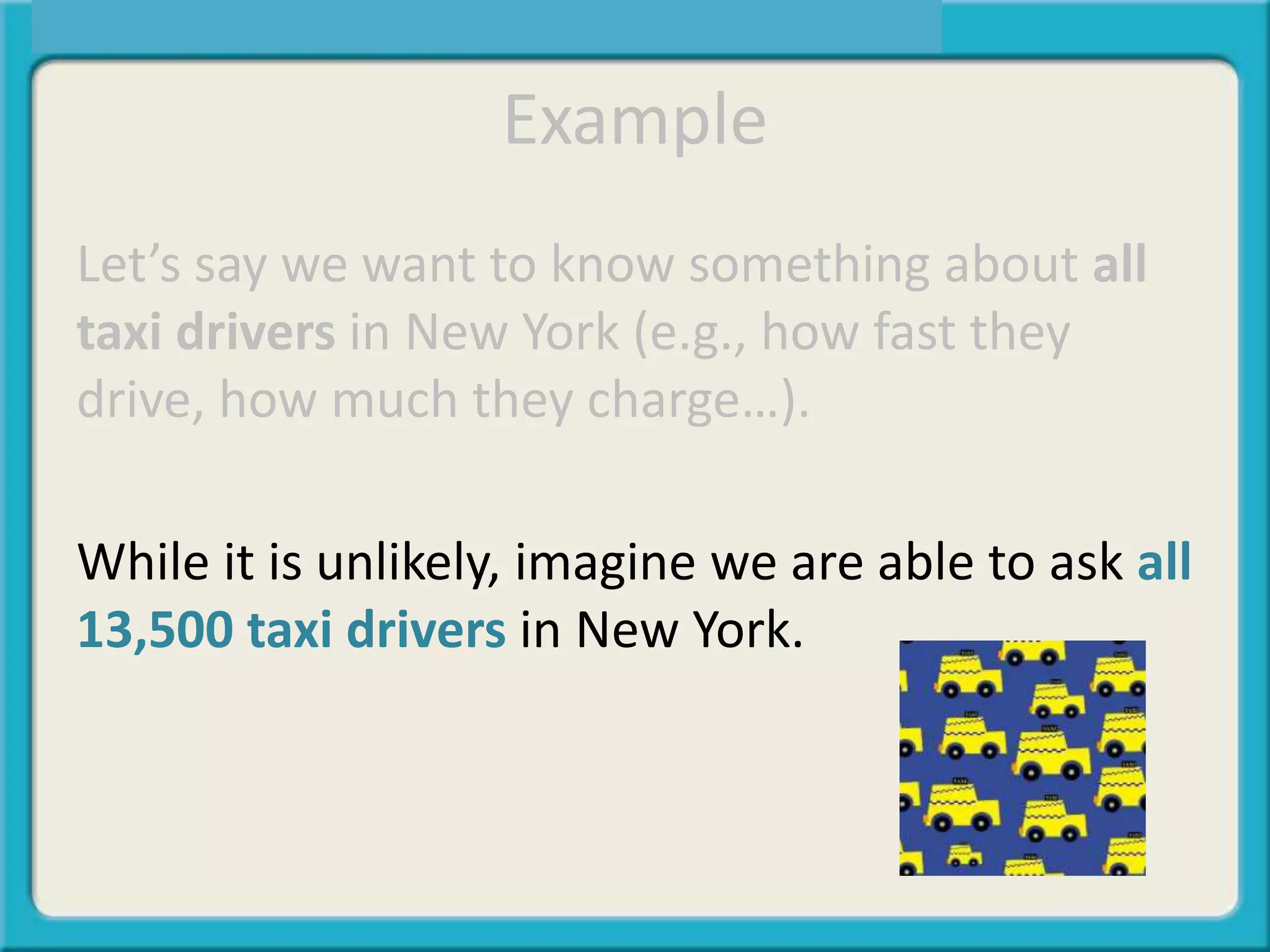
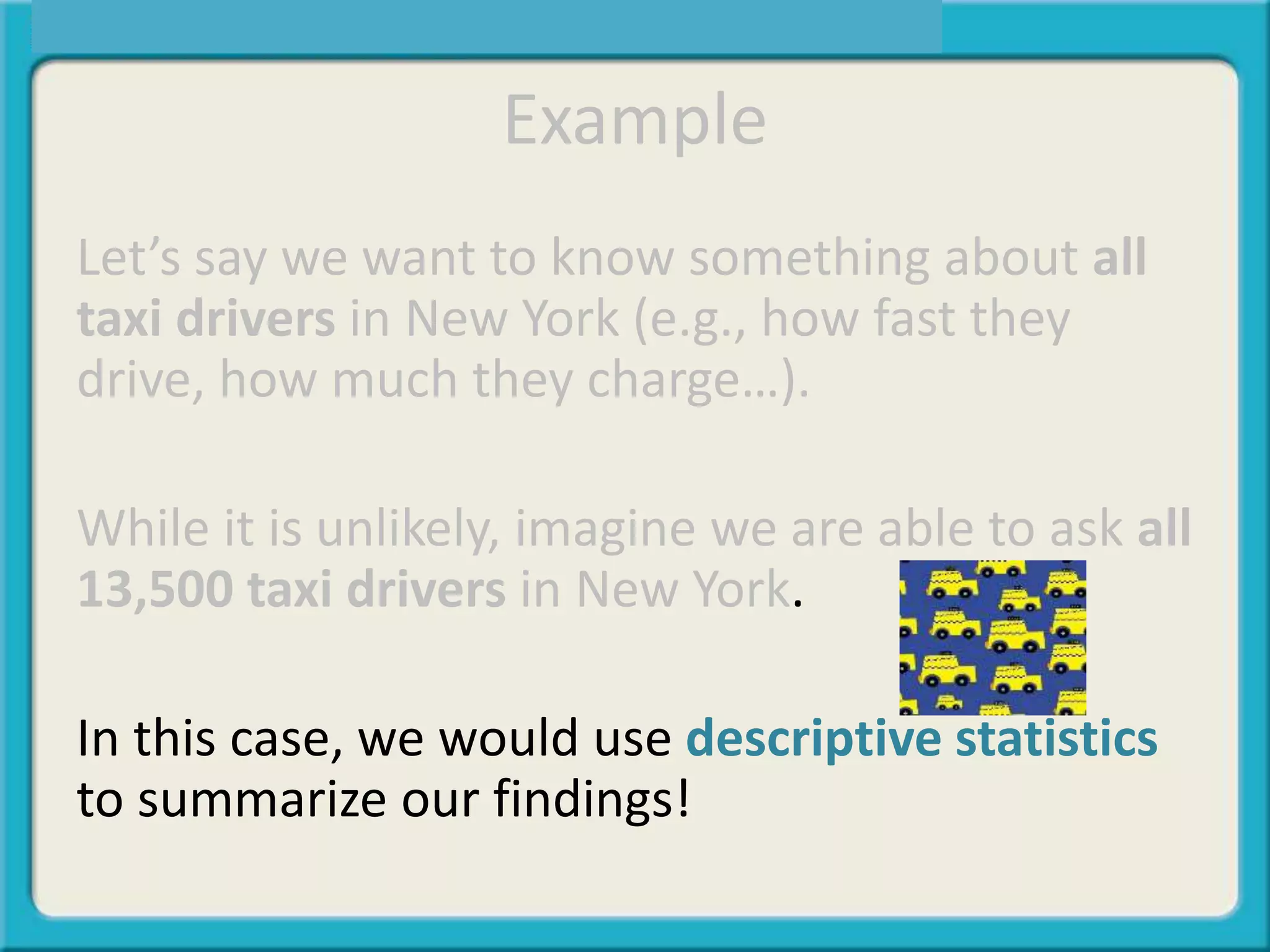
While it is unlikely, imagine we are able to ask all
13,500 taxi drivers in New York.
Example
Let’s say we want to know something about all
taxi drivers in New York (e.g., how fast they
drive, how much they charge…).
While it is unlikely, imagine we are able to ask all
13,500 taxi drivers in New York.
In this case, we would use descriptive statistics
to summarize our findings!
Inferential Statistics
Central Tendency, Spread, or Symmetry?
Sample of the
population
Everyone in the
population
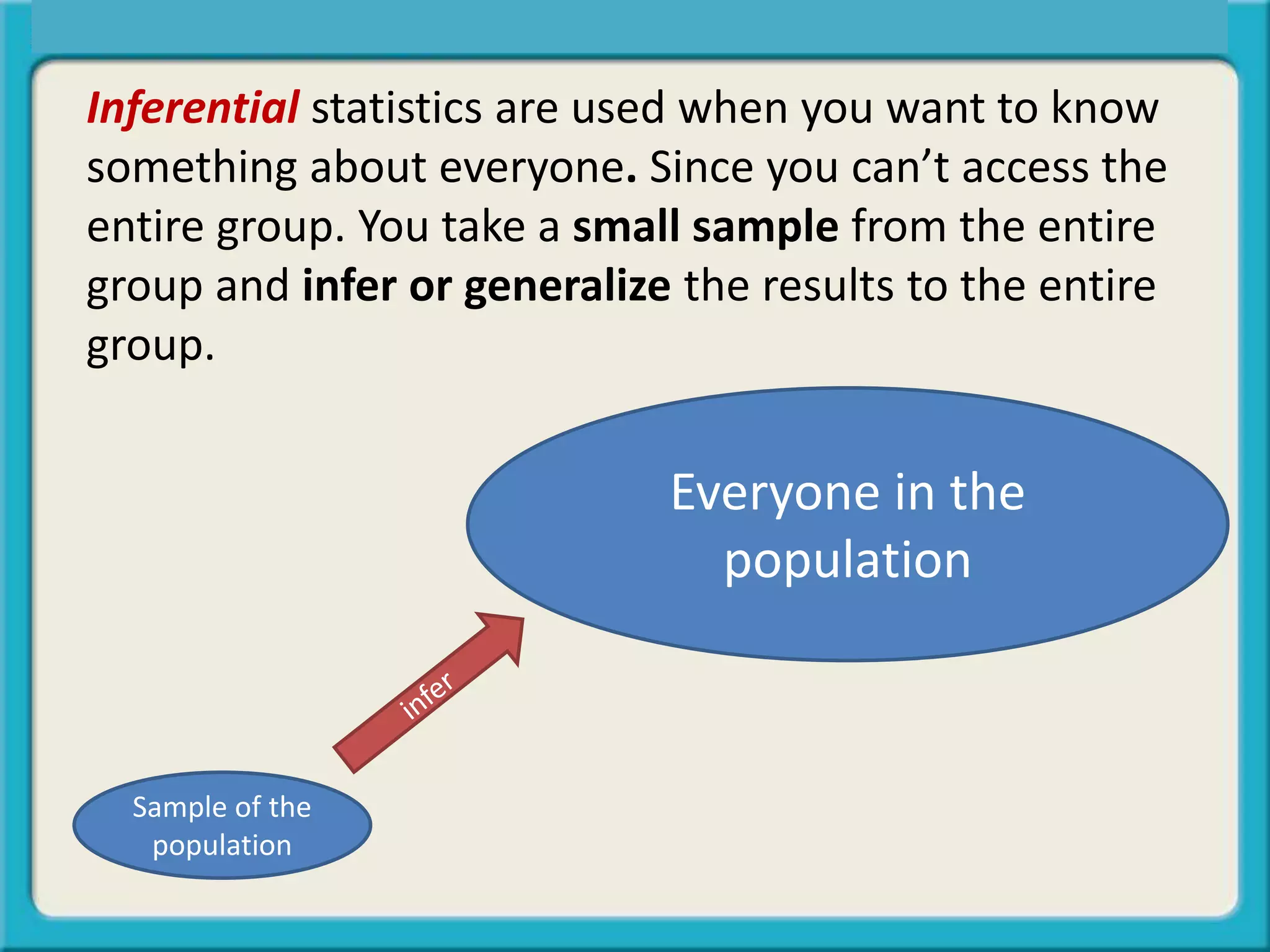
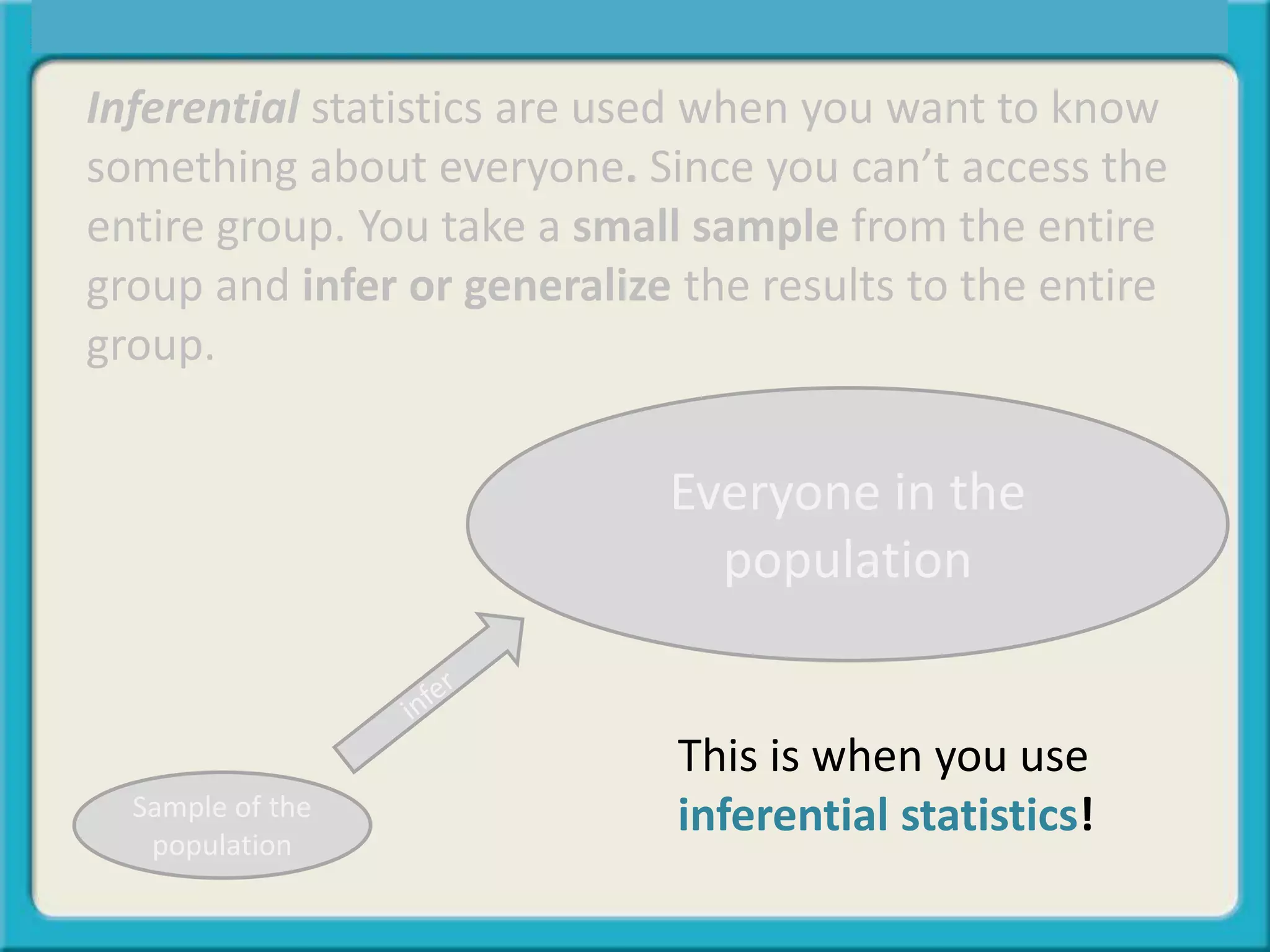
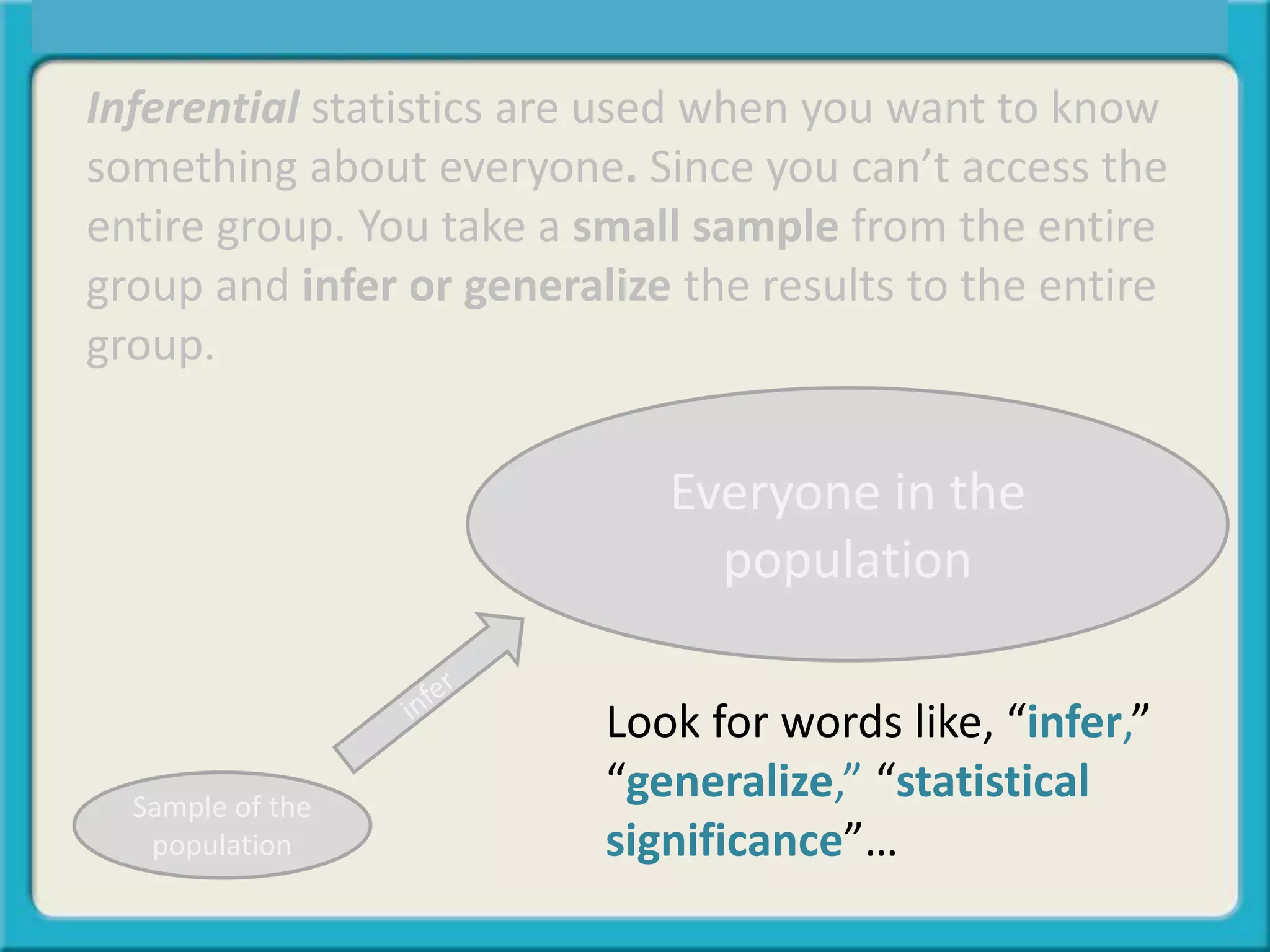
Inferential statistics are used when you want to know
something about everyone. Since you can’t access the
entire group. You take a small sample from the entire
group and infer or generalize the results to the entire
group.
Central Tendency, Spread, or Symmetry?
Sample of the
population
Everyone in the
population
This is when you use
inferential statistics!
Inferential statistics are used when you want to know
something about everyone. Since you can’t access the
entire group. You take a small sample from the entire
group and infer or generalize the results to the entire
group.
Central Tendency, Spread, or Symmetry?
Sample of the
population
Everyone in the
population
Look for words like, “infer,”
“generalize,” “statistical
significance”…
Inferential statistics are used when you want to know
something about everyone. Since you can’t access the
entire group. You take a small sample from the entire
group and infer or generalize the results to the entire
group.
Example
Let’s say we want to know something about all taxi
drivers in New York (e.g., how fast they drive, how
much they charge…)
But we do not have the ability to ask all 13,500 of
them.
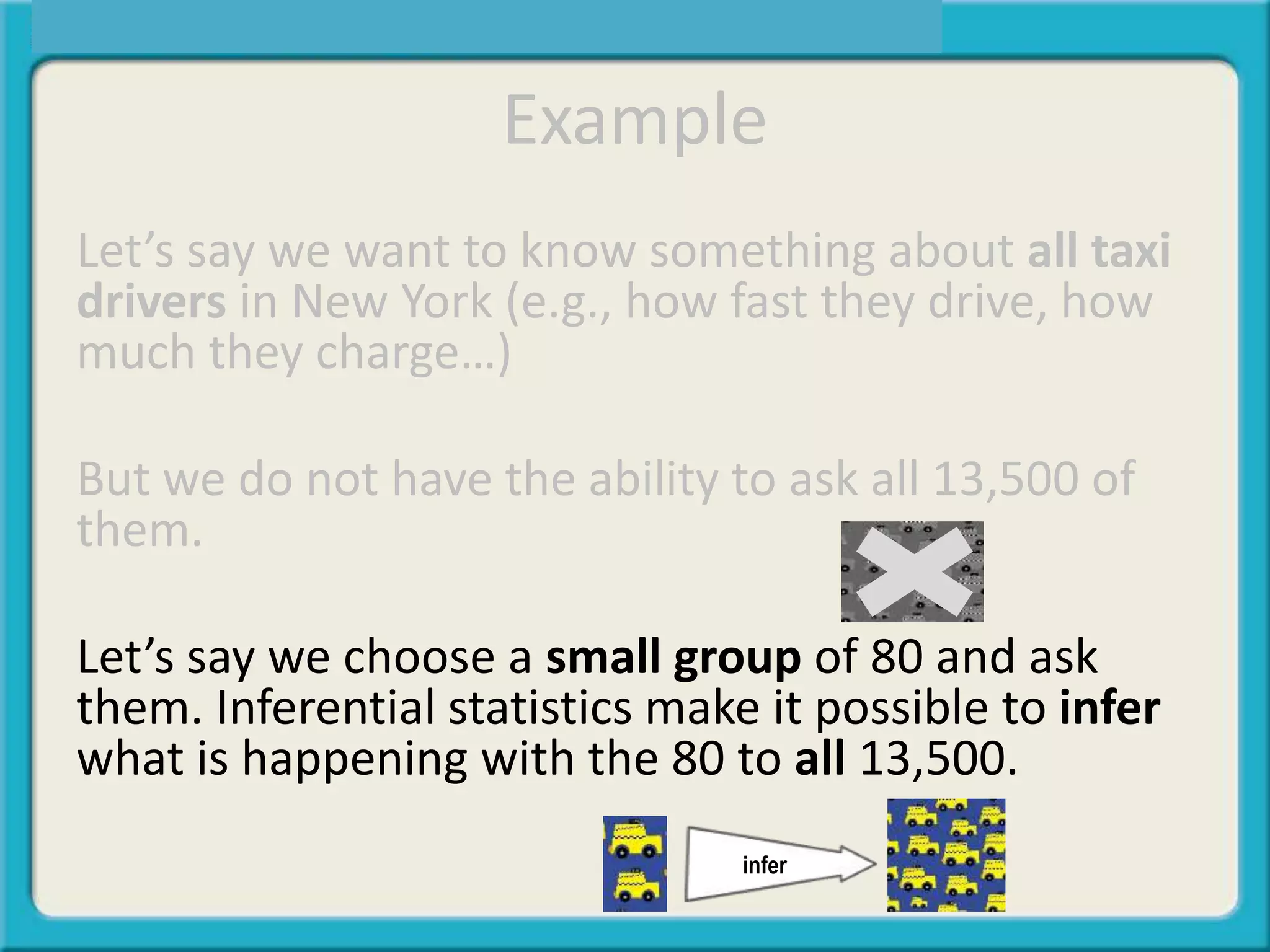
Let’s say we chose a small group of 80 and asked
them. Inferential statistics make it possible to infer
what is happening with the 80 to all 13,500.
Example
Let’s say we want to know something about all taxi
drivers in New York (e.g., how fast they drive, how
much they charge…)
But we do not have the ability to ask all 13,500 of
them.
Let’s say we chose a small group of 80 and asked
them. Inferential statistics make it possible to infer
what is happening with the 80 to all 13,500.
Example
Let’s say we want to know something about all taxi
drivers in New York (e.g., how fast they drive, how
much they charge…)
But we do not have the ability to ask all 13,500 of
them.
Let’s say we choose a small group of 80 and ask
them. Inferential statistics make it possible to infer
what is happening with the 80 to all 13,500.
infer
Example
Let’s say we want to know something about all taxi
drivers in New York (e.g., how fast they drive, how
much they charge…)
But we do not have the ability to ask all 13,500 of
them.
Let’s say we choose a small group of 80 and ask
them. Inferential statistics make it possible to infer
what is happening with the 80 to all 13,500.
infer
Let’s Practice!
Find the average driving distance from home to
work for all employees at your company.
Inferential Descriptive
Find the average driving distance from home to
work for all employees at your company.
Inferential Descriptive
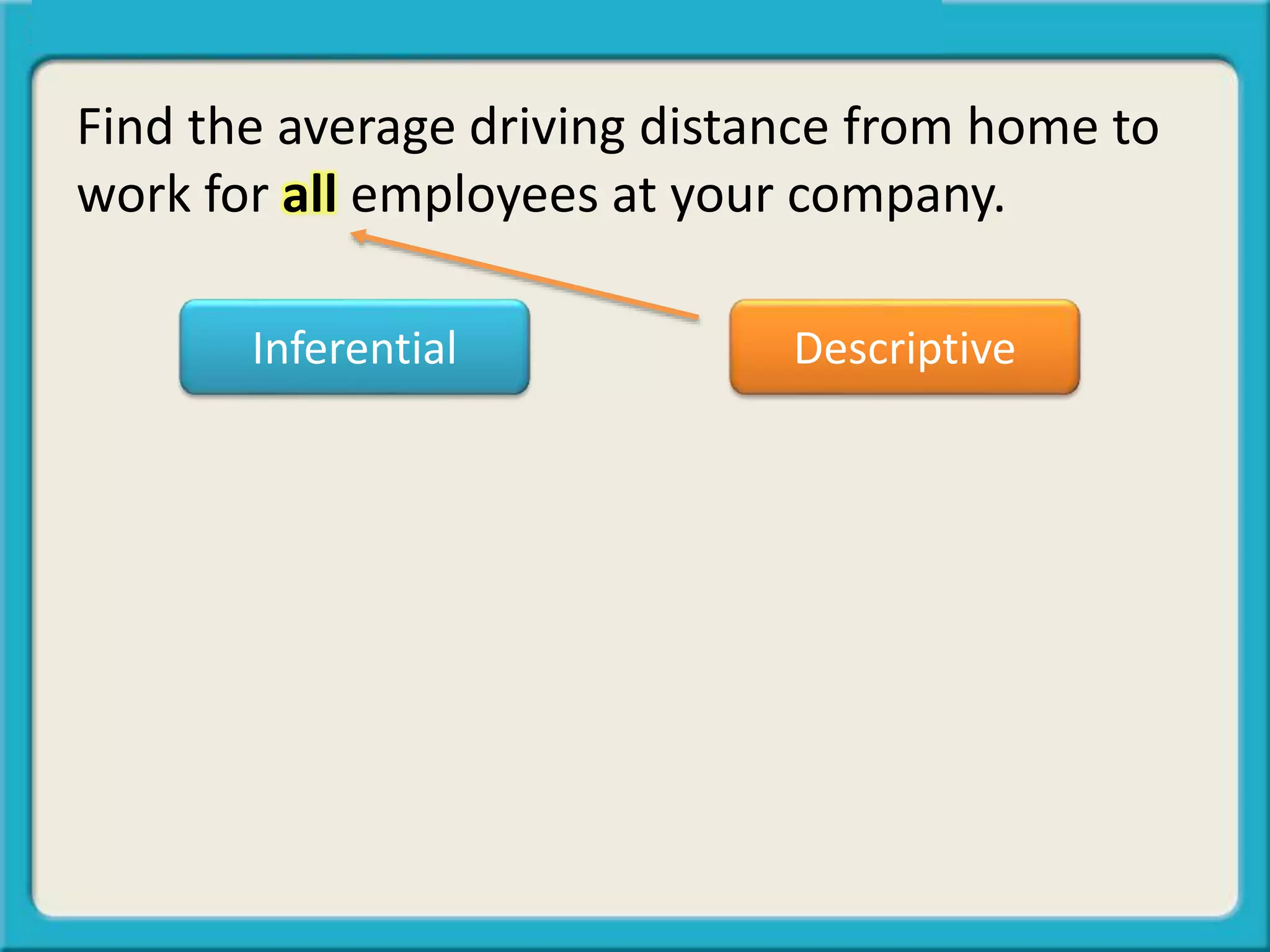
Find the average driving distance from home to
work for all employees at your company.
Inferential Descriptive
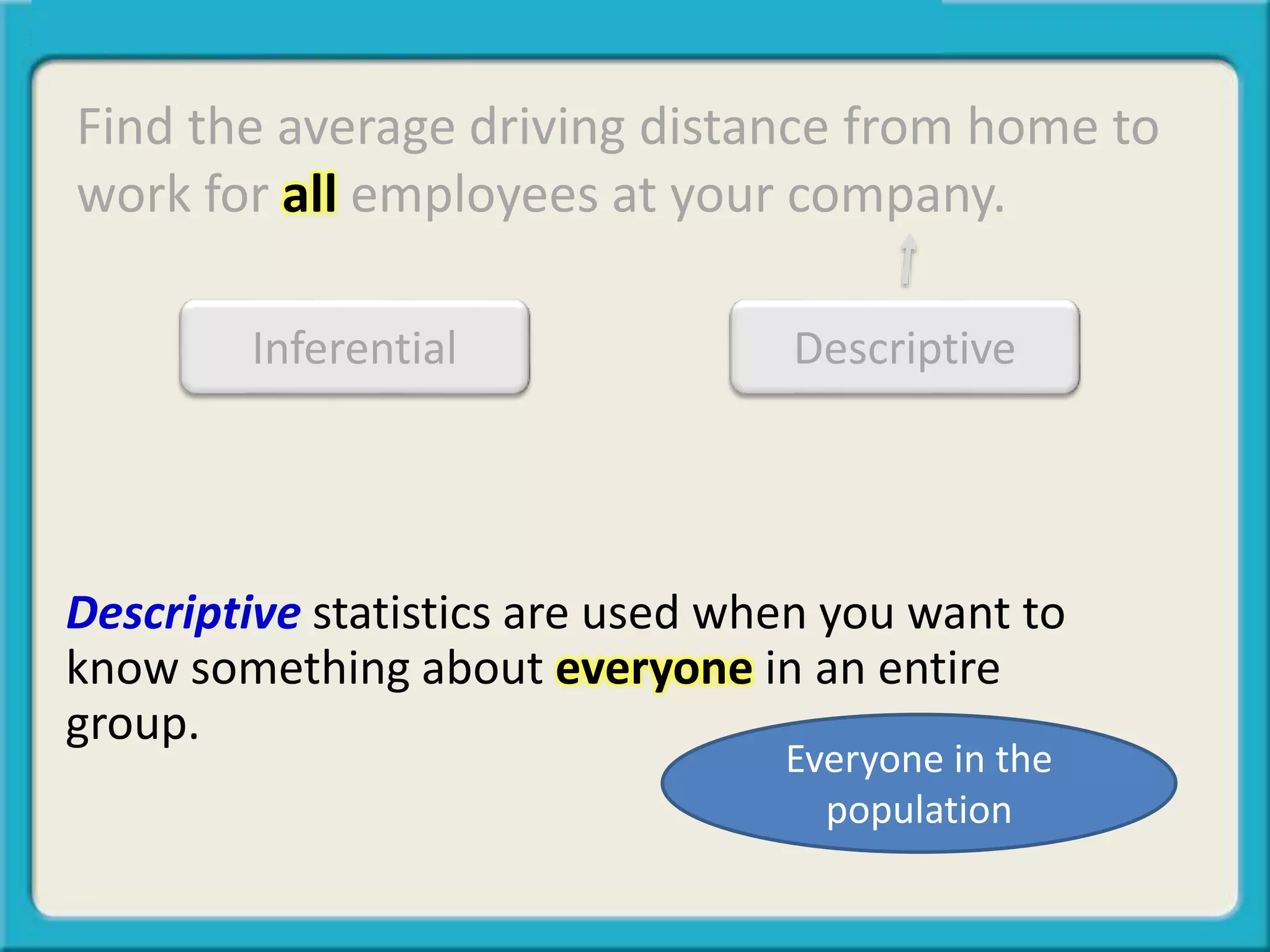
Find the average driving distance from home to
work for all employees at your company.
Inferential Descriptive
Descriptive statistics are used when you want to
know something about everyone in an entire
group.
Everyone in the
population
Next Example
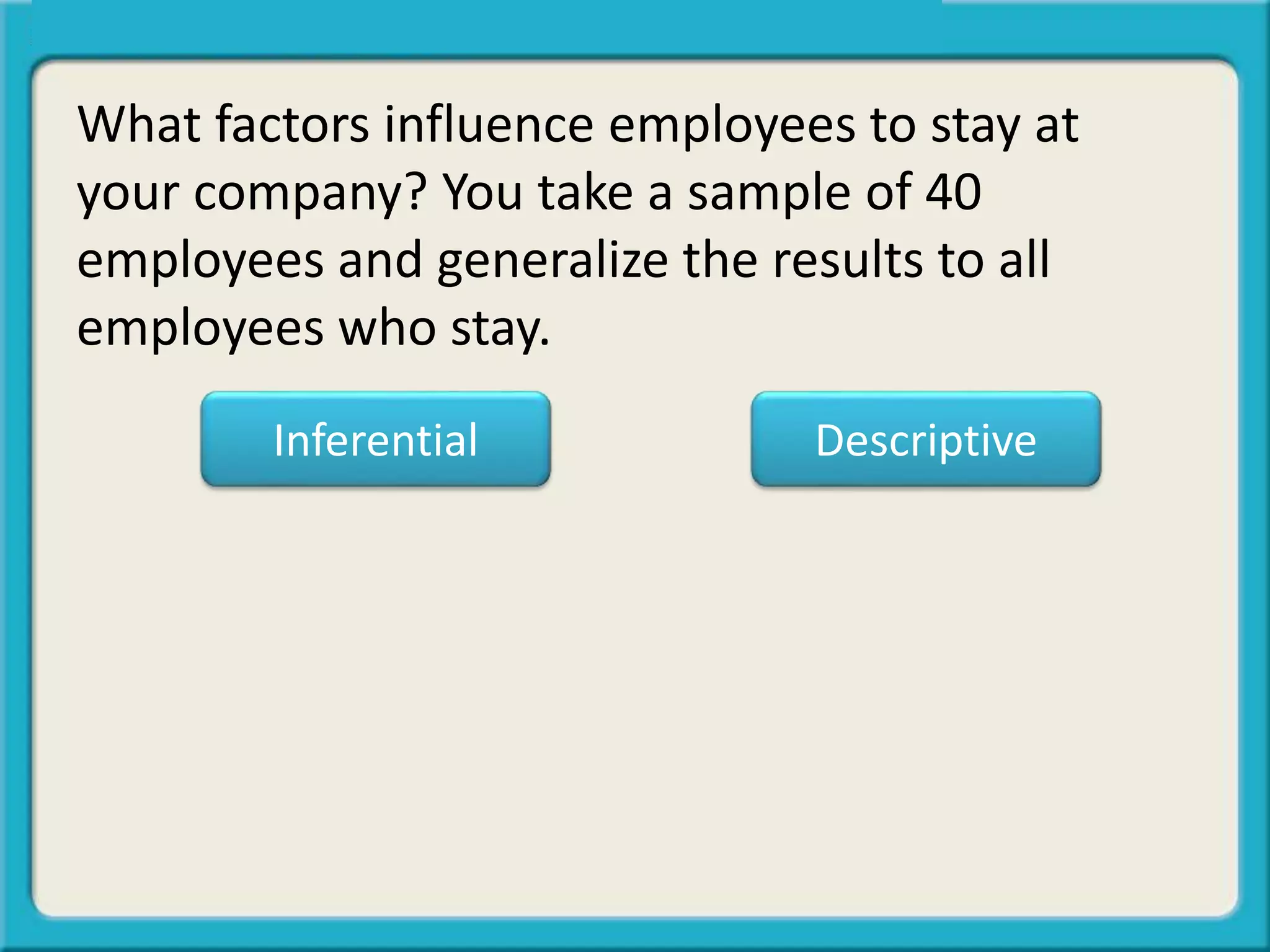
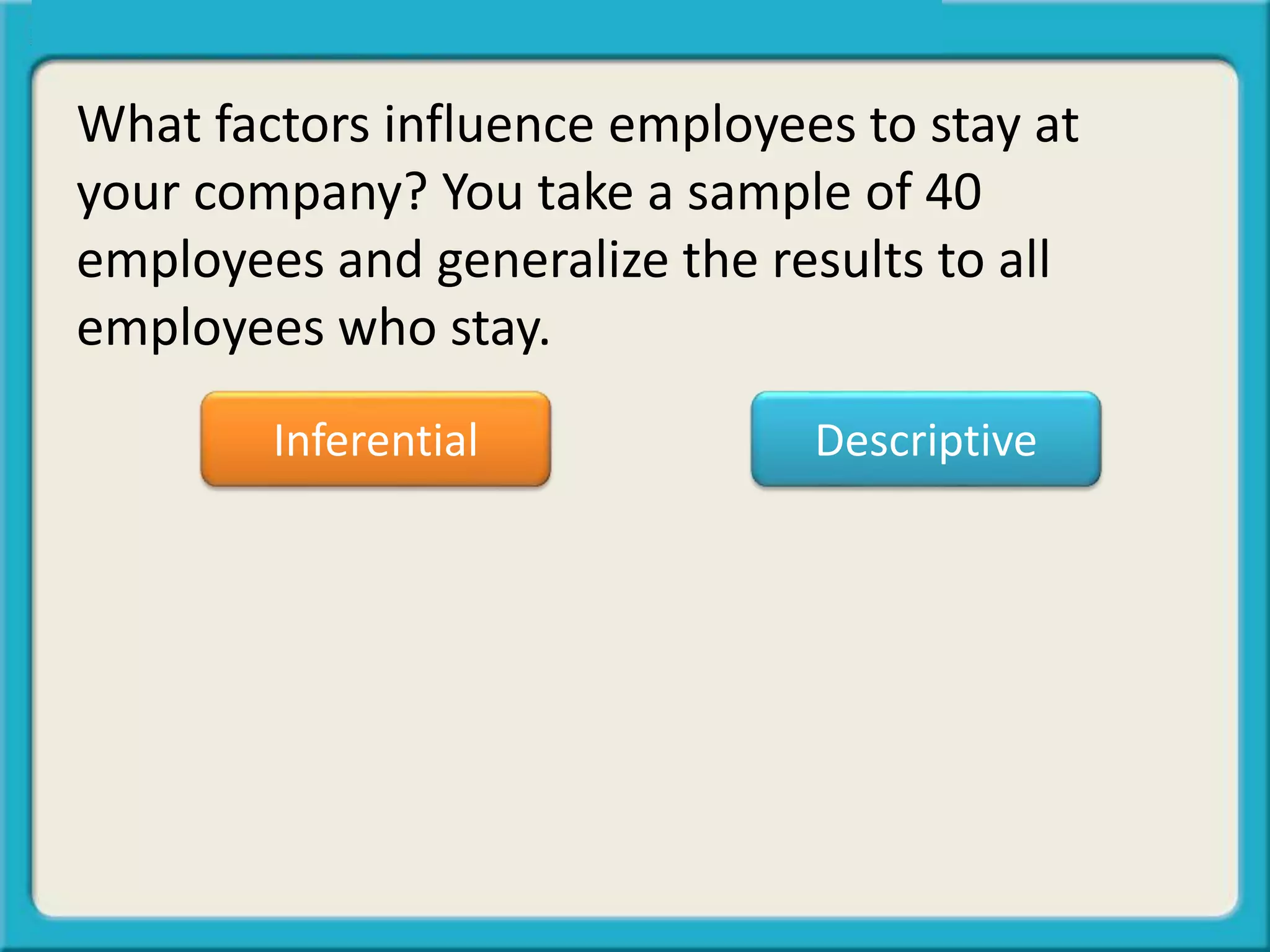
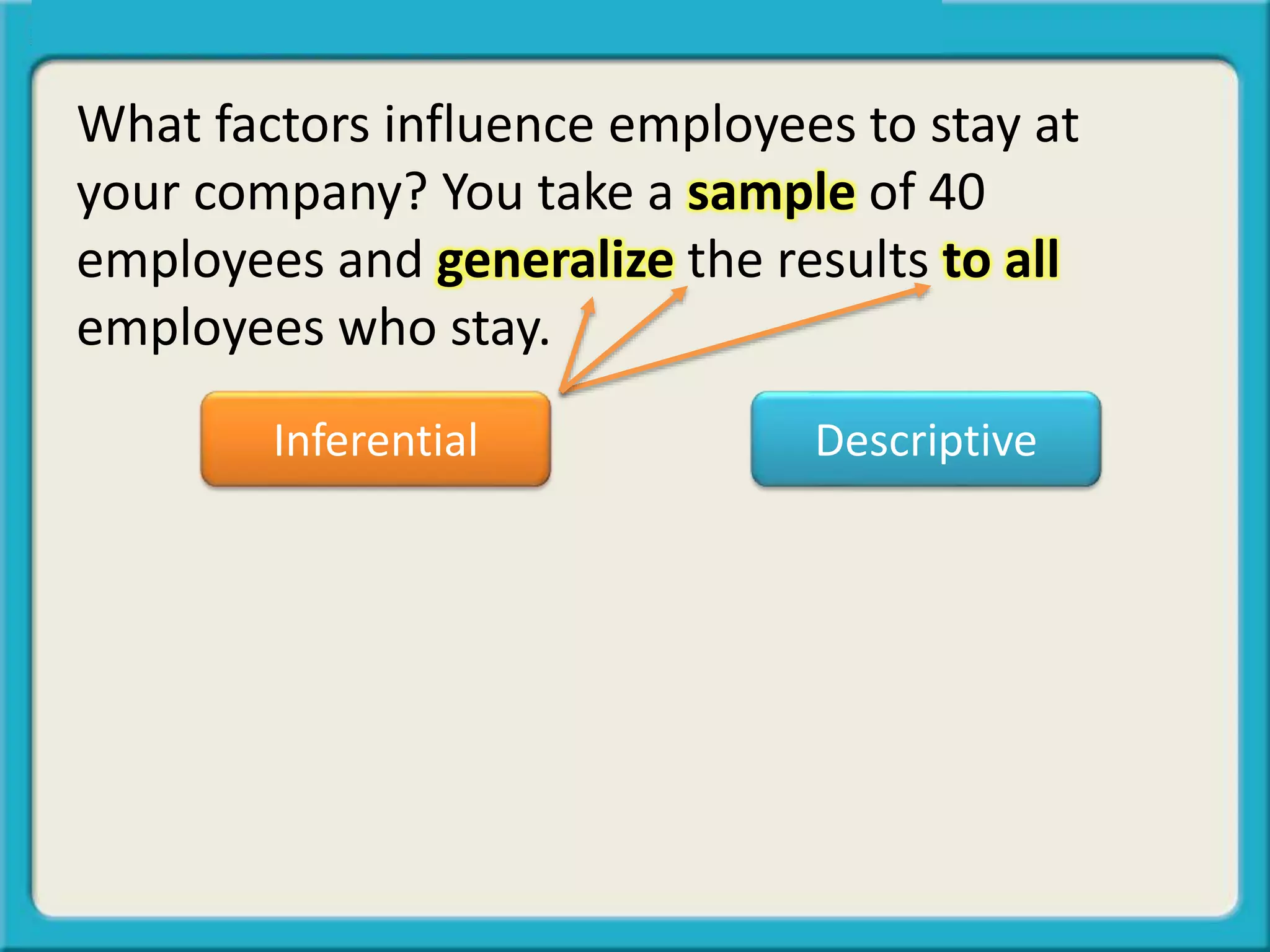
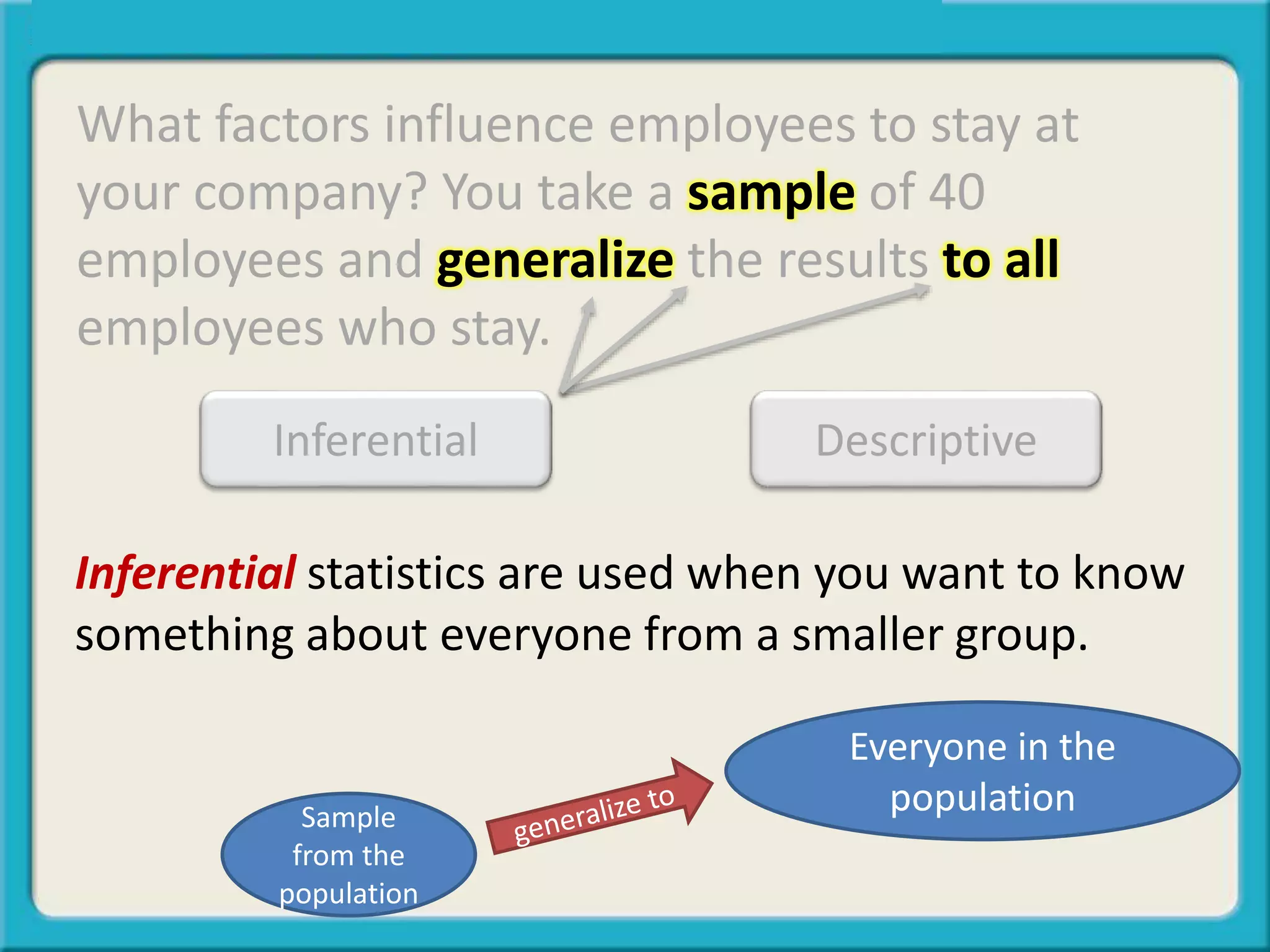
What factors influence employees to stay at
your company? You take a sample of 40
employees and generalize the results to all
employees who stay.
Inferential Descriptive
What factors influence employees to stay at
your company? You take a sample of 40
employees and generalize the results to all
employees who stay.
Inferential Descriptive
What factors influence employees to stay at
your company? You take a sample of 40
employees and generalize the results to all
employees who stay.
Inferential Descriptive
What factors influence employees to stay at
your company? You take a sample of 40
employees and generalize the results to all
employees who stay.
Inferential Descriptive
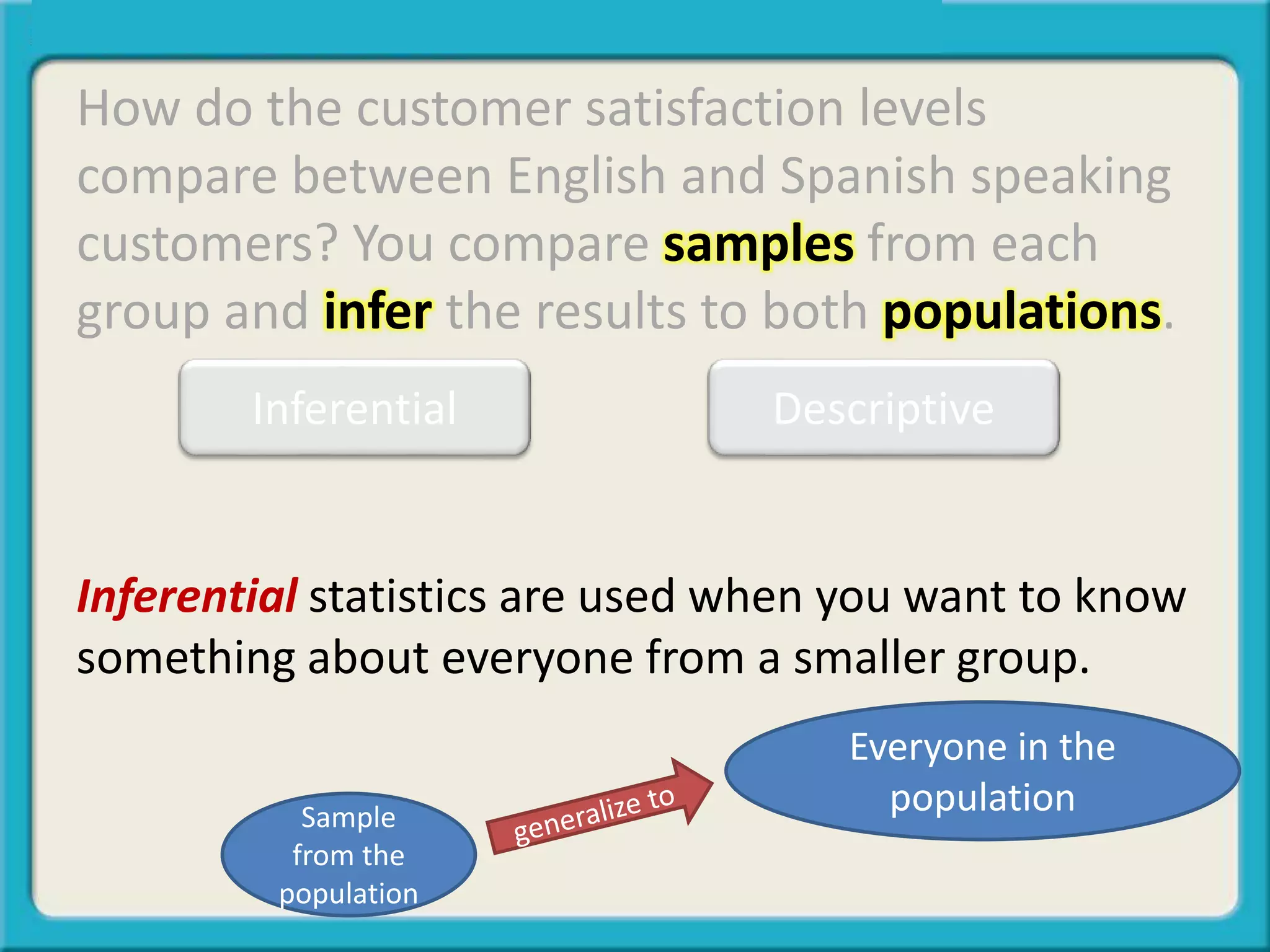
Inferential statistics are used when you want to know
something about everyone from a smaller group.
Sample
from the
population
Everyone in the
population
Final Example
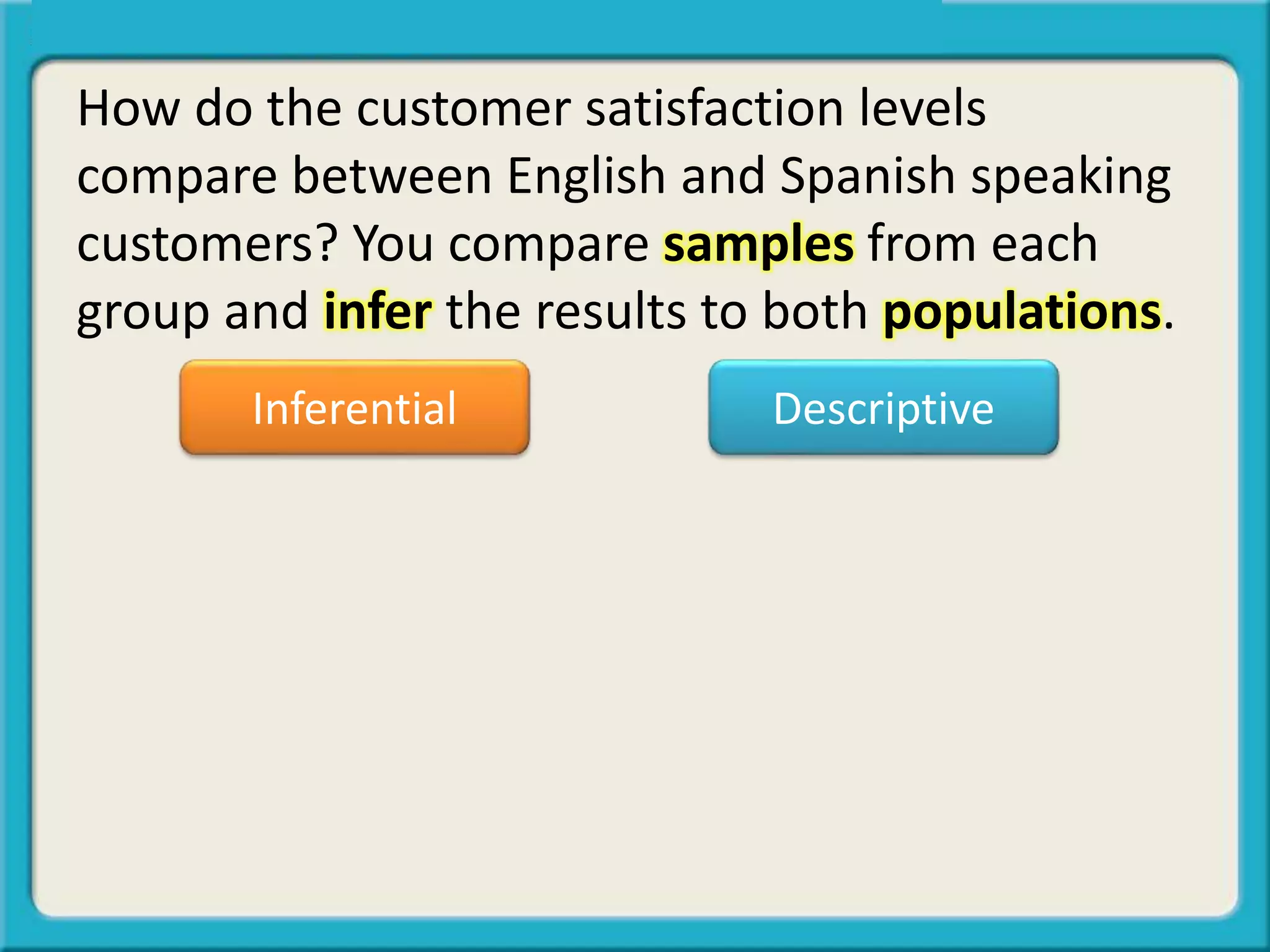
How do the customer satisfaction levels
compare between English and Spanish speaking
customers? You compare samples from each
group and infer the results to both populations.
Inferential Descriptive
How do the customer satisfaction levels
compare between English and Spanish speaking
customers? You compare samples from each
group and infer the results to both populations.
Inferential Descriptive
How do the customer satisfaction levels
compare between English and Spanish speaking
customers? You compare samples from each
group and infer the results to both populations.
Inferential Descriptive
How do the customer satisfaction levels
compare between English and Spanish speaking
customers? You compare samples from each
group and infer the results to both populations.
Inferential Descriptive
Sample
from the
population
Everyone in the
population
Inferential statistics are used when you want to know
something about everyone from a smaller group.
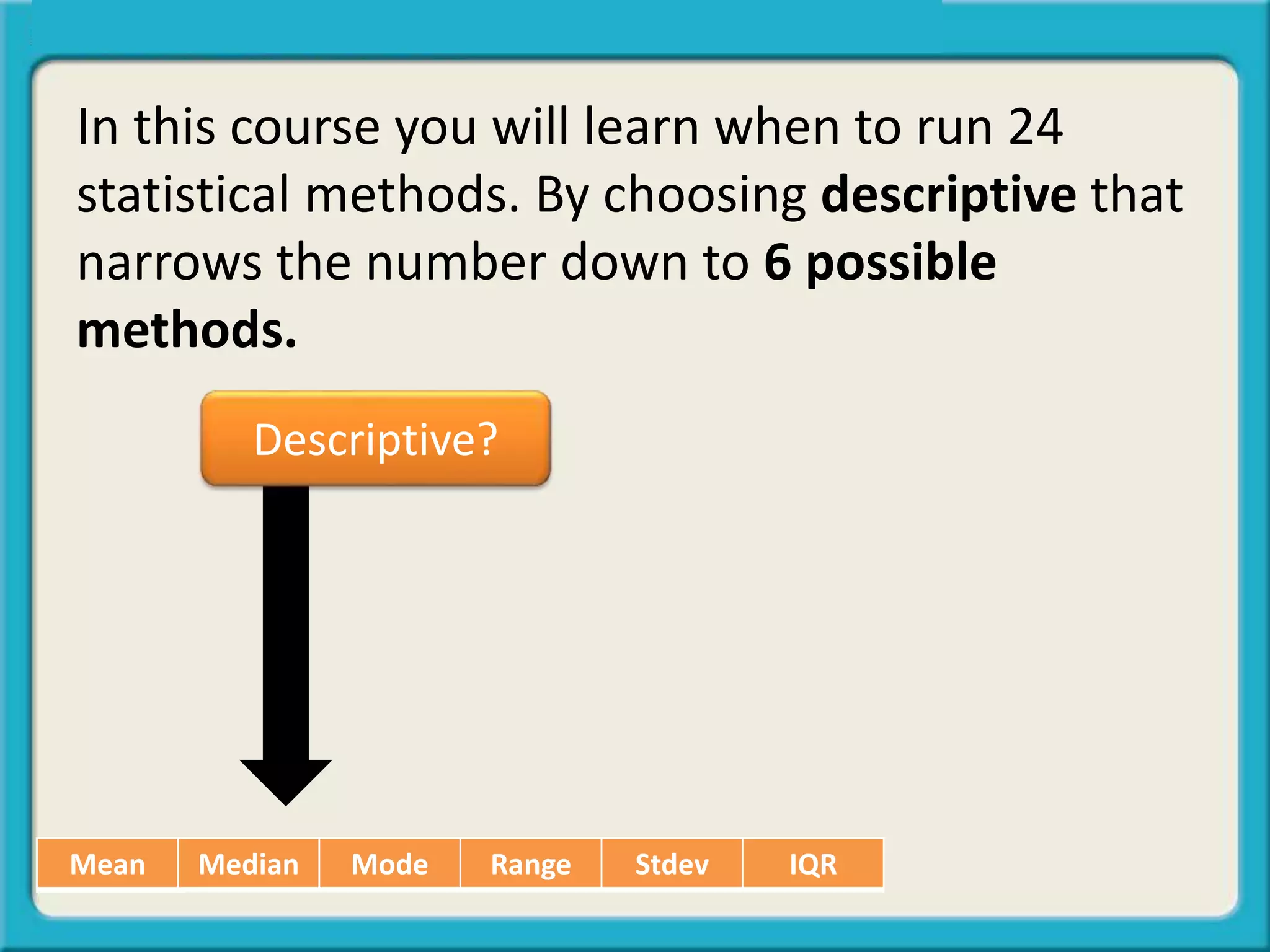
In this course you will learn when to run 24
statistical methods.
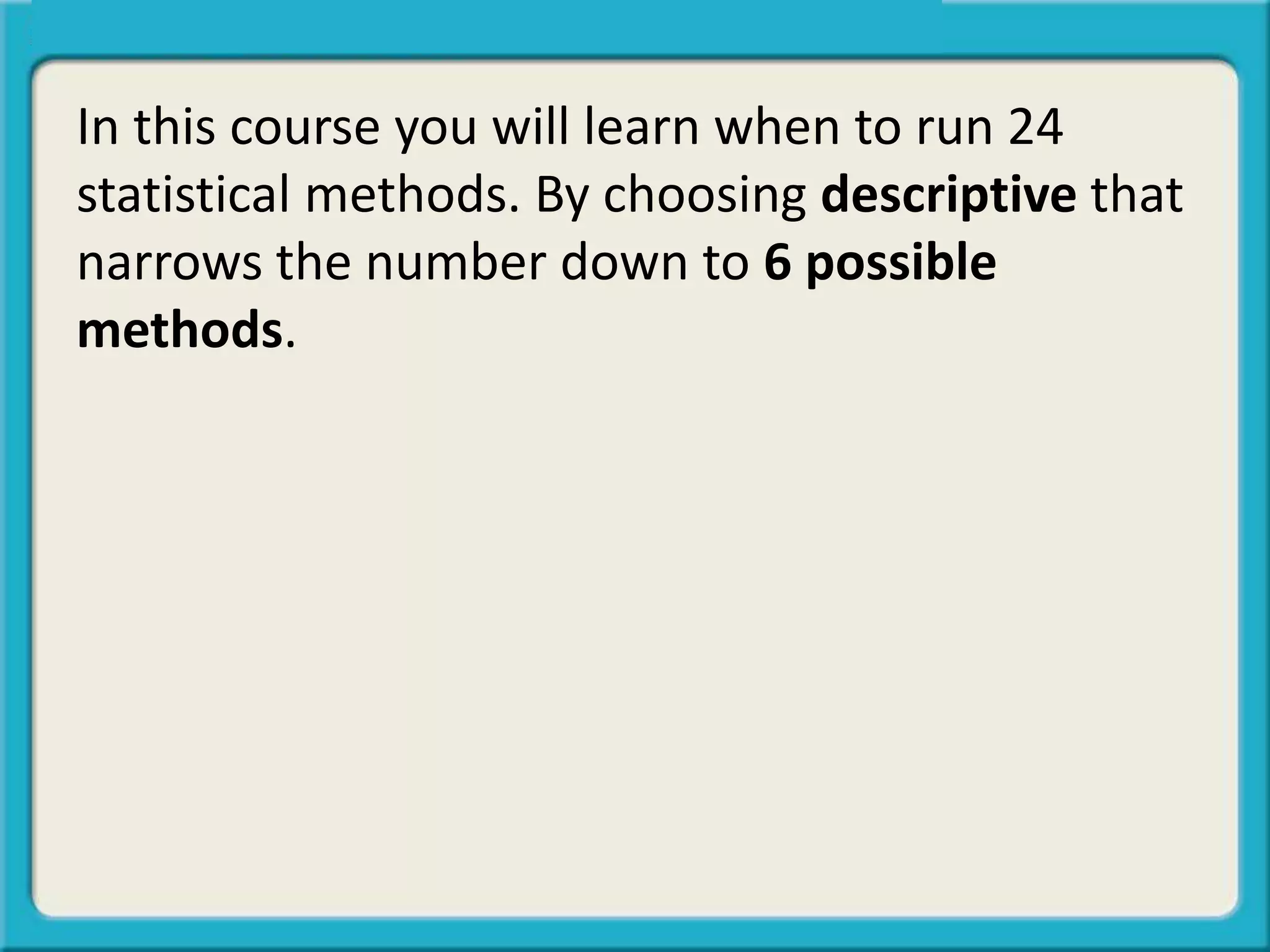
In this course you will learn when to run 24
statistical methods. By choosing descriptive that
narrows the number down to 6 possible
methods.
In this course you will learn when to run 24
statistical methods. By choosing descriptive that
narrows the number down to 6 possible
methods.
Mean Median Mode Range Stdev IQR
Descriptive?
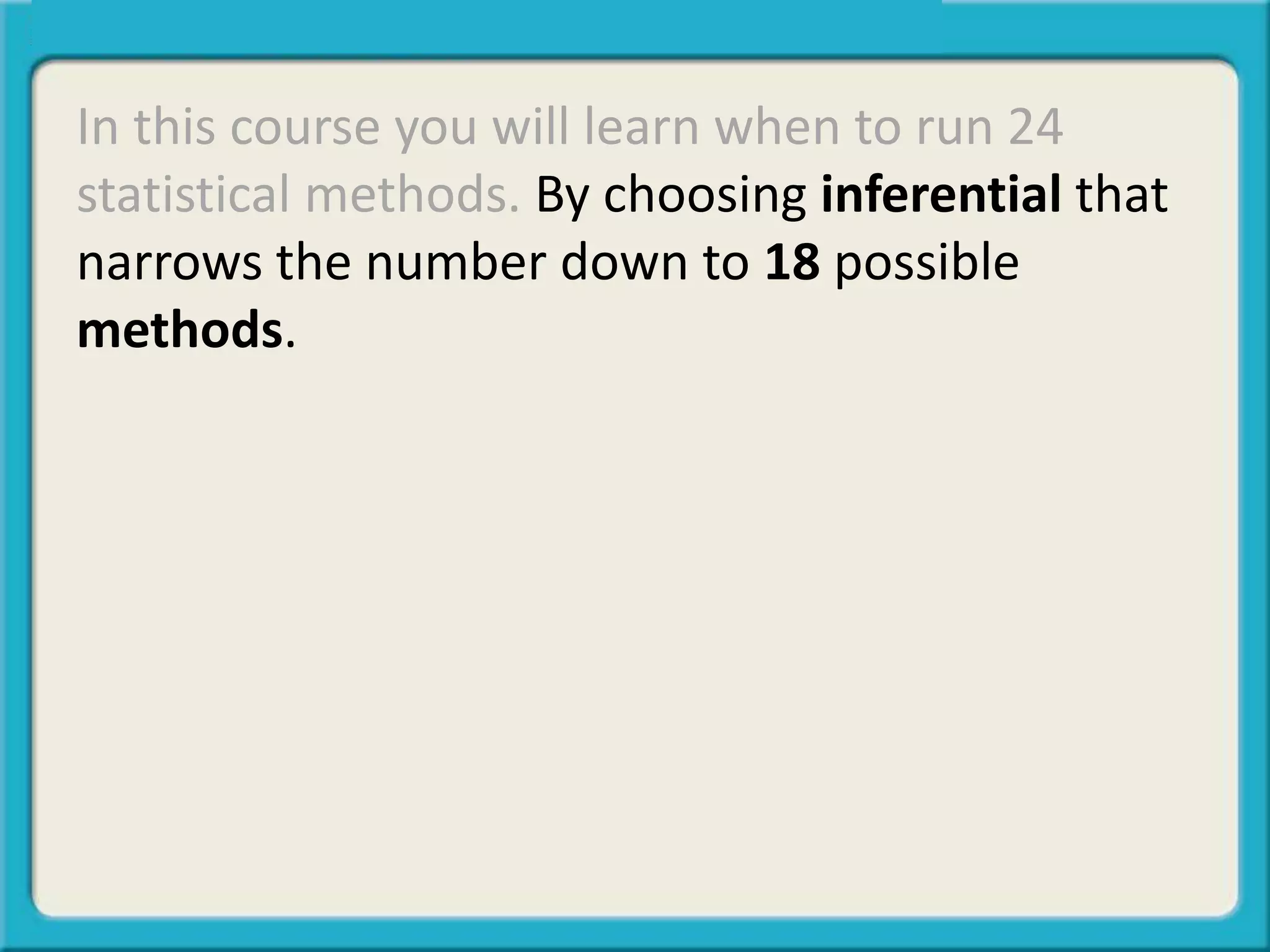
In this course you will learn when to run 24
statistical methods. By choosing inferential that
narrows the number down to 18 possible
methods.
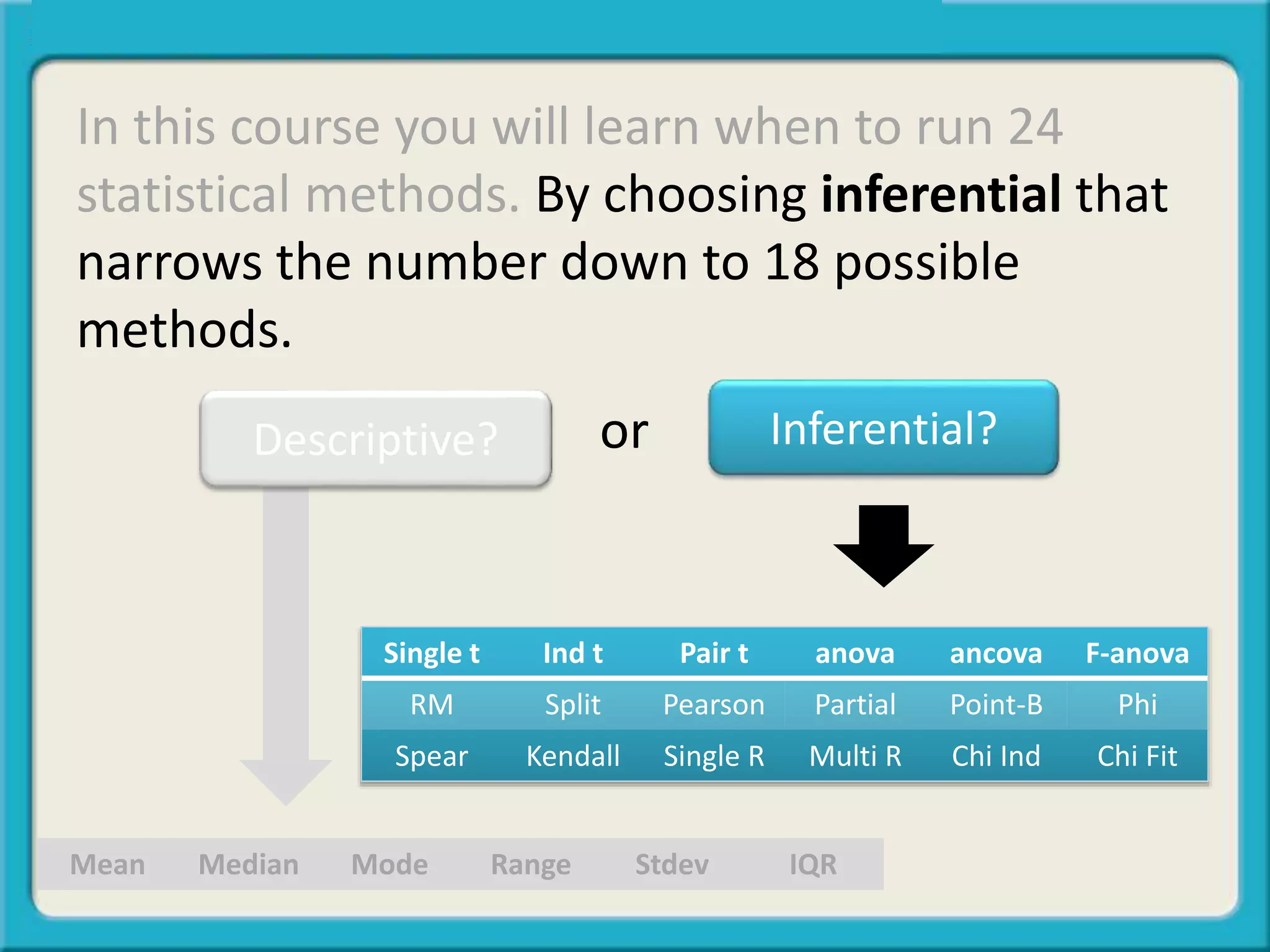
In this course you will learn when to run 24
statistical methods. By choosing inferential that
narrows the number down to 18 possible
methods.
Inferential?or
Single t Ind t Pair t anova ancova F-anova
RM Split Pearson Partial Point-B Phi
Spear Kendall Single R Multi R Chi Ind Chi Fit
Mean Median Mode Range Stdev IQR
Descriptive?
Return to your original question. What type of
research question is it?
Inferential?Descriptive? or

Inferential vs descriptive tutorial of when to use - Copyright Updated

  • 1.
    Is this question… Inferential?Descriptive? or
  • 2.
  • 3.
    Descriptive statistics areused when you want to know something about everyone in an entire group or population. Central Tendency, Spread, or Symmetry? Everyone in the population
  • 4.
    A population canbe - everyone in a country (e.g., United States, Zimbabwe, Peru, China, etc.) - everyone in a company. - every student in a state, in a school district, in a school or in a class.
  • 5.
    A population canbe - everyone in a country (e.g., United States, Zimbabwe, Peru, China, etc.) - everyone in a company - every student in a state, in a school district, in a school or in a class. The key words you look for in your research question are all, everyone, census, entire group…
  • 6.
    Example Let’s say wewant to know something about all taxi drivers in New York (e.g., how fast they drive, how much they charge…).
  • 7.
    Example Let’s say wewant to know something about all taxi drivers in New York (e.g., how fast they drive, how much they charge…). While it is unlikely, imagine we are able to ask all 13,500 taxi drivers in New York.
  • 8.
    Example Let’s say wewant to know something about all taxi drivers in New York (e.g., how fast they drive, how much they charge…). While it is unlikely, imagine we are able to ask all 13,500 taxi drivers in New York. In this case, we would use descriptive statistics to summarize our findings!
  • 9.
  • 10.
    Central Tendency, Spread,or Symmetry? Sample of the population Everyone in the population Inferential statistics are used when you want to know something about everyone. Since you can’t access the entire group. You take a small sample from the entire group and infer or generalize the results to the entire group.
  • 11.
    Central Tendency, Spread,or Symmetry? Sample of the population Everyone in the population This is when you use inferential statistics! Inferential statistics are used when you want to know something about everyone. Since you can’t access the entire group. You take a small sample from the entire group and infer or generalize the results to the entire group.
  • 12.
    Central Tendency, Spread,or Symmetry? Sample of the population Everyone in the population Look for words like, “infer,” “generalize,” “statistical significance”… Inferential statistics are used when you want to know something about everyone. Since you can’t access the entire group. You take a small sample from the entire group and infer or generalize the results to the entire group.
  • 13.
    Example Let’s say wewant to know something about all taxi drivers in New York (e.g., how fast they drive, how much they charge…) But we do not have the ability to ask all 13,500 of them. Let’s say we chose a small group of 80 and asked them. Inferential statistics make it possible to infer what is happening with the 80 to all 13,500.
  • 14.
    Example Let’s say wewant to know something about all taxi drivers in New York (e.g., how fast they drive, how much they charge…) But we do not have the ability to ask all 13,500 of them. Let’s say we chose a small group of 80 and asked them. Inferential statistics make it possible to infer what is happening with the 80 to all 13,500.
  • 15.
    Example Let’s say wewant to know something about all taxi drivers in New York (e.g., how fast they drive, how much they charge…) But we do not have the ability to ask all 13,500 of them. Let’s say we choose a small group of 80 and ask them. Inferential statistics make it possible to infer what is happening with the 80 to all 13,500. infer
  • 16.
    Example Let’s say wewant to know something about all taxi drivers in New York (e.g., how fast they drive, how much they charge…) But we do not have the ability to ask all 13,500 of them. Let’s say we choose a small group of 80 and ask them. Inferential statistics make it possible to infer what is happening with the 80 to all 13,500. infer
  • 17.
  • 18.
    Find the averagedriving distance from home to work for all employees at your company. Inferential Descriptive
  • 19.
    Find the averagedriving distance from home to work for all employees at your company. Inferential Descriptive
  • 20.
    Find the averagedriving distance from home to work for all employees at your company. Inferential Descriptive
  • 21.
    Find the averagedriving distance from home to work for all employees at your company. Inferential Descriptive Descriptive statistics are used when you want to know something about everyone in an entire group. Everyone in the population
  • 22.
  • 23.
    What factors influenceemployees to stay at your company? You take a sample of 40 employees and generalize the results to all employees who stay. Inferential Descriptive
  • 24.
    What factors influenceemployees to stay at your company? You take a sample of 40 employees and generalize the results to all employees who stay. Inferential Descriptive
  • 25.
    What factors influenceemployees to stay at your company? You take a sample of 40 employees and generalize the results to all employees who stay. Inferential Descriptive
  • 26.
    What factors influenceemployees to stay at your company? You take a sample of 40 employees and generalize the results to all employees who stay. Inferential Descriptive Inferential statistics are used when you want to know something about everyone from a smaller group. Sample from the population Everyone in the population
  • 27.
  • 28.
    How do thecustomer satisfaction levels compare between English and Spanish speaking customers? You compare samples from each group and infer the results to both populations. Inferential Descriptive
  • 29.
    How do thecustomer satisfaction levels compare between English and Spanish speaking customers? You compare samples from each group and infer the results to both populations. Inferential Descriptive
  • 30.
    How do thecustomer satisfaction levels compare between English and Spanish speaking customers? You compare samples from each group and infer the results to both populations. Inferential Descriptive
  • 31.
    How do thecustomer satisfaction levels compare between English and Spanish speaking customers? You compare samples from each group and infer the results to both populations. Inferential Descriptive Sample from the population Everyone in the population Inferential statistics are used when you want to know something about everyone from a smaller group.
  • 32.
    In this courseyou will learn when to run 24 statistical methods.
  • 33.
    In this courseyou will learn when to run 24 statistical methods. By choosing descriptive that narrows the number down to 6 possible methods.
  • 34.
    In this courseyou will learn when to run 24 statistical methods. By choosing descriptive that narrows the number down to 6 possible methods. Mean Median Mode Range Stdev IQR Descriptive?
  • 35.
    In this courseyou will learn when to run 24 statistical methods. By choosing inferential that narrows the number down to 18 possible methods.
  • 36.
    In this courseyou will learn when to run 24 statistical methods. By choosing inferential that narrows the number down to 18 possible methods. Inferential?or Single t Ind t Pair t anova ancova F-anova RM Split Pearson Partial Point-B Phi Spear Kendall Single R Multi R Chi Ind Chi Fit Mean Median Mode Range Stdev IQR Descriptive?
  • 37.
    Return to youroriginal question. What type of research question is it? Inferential?Descriptive? or