EDUC 316:
ASSESSMENT OF
LEARNING I
MEASURES OF
CENTRAL TENDENCY
Marikina PolytechnicCollege
1st Semester, A.Y. 2015 - 2016
MEASURE OF CENTRAL TENDENCY
The measure of central tendency
is populary known as an average,
where as ingle central value can
stand for the entire group of figures
as typical of all the values in the
group, these are:
1. Mean
2. Median
3. Mode
MEAN
Mean is the most frequently used
measure of central tendency
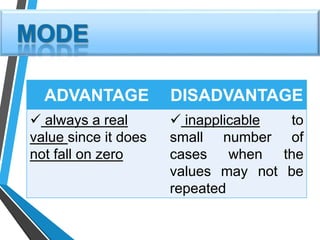
because it is subject to less error; it
is also easily calculated.
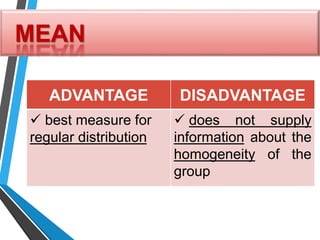
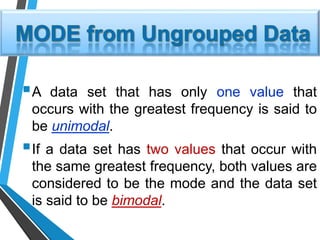
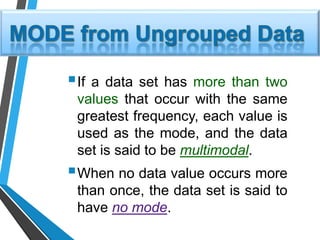
MEAN
ADVANTAGE DISADVANTAGE
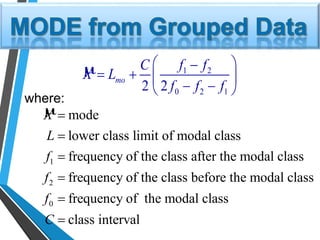
 best measure for
regular distribution
 does not supply
information about the
homogeneity of the
group
The ARITHMETIC MEAN
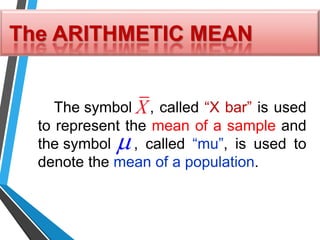
The symbol , called “X bar” is used
to represent the mean of a sample and
the symbol , called “mu”, is used to
denote the mean of a population.

X
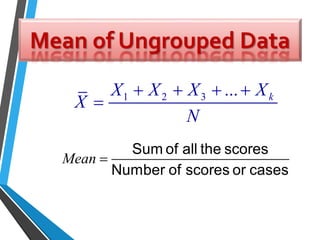
Mean of Ungrouped Data
Mean 
Sum of all the scores
Number of scores or cases
1 2 3 ... kX X X X
X
N
   

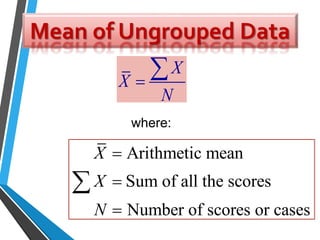
where:
Mean of Ungrouped Data
X
X
N


Arithmetic mean
Sum of all the scores
Number of scores or cases
X
X
N




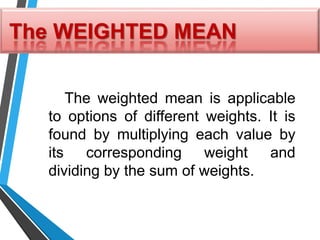
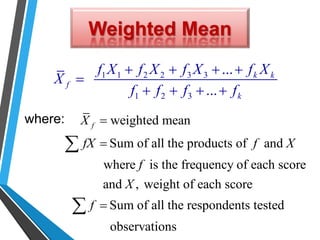
The weighted mean is applicable
to options of different weights. It is
found by multiplying each value by
its corresponding weight and
dividing by the sum of weights.
The WEIGHTED MEAN
Weighted Mean
1 1 2 2 3 3
1 2 3
...
...
k k
f
k
f X f X f X f X
X
f f f f
   

   
where: weighted mean
Sum of all the products of and
where is the frequency of each score
and , weight of each score
Sum of all the respondents tested
observations
fX
fX f X
f
X
f





18 14 12 10 9 7
18 13 12 10 8 7
17 13 11 10 8 6
16 12 11 10 8 5
15 12 11 9 8 3
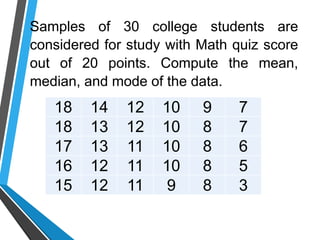
Samples of 30 college students are
considered for study with Math quiz score
out of 20 points. Compute the mean,
median, and mode of the data.
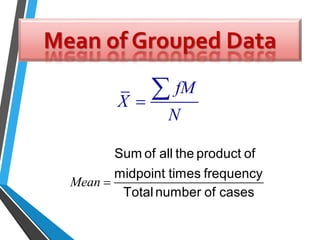
Mean of Grouped Data
Mean 
Sum of all the product of
midpoint times frequency
Total number of cases
fM
X
N


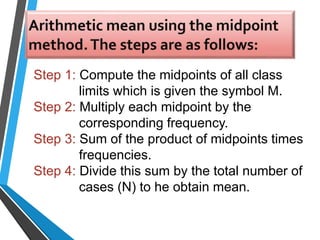
Step 1: Compute the midpoints of all class
limits which is given the symbol M.
Step 2: Multiply each midpoint by the
corresponding frequency.
Step 3: Sum of the product of midpoints times
frequencies.
Step 4: Divide this sum by the total number of
cases (N) to he obtain mean.
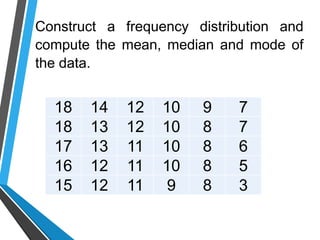
18 14 12 10 9 7
18 13 12 10 8 7
17 13 11 10 8 6
16 12 11 10 8 5
15 12 11 9 8 3
Construct a frequency distribution and
compute the mean, median and mode of
the data.
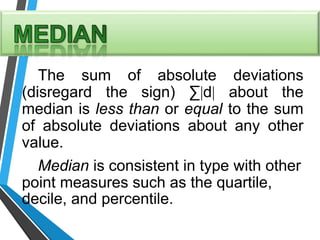
The sum of absolute deviations
(disregard the sign) ∑d about the
median is less than or equal to the sum
of absolute deviations about any other
value.
Median is consistent in type with other
point measures such as the quartile,
decile, and percentile.
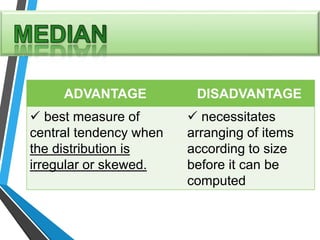
ADVANTAGE DISADVANTAGE
 best measure of
central tendency when
the distribution is
irregular or skewed.
 necessitates
arranging of items
according to size
before it can be
computed
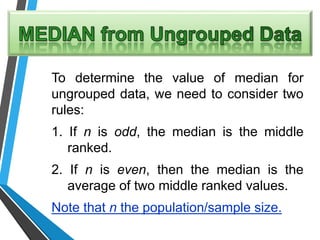
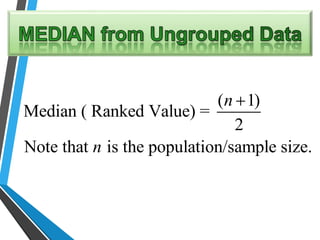
To determine the value of median for
ungrouped data, we need to consider two
rules:
1. If n is odd, the median is the middle
ranked.
2. If n is even, then the median is the
average of two middle ranked values.
Note that n the population/sample size.
( 1)
Median ( Ranked Value) =
2
Note that is the population/sample size.
n
n

The median is located in the middle
value of the frequency distribution. It is the
value that separates the upper half of the
distribution from the lower half. It is also a
measure of central tendency because it is
the exact center of the scores in a
distribution.
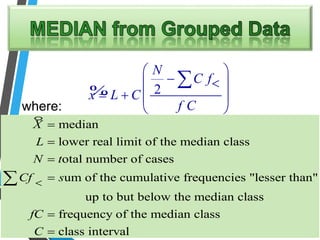
° median
lower real limit of the median class
otal number of cases
um of the cumulative frequencies "lesser than"
up to but below the median class
frequency of the median class
cla
X
L
N t
Cf s
fC
C








ss interval
% 2
N
C f
x L C
f C

 
 
   
 

where:
It is the value in a data set that
appears most frequently. In a data
set, extreme values do not affect
the mode. A data may not contain
any mode if none of the values is
“most typical”.
ADVANTAGE DISADVANTAGE
 always a real
value since it does
not fall on zero
 inapplicable to
small number of
cases when the
values may not be
repeated
A data set that has only one value that
occurs with the greatest frequency is said to
be unimodal.
If a data set has two values that occur with
the same greatest frequency, both values are
considered to be the mode and the data set
is said to be bimodal.
If a data set has more than two
values that occur with the same
greatest frequency, each value is
used as the mode, and the data
set is said to be multimodal.
When no data value occurs more
than once, the data set is said to
have no mode.
µ 1 2
0 2 12 2
mo
f fC
X L
f f f
 
   
  
µ
1
2
0
mode
lower class limit of modal class
frequency of the class after the modal class
frequency of the class before the modal class
frequency of the modal class
class interval
X
L
f
f
f
C






where:

MEASURESOF CENTRAL TENDENCY

  • 1.
    EDUC 316: ASSESSMENT OF LEARNINGI MEASURES OF CENTRAL TENDENCY Marikina PolytechnicCollege 1st Semester, A.Y. 2015 - 2016
  • 2.
    MEASURE OF CENTRALTENDENCY The measure of central tendency is populary known as an average, where as ingle central value can stand for the entire group of figures as typical of all the values in the group, these are: 1. Mean 2. Median 3. Mode
  • 3.
    MEAN Mean is themost frequently used measure of central tendency because it is subject to less error; it is also easily calculated.
  • 4.
    MEAN ADVANTAGE DISADVANTAGE  bestmeasure for regular distribution  does not supply information about the homogeneity of the group
  • 5.
    The ARITHMETIC MEAN Thesymbol , called “X bar” is used to represent the mean of a sample and the symbol , called “mu”, is used to denote the mean of a population.  X
  • 6.
    Mean of UngroupedData Mean  Sum of all the scores Number of scores or cases 1 2 3 ... kX X X X X N     
  • 7.
    where: Mean of UngroupedData X X N   Arithmetic mean Sum of all the scores Number of scores or cases X X N    
  • 8.
    The weighted meanis applicable to options of different weights. It is found by multiplying each value by its corresponding weight and dividing by the sum of weights. The WEIGHTED MEAN
  • 9.
    Weighted Mean 1 12 2 3 3 1 2 3 ... ... k k f k f X f X f X f X X f f f f          where: weighted mean Sum of all the products of and where is the frequency of each score and , weight of each score Sum of all the respondents tested observations fX fX f X f X f     
  • 10.
    18 14 1210 9 7 18 13 12 10 8 7 17 13 11 10 8 6 16 12 11 10 8 5 15 12 11 9 8 3 Samples of 30 college students are considered for study with Math quiz score out of 20 points. Compute the mean, median, and mode of the data.
  • 11.
    Mean of GroupedData Mean  Sum of all the product of midpoint times frequency Total number of cases fM X N  
  • 12.
    Step 1: Computethe midpoints of all class limits which is given the symbol M. Step 2: Multiply each midpoint by the corresponding frequency. Step 3: Sum of the product of midpoints times frequencies. Step 4: Divide this sum by the total number of cases (N) to he obtain mean.
  • 13.
    18 14 1210 9 7 18 13 12 10 8 7 17 13 11 10 8 6 16 12 11 10 8 5 15 12 11 9 8 3 Construct a frequency distribution and compute the mean, median and mode of the data.
  • 14.
    The sum ofabsolute deviations (disregard the sign) ∑d about the median is less than or equal to the sum of absolute deviations about any other value. Median is consistent in type with other point measures such as the quartile, decile, and percentile.
  • 15.
    ADVANTAGE DISADVANTAGE  bestmeasure of central tendency when the distribution is irregular or skewed.  necessitates arranging of items according to size before it can be computed
  • 16.
    To determine thevalue of median for ungrouped data, we need to consider two rules: 1. If n is odd, the median is the middle ranked. 2. If n is even, then the median is the average of two middle ranked values. Note that n the population/sample size.
  • 17.
    ( 1) Median (Ranked Value) = 2 Note that is the population/sample size. n n 
  • 18.
    The median islocated in the middle value of the frequency distribution. It is the value that separates the upper half of the distribution from the lower half. It is also a measure of central tendency because it is the exact center of the scores in a distribution.
  • 19.
    ° median lower reallimit of the median class otal number of cases um of the cumulative frequencies "lesser than" up to but below the median class frequency of the median class cla X L N t Cf s fC C         ss interval % 2 N C f x L C f C             where:
  • 20.
    It is thevalue in a data set that appears most frequently. In a data set, extreme values do not affect the mode. A data may not contain any mode if none of the values is “most typical”.
  • 21.
    ADVANTAGE DISADVANTAGE  alwaysa real value since it does not fall on zero  inapplicable to small number of cases when the values may not be repeated
  • 22.
    A data setthat has only one value that occurs with the greatest frequency is said to be unimodal. If a data set has two values that occur with the same greatest frequency, both values are considered to be the mode and the data set is said to be bimodal.
  • 23.
    If a dataset has more than two values that occur with the same greatest frequency, each value is used as the mode, and the data set is said to be multimodal. When no data value occurs more than once, the data set is said to have no mode.
  • 24.
    µ 1 2 02 12 2 mo f fC X L f f f          µ 1 2 0 mode lower class limit of modal class frequency of the class after the modal class frequency of the class before the modal class frequency of the modal class class interval X L f f f C       where:

Editor's Notes

  • #7 Sum of all the scores Number of scores or cases
  • #12 Sum of all the scores Number of scores or cases